
Knowledge · Tackle
Angling knife: Blade, handle and care
An angling knife kills the stunned fish, then opens its belly, and in between shortens baitfish or leftover line. Which blade can do which job, why the handle has to hold even with fish slime on your fingers and what the Weapons Act says about carrying one is explained in the sections below.
Four jobs at the water
In the material for the angling exam (Fischerprüfung) the knife is part of the basic kit. The question catalogue of the Landesanstalt für Landwirtschaft (LfL) in Bavaria lists it together with the measure, the fish priest and the hook disgorger among the tools that belong with you for reasons of fair practice (Waidgerechtigkeit). The question catalogue from Saxony-Anhalt and the tackle guide of the Landesfischereiverband Baden-Württemberg also list it as necessary equipment. At the water it has four jobs.
- Killing. The blow to the head is followed by the heart stab or the gill cut, as it says in the tackle guide from Baden-Württemberg. The youth section of the Landesfischereiverband Bayern requires a pointed, sharp knife for it. The blow beforehand is described under fish priest, the whole sequence under stunning and killing fish.
- Gutting. For cutting open the belly cavity the Bavarian catalogue considers a short, rigid blade suitable. Where the cut runs is explained under Gutting fish.
- Cutting bait. Halving a baitfish is a typical knife job at the water. The same goes for fish strips.
- Shortening line. A knife can do it, but scissors are more precise. How much breaking strain is left after the knot is shown by the Line calculator.
Blade shape and length
The Bavarian exam catalogue distinguishes two blades. A short, rigid blade opens the belly cavity, a long, flexible one cuts out the ribs on whitefish, pike and salmonids. The long blade belongs to the filleting knife; for a large sea trout Blinker names a blade length of at least 20 cm. For killing and the belly cut a shorter blade with a pronounced tip is enough.
| Job | Blade | Note |
|---|---|---|
| Gill cut, heart stab | pointed and sharp | straight after stunning |
| Opening the belly | short and rigid | cut shallow, do not hit the gall |
| Cutting out the ribs, filleting | long and flexible | a filleting knife of its own |
| Baitfish, line | any sharp blade | Scissors cut line more precisely |
| Wire trace | none | Use side cutters |
A knife fails on steel and titanium, where side cutters are the better choice. Some angling pliers already have cutting jaws for steel, and then the disgorger pliers will also cut the pike trace. Length also has a legal side: a fixed-blade knife with a blade over 12 cm falls under the carrying ban, more on that below.
Fixed or folding
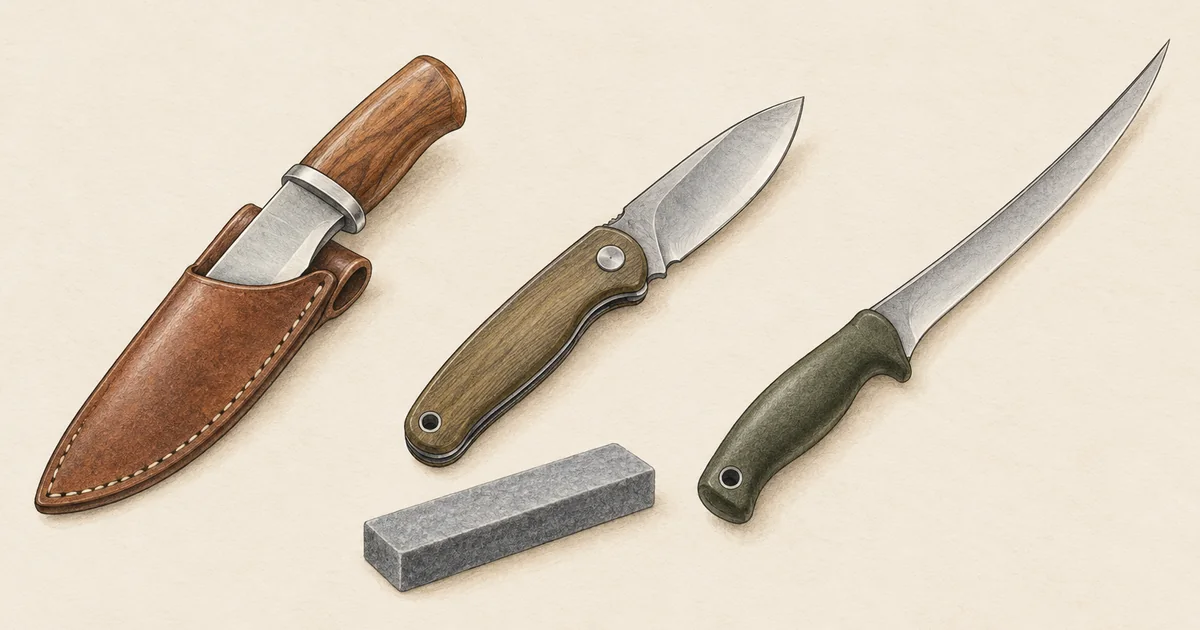
On a fixed-blade knife the blade continues into an extension, the tang (Erl), which is firmly anchored in the handle. That is how the Deutsche Gesetzliche Unfallversicherung (DGUV) describes it in a publication on hand knives, which names the tip, the cutting edge and the spine as parts of the blade. On the move, such a knife sits in a sheath (Fig. 1).
On a folding knife the blade lies in the handle and swings out at the pivot. Pocket knives and multitools often have scissors, pliers or a bottle opener on board and are therefore regarded as the most versatile cutting tools at the water. One detail counts for the Weapons Act: if the blade can be opened and locked with one hand, it is a one-hand knife (Einhandmesser). For these knives the carrying ban applies with no length limit.
Handle and finger guard
Fish skin is slippery, and the holding hand lies close to the blade. When cutting up fish, the DGUV describes exactly this situation: you cut towards the holding hand, the material is slippery, and if you slip you hit your hand or fingers. As a technical remedy it names handles that prevent the hand from sliding onto the blade.
For the angling knife that means: a handle with grooves or a grippy surface that does not slide through the hand even with slime on the fingers, and a finger guard between handle and blade that the hand stops against. The other hand can be protected by a cut-resistant glove when filleting. According to the DGUV, a glove of metal mesh clearly lowers the risk of a cut, more under filleting glove.
What the Weapons Act says
Under § 42a of the Waffengesetz (Weapons Act), nobody may carry one-hand knives, nor fixed-blade knives with a blade longer than 12 cm. According to Annex 1 of the law, carrying means exercising actual control over the object outside one’s own home, business premises or own enclosed property.
The ban does not apply to transport in a closed container, nor where there is a legitimate interest. Paragraph 3 names as such in particular practising a profession, upholding customs, sport or a generally recognised purpose. Angling is not mentioned there; what falls under it in an individual case, the text of the law leaves open.
Anyone visiting fairs, markets, sporting events or similar public events may, according to the text of the law, in principle not carry a knife (§ 42 paragraph 4a), with exceptions for, among others, sport and for knives that are not transported ready to hand. A similar ban applies under § 42b in long-distance trains and buildings of long-distance transport, and the state governments (Bundesland) may designate further ban zones. The exception in § 42a names transport in a closed container. Whether a particular bag, case or tackle box counts as closed is, in case of doubt, judged by the public order authority (Ordnungsbehörde).
A pointer, not legal advice: What is allowed in an individual case is judged by the police, the public order authority and, if necessary, a court. The current text of the law is what counts. An overview of permits and papers is given by Law and licences.
Steel, care and sharpening
According to the DGUV, knife blades are almost always made of alloy steel, for example with chromium. Even stainless steel can corrode at a high chloride concentration, and seawater is rich in chloride. Drying and removing chloride slow corrosion, says the Spektrum-Lexikon der Chemie.
Cleaning and drying
The Bundesamt für Verbraucherschutz und Lebensmittelsicherheit (BVL) advises cleaning hands, kitchen utensils and work surfaces thoroughly with hot water during and after preparing fish, and the youth section in Bavaria requires clean knives. After that, dry the knife, on a folding knife the pivot too, and only put it in the sheath or bag dry. After a day at the coast, rinse off the salt with fresh water first.
Sharpening
A blunt knife is the more dangerous one: it takes more force, and according to the DGUV that raises the risk of injury. Blinker describes sharpening on a stone in this order:
- Lay the blade at an angle of about 15 degrees on the coarse stone and grind the visible scratches out of the edge.
- Carry on with ever finer stones. A little honing oil makes the work easier and keeps the blade cooler.
- Finally draw off with the honing steel the burr that forms on the edge during grinding.
The edge is right when the blade parts a tomato almost without pressure. The 15 degrees are a guide value.
Common mistakes
- The knife is at the very bottom of the rucksack. The gill cut should follow the blow to the head promptly, so the knife belongs in a place you can reach at once.
- One blade for everything. For the belly cut and the ribs the exam catalogue names different blades; a filleting knife does not replace the short knife, nor the other way round.
- Cutting the steel trace with the knife. On steel and titanium the blade fails; that is what side cutters are for.
- Carrying on cutting with a blunt knife. More force means, according to the DGUV, a greater risk of injury, and on slimy fish skin all the more.
- Wearing the long blade openly on the belt. On the way to the water § 42a names transport in a closed container, and a knife within reach on the belt is exactly not that.
Frequently asked questions
May I take a knife with a blade longer than 12 cm fishing?
The law exempts transport in a closed container and carrying with a legitimate interest from the ban. Angling is not expressly named there, and the text does not say whether it counts as a legitimate interest. If in doubt, ask the responsible public order authority (Ordnungsbehörde).
Is a pocket knife enough?
For the gill cut, baitfish and line, any pointed, sharp blade will do. For fillets of larger fish a long, flexible blade is better. If the blade can be opened and locked with one hand, § 42a applies.
May I gut the fish right at the water?
According to the youth section in Bavaria, most angling clubs forbid gutting directly at the water. What applies at your water is in the water rules and in the fishing permit (Erlaubnisschein).
Related
- Fish priest: the blow before the knife
- Stunning and killing fish: the whole sequence with a check
- Gutting fish: the belly cut step by step
- Filleting knife: the long, flexible blade for fillets
- Filleting glove: cut protection for the holding hand
- Disgorger pliers: unhooking only on a dead fish
- Line calculator: breaking strain of line and knot
- Law and licences: what state law and the fishing permit regulate
Sources
- Bundesministerium der Justiz: Waffengesetz § 42a (Führverbot, Ausnahmen), § 42 (Veranstaltungen, Verbotszonen), § 42b (Fernverkehr) und Anlage 1 (Begriff Führen)
- LfL Bayern: Staatliche Fischerprüfung, Prüfungsfragen 2023/2024 (PDF) (Messer mitführen, Klingenformen, Gallenblase)
- Land Sachsen-Anhalt: Fragenkatalog zur Fischerprüfung (PDF) (Messer als Zubehör) und Landesfischereiverband Baden-Württemberg: Gerätekunde (PDF) (Messer mitführen, Herzstich oder Kiemenschnitt)
- Landesfischereiverband Bayern, Die Fischerjugend lernt: Betäuben und Schlachten (spitzes Messer, zügig schlachten, saubere Messer, Ausnehmen am Wasser)
- DGUV Information 212-864: Auswahl von Schnitt- und Stichschutz bei der Verwendung von Handmessern in der Nahrungsmittelwirtschaft (PDF) (Aufbau und Stahl der Klinge, stumpfe Messer, Griffe, Fischzerlegen, Handschuh)
- BVL: Hygienischer Umgang mit Fisch (Reinigen mit heißem Wasser)
- Blinker: Immer gut abschneiden (Messerarbeiten, Schere, Stahl und Titan, Seitenschneider), Blinker: Angler-Werkzeug (Taschenmesser und Multitools), Blinker: Messer schärfen (Ablauf und Winkel) und Blinker: Fisch filetieren (Klingenlänge)
- Wikipedia: Messerstahl (Stahlsorten, Chlorid, nur ergänzend) und Spektrum Lexikon der Chemie: Korrosionsschutz (Trocknen, Chlorid)
Text AI-assisted, drawing AI-generated. Sources opened and checked in October 2026; no graphics taken from the sources.
All figures are guide values without guarantee and do not replace legal advice. Whether and how you may carry a knife is regulated by the Weapons Act in its current version, and what is allowed at the water by the fishing permit (Erlaubnisschein).