
Knowledge · Tackle
Fish priest: Stunning properly
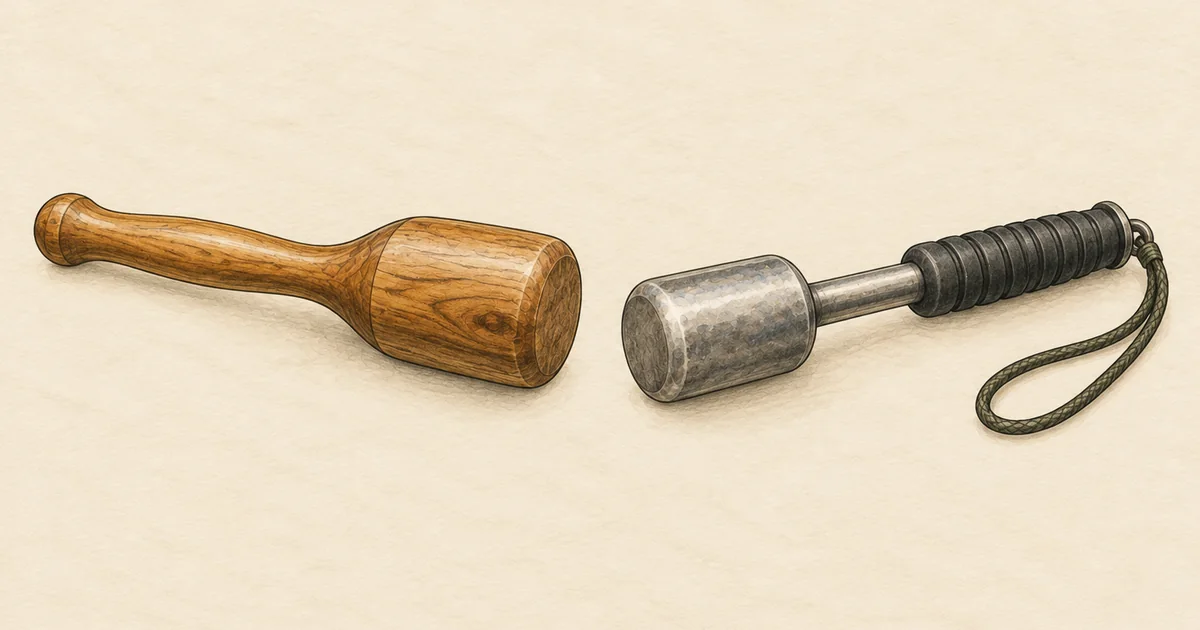
A fish priest (Fischbetäuber), also called a priest or club, is a sturdy, blunt stick for striking the head of a caught fish. It takes the fish’s awareness away before the knife kills it. This page covers the design, where to strike, the check afterwards and the place of the tool in your kit.
What animal welfare law requires
Fish are vertebrates. Under § 4 paragraph 1 of the Animal Welfare Act (Tierschutzgesetz), a vertebrate is in principle killed only once stunning has switched off perception and sensation. For fish, the Tierschutz-Schlachtverordnung (Animal Welfare Slaughter Ordinance) is more specific: whoever kills a fish must stun it immediately beforehand (§ 12 paragraph 10). Annex 1 of the ordinance permits four methods for this, namely current, a blunt blow to the head, carbon dioxide for salmonids and substances with a stunning effect. The exam material for anglers mainly describes the blow to the head, and the priest is built for it.
The ordinance sets three conditions for the blow: a suitable object, sufficient force and, directly afterwards, a method that causes death. In addition, as little time as possible should pass between catch and stunning. Without stunning, only flatfish may be killed, with a quick cut through throat and spine, and eels by a procedure of their own if no more than 30 are caught and processed in a day. More on this under eel dispatcher.
This is a pointer, not legal advice. Whether your federal state (Bundesland) or the water manager sets further requirements is in the state fisheries rules and in the fishing permit (Erlaubnisschein). An overview is given by Law and licences.
Club, priest, fish killer: one tool, three names
In the exam material the tool is usually called Schlagholz (striking wood). The Landesfischereiverband Baden-Württemberg simply writes in its tackle guide that a sturdy piece of wood is suitable. In the English-speaking world it is called a priest, a name that German angling magazines also use. The word Fischtöter (fish killer) persists as well, but misses the point: the angling club Löningen expressly calls it wrong in its course material, because the wood stuns and the killing is done with the knife.
Specialist shops sell priests in many sizes and shapes, according to Blinker also as a combination tool with a blade. All have a handle and a blunt end, the striking head, in common. With a combination tool you strike only with the blunt part, because the ordinance speaks of a blunt blow.
How heavy the priest must be
None of the official and exam sources evaluated here gives a weight in grams. The Bavarian exam catalogue requires an object that is heavy enough, the ordinance a suitable one. The portal nutztierhaltung.de of the Bundesanstalt für Landwirtschaft und Ernährung (BLE) writes from fish farming that large species such as African catfish and sturgeon are much harder to stun. For the choice that means: size the priest for the biggest fish you intend to take, not the smallest. Anyone who takes pike or wels catfish as well as trout needs more mass in the striking head.
The blow: place and execution
The blow to the head works by concussion. If it hits the right spot with enough force, the fish is, according to the BLE, instantly without perception. That is why the Bavarian angling exam asks why you need to know where the brain lies, and the right answer is: to be able to stun in line with animal welfare. The same catalogue describes a powerful blow above the eyes, the Saxony-Anhalt catalogue a firm blow to the hindbrain. Rute & Rolle places the spot on the top of the skull just behind eye level. Fig. 1 shows it with the red cross.
- Secure the fish. Take hold of it with a cloth and hold it firmly on the ground or a mat so the blow does not slip.
- Leave the hook in. Unhooking comes only after killing. Saxony-Anhalt asks the sequence in the exam: stun, kill, unhook, deal with the fish.
- Strike hard and on target. The striking head hits the top of the skull above the brain. A blow to the nape is one of the wrong answers in the Bavarian catalogue.
The whole sequence with the circular gill cut and the heart stab is under Stunning and killing fish.
Check: eye-roll reflex and breathing
Two reflexes show whether the blow has landed. The BLE names the breathing reflex, that is, the movement of the gill covers, and the eye-roll reflex. For the eye test, turn the fish on its side. A conscious fish keeps the eye level while you do so, the eyeball visibly rotating up or down in its socket. A stunned fish no longer turns the eye with the body, as the association in Baden-Württemberg also describes it. In the Bavarian catalogue the absence of this reflex is the sign of proper stunning.
If the gill covers are still moving or the eye turns with the body, the fish is not stunned, and the knife has to wait until a second blow lands. After that it carries on without a pause: the BLE describes the circular gill cut on both sides, which opens the large arteries, and the association in Baden-Württemberg additionally the heart stab.
A fish killer that does not kill. Even if the fish lies still after the blow, the cut follows at once. The ordinance requires, directly after the blow to the head, a method that causes death.
To hand at the water
Exam material from Bavaria, Saxony-Anhalt and Baden-Württemberg counts the priest as part of the kit you have with you when fishing, alongside the measure, the knife and the hook disgorger. Because the time between catch and stunning is supposed to stay short, it belongs in a pocket you can reach with one hand. The table shows which tool is next when you take a fish.
| Step | Tackle | What matters |
|---|---|---|
| Landing | Landing net | Fish safely out of the water |
| Measuring | Measuring tape | Check the minimum size before taking |
| Stunning | Fish priest | The hook stays in the mouth for now |
| Killing | Knife | straight after checking the reflexes |
| Unhooking | Disgorger pliers | only on a dead fish |
Common mistakes
- The priest is at the very bottom of the rucksack. Every minute of searching lengthens the time between catch and stunning that the ordinance wants kept short.
- Unhooking first. The exam material provides for unhooking after killing. On a live fish it costs time that it experiences fully conscious.
- Striking the nape. The target is the top of the skull above the brain, not the back behind it.
- Choosing the priest for the smallest fish. What is enough for a portion-sized trout can be too light for a big pike.
- Reaching for the knife without a check. Check the gill covers and the eye first, then cut.
Frequently asked questions
Do I have to carry a fish priest?
The exam material of several states counts it as equipment to be carried at the water. Whether your state or club expressly requires it is in state law and in the fishing permit (Erlaubnisschein).
Is any object enough?
The ordinance prescribes no particular tool; it requires a suitable object and a hard blow. A priest of your own has a secure handle and a blunt striking end, and you do not have to search for something on the bank first.
Do I need proof of competence to kill?
The Animal Welfare Act requires that only someone with the necessary knowledge and skills kills. Formal proof towards the authority is required by § 4 paragraph 1a of people who regularly stun or kill vertebrates professionally or commercially. The knowledge is tested by the angling exam (Fischerprüfung).
Related
- Stunning and killing fish: the full sequence with the circular gill cut and the heart stab
- Eel dispatcher: the tool and the special rule for eels
- Landing and unhooking fish: what happens before stunning
- Measuring tape and measuring mat: check the minimum size before you take the fish
- Disgorger pliers and artery clamp: taking the hook out of a dead fish
- Gutting fish: the work after killing
- Line calculator: whether line and knot are enough for big fish
Sources
- Bundesministerium der Justiz: Tierschutzgesetz § 4 (Töten nur unter Betäubung, Kenntnisse und Fähigkeiten, Sachkundenachweis bei berufs- oder gewerbsmäßigem Töten)
- Bundesministerium der Justiz: Tierschutz-Schlachtverordnung § 12 (Fische unmittelbar vor dem Töten betäuben, Ausnahmen für Plattfische und Aale) und Anlage 1 (vier zulässige Verfahren, geeigneter Gegenstand, ausreichende Kraft, Tötung unmittelbar danach, kurze Zeit zwischen Fang und Betäubung)
- LfL Bayern: Staatliche Fischerprüfung, Prüfungsfragen 2023/2024 (PDF) (Kopfschlag oberhalb der Augen mit genügend schwerem Gegenstand, Nackenschlag als falsche Antwort, Lage des Gehirns, Augendrehreflex, Fischbetäuber als Zubehör, Kiemenrundschnitt)
- Land Sachsen-Anhalt: Fragenkatalog zur Fischerprüfung (PDF) (Schlag auf das Nachhirn, Reihenfolge Betäuben, Töten, Abködern, Versorgen, Fischtöter als nötiges Zubehör)
- Landesfischereiverband Baden-Württemberg: Gerätekunde (PDF) (kräftiges Stück Holz, Betäubungsinstrument als mitzuführende Ausrüstung, Haken erst nach dem Töten lösen, Augendrehreflex, Herzstich und Kiemenschnitt)
- Fischereiverein Löningen: Gerätekunde (PDF) (Schlagholz, fälschlich Fischtöter genannt, Töten mit dem Messer, Maßband vor der Entnahme)
- BLE, nutztierhaltung.de: Tierschutzgerechte Betäubung und Schlachtung von Fischen (Wirkung über Gehirnerschütterung, Atem- und Augendrehreflex, Test in Seitenlage, Kiemenrundschnitt, große Arten schwerer zu betäuben)
- Rute & Rolle: Fischverwertung, schnell und waidgerecht (englischer Name Priest, Schlag auf die Schädeldecke knapp hinter Augenhöhe, Fisch mit Tuch fassen) und Blinker: Wie töte ich einen Fisch richtig beim Angeln? (Betäuber in vielen Größen, Kombiwerkzeuge mit Klinge)
Text AI-assisted, drawing AI-generated. Sources opened and checked in October 2026; no graphics taken from the sources.
All figures are guide values without guarantee and do not replace legal advice. What applies at your water is regulated by state law, the water rules and the fishing permit (Erlaubnisschein).