
Knowledge · Tackle
Eel dispatcher: Stunning and killing eels in line with animal welfare
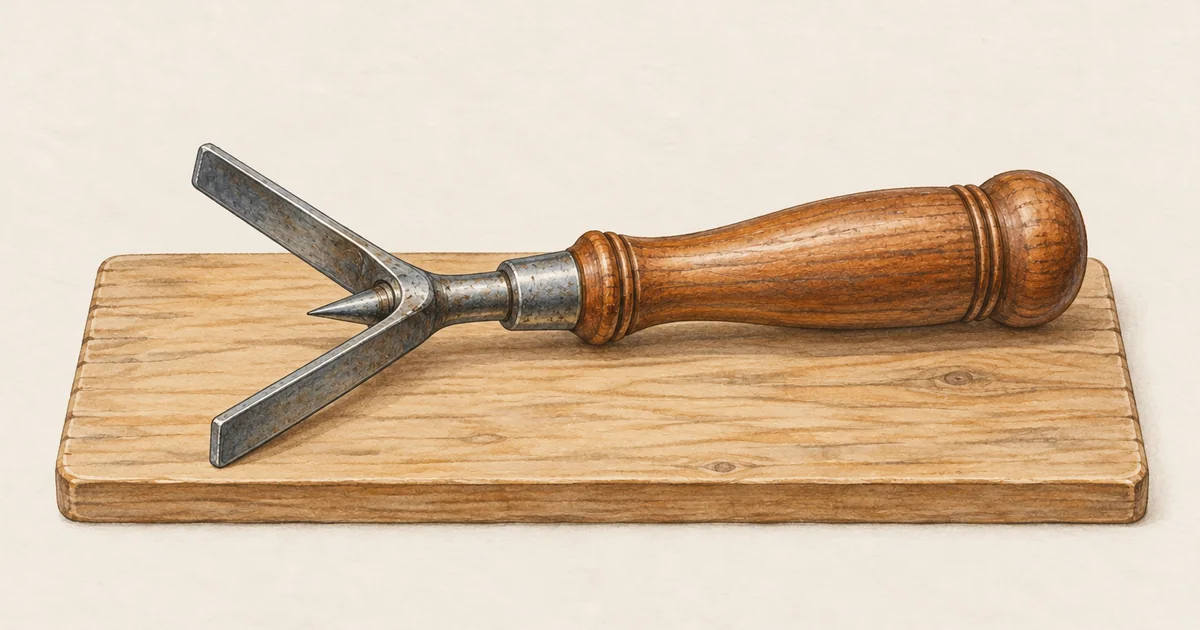
An eel dispatcher (Aaltöter) is a hand tool that holds the eel down by the back of the head on a surface and pierces the spine behind the head with a spike. Animal welfare law has a rule of its own for eels. Here you will find the permitted methods, the tool and the procedure at the water.
What the trade calls an eel dispatcher
Sold as an eel dispatcher is a tool with a V-shaped foot and a spike. The angling magazine Blinker describes its use like this: the foot presses the eel by the back of the head against a firm surface, then you push the spike out downwards and it enters behind the head. If the eel does not lie firmly, the spike misses the spine. With large eels, that is exactly what is difficult.
A variant is the eel pliers. They too take hold at the back of the head, the spike goes in as you squeeze, and the eel does not have to lie on the ground for it.
The eel dispatcher has little in common with the fish priest. The fish priest is a club for stunning. The tackle guide of the angling club Löningen notes that it is wrongly called a fish killer (Fischtöter), and names the knife for the actual killing. The eel dispatcher stabs, it does not strike. So it replaces the knife, not the fish priest.
The special rule for eels
Whoever kills a fish must, under § 12 paragraph 10 of the Tierschutz-Schlachtverordnung (Animal Welfare Slaughter Ordinance), stun it immediately beforehand. The same paragraph exempts two groups, flatfish and eels. Eels may be killed without stunning as long as no more than 30 animals are caught and processed in a day. The procedure is then laid down: a stab directly behind the head that severs the spine, and straight afterwards the removal of all the entrails together with the heart. The ordinance names both steps together.
The Animal Welfare Act (Tierschutzgesetz) draws a line in § 4: if killing without stunning is permitted under another provision, only unavoidable pain may be caused in doing so. The law also requires anyone who kills a vertebrate to have the necessary knowledge and skills.
The angling exam (Fischerprüfung) tests the rule. In the Bavarian question catalogue 2023/2024, the stab or cut through the spine just behind the head, followed by immediate gutting including the heart, counts as the welfare-compliant way for an eel caught by rod without stunning. So the catalogue also names the cut, while the ordinance names only the stab. Saxony-Anhalt asks in its catalogue (as of April 2022) how the angler must kill an eel, and gives the same procedure as the correct answer.
A pointer: Whether you may take an eel at all and from what length is regulated by your federal state (Bundesland) and your fishing permit (Erlaubnisschein). Protection status and closed-season rules are on the Eel page and under Closed season and minimum size explained.
Stunning by blow or by current
Anyone who stuns the eel before killing it chooses from the methods that Annex 1 number 9 of the ordinance permits for fish: electrical stunning, a blunt blow to the head, carbon dioxide only for salmonids and substances with a stunning effect. Substances such as ammonia, which remove slime at the same time, are excluded.
The annex describes the blow to the head briefly. It is delivered with a suitable object and hard enough, and straight afterwards comes a method that causes death. With fish there should be as little time as possible between catch and blow. The Saxony-Anhalt catalogue names hard blows to the head or electro-narcosis devices for stunning fish.
For current on eels the annex has a rule of its own. The eel lies in drinking water with a conductivity below 1000 microsiemens per centimetre, the current density depends on the measured conductivity, and the current flows for at least five minutes. Directly afterwards the eel is de-slimed and slaughtered. What is described is therefore a stunning installation with a water bath. Whether a portable device for anglers meets these requirements, the ordinance does not say. Before buying, ask the responsible veterinary authority.
The three methods compared, summarised from § 12 and Annex 1 of the Tierschutz-Schlachtverordnung:
| Method | Requirement | Limit or next step |
|---|---|---|
| Without stunning | Stab through the spine behind the head | gut immediately including the heart, at most 30 eels a day |
| Blow to the head | hard, with a suitable object | kill directly afterwards |
| Current | drinking water below 1000 µS/cm, at least 5 minutes | then de-slime and slaughter |
Why eels are hard to settle
According to the Anglerverband Niedersachsen, the eel can take up oxygen through its skin and so crawl over land for a short time. It keeps its gills tightly shut meanwhile so they do not dry out.
From practice, the magazine Blinker reports that eels cannot be stunned with a blow to the head and a stab to the heart often shows no visible effect. Even eels dealt with according to the rules keep moving afterwards and are hard to hold or to measure with the measuring tape. The editors therefore advise also severing the spine behind the head, and write that two or three stabs are sometimes needed for that. This is experience from angling practice, not a study. The ordinance permits the blow to the head for fish in general and makes no exception for eels.
Procedure at the water
Before the session, have everything to hand: a board or other firm surface, eel dispatcher or pointed knife, fish priest and a dry cloth.
- Holding: An eel is almost impossible to grip with bare hands. Take a dry cloth and grip firmly with it. A wet one slips more.
- Stunning, if you choose that route: a hard blow to the head with the fish priest, then without a pause the stab.
- Stabbing: place the eel dispatcher or the knife tip close behind the head until the spine is severed. According to Blinker, the blade belongs along the spine, not across it. Held across, it easily cuts the head off, and the eel can no longer be hung up for smoking.
- Gutting: remove the entrails together with the heart at once. The Bavarian question catalogue names a peculiarity of the eel: the belly wall is cut open beyond the vent so that the rear kidney extension comes out too. The belly cut step by step is shown under Gutting fish.
- Checking: If the eel is still moving strongly, another stab behind the head follows.
Common mistakes
- Putting the eel in a salmiak solution. The Bavarian question catalogue lists this as a wrong answer. The ordinance expressly excludes stunning substances such as ammonia that remove slime at the same time.
- Only stabbing, not gutting. Without stunning, the stab is permitted only together with the immediate removal of the entrails including the heart.
- Not fixing the head. A spike that meets a moving head easily misses the spine.
- Buying a current device unchecked. The requirements for eels call for a water bath, measured conductivity and five minutes of current. Find out beforehand whether a hand-held device does that.
- Starting without practice. Only someone with the necessary knowledge and skills may kill. In Baden-Württemberg the state fisheries regulation requires, in the preparatory course for the angling exam (Fischerprüfung), a practical day on which every participant practises stunning and killing until it comes confidently.
Frequently asked questions
May I kill an eel without stunning it?
Under § 12 paragraph 10 of the Tierschutz-Schlachtverordnung, an exception to the duty to stun applies to eels if no more than 30 animals a day are caught and processed. The stab through the spine behind the head and immediate gutting including the heart are prescribed. Avoidable pain must not occur in doing so.
Do I need an eel dispatcher?
The ordinance prescribes no particular tool, it only describes the stab. A knife whose tip is pressed into the back of the head until the spine is felt to be hit counts as an alternative. With the eel dispatcher, the V-shaped foot takes over holding at the back of the head.
Why does the eel still move after the stab?
Anglers also observe this in eels dealt with according to the rules. The magazine Blinker advises severing the spine behind the head reliably and stabbing again if necessary. What happens inside the animal while this goes on is not answered by the sources used here.
Related
- Stunning and killing fish: procedure and check for the other species
- Fish priest: the club for the blow to the head
- Eel: way of life, endangerment and rules
- Gutting fish: belly cut, cleaning and hygiene
- Fishing licence and angling exam: where killing is taught and tested
- Line calculator: breaking strain of the eel rig after the knot
Sources
- Bundesministerium der Justiz: Tierschutz-Schlachtverordnung, § 12 (Betäubungspflicht für Fische, Ausnahme für Aale bis 30 Tiere am Tag mit Stich und sofortigem Ausnehmen samt Herz)
- Bundesministerium der Justiz: Tierschutz-Schlachtverordnung, Anlage 1 (zulässige Betäubungsverfahren für Fische, Ausschluss von Ammoniak, Kopfschlag, Elektrobetäubung von Aalen mit Leitfähigkeit und fünf Minuten)
- Bundesministerium der Justiz: Tierschutzgesetz, § 4 (nur unvermeidbare Schmerzen beim Töten ohne Betäubung, Kenntnisse und Fähigkeiten)
- Bayerische Landesanstalt für Landwirtschaft: Staatliche Fischerprüfung in Bayern, Prüfungsfragen 2023/2024 (PDF) (Aal ohne Betäubung, Salmiaklösung als falsche Antwort, Ausnehmen über den After hinaus)
- Ministerium für Wirtschaft, Tourismus, Landwirtschaft und Forsten Sachsen-Anhalt: Fragenkatalog zur Fischerprüfung, Stand 28.04.2022 (PDF) (wie der Angler einen Aal töten muss, Betäubung mit Kopfschlag oder Elektronarkosegerät)
- Land Baden-Württemberg: Landesfischereiverordnung, Stand 2022 (PDF) (Praxistag im Vorbereitungslehrgang, Betäuben und Töten üben)
- Fischereiverein Löningen: Gerätekunde (PDF) (Schlagholz fälschlich Fischtöter genannt, Messer zum Abstechen)
- Anglerverband Niedersachsen: Aal (Sauerstoffaufnahme über die Haut, kurze Zeit über Land)
- Blinker: Aal richtig töten, damit sie sich nicht mehr bewegen (Aaltöter und Aalzange, Kopfschlag und Herzstich beim Aal, Stich in den Hinterkopf, Klinge längs) und Blinker: Glatte Aale: So lassen sie sich sicher greifen (trockenes Tuch zum Festhalten)
Text AI-assisted, drawing AI-generated. Sources opened and checked in October 2026; no graphics taken from the sources.
All figures are guide values without guarantee and do not replace legal advice. What counts are the Tierschutz-Schlachtverordnung in its current version, the law of your federal state (Bundesland) and your fishing permit (Erlaubnisschein).