
Knowledge · Tackle
Measuring tape and measuring mat: Measuring the minimum size reliably
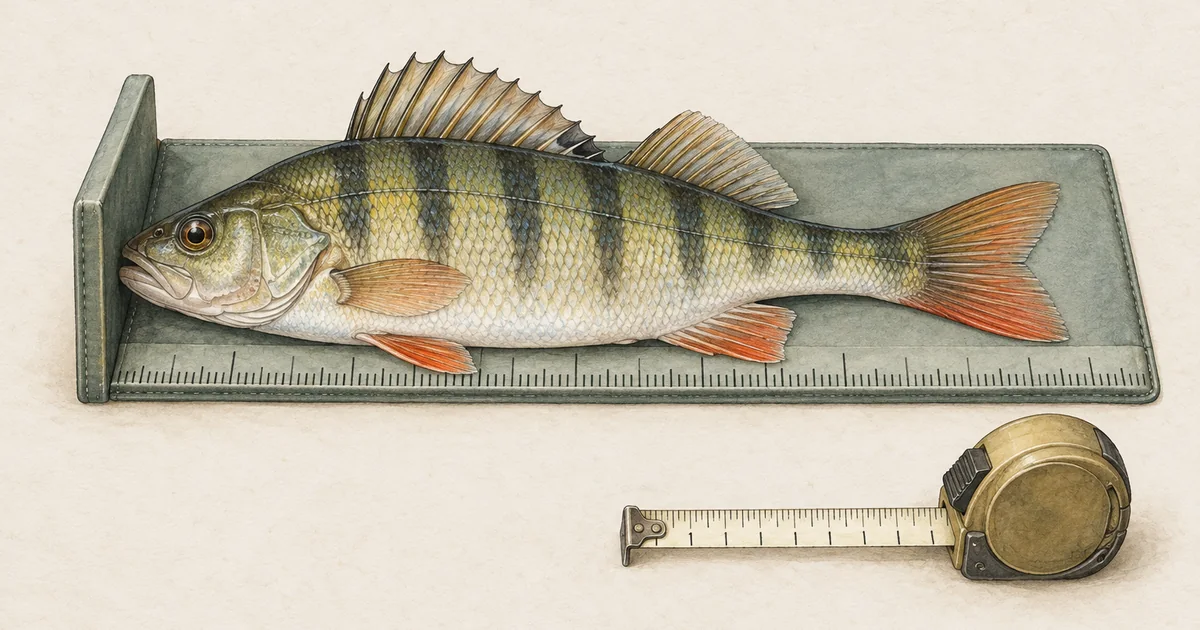
For the minimum size (Mindestmaß) the length counts from the tip of the head to the end of the tail fin, and you have to measure it at the water itself. With a tape or measuring mat it takes seconds if the stop, fin and surface are right. Here is how the states regulate measuring and how to measure without keeping the fish in the air for long.
What counts as length
The total length is measured, that is, the overall length of the fish from the foremost point of the head to the rearmost point of the tail fin. The fish database FishBase describes it as the greatest length of the whole body, measured in a straight line and expressly not over the curve of the back or belly. The tail fin therefore counts. How it should lie when you read it is set by each federal state in its fisheries regulation, and the wording differs.
| State | Regulation | Measured to |
|---|---|---|
| Bavaria | § 11 AVBayFiG | End of the body including the closed tail fin |
| Berlin, Brandenburg | § 8 LFischO, § 2 BbgFischO | End of the naturally spread tail fin |
| Saxony | § 2 SächsFischVO | End of the naturally spread tail fin |
| North Rhine-Westphalia | § 3 LFischVO | End of the longest part of the tail fin |
„Closed“ means: you push the two lobes of a forked fin together before reading. „Naturally spread“ means: the fin stays as it falls by itself. FishBase lists both as separate ways of measuring the total length. Incidentally, Bavaria calls the limit Schonmaß instead of Mindestmaß; fish below it may not be kept there. If a fish is right on the limit, it is worth knowing the wording for your state. The regulations of all 16 states are linked on the page Closed seasons and minimum sizes explained.
Note on the law: This page deliberately gives no minimum sizes. The values per species are in the annex of your federal state’s fisheries regulation. Also check the water regulations and fishing permit; the current wording is always what counts.
The measure is part of the basic equipment
The exam materials treat the measure as a fixed part of the equipment. The Bavarian question catalogue counts a length measure, alongside fish stunner, knife and disgorger, among the gear that belongs at the water for reasons of sporting conduct. In the Saxony-Anhalt catalogue a centimetre rule is on the list of accessories you absolutely need when fishing. The equipment guide of the Löningen angling club gives a brief reason: before a fish is kept the minimum size (Schonmaß) must be checked, and for that you need a tape.
Measuring aids and what they are good for
Roll-up tape
A roll-up tape measure weighs little and fits in a jacket pocket. It does need a wet surface, though, because sand or stones harm the fish’s mucous membrane. A wide tape can be wetted yourself and used as a surface for slim fish when there is no room for a mat in the undergrowth. That is better than laying the catch on sandy ground.
Measuring mat
A measuring mat is a padded unhooking mat with a printed centimetre scale. The fish lies soft, and you measure it while it is lying there anyway. On the mats that Blinker presents for predator anglers, the scale usually goes up to 120 centimetres, enough for a big pike. For bank anglers, large mats with a high edge are suitable, from which a thrashing fish will not slide off. Before you lay the fish down, the mat needs to be thoroughly wetted.
Stop at the zero point
A stop is a fixed edge at the start of the scale. You push the tip of the head against it, and then it lies securely at zero. There are wide tapes with a plastic stop as the zero point and versions to stick on the side of the boat. Without a stop you have to make sure yourself that the tip of the head lies exactly at zero.
Measuring gently: wet, flat, brief
Every measurement lengthens the time in the air. According to Blinker, this risks oxygen deficiency and a drying mucous membrane. Tape, mat and disgorger should therefore be within reach before the fish is in the landing net.
- Wet: Wet the mat or tape, and your hands too. The Bavarian examination catalogue gives as the reason for wet hands that otherwise the skin of the fish is damaged.
- Flat: Lay the fish horizontally on the scale, head against the stop. If you have no mat, a wet landing net or damp grass serves as a surface.
- Brief: Position the tail fin according to your state’s rule, read it off, done. Then the fish goes straight back into the water or is stunned, as described in Stunning and killing a fish.
A working group at Humboldt University in Berlin studied how heavily time in the air stresses carp (study from 2014). Small carp that lay in the air for ten minutes in the laboratory afterwards had 24 per cent more lactate, the salt of lactic acid, in the blood than fish without this air time. In the two months after release no fish died, and the researchers consider carp very hardy. From the point of view of fish welfare they nevertheless advise taking photos straight after the catch rather than after longer retention in a carp sack. The study says nothing about other species.
If a fish is visibly too small already in the landing net, you do not need a measure. For undersized, viable fish, the Bavarian catalogue gives as the correct answer to unhook them in the water or with wet hands and let them slip straight back. That includes: no detour via a souvenir photo. More on this is under Releasing a fish.
Common mistakes
- Measured over the curve. A tape laid over the back or belly shows more than the straight distance. FishBase measures in a straight line. Lay the fish on the measure, not the measure on the fish.
- Tail fin positioned by the wrong rule. Anyone who in Bavaria does not close the lobes, or in Saxony squeezes the fin together, is not measuring by the wording of their state.
- Not checking the zero point. If a tape is missing a few centimetres at the front, it shows too much for every fish, for example a zander. With every new tape, check that the scale really starts at zero.
- Measuring on dry or cold ground. According to Blinker, sand and dirt damage the mucus layer, as do ice, snow and hard-frozen ground.
- Looking for the measure only when the fish is lying on land. Every minute in the pocket is air time for the fish.
Frequently asked questions
Does the tail fin count towards the length?
Yes. In all the states in the table the measurement goes to the end of the tail fin. The only difference is whether it is measured closed, naturally spread or to its longest part.
May I estimate by eye?
For keeping a fish, estimating is risky: the regulations tie it to a specific length, and the exam materials count a length measure as equipment. Anyone who unhooks a fish in the water anyway and returns it can do without measuring.
How are crayfish measured?
Berlin and Brandenburg give a separate rule for this: from the tip of the carapace at the front to the end of the tail, with the abdomen lying flat and stretched out. Other states may word this differently; your state regulation is what counts.
Do I need a measuring mat if I already have an unhooking mat?
Not necessarily. A wet tape lying on the mat does the same. The printed scale only saves the movement of reaching for the tape.
Related
- Closed seasons and minimum sizes explained: the terms and the regulations of all 16 states
- Landing and unhooking a fish: landing net, wet hands and short air time
- Releasing fish: what happens to undersized fish
- Unhooking mat: the surface you also measure on
- Fish scales: for when weight counts as well as length
- Identifying fish: first be sure of the species, then look up the size limit
- Line calculator: choose the right breaking strain so the fight does not last longer than necessary
Sources
- Bayern.Recht: § 11 Ausführungsverordnung zum Fischereigesetz (AVBayFiG) (Schonmaß, Messung bis zum Körperende samt zusammengelegter Schwanzflosse, Werte in der Anlage)
- Fischereiamt Berlin: Mindestmaße und Schonzeiten (Auszug § 8 LFischO: natürlich ausgebreitete Schwanzflosse, Messung bei Krebsen) und Land Brandenburg: Fischereiordnung (BbgFischO) (§ 2, gleiche Messregel)
- Freistaat Sachsen: Sächsische Fischereiverordnung (§ 2 Abs. 2, natürlich ausgebreitete Schwanzflosse) und Land Nordrhein-Westfalen: Landesfischereiverordnung (LFischVO) (§ 3, längster Teil der Schwanzflosse, Entnahme erst ab Mindestlänge)
- FishBase: Glossar, Stichwort total length (Totallänge in gerader Linie, nicht über die Körperwölbung; zusammengelegte und natürlich liegende Schwanzflosse als Messweisen)
- LfL Bayern: Staatliche Fischerprüfung, Prüfungsfragen 2023/2024 (PDF) (Fragen 4.118, 4.128 und 4.129: Längenmaß mitführen, Umgang mit untermaßigen Fischen, nasse Hände), Land Sachsen-Anhalt: Fragenkatalog Fischerprüfung (PDF) (Zentimetermaß als nötiges Zubehör) und Fischereiverein Löningen: Gerätekunde (PDF) (Maßband zur Prüfung des Schonmaßes)
- Blinker: Abhakmatte richtig einsetzen und schonend releasen (Matten mit Skala bis meist 120 cm, Matte nass halten, breites Maßband als Unterlage, Anschlag als Nullpunkt, Band für die Bootswand, Schäden durch Sand und gefrorenen Boden)
- Blinker: Fische landen mit Kescher, Lip-Grip und Co. (kurze Luftzeit, Maßband griffbereit) und Blinker: Wie behandelt man untermaßige Fische richtig? (nasser Kescher oder feuchtes Gras, kein Foto)
- Humboldt-Universität zu Berlin, Fachgebiet Integratives Fischereimanagement: Studie von 2014 zur Luftexposition bei Karpfen (Laktat plus 24 Prozent nach zehn Minuten an der Luft, keine Todesfälle, Fotos direkt nach dem Fang)
Text AI-assisted, drawing AI-generated. Sources opened and checked in October 2026; no graphics taken from the sources.
All figures are guidelines only, without guarantee. How a fish is measured and which size limit applies is set by the current wording of the fisheries regulation in your federal state (Bundesland).