
Knowledge · Tackle
Fish scales: Working out the weight of your catch
Fish scales tell you what your catch really weighs, instead of you guessing. Here you can read how spring scales differ from digital hanging scales, how to zero them with a wet sling and check the reading, and how to keep the fish out of the water for only a short time.
Estimating, measuring or weighing
Estimated weights are often too high. In a Fisch & Fang report on giant pike, the author’s weight estimates used to be almost always above the true weight. Only a calibrated spring scale sharpened his eye.
Angling Times reports on European studies that advise measuring fish rather than weighing them. You take the length with the tape measure on the wet mat, while for the weight the fish has to go into a sling and hang from the hook of the scales.
Hardly anyone has a suitable set of scales with them for very large wels catfish. Blinker gives a rule of thumb: length in centimetres minus 100 gives the approximate weight in German pounds of 500 g. A catfish 180 cm long would therefore weigh about 80 pounds, around 40 kg. For normally proportioned catfish between 160 and 220 cm this works quite well. For shorter ones the true weight is usually lower, for longer ones often higher.
Spring scales and digital hanging scales
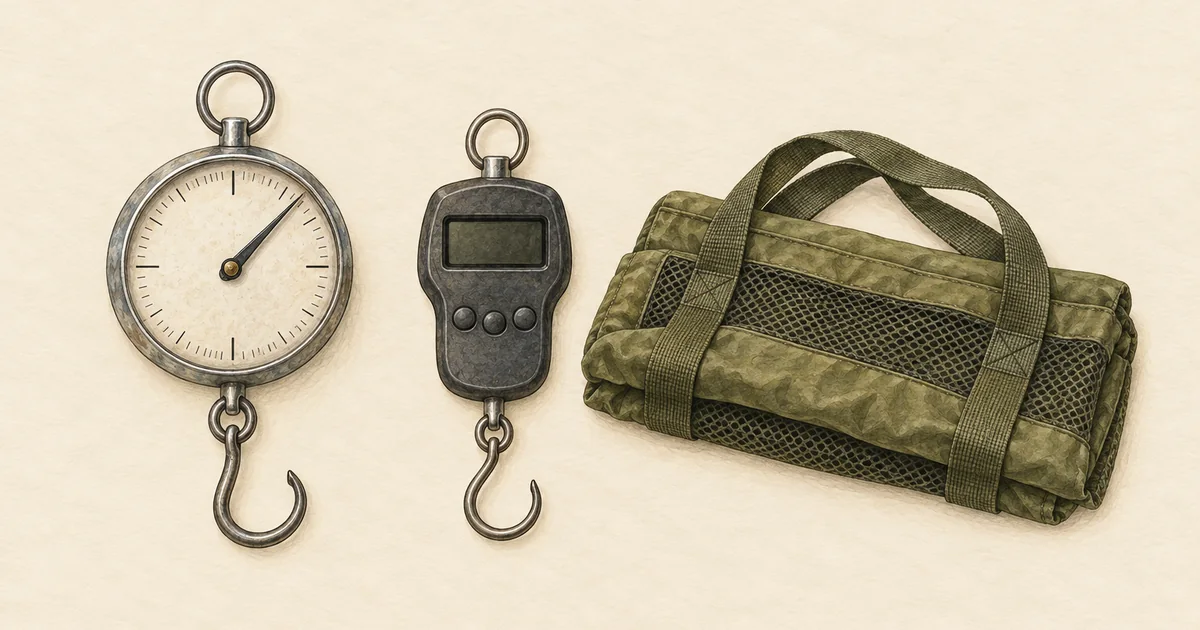
A mechanical spring scale contains a coil spring that stretches under load and then springs back. According to the Spektrum Lexikon der Physik, this stretch is therefore suitable as a measure of force. A pointer transfers it to the scale. Simple tube models are usually not very accurate, while a round dial is easier to read. Weighing with a simple spring scale is described in that report as “not exactly a precise method”.
The digital hanging scale shows the weight as a number on the display. Angling Times calls it popular because it is easy to use, whereas pointer scales are often preferred for their reliability and durability. Every set of scales has an upper limit. In a catch report in Fisch & Fang, the digital scales showed only “Error” for a big carp, which the angler took as a sign of clearly more than 25 kilos. Only a second, larger set of scales showed 27,5 kg. Choose the weighing range to suit the heaviest fish your water can produce.
| Design | Display | Strength | What to watch for |
|---|---|---|---|
| Spring scales with a pointer | Pointer on a round scale | considered robust and durable | simple tube models are inaccurate |
| Digital hanging scales | Number on the display | easy to use | above the weighing range only an error message |
| Lip gripper with scales | built into the handle | small and light | Fish hangs by the jaw |
Lip grippers clamp the fish by the lower jaw. Blinker explains their popularity among spinning anglers by their small size, low weight and often built-in scales, but warns of a very high risk of injury. The IGFA, the international body for record catches, advises against lifting large fish out of the water vertically, because that can damage the jaw, bones and internal organs. For weighing, the fish therefore belongs in a sling.
Zeroing with the wet sling
Taring means setting the empty weight to zero. Hang the empty, wet weigh sling on the scales and set the display to zero, so that it measures only the fish. The sling must not be dry, or it will rub off the protective layer of slime. If there is no tare button, you subtract the weight of the wet sling, which is also what the IGFA requires for record claims. The steps are set out under weigh sling.
Hold the scales at the top by the handle or eyelet so that nothing distorts the reading, or hang them from a tripod or a weighing bar.
Checking the reading
Only a known weight will show whether a set of scales is right. For a world record the IGFA requires scales whose accuracy has been certified by an authority or recognised body within the past twelve months.
For everyday use, a test at home is enough: hang up an object whose weight you worked out beforehand on reliable scales, and compare. If the display is off, note the difference or replace the scales. An IGFA rule helps with reading: if the pointer sits between two marks, the lower value counts.
Weighing that spares the fish
In its code of conduct for releasing fish, the Department of Integrative Fisheries Management at Humboldt University in Berlin advises keeping the fish wet, using unhooking mats in the boat too, avoiding contact with the air and putting the fish back within a few seconds. For weighing, that means:
- Prepare the scales, sling and unhooking mat and zero the scales before the fish comes out of the water.
- Lay the fish in the wet sling, tucking the pectoral fins against its body so that nothing tears.
- Lift, read, set down. The fish lies level, which the Berlin department expressly recommends for the pike, for example.
- Skip it in hot weather. Blinker repeats the advice not to weigh at all in high summer, and the Berlin researchers advise against catching pike for release at all when the water is above 22 °C. The IGB reports that pike often die after the fight when the water is clearly above 20 °C.
Legally, weighing is not an end in itself. The Bavarian State Office for Health and Food Safety (Bayerisches Landesamt für Gesundheit und Lebensmittelsicherheit) writes of trophy fishing, in which capital fish are released after being measured, weighed or photographed, that the courts which have dealt with it have consistently classed it as a criminal offence. What applies in an individual case is settled by state law and the water rules; the classification is under Releasing fish, the handling steps under Landing and unhooking fish.
Kilograms, pounds and lb
Many scales can be switched between kg and lb. According to the US standards institute NIST, an English pound (lb) is about 454 g and an ounce (oz) about 28,3 g. The German pound is heavier: in Germany it has meant 500 g since the Zollverein. Catch reports mix the two: a German pound is 500 g, and Fisch & Fang expressly says English pounds when lb is meant.
If the scales are set to pounds and ounces instead of kilograms, you have to convert, or a wrong value ends up in the catch log. So check the unit on the display before lifting the fish.
Worked example: The scales show 12 lb 8 oz. That is 12 × 454 g plus 8 × 28,3 g, together about 5,67 kg. Other values can be converted with the unit converter.
Common mistakes
- Weighing range too small. Above the upper limit the digital scales show only an error message, and the fish hangs in the air for nothing.
- Not zeroed, or zeroed dry. Then the weight of the sling is included in the result, and the dry cloth harms the slime layer.
- Wrong unit selected. Then a value in lb ends up in the catch log as kilograms.
- Weighed by the jaw. If the fish hangs vertically from a lip gripper, damage to the jaw and organs is a risk.
- Keeping first, weighing later. The Berlin code of conduct advises against keeping fish in a retaining sack; the fish should go back into the water within a few seconds.
Frequently asked questions
Spring scales or digital hanging scales?
Both will do if you check them. The pointer scale needs no battery, while the digital one is easier to use. More important than the design is a weighing range that suits your heaviest target fish.
Do fish scales have to be certified?
For a world record claim to the IGFA, yes; the certification may be at most twelve months old. If you weigh only for your own catch log, you check the scales yourself with a known weight.
How do I weigh small fish?
For small fish such as roach or dace, Angling Times recommends a strong plastic bag instead of the large sling, which gives a more accurate reading. Zero the bag beforehand, just like the sling.
Related
- Weigh sling: the sling in which the fish hangs from the scales
- Unhooking mat: the wet surface for unhooking and weighing
- Tape measure and measuring mat: record the length instead of the weight
- Landing and unhooking a fish: handling from landing net to mat
- Releasing fish: the legal classification and gentle release
- Unit converter: turning lb and oz into kg and g
- Line calculator: breaking strain after the knot and a starting value for the drag
- Setting the reel drag: measuring the drag force with a spring scale
Sources
- Angling Times: How to weigh fish safely and accurately (Bauarten, Tarieren mit nasser Schlinge, Plastiktüte, Brustflossen) und Angling Times: Can we do more to care for our fish on the bank? (Messen statt Wiegen)
- IGFA: International Angling Rules & World Record Requirements (Zertifizierung, Schlinge abziehen, Abrunden, nicht senkrecht heben)
- Fisch & Fang: Auf der Jagd nach Riesenhechten, Teil 8 (Schätzungen zu hoch, englische Pfund) und Teil 4 (einfache Federwaage)
- Fisch & Fang: Rekordkarpfen für Gründer (Messbereich)
- HU Berlin und IGB, Fachgebiet Integratives Fischereimanagement: Catch & Release (PDF) (Verhaltenskodex) und Waidgerecht: Hecht (waagerecht halten, 22 °C)
- IGB: Bericht 33, Boddenhecht (PDF, 2023) (Hechte deutlich über 20 °C)
- Blinker: DHC-Tipps zum schonenden Zurücksetzen (Hochsommer), Blinker: Fische landen, Kescher, Lip-Grip und Co. (Lippengreifer) und Blinker: Wie schwer ist ein Wels? (Faustformel)
- Bayerisches Landesamt für Gesundheit und Lebensmittelsicherheit: Tierschutzaspekte in der Angelfischerei (Trophäenfischen)
- Spektrum Lexikon der Physik: Federwaage (Prinzip) und Wikipedia: Federwaage (Genauigkeit, nur ergänzend)
- NIST: Guide to the SI, Appendix B.8, Conversion Factors (lb und oz) und Wikipedia: Pfund (500 g, nur ergänzend)
Text AI-assisted, drawing AI-generated. Sources opened and checked in October 2026; no graphics taken from the sources.
All figures are guidelines only, without guarantee, and are no substitute for legal advice. How accurately a set of scales measures depends on the individual device, so check yours yourself with a known weight.