
Knowledge · Tackle
weigh sling: Weighing fish gently
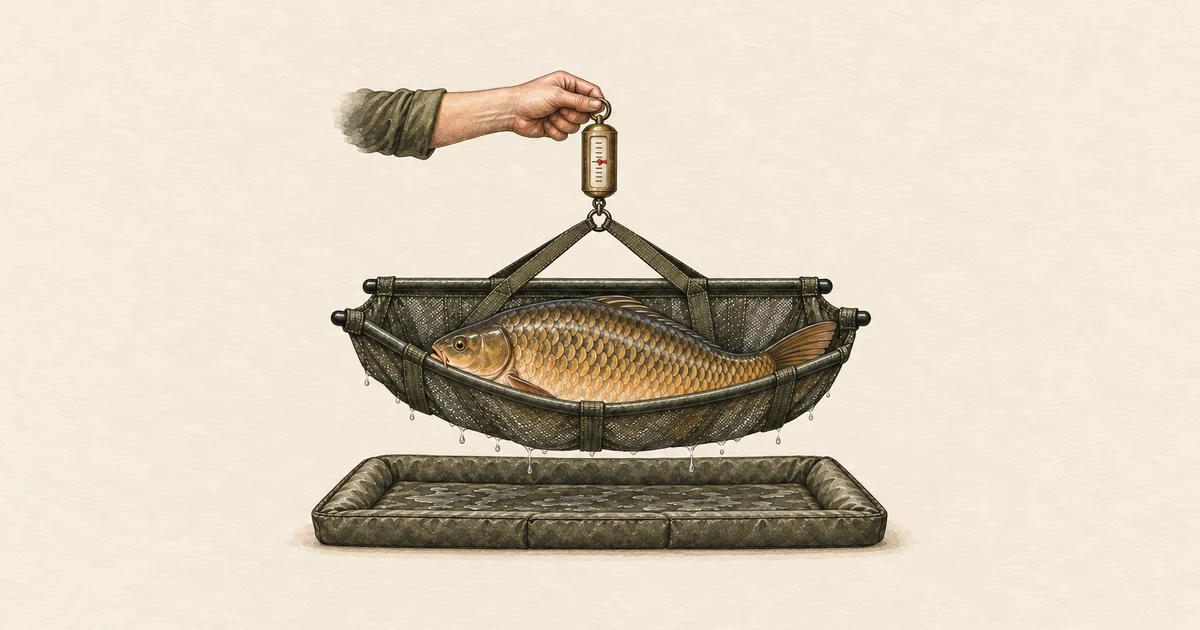
A weigh sling, also called a weigh bag, is a cloth bag in which a fish lies for weighing, instead of hanging from the scales by the mouth or gills. You wet it, set the scales to zero with the empty sling, and lift the fish only briefly and just above the unhooking mat.
What the weigh sling is for
You need a weigh sling for fish that are to go back into the water after weighing, such as a big carp or pike. Without a sling the fish would have to hang from a single point: by the gill cover, by the lower jaw or in a jaw gripper with built-in scales. Then one small spot carries the whole weight of the body.
Blinker describes what can happen. Anyone who lifts a fish out of the water vertically by a gill grip loads its neck vertebrae, and in heavy specimens this can go as far as damage to the spine. Jaw grippers, often with scales in the handle, frequently injured the lower jaw in studies the magazine reports on; in barramundi hanging from them vertically, neck vertebrae were even displaced.
In the sling, by contrast, the fish lies on its side and is supported along its whole length. For the same reason a landing net has a flat net bottom: stretched out and level, the weight is spread, and crushing and bent fins are avoided. The wet cloth also protects the skin. For exactly this reason the exam questions of the LfL Bayern require wet hands when a fish goes back into the water.
| Weighed like this | What carries the weight | Result |
|---|---|---|
| Gill grip, vertical | Head and gill cover | Load on the neck vertebrae |
| Jaw gripper with scales | Lower jaw | Jaw injuries, displaced vertebrae |
| Wet weigh sling | the whole body | Weight spread, as in a flat landing net |
Have everything ready before the bite comes
The sling only helps if it does not have to be searched for first. Disgorger, tape measure, scales, weigh bag, mat and camera should lie so close to hand that nobody has to rummage in a bag with the fish in their hands. For a night session, Fisch & Fang recommends always laying scales, tape measure, a wet weigh bag and a full bucket of water next to the mat. That way there is no searching with a torch in the dark.
The page Fish scales is about the scales themselves. The page Unhooking mat describes the surface for unhooking.
Taring: subtracting the empty weight
Tare is the weight of the packaging, that is, the difference between gross and net weight. With scales that have a tare function, you set them to zero with the empty container, and from then on they show only the contents. With a fish, the container is the wet sling.
The order matters: wet first, then zero. Wet cloth holds water and weighs more than dry. If you zero the scales with the dry sling, you add the water in the cloth to the fish’s weight. If your scales have no tare button, weigh the wet, empty sling beforehand and subtract the value.
Worked example with assumed values: The wet sling alone shows 0,6 kg, and with the fish the scales show 9,4 kg. The fish therefore weighs 8,8 kg. If your scales show pounds and ounces, convert them in the unit converter.
Weighing in five steps
- Wet the sling and the mat. Dip the sling completely in the water and dampen the mat thoroughly.
- Zeroing. Hang the wet, empty sling on the scales and set them to zero, or note its weight.
- Put the fish in. Unhook it on the mat, then lay it in the sling with wet hands so that it lies completely inside the cloth.
- Lift briefly and low. Only high enough for the sling to hang free, directly above the mat. Petri-Heil advises lifting a fish only very briefly, just above the water rather than above hard ground, because a fall can injure it. On land the soft, wet mat cushions such a fall. Read off the value and set the fish down again straight away.
- Set down and release. Lay the sling on the mat, put the fish into the water quickly and gently, and support it until it swims off by itself.
Whether a fish must or may go back is regulated by state law. The classification is under Releasing fish, the preceding handling steps under Landing and unhooking fish.
Time in the air: every second counts
Unhooking, measuring, weighing and photos add up to time in the air. The guidelines of the Food and Agriculture Organization (FAO) on recreational fishing expressly name weighing as one of the reasons. In the air the fine gill lamellae collapse and stick together, and beyond a certain time lasting tissue damage is a risk. The same overview also notes, however, that many species cope well even with longer periods in the air.
That is why there is no general maximum time. For pike, the Leibniz Institute of Freshwater Ecology and Inland Fisheries (IGB) sums up experiments like this: one to three minutes in the air made no measurable difference to behaviour after release, while longer times reduced swimming activity in the first hour. In a study by Humboldt University in Berlin, carp proved very robust against air exposure. From the point of view of fish welfare, the researchers still advise taking photos straight after the catch rather than first keeping the fish in a carp sack.
Heat changes the calculation. Blinker repeats the advice to do without extras such as weighing in high summer, and if you do, only in a weigh sling. According to the IGB, practical experience shows that pike at water temperatures clearly above 20 °C often die straight after the fight. HU Berlin advises not catching pike for release at all when the water is above 22 °C.
Common mistakes
- Zeroing dry, weighing wet. The water in the cloth ends up as weight on the fish.
- Looking for the sling only once the fish is on the mat. Every search lengthens the time in the air.
- Weighing standing up, high above the ground. If the fish slips out of the sling, it falls a long way. Hold the sling just above the mat.
- Using the jaw gripper with built-in scales. It is practical, but it hangs the fish vertically by the jaw.
- Weighing anyway in the heat. When the water is very warm, it is better to leave the scales in the bag.
Frequently asked questions
Do I need the sling for fish I am keeping too?
No. According to the exam questions of the LfL Bayern, a fish of legal size that you want to keep is stunned and killed first, not weighed. You can weigh it afterwards, and you do not need a sling for that. The procedure is described under Stunning and killing fish.
How long may weighing take?
There is no fixed limit; the specialist sources agree: as briefly as possible. The better the sling and scales are prepared, the less time weighing takes. If you are going to measure and photograph afterwards, have the tape measure and camera ready beforehand too.
Do all fish tolerate weighing equally well?
No. According to the study mentioned, carp are considered resilient and, according to the IGB, pike relatively robust, as long as the water is not very warm. Blinker points out that salmonids in particular are already stressed at water temperatures well above 20 degrees.
Are fish scales also suitable for the reel drag?
Yes, a spring or digital scale also measures the pull on the line. How to do it is described under Setting the reel drag, and the line calculator gives the starting value.
Related
- Fish scales: the scales from which the sling hangs
- Unhooking mat: the wet surface under the sling
- Landing net: landing the fish before weighing
- Tape measure and measuring mat: recording the length alongside or instead of the weight
- Landing and unhooking fish: handling, landing net and time in the air
- Releasing fish: when releasing is a duty
- Line calculator: breaking strain and drag value for the fight
Sources
- Blinker: Fische landen, Kescher, Lip-Grip und Co. (senkrechter Kiemengriff belastet die Halswirbel, Kiefergreifer mit Waage und ihre Verletzungen, flacher Kescherboden verteilt das Gewicht, Waage und Wiegesack griffbereit, kurze Luftzeit)
- Blinker: DHC-Tipps zum schonenden Zurücksetzen (im Hochsommer auf das Wiegen verzichten, wenn doch, dann nur im Wiegesack) und Blinker: Das Fischwohl geht vor (Salmoniden bei Wasser weit über 20 Grad gestresst)
- Fisch & Fang: Nachtangeln auf Karpfen (Waage, Maßband, nasser Wiegesack und Wassereimer neben der Matte)
- Petri-Heil: Vom Haken zurück ins Wasser (nur kurz und niedrig anheben, Gefahr durch Stürze, Schleimhaut und Sauerstoffdefizit bei langer Luftzeit)
- FAO: Technical Guidelines for Responsible Fisheries 13, Recreational Fisheries (PDF, 2012) (Luftzeit durch Abhaken, Wiegen und Messen, zusammenfallende Kiemenblättchen, Gewebeschäden, viele Arten widerstandsfähig) und EIFAC Code of Practice for Recreational Fisheries (PDF, 2008) (lange Luftzeiten vermeiden, nur mit nassen Händen anfassen)
- HU Berlin und IGB, Fachgebiet Integratives Fischereimanagement: Waidgerecht, Pike (22 °C), IGB: Bericht 33, Boddenhecht (PDF, 2023) (S. 616 f.: ein bis drei Minuten Luft ohne Verhaltenseffekt, längere Zeiten mindern die Aktivität, Hechte vergleichsweise robust, über 20 °C Todesfälle nach dem Drill) und Humboldt-Universität zu Berlin, Fachgebiet Integratives Fischereimanagement: Studie von 2014 zur Luftexposition beim Karpfen (Karpfen sehr robust, Fotos direkt nach dem Fang statt nach Hälterung)
- LfL Bayern: Fragenkatalog zur Fischerprüfung 2023/2024 (PDF) (Fragen 4.129 nasse Hände schonen die Haut, 4.133 maßige Bachforelle zuerst betäuben und töten) und Wikipedia: Tara (Gewicht) (Begriff Tara und Tarafunktion, nur ergänzend)
Text AI-assisted, drawing AI-generated. Sources opened and checked in October 2026; no graphics taken from the sources.
All figures are guidelines only, without guarantee. How well a fish tolerates weighing depends on the species, size, fight and water temperature.