
Knowledge – Fish
Brown trout: Recognition, habitat, bait and spawning time
The brown trout (Salmo trutta fario) is the characteristic fish of the trout zone, the uppermost fish zone of running waters. It needs cool, clear and oxygen-rich water and, as an adult, holds a fixed lie. Biologically it belongs to the same species as the sea trout and the lake trout.
In short: The best time to catch brown trout is from April to June, in the morning, in the evening and at night. Good spots on a river: behind stones, an undercut bank and pools. Proven baits: wet and dry flies and, where allowed, small spoons and spinners. Depending on the state, the closed season (Schonzeit) ends between mid-February and the end of April, in Bavaria on 15 March, in Saxony on 30 April (as of October 2026). Trout waters often have their own fishing times and water rules, so read the permit conditions before fishing. Step by step: Fishing for brown trout.
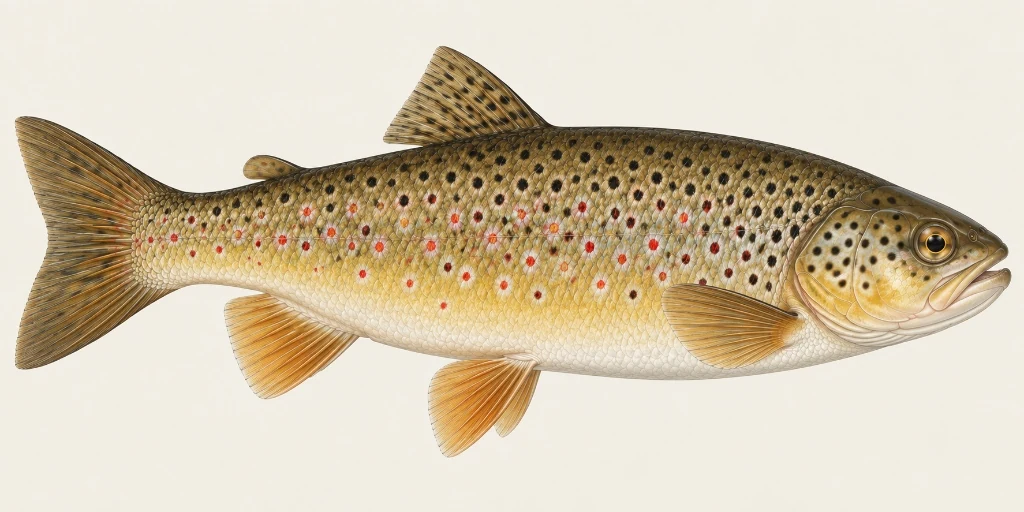
- Back olive-blackish-brown and silvery blue
- Red spots with a pale halo
- Underside of the belly white-yellow
Catch chances through the year
- Hardly any chance
- Possible
- Good
- Peak season
- Spawning (observe the closed season)
Editorial assessment for waters in Germany, not a measured value and no guarantee. Spawning time is not the same as the legal closed season.
Species profile and sources in the catch calendarAll species compared month by monthThe rules of your federal state
How to recognise a brown trout
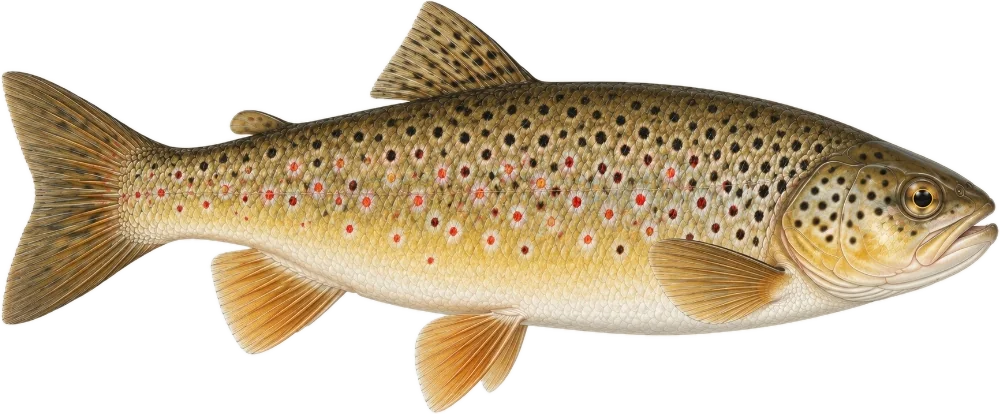
The body is spindle-shaped and more or less deep-backed, the snout blunt and the mouth cleft wide. The ground colour is usually grey-green. Red spots, often ringed in white, sit on the flanks, along with dark spots that extend onto the dorsal fin. The adipose fin, the small rayless fin in front of the tail, carries red or black spots depending on the water.
Size and colouring depend heavily on the water. The Landesfischereiverband Bayern gives 25 to 50 centimetres as the average and 95 centimetres as the upper limit.
Older males develop a kype, a hooked lower jaw, in the spawning season. Stone trout of food-poor mountain streams stay small at 15 to 20 centimetres.
Brown trout, lake trout and sea trout are the same species, Salmo trutta. The sea trout is silvery, carries a few x-shaped spots and no red dots. The lake trout is more silvery, grows clearly larger and moves up from lakes into the inflows to spawn. Red dots on the flanks point to the brown trout.
The rainbow trout has a pink iridescent lengthwise band and spots on the tail fin as well. The brook trout has a pale marbled back and white-edged fins. It crosses with the brown trout to give the sterile tiger trout.
At the water, rising behaviour helps: a fish that rises busily and in quick succession in the same place is usually a grayling. Brown trout rise at longer intervals near their lies.
Side by side
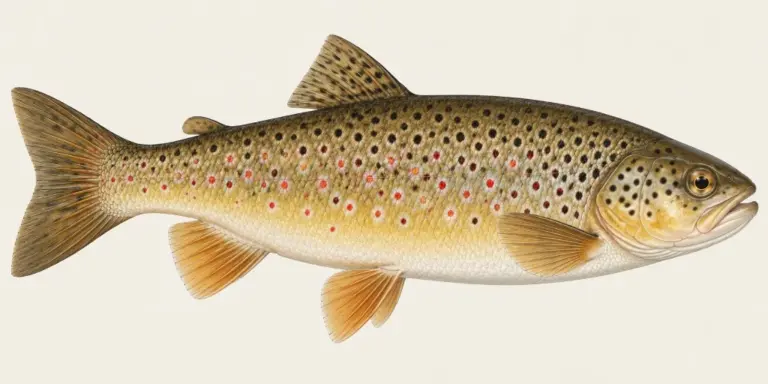
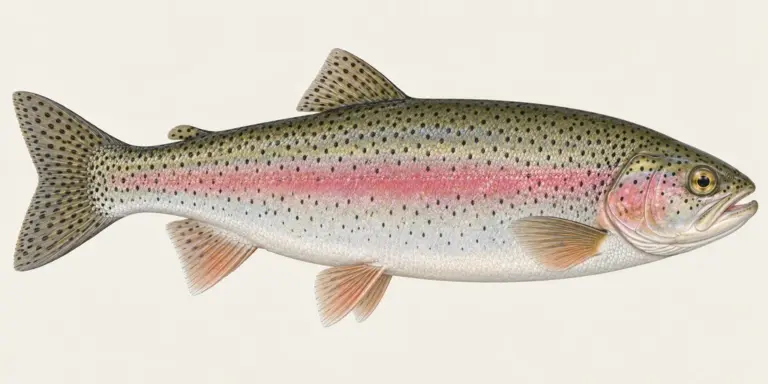

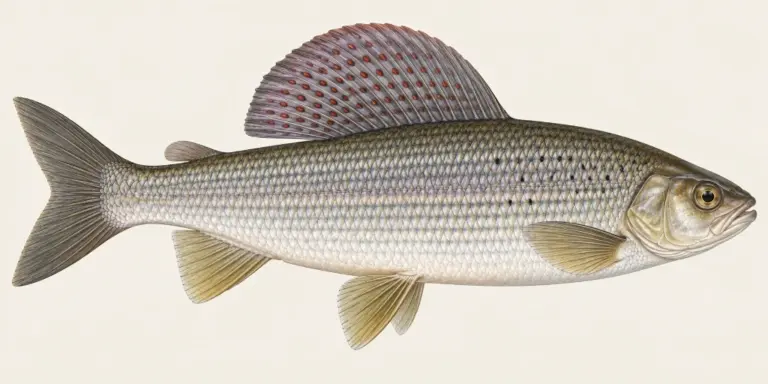
AI-generated illustrations.
Where the brown trout lies
It inhabits clear, cool, oxygen-rich running waters and mountain lakes. It also lives in high mountain lakes; the Austrian Ministry of Agriculture gives Alpine lakes up to about 2.500 metres for trout. In the river it is the fish of the uppermost zone, the trout zone (fish zones in a river).
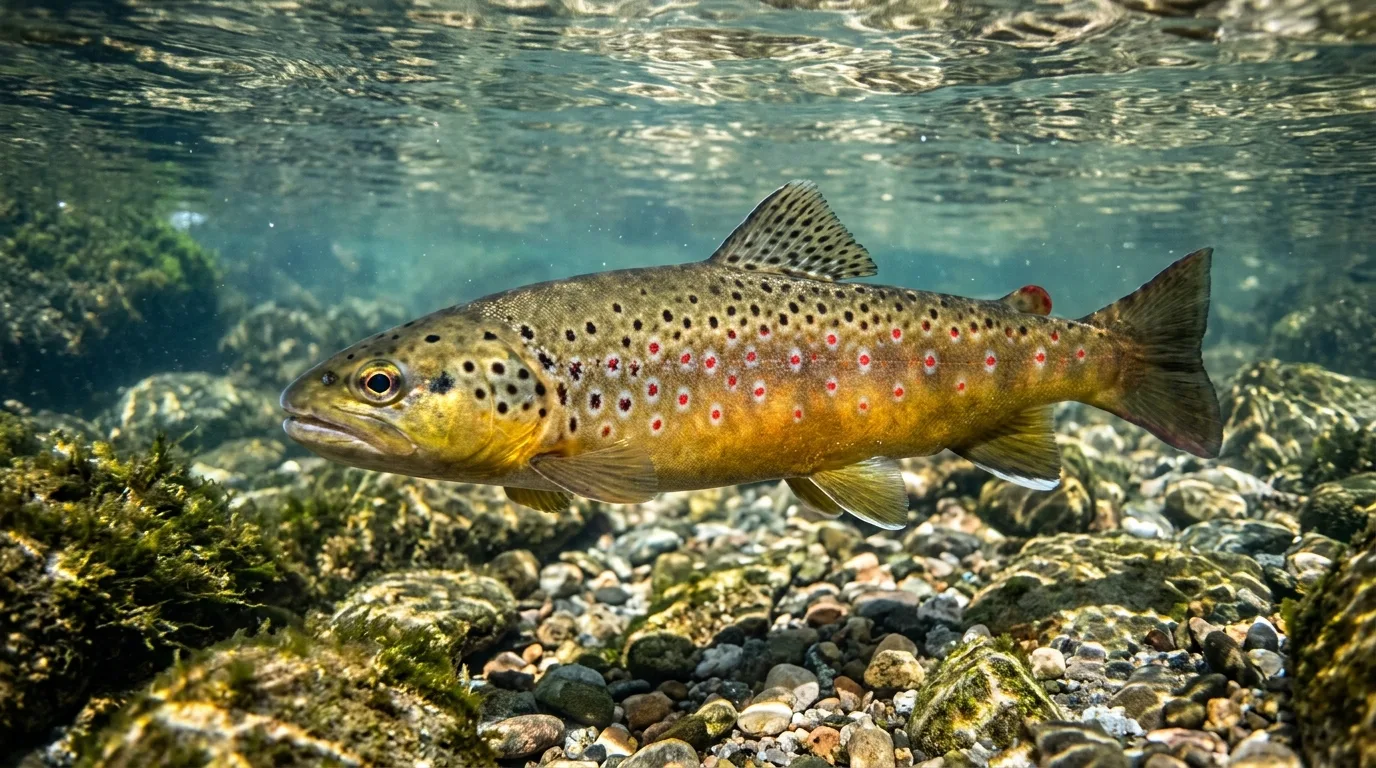
Structure is decisive. It needs cover: deep spots, undercut roots, overhanging bushes, big stones. It quickly disappears from straightened streams. Every fish holds a fixed lie, for example behind a stone or in a hollow among roots.
In the uplands young trout move down from the small headwaters after their first or second year, as far as the lower grayling zone or the barbel zone, where they live as adult fish. Below about 7 milligrams of oxygen per litre it comes under stress, and the eggs in the gravel need more than 6 (Water temperature and oxygen).
Holding spots in the picture
Choose a season and time of day: the picture shows where the species sits then. Tap a fish or a spot in the list to bring it closer. The picture is schematic and AI-generated, every water is different.
Catch chance in springPeak season
Catch chance in summergood
Catch chance in autumnhardly anySpawning, observe the closed seasons (Schonzeit)
Catch chance in winterslimSpawning, observe closed seasons
- J
- F
- M
- A
- M
- J
- J
- A
- S
- O
- N
- D
Spawning season
Active time Brown trout feed mainly at dusk, at night and when insects hatch.
Not a prime time Brown trout feed mainly at dusk, at night and when insects hatch.
Active time Brown trout feed mainly at dusk, at night and when insects hatch.
Active time Brown trout feed mainly at dusk, at night and when insects hatch.
In the river
Undercut bank, overhanging branches, timber
Brown trout are present here all year round.
Slack water behind rocks
Brown trout are present here all year round.
Pools, deep spot
Brown trout are present here all year round.
The brown trout is faithful to its place and holds a fixed lie: the calm slack water behind a stone, a root hole, an undercut bank or a deep pool. By day it stands there in the shade, head into the current.
Spring: chance of a catch according to the catch calendar possible in March, peak season in April and May. After spawning many fish are not yet in good condition. In late spring, when the mayflies hatch, they feed hard.
Summer: chance of a catch according to the catch calendar peak season in June, good in July and August. At 12 to 18 °C trout are active. When the water gets warmer they feed little and stand in the shade. Good summer spots are weed beds with floating water crowfoot, stream mouths where cooler water flows into the warmer river, and the well-oxygenated white water under weirs.
Autumn: chance of a catch according to the catch calendar good in September, slim in October and November. Spawning falls in this period, so observe closed seasons (Schonzeit). In autumn the spawning migration to gravelly shallows begins. These riffles are spawning grounds, where you leave the fish in peace.
Winter: chance of a catch according to the catch calendar slim. Spawning falls in this period, so observe closed seasons (Schonzeit). Spawning takes place in winter on gravelly, shallow spots with strong current. In this period the species is protected in many places. Do not wade over gravel bars then, because the eggs lie in the gravel until spring.
Size comparison: AI-generated drawing, schematic.
How it feeds and spawns
Young fish eat insect larvae, freshwater shrimps and water lice. Later flying insects and small fish such as minnows and bullheads are added, and for large fish amphibians too. The main food is larvae of mayflies, stoneflies and caddisflies. According to Blinker, brown trout are particularly active at dusk, at night and during insect hatches. FishBase, by contrast, lists the species as mainly active by day.
According to the Landesfischereiverband Bayern, spawning takes place from October to February. For this the fish look for gravel beds with a good flow over them, and fish from lakes move into the inflows. The female digs spawning redds in the gravel, preferably at the tail of a moderately flowing glide ahead of a strongly flowing riffle. For trout spawning sites the Lower Saxony state office gives a current of 0,3 to 0,5 metres per second and a water depth of at least 30 centimetres. The eggs lie 10 to 15 centimetres deep in the gravel.
The water is then only about 4 to 8 °C. At 4 °C the eggs take about 70 to 80 days to develop, and the larvae stay in the gravel until the yolk sac is used up. Brown trout usually become ready to spawn at two to three years, and depending on size a female lays 200 to over 2000 eggs. Weirs and drops that block migrating trout from reaching the spawning sites are a danger.
When it bites
Blinker gives 8 to 16 °C as the favourable range, the Austrian ministry 8 to 18 °C. Above 20 °C the brown trout cannot survive in the long run.
The season begins when the closed season ends. In many places that is not until April, in Bavaria on 16 March (AVBayFiG), in Saxony not until 1 May (as of October 2026). Many fish are then emaciated after spawning, with a big head and little body, and are building up fat. The first peak is usually the hatch of the mayflies, often at the beginning of June. In summer the fish feed mainly on insects, and then the fly rod pays off.
In late summer so-called black trout occur in rivers of the Alpine foreland, a die-off whose cause the Landesfischereiverband Bayern describes as not clearly established. In winter the fish spawn, and many waters then have closed seasons and protected stretches (The year at the water).
Today’s catch index needs JavaScript. Season and spawning time are in the catch calendar.
You will find the monthly overview of all species and the water temperature check in the catch calendar.
From the blog: Fishing in November: which fish bite now and where I look for them · Freshwater fish in Germany: which species you catch where
What to catch it with
Step by step: Fishing for brown trout: tips on bait, rig and tackle – season, spots, bait, tackle and rules on one page.
Fly fishing is the classic method (Fly fishing). For the nymph, rods of 2,40 to 2,70 metres in classes 6 to 8 are suitable. The take is delicate. You fish the dry fly with a rod of about two metres in class 5 or 6. You aim at the rings of a rising fish and place the fly ahead of it without it leaving a wake. If no fish are rising, you search for them with wet flies, small streamers or nymphs.
With the spinning rod (Spinning) a light rod of around two metres with a small reel and thin line, about 0,20 millimetres monofilament, is enough. A swivel ahead of it prevents line twist. Spinners in size 0 to 2 work well, which you bring past the lies against the current as slowly as possible, as do small fluttering spoons in gold, silver and copper, and floating crankbaits. The take comes in a flash. After a missed bite, pause briefly and offer a different lure in the same spot.
Natural baits are banned on most brown trout waters. Where they are allowed, many anglers avoid worm and maggot because undersized fish swallow them deep (Worms). For big predatory trout, a dead baitfish on a small lead-head rig with a single hook is an old bait (Baitfish rig), provided the fishing permit and state law allow it.
Note the lies: The brown trout is faithful to its spot. A lie you have found reliably produces fish, and once you have caught the resident fish, the next smaller fish from the surroundings usually moves back into the spot.
Return fish gently: Fish that have to go back you unhook in the water, ideally with a hook remover (Releasing fish).
Suitable lures
Wet and dry flies and, where allowed, small spoons and spinners.
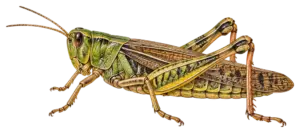
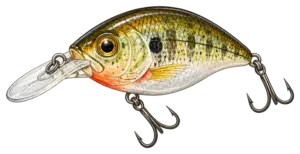
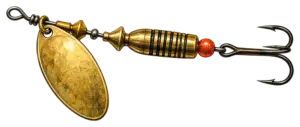
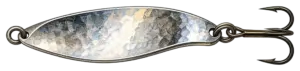
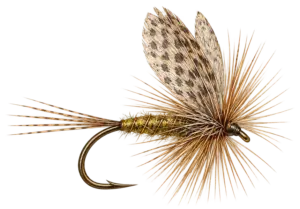
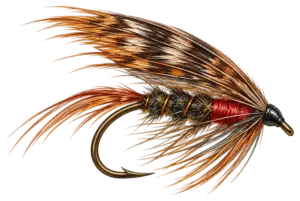
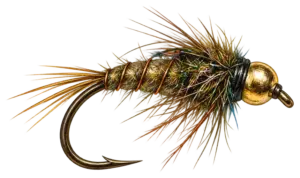
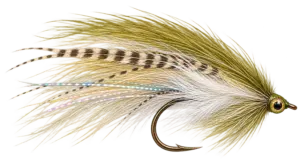
AI-generated illustrations. A click opens the lure’s page.
Rigs for these baits: sbirolino rig, running ledger rig.
Natural baits are unwelcome on many trout waters, and crankbaits and soft plastics are partly banned.
How brown trout tastes and what you can do with it
Trout flesh is firm, tasty and finely structured. Wild trout have 2 to 4 percent fat, clearly less than farm-fed salmon trout with 6 to 10 percent. Trout are eaten fresh, boiled, fried or smoked.
Preparation: Gutting fish, then frying or smoking. Take only fish of legal size that the closed season and minimum size of your water allow.
What you need to observe
Closed seasons (Schonzeit), minimum sizes (Mindestmaß) and harvest windows are set by the federal states (Bundesland), and on many waters additionally by the club or leaseholder. They differ depending on the water and the time of year. We give figures only with a date and a source; always binding are the fisheries regulation of your federal state and your fishing permit (Erlaubnisschein). You will find a list of links to the official sources in the catch calendar.
A fish of legal size that you want to keep you stun and kill at once, in line with animal welfare rules. Protected, undersized fish or fish too large under a harvest slot you unhook, if possible still in the water and with wet hands, and release gently. What exactly applies is regulated by state law and your fishing permit (Erlaubnisschein).
Trout waters often have their own fishing times, bait rules and protected stretches. Many federal states expressly ban fishing with a live baitfish; use a dead baitfish.
According to the Red List of freshwater fish of Germany of 2023, the trout Salmo trutta, including sea trout and lake trout, is threatened. The long-term stock trend shows a sharp decline, and in the previous list it was still regarded as not threatened.
What closed season, minimum size and harvest slot mean and where to find them is explained on the page Closed season and minimum size explained.
What state law specifies on the closed season and minimum size for this species can be found in the “At a glance” box on the state pages for Baden-Württemberg, Bavaria, Brandenburg, Hamburg, Hesse, Mecklenburg-Western Pomerania, Lower Saxony, North Rhine-Westphalia, Rhineland-Palatinate, Saarland, Saxony, Saxony-Anhalt and Thuringia. For the other states our overview does not list this species, and the state fisheries regulation is what counts there.
Frequently asked questions (FAQ)
When does the brown trout bite best?
The season begins after the closed season, which in many places does not end until April. The hatch of the mayflies, usually at the beginning of June, and dusk are good times. At water temperatures of about 8 to 16 °C the fish feed actively.
How do I recognise a brown trout and tell it from a sea trout?
The brown trout has red spots on its flanks, often ringed in white. The sea trout is silvery with a few x-shaped spots and no red dots.
May I catch brown trout with worm or maggot?
On most brown trout waters natural baits are banned because undersized fish swallow them deep. What counts are the fishing permit and the water rules.
Sources
The rating of catch chances is an editorial assessment. The facts come from these sources, and the text is worded in our own words. The illustration is an original design by Angel Momente in the style of a natural history plate (AI-generated, see the AI notice).
- Landesfischereiverband Bayern: Fischlexikon (Laichzeit, Lebensraum, Nahrung, Aktivität)
- FishBase: Salmo trutta (Lebenszyklus, Bestimmungsmerkmale, Nahrung)
- KEA-BW, Kompetenzzentrum Wasser und Boden: Steckbrief Bachforelle (Größe, Färbung, Laichplatz, Deckung)
- Blinker: Steckbrief Bachforelle (Merkmale, Lebensraum, Alter, Angeln)
- BMLUK Österreich: Forelle (traditionelle Lebensmittel; Lebensraum, Temperatur, Fleisch)
- LAVES Niedersachsen: Vollzugshinweise Meerforelle (Laichhabitat, Wanderung, Bachforelle und Meerforelle als eine Art)
- Rote-Liste-Zentrum: Forelle, Salmo trutta einschließlich Meerforelle (Rote Liste der Süßwasserfische Deutschlands 2023: gefährdet)
- Bayern: AVBayFiG, Anlage 1 (Schonzeiten und Schonmaße, Fassung ab 1.6.2025)
- Wikipedia: Bachforelle
- Landesanglerverband Brandenburg
- Blinker: Heiße Bachforellen, die besten Sommerspots (Krautbetten, Bachmündungen, Wehre)
- Umweltbundesamt Österreich: Nachhaltig fischen, Tipps für Angler:innen (kein Waten in Laichzeit und Eientwicklung)
Created with AI support from the sources listed. Figures only appear in the text if a source gives them. Last updated: 7 November 2026. Found a mistake? Write to us. Who is behind this site: About me.
More in the lexicon
- All fish species at a glance
- Catch calendar – month, water temperature and profile for 93 species
- Line calculator – breaking strain after the knot, drag guideline, backing
- Angling methods