
Knowledge – Fish
Brown trout fishing
Fishing for brown trout means finding its fixed lie, approaching quietly and offering a bait that drifts like its natural prey. Here is the way there in nine steps, each with a link to the detailed page.
 Choose another fish117 fish with guides
 EelOff-peak season
 EelpoutPossible
 IdePossible
 ArapaimaGood
 GraylingPeak season
 Atlantic salmonSpawning time, please spare
- Brown troutSpawning time, please spare
 Brook troutSpawning time, please spare
 BarbelOff-peak season
 BarramundiSpawning season
 Greater amberjackGood
 Topmouth gudgeonOnly as bycatch
 Blue marlinSpawning season
 BonefishSpawning season
 BonitoGood
 BreamOff-peak season
 Dusky grouperOnly as bycatch
 CobiaPossible
 Spiny dogfishOnly as bycatch
 CodPeak season
 ChubPeak season
 MinnowOnly as bycatch
 European sturgeonOnly as bycatch
 FlounderPeak season
 PerchPeak season
 Largemouth bassGood
 Ballan wrasseOnly as bycatch
 Yellowfin tunaSpawning season
 Giant trevallyGood
 Prussian carpPossible
 BrillPossible
 Gilthead breamSpawning time, please spare
 Golden doradoSpawning season
 Golden mahseerOnly as bycatch
 Dolphinfish (mahi-mahi)Good
 Grass carpPossible
 Great barracudaGood
 GudgeonPossible
 White breamPossible
 DaceOff-peak season
 PikePeak season
 HalibutOff-peak season
 HerringPossible
 GarfishOut of season
 Huchen (Danube salmon)Possible
 Crucian carpOnly as bycatch
 CarpOff-peak season
 RuffeOff-peak season
 VendaceOnly as bycatch
 DabPeak season
 GurnardPossible
 Coley (saithe)Peak season
 Chinook salmonHardly any chance
 King mackerelSpawning season
 LingPeak season
 TuskOff-peak season
 MackerelPossible
 Bighead carpOut of season
 WhitefishPossible
 Conger eelOff-peak season
 Sea troutSpawning time, please spare
 Grey mulletPossible
 Murray codSpawning season
 MuskellungeGood
 Common nasePossible
 Nile perchPossible
 PayaraPossible
 Peacock bassPeak season
 PermitGood
 WeeverOnly as bycatch
 PollackOff-peak season
 BurbotOff-peak season
 AspPossible
 Red snapperSpawning season
 Rainbow troutPeak season
 RoosterfishGood
 RoachPeak season
 RedfishOut of season
 Bluefin tunaOnly as bycatch
 RuddPossible
 Russian sturgeonOnly as bycatch
 HaddockOff-peak season
 SnakeheadPossible
 TenchOff-peak season
 SpirlinOnly as bycatch
 PlaiceOff-peak season
 Greenland halibutOnly as bycatch
 Round gobyOnly as bycatch
 SwordfishGood
 Lake troutSpawning time, please spare
 HakeSpawning time, please spare
 Alpine charSpawning time, please spare
 MonkfishPossible
 SoleOff-peak season
 SailfishGood
 Silver carpOut of season
 SnookPeak season
 PumpkinseedOnly as bycatch
 SpratOnly as bycatch
 Atlantic wolffishSpawning time, please spare
 TurbotPeak season
 SterletOnly as bycatch
 SmeltOnly as bycatch
 Horse mackerelPossible
 TaimenGood
 TarponGood
 TigerfishSpawning season
 BleakPossible
 WahooGood
 Wels catfishOff-peak season
 WhitingPeak season
 Sea bassOff-peak season
 ZanderPeak season
 White-eye breamOnly as bycatch
 Blue breamOnly as bycatch
 Brown bullheadPossible
 VimbaOnly as bycatch
Season in October according to the catch calendar, an estimate and not a guarantee of a catch. The fish pictures are reduced natural-history plates and AI-generated.
Best time
From April to June, in the morning, in the evening and at night.
In January: Slim chances, spawningIn February: Slim chances, spawningIn March: PossibleIn April: Peak seasonIn May: Peak seasonIn June: Peak seasonIn July: GoodIn August: GoodIn September: GoodIn October: Slim chances, spawningIn November: Slim chances, spawningIn December: Slim chances, spawning
Good spot
- River: behind stones, undercut banks and plunge poolsbehind stones, undercut banks and plunge poolsbehind stones, undercut banks and plunge poolsbehind stones, undercut banks and plunge pools
Starter tackle
- Rod: ultralight spinning rod of about 1,80–2,00 m, casting weight up to about 12 g
- Line: monofilament 0,20–0,25 mm or braid around 0,12 mm
- Hook: barbless hooks make releasing easier
- Rod: 2,40–2,70 m, line class 5–6; up to class 8 on big rivers
- Line: floating fly line WF 5–6
- Hook: gold-head nymph size 12–14
- Rod: about 2 m on a small stream, up to 2,70 m on a river, line class 5–6
- Line: floating fly line WF 5–6
- Hook: dry fly around size 16 as a guide
In short
In short: The best time for brown trout is April to June, in the morning, in the evening and at night. Good spots on the river: behind stones, undercut banks and deep pools. Proven baits: wet and dry flies and, where permitted, small spoons and spinners. The closed season (Schonzeit) ends depending on the state between mid-February and the end of April, in Bavaria on 15 March, in Saxony on 30 April (as of October 2026). Trout waters often have their own fishing times and water rules, so read the permit conditions before fishing.
Quick to recognise
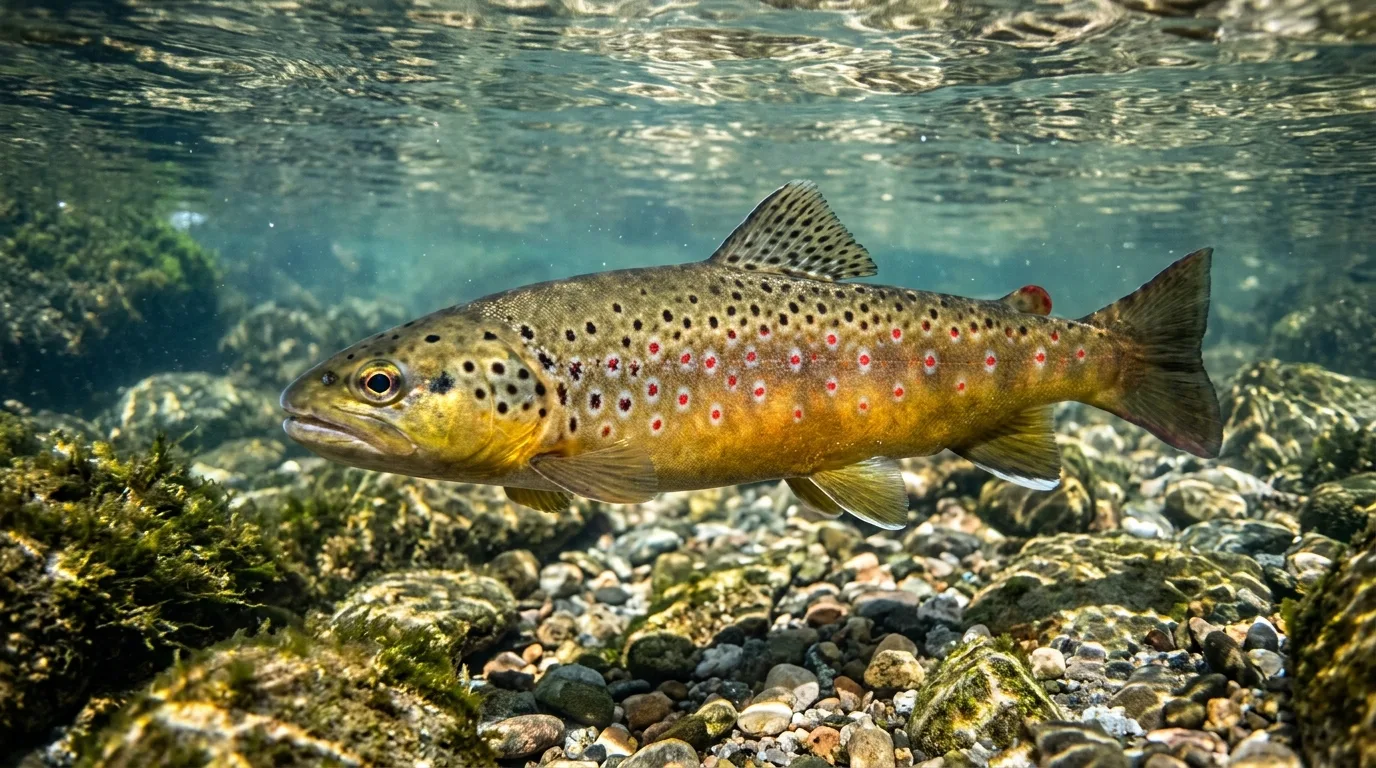
The indicator fish of the trout zone needs cool, clear, well-oxygenated water and is biologically a form of the same species as the sea trout and the lake trout. Typical lengths are 25 to 50 centimetres; the LFV Bayern reports fish up to 95 centimetres.
When
It goes best from April to June and stays good until September; in March a catch is possible only where the closed season (Schonzeit) is already over. It ends, depending on the state, between 15 February (Hamburg, Lower Saxony) and 30 April (Saxony), in Bavaria on 15 March, in Brandenburg on 15 April (as of October 2026). A first peak is often the hatch of the mayflies. From October to February the brown trout spawns. Whether a closed season applies then is set by your federal state (Bundesland).
- JanSlim chances, spawning
- FebHardly any chance, spawning
- MarPossible
- AprPeak season
- MayPeak season
- JunPeak season
- JulGood
- AugGood
- SepGood
- OctHardly any chance, spawning
- NovHardly any chance, spawning
- DecHardly any chance, spawning
Peak seasonGoodPossibleHardly any chanceSpawning season
Spring tactics
When you may fish for brown trout again is set by your federal state (Bundesland), in many places only from April. After spawning the fish are still worn out and sit deep on cold nights; then small crankbaits and spinners catch in pools and on outside bends.
Summer tactics
When the mayflies hatch in early June, the trout feed hard at the surface, and through the summer the fly rod has the advantage. In heat they stand under weed streamers, under alder roots and at stream mouths where cooler water flows in. If the water is very warm and the stream is running low, you are better off leaving the trout alone.
Autumn tactics
Until September you still catch well, best in the morning and evening twilight. Then spawning begins; whether you may still fish for brown trout then is set by your federal state (Bundesland).
Winter tactics
In winter the brown trout spawns on gravelly shallows and is protected in many waters then. Do not wade over gravel bars at this time, so that redds and eggs stay undamaged.
Are they biting today?
In January: Spawning season, please spare themIn February: Spawning season, please spare themIn March: PossibleIn April: Peak seasonIn May: Peak seasonIn June: Peak seasonIn July: Shoulder seasonIn August: Shoulder seasonIn September: Shoulder seasonIn October: Spawning season, please spare themIn November: Spawning season, please spare themIn December: Spawning season, please spare them
Today’s catch index needs JavaScript. Season and spawning time are in the catch calendar.
From the blog: Fishing in November: which fish bite now and where I look for them · Freshwater fish in Germany: which species you catch where
Where it sits now
In the river
Every brown trout holds a fixed place, such as calm water behind a big stone, a root hole, a washed-out bank or a deep scour hole. By day it waits there in the shade, head pointing into the current.
How to go about it: On a small stream you work your way upstream and fish each spot with only a few casts, because a fleeing fish warns the others. On larger rivers, stream mouths, weirs and weed beds are worth a look; fish outside bends from above the bend, not from its middle.
| All year round | behind stones, undercut bank, plunge pools |
|---|
Feeding time: in the morning, in the evening and at night. How this looks on the water is shown by the picture of the holding spots right below.
Waters with rules for brown trout
Holding spots in the picture
Choose a season and time of day: the picture shows where the species sits then. Tap a fish or a spot in the list to bring it closer. The picture is schematic and AI-generated, every water is different.
Catch chance in springPeak season
Catch chance in summergood
Catch chance in autumnhardly anySpawning, observe the closed seasons (Schonzeit)
Catch chance in winterslimSpawning, observe closed seasons
- J
- F
- M
- A
- M
- J
- J
- A
- S
- O
- N
- D
Spawning season
Active time Brown trout feed mainly at dusk, at night and when insects hatch.
Not a prime time Brown trout feed mainly at dusk, at night and when insects hatch.
Active time Brown trout feed mainly at dusk, at night and when insects hatch.
Active time Brown trout feed mainly at dusk, at night and when insects hatch.
In the river
Undercut bank, overhanging branches, timber
Brown trout are present here all year round.
Slack water behind rocks
Brown trout are present here all year round.
Pools, deep spot
Brown trout are present here all year round.
The brown trout is faithful to its place and holds a fixed lie: the calm slack water behind a stone, a root hole, an undercut bank or a deep pool. By day it stands there in the shade, head into the current.
Spring: chance of a catch according to the catch calendar possible in March, peak season in April and May. After spawning many fish are not yet in good condition. In late spring, when the mayflies hatch, they feed hard.
Summer: chance of a catch according to the catch calendar peak season in June, good in July and August. At 12 to 18 °C trout are active. When the water gets warmer they feed little and stand in the shade. Good summer spots are weed beds with floating water crowfoot, stream mouths where cooler water flows into the warmer river, and the well-oxygenated white water under weirs.
Autumn: chance of a catch according to the catch calendar good in September, slim in October and November. Spawning falls in this period, so observe closed seasons (Schonzeit). In autumn the spawning migration to gravelly shallows begins. These riffles are spawning grounds, where you leave the fish in peace.
Winter: chance of a catch according to the catch calendar slim. Spawning falls in this period, so observe closed seasons (Schonzeit). Spawning takes place in winter on gravelly, shallow spots with strong current. In this period the species is protected in many places. Do not wade over gravel bars then, because the eggs lie in the gravel until spring.
Size comparison: AI-generated drawing, schematic.
How
With the fly rod you present the dry fly when fish are rising, otherwise a wet fly, nymph or small streamer. With the light spinning rod you work small spinners slowly upstream past the lies.
Easiest way
To start with, a light spinning rod of just under 2 metres, a small reel with 0,20 mm monofilament and a small spinner behind a swivel is enough. Walk slowly upstream along a narrow stream and offer the bait at pools, stones and washed-out outside bends.
Spinners and mini crankbaits in the stream
The direct way to brown trout: you walk the stream and test each lie with a few casts, especially in spring.
- Reading holding spots
Look for deep outside bends with undercut banks, pools, big stones with slack water behind them and the white water under weirs. Stretches far from the car park are fished less often.
- Swivel and leader
Tie a small swivel or snap in front of the lure to stop line twist. In very clear water a fluorocarbon leader of about 1,5 metres and around 0,24 millimetres helps.
- Casting under cover
Approach in small steps, use bushes as cover and do not let your shadow fall on the water. Cast a little beyond the suspected lie, not directly onto it.
- Slowly at the holding spot
Retrieve the spinner against the current so slowly that the blade only just turns, and work it close past the hiding place. Under weirs let a small, heavy lure drop straight into the white water.
- Use the missed bite
The trout darts out of cover and grabs the lure or misses it. After a missed bite give the spot a short rest and then try a different lure.
- Away from the obstacle
Pull the fish away from roots and stones straight after the strike. After that it may thrash for a moment; on a small stream the way to the landing net is short anyway.
- Unhook in the water
Land the trout with a small landing net. If it has to go back, unhook it with wet hands while it is still in the water.
Nymph on the bottom
When no fish are rising you present the nymph close to the bottom, because larvae of water insects make up most of the diet.
- Look for pockets
Look for calmer pockets behind rocks and channels between weed streamers. If you see a trout in the shallows, watch it for two to three minutes until you are sure it is feeding.
- Leader by depth
Tie a rather short leader with a tippet of 0,14 to 0,16 millimetres. The tippet should be about one and a half times as long as the water is deep.
- Weighted nymph
Take a gold-head nymph in hook size 12 to 14. If it sinks too slowly, pinch a small split shot onto the leader about 20 centimetres in front of it.
- Short upstream
Cast three to six metres diagonally upstream with a roll cast so the nymph gets down to depth. Gather in the drifting line at the speed of the current.
- Reading the strike indicator
A small strike indicator at the join from line to leader reveals the cautious bite: it hesitates, twitches or pulls briefly against the current. Then lift the rod at once and tighten the line.
- With feel
Keep the rod up and let the trout work against light pressure. A fine tip does not tolerate yanking, so stay calm.
- Wading net
Net the fish with a small wading net and unhook the fly without lifting it out of the water if it has to go back.
Dry fly for rising fish
From early summer on, when insects hatch and trout feed at the surface, especially in the morning and evening.
- Watch for rings
Look for rings in the shade of large alders and at the edge of eddies below weirs. If a fish keeps rising at intervals close to the same cover, it is usually a brown trout.
- Long tippet
A dry-fly leader has a strong butt section and a tippet of 100 to 150 centimetres at 0,14 to 0,16 millimetres. Degrease the leader, otherwise it will sit visibly on the water.
- Choose a pattern
Use an all-round dry fly in size 16 or a pattern that resembles the hatching insect. In the evening a dark caddis often catches fish, as it is easy to see against the bright sky.
- Casting from below
Cast from a position below the fish, at an angle upstream, and place the fly a little above the rings so that it drifts towards the fish without drag.
- React fast
Brown trout rise quickly and take in a flash. When the fly disappears, lift the rod with a short, firm movement, without yanking.
- Stay calm
Keep the rod up and let the fish take line when it runs. Light, steady pressure is usually enough.
- Short and wet
Net the trout as soon as it shows its side, and keep it out of the water only as long as necessary.
What with
For fly fishing: dry fly, wet fly, nymph and streamer; for the spinning rod: small spinners. You place the dry fly ahead of the rings of a rising fish, without it dragging a furrow. On most brown trout waters natural bait is not allowed; what applies is stated in the fishing permit (Erlaubnisschein).
- SpinnerSpring to autumn, in the stream
A small spinner turns even when retrieved slowly against the current and flashes close to stones and roots.
- Nymphall season, when no fish are rising
Insect larvae are the main prey, and the weighted nymph drifts right along the bottom, where the trout picks it up.
- Dry flyEarly summer and summer, during the insect hatch
Rising fish reveal where they are holding and visibly take a suitable fly at the surface.
Tackle
For fly fishing you need a fly rod; for spinning a light rod of about two metres is enough, with a small reel and thin line. A swivel in front of the spinner keeps the line free of twist. The pages on the fly rod and the spinning rod help with class, length and casting weight.
Spinners and mini crankbaits in the stream
- Rod
- ultralight spinning rod of 1,80–2,00 m, casting weight up to about 12 g
- Reel
- small fixed-spool reel, preferably with a high gear ratio
- Line
- monofilament 0,20–0,25 mm or braid of about 0,12 mm
- Leader
- in clear water fluorocarbon, about 1,5 m, around 0,24 mm; in front of it a swivel or small snap
- Hooks
- barbless hooks make it easier to release fish
- Weight, float, lead
- spinner size 0–2, crankbait about 5–8 cm
Nymph on the bottom
- Rod
- 2,40–2,70 m, line class 5–6; on large rivers up to class 8
- Reel
- Fly reel matched to the line weight
- Line
- floating fly line WF 5–6
- Leader
- 60 cm 0,28 mm + 60 cm 0,20 mm, tippet ring, tippet 100–200 cm at 0,14–0,16 mm; no more than about 2,70 m in total
- Hooks
- gold-head nymph size 12–14
- Weight, float, lead
- if needed, split shot about 20 cm above the nymph
More on tackle
Common mistakes
- Fishing from the middle of the bend or under the bridge: Wary trout rarely hold directly under bridges. Fish the first few metres in front of and behind it from far upstream, and outer bends from above the bend.
- Avoiding obstacles for fear of snags: Good fish hold at roots, wedged timber and drifted debris. Let a crankbait drift in underneath from the outside instead of casting past it.
- Moving on straight after the first fish: A deep pool often holds several trout. After a catch wait a few minutes, cast again and cover every layer with shallow and deeper running lures.
- Hooklength too fine in a strong current: A 0,16 hooklength is barely noticeable in clear water, but it breaks easily in a strong flow. Play the fish very gently or use one size stronger among roots.
- Waiting too long with a worm: Where natural bait is allowed, small trout swallow it quickly and deeply. Strike promptly, then the hook sits well forward and you can release an undersized fish gently.
Rules
Each federal state (Bundesland) sets its own closed season (Schonzeit) and minimum size (Mindestmaß). Choose your state; the values come from our state pages.
Baden-Württemberg
- Minimum size
- 25 cm
- Closed season
- 1.10.–28.2.
- Note
- Hochrhein 35 cm, streams above 800 m above sea level 20 cm
As of October 2026. All rules, exceptions and sources: Fishing in Baden-Württemberg.
Bavaria
- Minimum size
- 26 cm
- Closed season
- 1.10.–15.3.
As of October 2026. All rules, exceptions and sources: Fishing in Bavaria.
Berlin
Our overview for Berlin does not list the brown trout. What applies there is explained on the page Fishing in Berlin, with the spots in the state.
Brandenburg
- Minimum size
- 30 cm
- Closed season
- 16.10.–15.4.
- Note
- do not keep in a keepnet
As of October 2026. All rules, exceptions and sources: Fishing in Brandenburg.
Bremen
Our overview for Bremen does not list the brown trout. What applies there is explained on the page Fishing in Bremen, with the spots in the state.
Hamburg
- Minimum size
- 20 cm
- Closed season
- 15.10.–15.2.
- Note
- harvest slot 20–40 cm
As of October 2026. All rules, exceptions and sources: Fishing in Hamburg.
Hesse
- Minimum size
- 25 cm
- Closed season
- 1.10.–31.3.
- Note
- harvest slot 25–60 cm, also applies to sea trout and lake trout
As of October 2026. All rules, exceptions and sources: Fishing in Hesse.
Mecklenburg-Western Pomerania
- Minimum size
- 30 cm
- Closed season
- 1.10.–31.3.
As of October 2026. All rules, exceptions and sources: Fishing in Mecklenburg-Western Pomerania.
Lower Saxony
- Minimum size
- 25 cm
- Closed season
- 15.10.–15.2.
As of October 2026. All rules, exceptions and sources: Fishing in Lower Saxony.
North Rhine-Westphalia
- Minimum size
- 25 cm
- Closed season
- 20.10.–15.3.
As of October 2026. All rules, exceptions and sources: Fishing in North Rhine-Westphalia.
Rhineland-Palatinate
- Minimum size
- 25 cm
- Closed season
- 15.10.–15.3.
- Note
- in waters without a winter closed season
As of October 2026. All rules, exceptions and sources: Fishing in Rhineland-Palatinate.
Saarland
- Minimum size
- 25 cm
- Closed season
- 1.10.–31.3.
As of October 2026. All rules, exceptions and sources: Fishing in Saarland.
Saxony
- Minimum size
- 28 cm
- Closed season
- 1.10.–30.4.
Correct as of October 2026. All rules, exceptions and sources: Fishing in Saxony.
Saxony-Anhalt
- Minimum size
- 25 cm
- Closed season
- 15.9.–31.3.
- Note
- LAV waters: at most 1 grayling or brown trout per day
As of October 2026. All rules, exceptions and sources: Fishing in Saxony-Anhalt.
Schleswig-Holstein
Our overview for Schleswig-Holstein does not list the brown trout. What applies there is explained on the page Fishing in Schleswig-Holstein, with the spots in the state.
Thuringia
- Minimum size
- 30 cm
- Closed season
- 1.10.–31.3.
As of October 2026. All rules, exceptions and sources: Fishing in Thuringia.
The regulation and your fishing permit (Erlaubnisschein) are what count. Lake Constance, the Rhine and the coast, for example, have their own rules: Fishing waters in Germany.
After the catch
Playing and landing
Set the hook briefly and firmly, without yanking, and first pull the trout away from roots and stones. Keep the fight short and land it with a small net. Handle it only with wet hands; protected or undersized fish you unhook in the water and support until they swim off by themselves. A fish of legal size that you may keep you stun and kill immediately.
Fish that have to go back you unhook directly in the water, ideally with a hook remover. You may only keep a fish if it has reached the minimum size (Mindestmaß) and no closed season (Schonzeit) applies; then you stun and kill it immediately. The firm, fine flesh is good for pan-frying or smoking.
Frequently asked questions
Which spinner size for brown trout?
Sizes 0 to 2 are usual, and in shallow water rather the small ones. Crankbaits should not be longer than a little finger, so about 5 to 8 centimetres.
Which line for trout fishing in a stream?
Monofilament of 0,20 to 0,25 millimetres or a thin braid of about 0,12 millimetres. With it you can also hold fish of around 50 centimetres; in very clear water a fluorocarbon leader goes in front.
When do brown trout bite best?
During the day at dawn and dusk, when they venture out of cover even in small streams. In the year, late spring with the mayfly hatch is a peak.
Which fly rod for brown trout?
On a small stream a rod of about 2 metres in class 5 to 6, on a larger river about 2,70 metres. Add a floating line of the same class.
How long does the leader need to be when nymph fishing?
The tippet depends on the depth, roughly one and a half times as long as the water is deep. Around 2,70 metres in total counts as the upper limit; longer leaders form bows in the current.
Similar species
Anyone who catches brown trout can fish for these species with similar tackle:
 Brook trout fishingSpawning season, please spare
 Fishing for rainbow troutPeak season
 Atlantic salmon fishingSpawning season, please spare
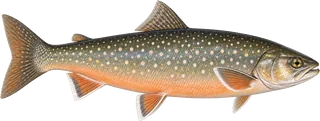 Fishing for Alpine charSpawning season, please spare them
Sources
Correct as of October 2026. The practical knowledge comes from 12 sources, summarised in our own words.
View all 12 sources
- Bachforelle: Die rotgetupfte Salmonide im Steckbrief · BLINKER (Redaktion)
- 5 Tipps für Bachforellen · RUTE & ROLLE (C. Siegler)
- Angeln auf Bachforellen: Rinnsal Kapital · BLINKER (Redaktion)
- Heiße Bachforellen: Das sind die besten Sommerspots · BLINKER (T. Pruß)
- Risikozuschlag: Angeln auf Bachforellen · BLINKER (Redaktion)
- Vorfächer fürs Fliegenfischen: dick oder dünn · BLINKER (C. Leppin)
- Fliegenfischen im Wildwasser: Erfolgreiche Fangstrategie · BLINKER (M. Werner)
- Nymphenfischen: Besser mit Bissanzeiger · BLINKER (M. Werner)
- Fliegenfischen: Welche Fliegen brauche ich als Einsteiger? · BLINKER (M. Werner)
- Die erste Bachforelle mit der Fliege fangen · BLINKER (Redaktion)
- Nachhaltig fischen – Tipps für Angler:innen · Umweltbundesamt Österreich (im Auftrag des BMLUK, mit österreichischen Landesfischereiverbänden)
- LFV Fischlexikon: Bachforelle · Landesfischereiverband Bayern
Text AI-assisted, based on the sources named and these pages: Brown trout (profile), Fly fishing, Spinning, Insects, Releasing fish.