
Knowledge – Fish
Bonito fishing
Bonito fishing means this: finding schools hunting along the coast early in the morning or in the evening and casting a slim metal lure into them. Here is the way there in nine steps, each with a link to the detailed page.
 Choose another fish117 fish with guides
 EelOff-peak season
 EelpoutPossible
 IdePossible
 ArapaimaGood
 GraylingPeak season
 Atlantic salmonSpawning time, please spare
 Brown troutSpawning time, please spare
 Brook troutSpawning time, please spare
 BarbelOff-peak season
 BarramundiSpawning season
 Greater amberjackGood
 Topmouth gudgeonOnly as bycatch
 Blue marlinSpawning season
 BonefishSpawning season
- BonitoGood
 BreamOff-peak season
 Dusky grouperOnly as bycatch
 CobiaPossible
 Spiny dogfishOnly as bycatch
 CodPeak season
 ChubPeak season
 MinnowOnly as bycatch
 European sturgeonOnly as bycatch
 FlounderPeak season
 PerchPeak season
 Largemouth bassGood
 Ballan wrasseOnly as bycatch
 Yellowfin tunaSpawning season
 Giant trevallyGood
 Prussian carpPossible
 BrillPossible
 Gilthead breamSpawning time, please spare
 Golden doradoSpawning season
 Golden mahseerOnly as bycatch
 Dolphinfish (mahi-mahi)Good
 Grass carpPossible
 Great barracudaGood
 GudgeonPossible
 White breamPossible
 DaceOff-peak season
 PikePeak season
 HalibutOff-peak season
 HerringPossible
 GarfishOut of season
 Huchen (Danube salmon)Possible
 Crucian carpOnly as bycatch
 CarpOff-peak season
 RuffeOff-peak season
 VendaceOnly as bycatch
 DabPeak season
 GurnardPossible
 Coley (saithe)Peak season
 Chinook salmonHardly any chance
 King mackerelSpawning season
 LingPeak season
 TuskOff-peak season
 MackerelPossible
 Bighead carpOut of season
 WhitefishPossible
 Conger eelOff-peak season
 Sea troutSpawning time, please spare
 Grey mulletPossible
 Murray codSpawning season
 MuskellungeGood
 Common nasePossible
 Nile perchPossible
 PayaraPossible
 Peacock bassPeak season
 PermitGood
 WeeverOnly as bycatch
 PollackOff-peak season
 BurbotOff-peak season
 AspPossible
 Red snapperSpawning season
 Rainbow troutPeak season
 RoosterfishGood
 RoachPeak season
 RedfishOut of season
 Bluefin tunaOnly as bycatch
 RuddPossible
 Russian sturgeonOnly as bycatch
 HaddockOff-peak season
 SnakeheadPossible
 TenchOff-peak season
 SpirlinOnly as bycatch
 PlaiceOff-peak season
 Greenland halibutOnly as bycatch
 Round gobyOnly as bycatch
 SwordfishGood
 Lake troutSpawning time, please spare
 HakeSpawning time, please spare
 Alpine charSpawning time, please spare
 MonkfishPossible
 SoleOff-peak season
 SailfishGood
 Silver carpOut of season
 SnookPeak season
 PumpkinseedOnly as bycatch
 SpratOnly as bycatch
 Atlantic wolffishSpawning time, please spare
 TurbotPeak season
 SterletOnly as bycatch
 SmeltOnly as bycatch
 Horse mackerelPossible
 TaimenGood
 TarponGood
 TigerfishSpawning season
 BleakPossible
 WahooGood
 Wels catfishOff-peak season
 WhitingPeak season
 Sea bassOff-peak season
 ZanderPeak season
 White-eye breamOnly as bycatch
 Blue breamOnly as bycatch
 Brown bullheadPossible
 VimbaOnly as bycatch
Season in October according to the catch calendar, an estimate and not a guarantee of a catch. The fish pictures are reduced natural-history plates and AI-generated.
Best time
From May to October, mainly in the morning and in the evening.
In January: PossibleIn February: PossibleIn March: PossibleIn April: PossibleIn May: Good, spawning seasonIn June: Good, spawning seasonIn July: GoodIn August: GoodIn September: GoodIn October: GoodIn November: PossibleIn December: Possible
Good spot
- Coast: open water and just below the surfaceopen water and just below the surfaceopen water and just below the surfaceopen water and just below the surface
Top baits
Starter tackle
- Rod: from the bank 2,70 m, in places with many obstacles up to 3,30 m, casting weight not under 80 g; from a boat without obstacles a light rod of around 20 g is enough
- Line: braid 0,18–0,30 mm
- Rod: spinning or boat rod up to 3 m, tough enough for the fight and absorbing jolts, casting weight not under 80 g
- Line: mono because of its stretch in the hard fight, somewhat stronger than the 0,35 mm used for horse mackerel and mackerel
In short
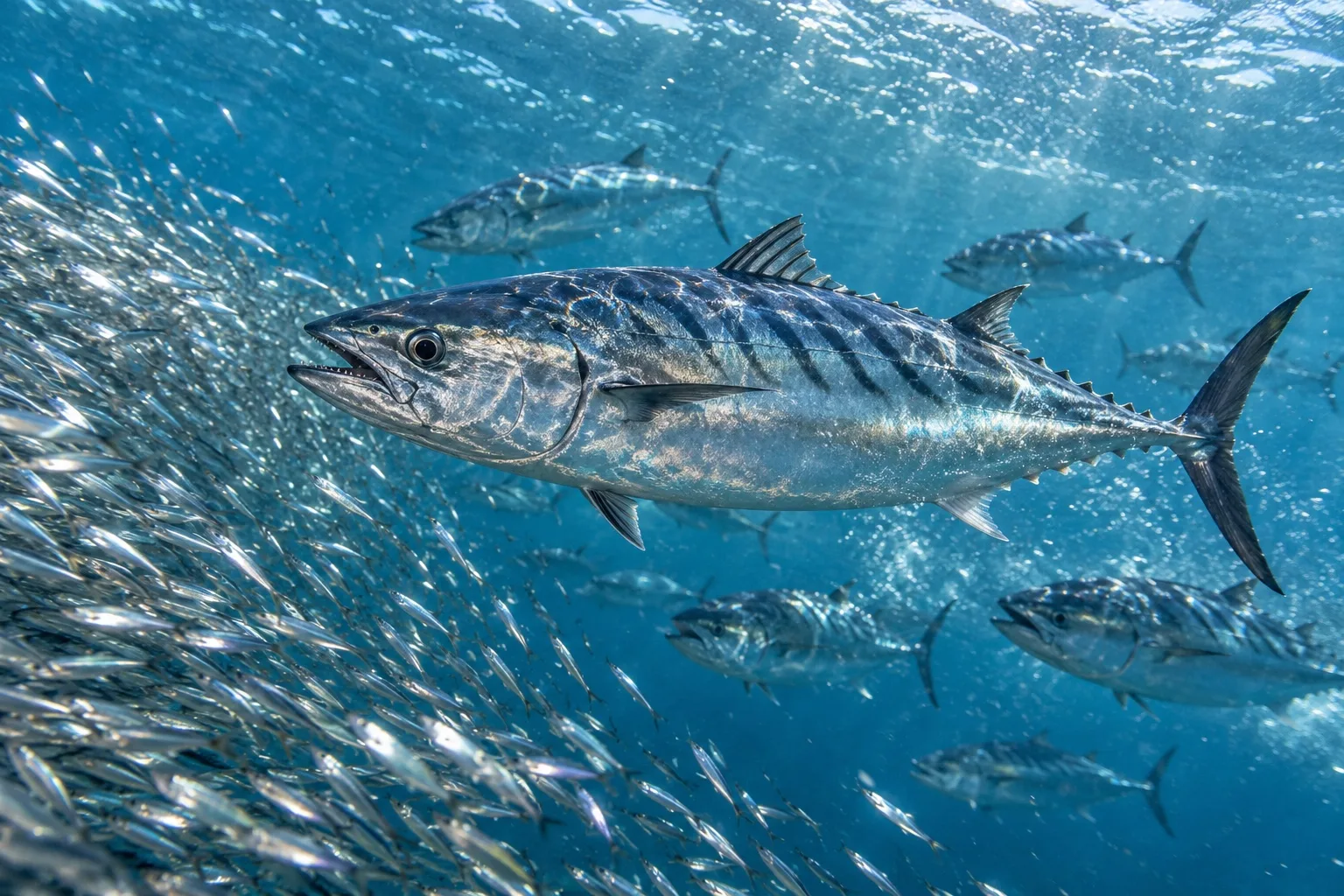
In short: According to the catch calendar the best time is May to October. Good spots along the coast: open water and just under the surface. Proven baits: small metal lures and plugs when spinning or trolling, feathered lures, also strips of fish. Do not confuse it with the skipjack tuna (Katsuwonus pelamis): the bonito has oblique stripes on the back, the skipjack longitudinal bands on the belly.
Quick to recognise
A small tuna with a steel-blue back and a silvery underside, also called pelamid. Five to eleven oblique dark stripes run across the back, pointing forward and down. Around 50 centimetres is usual; it is not the same as the canned skipjack.
When
In the Mediterranean and the eastern Atlantic May to October are the good months; at other times a catch is possible. Spawning in the Mediterranean and off Morocco takes place mainly in May and June, off the Algerian coast already from March. During the day the early morning hours and the evening count.
- JanPossible
- FebPossible
- MarPossible
- AprPossible
- MayGood, spawning
- JunGood, spawning
- JulGood
- AugGood
- SepGood
- OctGood
- NovPossible
- DecPossible
Peak seasonGoodPossibleHardly any chanceSpawning season
Season in the destination
In the main range the best months lie between May and October. In straits such as the Dardanelles bonito pass through mainly in spring and autumn, and in the Turkish Black Sea recreational anglers catch them mainly from August to October. On the French Atlantic coast big schools move along the shore in the warmer months, and then light trolling and spinning from a boat pay off.
Season and biting time
In January: PossibleIn February: PossibleIn March: PossibleIn April: PossibleIn May: Spawning seasonIn June: Spawning seasonIn July: GoodIn August: GoodIn September: GoodIn October: GoodIn November: PossibleIn December: Possible
Where it is now
On the coast
Bonito are schooling fish of open water over the shelf and travel along the coasts. In the morning and evening they often hunt close inshore for sardines and anchovies, and occasionally they swim as far as river mouths. Schools close to the coast tend to consist of smaller fish.
How to go about it: From the bank you look for rocky coasts that drop steeply into deep water where currents meet, plus quay walls and breakwaters. In the Adriatic bonito hunt over open water as well as in channels and bays. Expect the boat to have the advantage in most cases: in North Carolina on the US east coast only about 5 per cent of the bonito landed recently came from shore anglers.
| All year round | open water, just below the surface |
|---|
Biting time: mainly in the morning and in the evening. What that looks like at the water is shown by the picture of the holding spots just below.
Holding spots in the picture
Choose a season and time of day: the picture shows where the species sits then. Tap a fish or a spot in the list to bring it closer. The picture is schematic and AI-generated, every water is different.
Catch chances in springpossible
Catch chance in summergood
Catch chance in autumngood
Catch chance in winterpossible
- J
- F
- M
- A
- M
- J
- J
- A
- S
- O
- N
- D
Spawning season
Active time It feeds mainly in the early morning hours and in the evening, usually close inshore.
No peak time It feeds mainly in the early morning hours and in the evening, usually close inshore.
Active time It feeds mainly in the early morning hours and in the evening, usually close inshore.
No peak time It feeds mainly in the early morning hours and in the evening, usually close inshore.
On the coast
Open water, mid-water
Bonito (pelamid) is here all year round.
Just below the surface
Bonito (pelamid) is here all year round.
Bonito travel in schools through open water over the shelf and follow the coasts. There they hunt sardines, anchovies and mackerel. Occasionally they come as far as river mouths.
Spring: catch chances according to the catch calendar are possible in March and April, good in May.
Summer: catch chance according to the catch calendar good.
Autumn: catch chance according to the catch calendar good in September and October, possible in November.
Winter: catch chance according to the catch calendar possible.
Size comparison: AI-generated drawing, schematic.
How
When spinning you cast slim metal lures into hunting schools. Anglers also report catches when trolling with small artificial lures.
Easiest way
From a boat a light spinning rod with a casting weight of around 20 grams is enough, as long as no rocks or obstacles are in the way. From a rocky shore, on the other hand, you need strong tackle with a casting weight from about 80 grams. Find a spot where the bank drops off steeply and there is current, and cast where bonito are hunting at the surface with birds circling above.
Spinning from a rocky shore
For shore anglers on rocky coasts, breakwaters and quay walls, for example on the Adriatic: strong spinning tackle, a long hooklength and fast metal lures.
- Steep edges
Pelagic predators such as the bonito mostly stand where the bank drops steeply into deep water and currents converge. In Croatia shore anglers land palamidas, as the bonito is called there, even from quay walls in small harbours.
- Long, stiff hooklength
Add two to three metres of stiff fluorocarbon of 0,50 to 0,80 millimetres. Hooked fish like to bolt into rocks and obstacles, and the strong hooklength protects the main line there.
- Cast to the signs
Watch the surface: leaping bonito chasing small fish and birds diving for prey above them show you the school. Cast your lure into that area.
- Retrieve fast
Fast-retrieved lures bring the most bites from bonito. Shore anglers in Croatia catch them on metal jigs of around 40 grams and on plugs, and the bite can come right at the surface.
- Away from the rocks
The rod needs enough backbone for you to keep the fish away from obstacles. If the line still rubs on an edge, do not force anything: give line through the drag and patiently play the fish out.
- Long landing net
From high harbour walls and cliffs you can hardly reach the fish without a landing aid with a handle at least two metres long. If it is to go back, use the landing net; use the gaff only for a fish you keep.
Light trolling on the Adriatic
From a moving boat you pull an artificial lure behind you at a depth of a few metres; on the Croatian coast this light trolling rig is called a panula.
- Channels and bays
In the Adriatic the bonito turns up almost everywhere, more often over open water, but also in channels, bays and indentations of the coast. It chases small schooling fish from the bottom up to the surface.
- Weight for five metres
Choose the weight so that the lure at around 2 knots does not run deeper than about 5 metres. On the rod you use a running weight or a clip-on weight that can be taken off.
- Plug or metal
Troll plugs or metal lures as when fishing for horse mackerel and mackerel, but one size bigger. Croatian anglers hardly use live bait fish when trolling for bonito.
- Speed sets depth
If you go slower, the lure sinks several metres deeper; if you open the throttle, it rises to just under the surface. That is how you find the depth at which the fish are feeding right now.
- Past the school
If you see a hunting school, run along its side rather than through the middle. Otherwise the boat scatters the fish and you often will not find them again.
- A sudden strike
The bite comes suddenly and with full force, and all the tackle is at once under maximum load. Mono line gives then and absorbs the hard jolts in the fight.
- Not under the boat
The fish takes off at speed and only a reliable drag holds it. The runs get shorter with time, but just before landing it often starts off once more and likes to pull under the hull, which you must prevent.
- Have the net ready
With a landing net or a gaff you land the lively fish much more easily. A fish that is to go back into the water belongs only in the net.
What with
For spinning you take a spoon: it flies far and can be worked with a wobbling action at changing speed. A strip of fish can catch too, because sardines and anchovies are its main prey.
- Spoonwhen schools hunt at the surface, from the bank and from a boat
Fast-retrieved artificial lures bring the most bites from bonito; in the Adriatic shore anglers catch them on metal jigs of around 40 grams.
- Cut baitfrom the bank on a long hooklength or when trolling lightly
Dead bait fish such as sardine or horse mackerel catch from the bank in the Adriatic when they sink slowly through the water layers, and strips of fish with the skin on can also be offered when trolling.
Tackle
A spinning rod with which you can cast slim spoons far. The linked pages help with line and reel.
Spinning from a rocky shore
- Rod
- from the bank 2,70 m, in places with many obstacles up to 3,30 m, casting weight not under 80 g; from a boat without obstacles a light rod of around 20 g is enough
- Reel
- Fixed-spool reel with more than 1 m of line retrieved per turn of the handle and at least 10 kg of drag force
- Line
- Braid 0,18–0,30 mm
- Leader
- stiff fluorocarbon 0,50–0,80 mm, 2–3 m long
- Weight, float, lead
- metal jigs of around 40 g, plus plugs and stickbaits
Light trolling on the Adriatic
- Rod
- Spinning or boat rod up to 3 m, tough enough for the fight and absorbing jolts, casting weight not under 80 g
- Reel
- reel with room for about 200 m of 0,40 mm line and a reliable drag
- Line
- Mono because of its stretch in the hard fight, somewhat stronger than the 0,35 mm used for horse mackerel and mackerel
- Leader
- Mono, somewhat stronger than the 0,30 mm used for horse mackerel and mackerel
- Weight, float, lead
- Running weight or clip-on weight, heavy enough that the lure at about 2 knots runs no deeper than 5 m
Common mistakes
- Tackle that is too light at the rocks: Light rods with a casting weight of around 20 grams are only suitable without obstacles, for example from a boat. From a rocky shore take a casting weight of at least 80 grams and a strong hooklength, because the bonito deliberately bolts into the rocks.
- Driving through the middle of the school: A boat that drives into the hunting fish scatters the school. Run along the edge and keep your distance.
- Lure running too deep: When trolling, the lure should not run deeper than about 5 metres. Use less lead or go faster, and it will rise towards the surface.
- Drag that does not run smoothly: Against the first run only a good, evenly working drag helps. If it jerks, the line breaks or the fish is gone.
- Very small hooks: In a study of line fishing in the Dardanelles, hooks of size 1/0 caught mainly small bonito. With larger hooks up to 4/0 the typical length of the fish caught rose markedly.
Rules
For the bonito the rules of the country where you fish apply, not the German fisheries laws. Licence, closed seasons, minimum sizes and keeping fish are set by each country, often by each water.
What the profile says: Do not confuse it with the skipjack tuna (Katsuwonus pelamis): the bonito has oblique stripes on the back, the skipjack longitudinal bands on the belly.
The fisheries authority (Fischereibehörde) of the country you travel to is what counts. Ask about the current rules before the trip and read in the profile how threatened the species is.
After the catch
Playing and landing
After the bite the bonito takes off at speed; give it line through a reliable drag and then keep it away from rocks and the boat’s hull. Handle even a seemingly calm fish carefully, because it can suddenly thrash and drive the hook into your hand. If you release it, keep the fight and handling short: for post-release mortality there is no estimate for bonito, for similar offshore fish it depends on hook placement, fight time and water temperature, and according to the experience of anglers in North Carolina the hook in a bonito often sits close to the gills. A fish you are allowed to take you stun and kill at once, let it bleed out and chill it. Rules, licence and keeping fish are set by the country where you fish.
Bonito schools are sometimes mixed with other small tunas, so identify every catch individually. Oblique stripes on the back indicate the bonito, longitudinal bands on the belly the skipjack; different rules may apply to the two. For landing, unhooking, releasing or caring for the fish the linked fish welfare pages help.
Frequently asked questions
Which rod for bonito from the bank?
A spinning rod of around 2,70 metres with a casting weight of at least 80 grams, up to 3,30 metres in places with many obstacles. It needs enough backbone to keep the fish away from rocks.
Which hook size for bonito?
In a study of line fishing in the Dardanelles with feathered hooks in sizes 1/0 to 4/0, the larger hooks caught larger fish on average and the smallest mainly young ones. Larger hooks therefore spare the young fish.
How fast should you troll for bonito?
On the Croatian coast at around 2 knots, with the lure running no deeper than about 5 metres. Slower means deeper, faster brings it up.
Braid or mono for bonito?
From a rocky shore many anglers fish braid of 0,18 to 0,30 millimetres with a long fluorocarbon hooklength. When trolling, mono is more practical because its stretch absorbs the hard jolts in the fight.
Can you catch bonito from the bank?
Yes, in Croatia it works on rocky coasts and at quay walls with deep water in front of them. Most fish are caught from a boat, though; on the US east coast in North Carolina only about every twentieth recently came from the bank.
Does bonito take natural bait?
Yes. In North Carolina anglers with live young menhaden often catch better than when casting to fish they can see or when trolling; in the Adriatic, dead sardines or horse mackerel on long hooklengths work from the bank.
Similar species
Anyone who catches the bonito can fish for these species with similar tackle:
 Amberjack fishingGood
 Chinook salmon fishingSlim chances
 King mackerel fishingSpawning season
 Tarpon fishingGood
Sources
As of October 2026. The practical knowledge comes from 14 sources, summarised in our own words.
See all 14 sources
- Adria: Spinnfischen in Kroatien · RUTE & ROLLE (Markus Androsevic)
- Odlazite li u ciljani lov na palamide? (Palamida na udici) · Novi list, Rubrik More (Boris Bulić)
- Kakvo otežanje koristite u panulanju palamida? · Novi list, Rubrik More (Boris Bulić)
- Lovite li laganom panulom? A koristite li uvijek isti sistem ili pribor usklađujete s ciljanom vrstom? · Novi list, Rubrik More (Boris Bulić)
- Jeste li znali da palamida može doživjeti 5 godina starosti? Evo još nekoliko zanimljivosti o ovoj ribi · Novi list, Rubrik More (Boris Bulić)
- Samo se prve pamte! U prvih par zabačaja uspio nasukati svoju prvu palamidu · Novi list, Rubrik More (Boris Bulić, Fangbericht)
- Treba rano ustajati – Dok je jedan spavao, druga dvojica su nasukala palamidu · Novi list, Rubrik More (Boris Bulić, Fangbericht)
- Najbolja spinnerska borba! Na samoj površini zakačio palamidu pa se s njom borio 40 minuta · Novi list, Rubrik More (Boris Bulić, Fangbericht)
- Kako postupate s ulovljenim palamidama? · Novi list, Rubrik More (Boris Bulić)
- Learn about Atlantic bonito · Massachusetts Division of Marine Fisheries
- Atlantic Bonito Issue Paper (Marine Fisheries Commission, Februar 2026) · North Carolina Department of Environmental Quality, Division of Marine Fisheries
- Trotline hook selectivity for the Atlantic bonito (Sarda sarda Bloch, 1793) fishery in the Çanakkale Strait (northern Aegean Sea, Turkey) · Oceanological and Hydrobiological Studies, Universität Gdańsk (A. Öztekin, Çanakkale Onsekiz Mart Universität)
- Evaluating the unexplored recreational fishing in the Turkish Black Sea: socio-economic significance and environmental impact · Frontiers in Marine Science (M. Erbay, A. Carlson, F. Grati)
- Angeln in Frankreich · BLINKER (Redaktion)
Text AI-assisted, based on the sources named and these pages: Bonito (profile), Spinning, Spoon, Fish strips.