
Knowledge – Fish
Fishing for ballan wrasse
You should not fish for ballan wrasse: it is a rarity on German coasts and grows very slowly. Here you can read how to recognise it, where it lives and what to do if one takes your bait anyway.
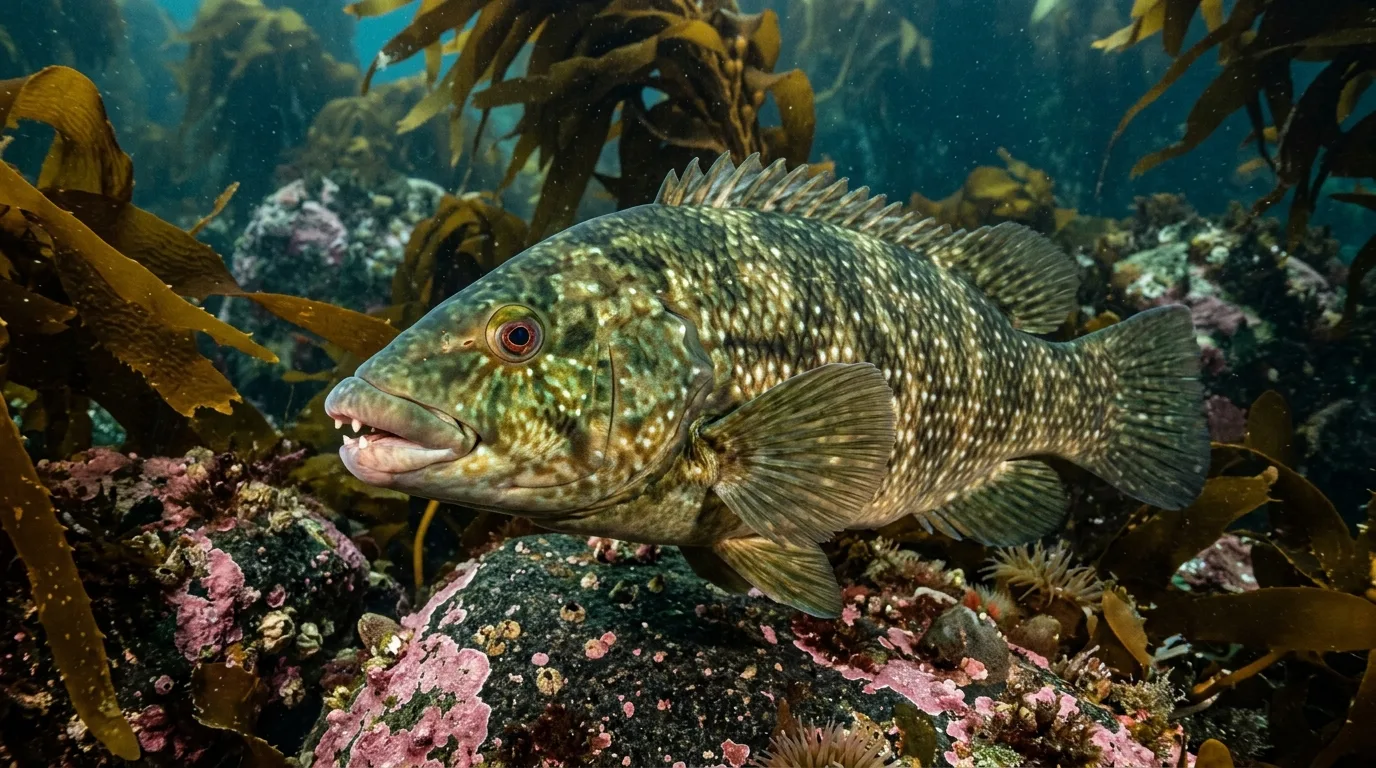
The ballan wrasse is not a target species: in Germany it is very rare and grows slowly. The Norwegian fisheries directorate does not list it as a protected species for recreational anglers (as of October 2026).
Quick to recognise
A deep-bodied, bulky fish with a small mouth, thick lips and strong, conical teeth, mostly brown or green and heavily marbled. It can grow up to 60 centimetres long; most stay clearly smaller.
Why it is not a target fish
Wrasses are not on the list of species that sea anglers in Norway may not fish for (as of October 2026). In Germany the Red List classes it as not threatened but very rare; there is no angling season here or there.
Where it lives
On the coast
It lives on rocky coasts, reefs and in kelp forest, often on steep rock faces in the surf, mostly from the shore down to around 50 metres. In summer it stays in the kelp belt and in winter it goes deeper; in the Baltic Sea it breeds only in the Kattegat and the Öresund.
| All year round | wreck, reef, edge, mixed stony ground, seagrass |
|---|---|
| Winter extra | deep water |
Holding spots in the picture
Choose the season and time of day: the picture shows where the species stands then. Spots outlined in red apply only in the chosen season. Tap a fish or a spot in the list to bring it closer. The picture is schematic and AI-generated, every water is different.
No main time Wrasses are active by day and retreat into rock crevices at night.
Active time Wrasses are active by day and retreat into rock crevices at night.
No main time Wrasses are active by day and retreat into rock crevices at night.
No main time Wrasses are active by day and retreat into rock crevices at night.
On the coast
Seagrass, gravel and stones in the shallows
Ballan wrasse (great wrasse) is found here all year round.
Stony mixed ground
Ballan wrasse (great wrasse) is found here all year round.
Drop-off
Ballan wrasse (great wrasse) is found here all year round.
Wreck, reef
Ballan wrasse (great wrasse) is found here all year round.
Deep, colder water
Ballan wrasse (great wrasse) is found here in winter only.
The ballan wrasse lives on rocky coasts, reefs and in kelp, and likes steep rock faces in the surf. It stays in a small territory all year round. In German waters it is very rare.
Spring: The spawning season falls in this period; observe the closed seasons (Schonzeiten).
Summer: This is when spawning takes place, so observe the closed seasons (Schonzeiten). In the warm months you will find them mainly among the kelp plants near the shore.
Winter: In winter they move out into deeper water.
Depth: It is most common between the shore and about 50 metres; single fish have been caught down to 200 metres.
Size comparison: AI-generated drawing, schematic.
Do not confuse
Small fish resemble the wrasses known in Germany as Grüngylt and Grasgylt. Look at the gill cover: it is marbled on the ballan wrasse and has parallel stripes on the other two. The Grüngylt also has a dark kidney-shaped spot behind the eye.
If it bites anyway
If it takes on a rocky edge, bring it out quickly so that it does not lodge itself in the rocks. Unhook it in the water if you can, otherwise with wet hands, and release it right where you caught it. Because it grows very slowly, releasing it is the better choice in Norway too.
Rules
For the ballan wrasse our overview of the states gives no figures for minimum size (Mindestmaß) or closed season (Schonzeit). That does not mean you may catch or keep it: protection is governed by state fisheries law and nature conservation law.
On the coast the rules of the coastal states apply, partly with their own catch restrictions: North Sea coast, Baltic coast of Schleswig-Holstein and Baltic coast of Mecklenburg-Western Pomerania.
The regulation and your fishing permit (Erlaubnisschein) are what count. Lake Constance, the Rhine and the coast, for example, have their own rules: Fishing waters in Germany.
Text AI-assisted, summarised from these pages: Ballan wrasse (profile), Releasing a fish.