
Knowledge · Fish welfare and practice
Bird or wild animal on the hook
If a bird is on the hook, the quick fix is usually the wrong one: cutting the line sends the animal off with the hook and a trailing piece of line. How swans, gulls or cormorants get caught up in bait and line can usually be foreseen, and for an emergency, bird protection groups and authorities give clear advice.
How birds get caught on bait and line
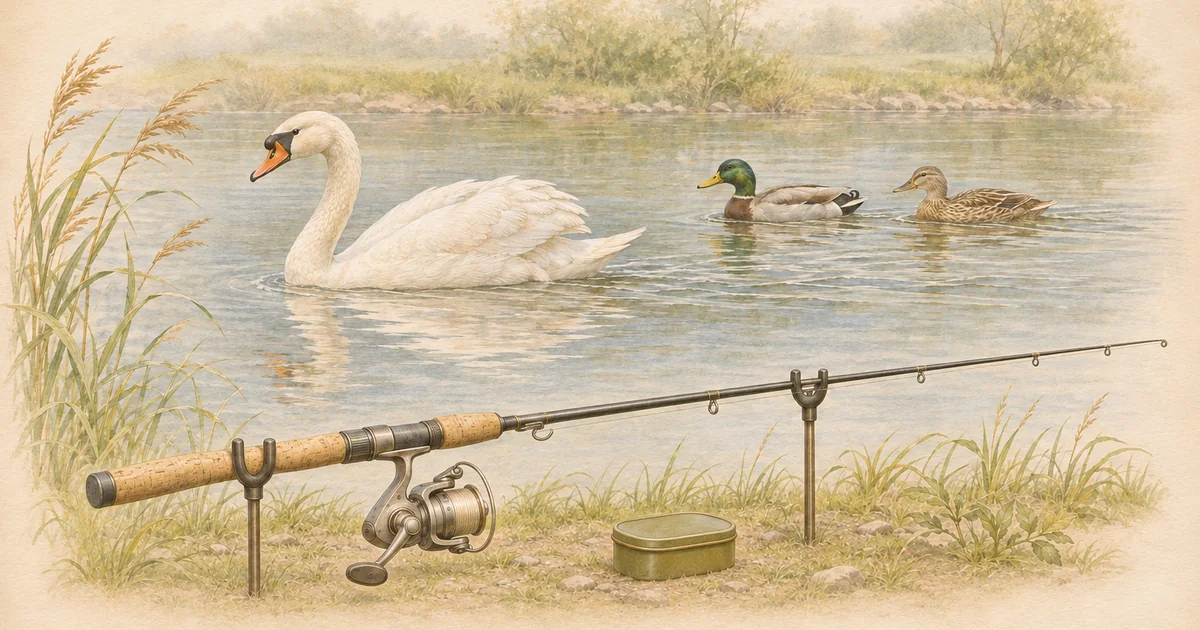
Fish-eating birds hunt the same prey as you. When a hooked fish is struggling on the line, it becomes easy prey for waterbirds, and the bird swallows hook and line along with it. That is how Michael Wink of Heidelberg University and Kirstin Gröhn-Stauber describe it in the Ornithologische Jahreshefte Baden-Württemberg; according to them, a bird almost always dies as a result. They refer to a compilation of 29 bird species that were injured by fishing tackle or died from it. Most often affected are ducks, geese, mute swans, grebes and divers, cormorants, herons, moorhens and gulls, less often birds of prey and songbirds.
The second route is tackle left behind at the water. Snapped-off hooks with bits of line and cut-off tangles get swallowed, or birds get caught up in them. In a goosander on the Neckar near Ladenburg, line and hook had wrapped so tightly around the bill and tongue that the tongue had already died off (Wink and Gröhn-Stauber). How to get rid of leftovers properly is explained under Disposing of fishing line and hooks.
The US fisheries agency NOAA Fisheries points out that seabirds eat exactly the small fish that anglers use as bait. Cormorants dive after their prey, while gannets and terns plunge into the water from above. When herring fishing with a paternoster, several fish often hang at the surface at once, which is exactly the situation Wink and Gröhn-Stauber consider dangerous. The sources checked contained no figures on seabirds caught on herring rigs.
Prevention on the bank and on the boat
These points mainly follow NOAA Fisheries, supplemented by the report from the Neckar.
- Look around before you cast: Scan the sky, the bank and the water so that no bird flies through your casting path or chases the bait.
- Don’t leave the rod alone: As long as there is bait on the hook, the rod stays under supervision. Check baits you have cast out regularly, because a hooked fish attracts birds.
- No feeding: Don’t hand out leftover bait to gulls or ducks. If seabirds are around the boat, the groundbaiting waits.
- Keep your distance by boat: Go around resting or feeding flocks instead of straight through them. Where birds breed or rest, special rules often apply; more under Nature conservation on the bank.
- Choose your tackle: According to NOAA, barbless hooks and artificial lures lower the risk of hooking a seabird. What hook shapes do otherwise is covered under Fish-friendly tackle.
- Leave nothing behind: Bits of line, tangles and hooks go in your bag, never into the bushes.
When a bird is on the hook
The steps follow NOAA Fisheries and the information sheet from SVS/BirdLife Schweiz and the Vogelwarte Sempach.
- Keep the line on. NOAA expressly advises against cutting the line or letting it snap. A bird that flies off with hook and line can drown, starve or fall prey to a predator.
- Reel in slowly. Wind calmly and evenly; don’t lift the bird out of the water by the line, but land it with the landing net.
- Secure the bill. Before you take the bird out of the net, NOAA says you should get the bill under control so that it cannot peck.
- Cover the head. A cloth or jacket over the head and eyes calms the bird, but it must not hinder breathing. Keep the wings folded in their natural position, and keep hold of head and body the whole time.
- Look at the hook. If it is on the outside and comes out easily, NOAA describes this approach: never just rip it out; instead pinch off the barb and back the hook out the way it went in, then remove all the line and release the bird. Pliers work for the hook, line scissors for the line.
- Otherwise, a specialist. If the hook has been swallowed or sits deep, remove as much line as possible, cut it close to the hook and leave the hook in. Then call for help and keep the bird calm and secured until help arrives (NOAA).
There is deliberately no phone number here, because the right place to call depends on where you are. Call the nearest wild bird or wildlife rescue centre, or a vet who treats wild birds, and ask whether and where you should take the animal. The wildlife guidance from Berlin’s state animal welfare commissioner also names the police and the lower nature conservation authority (untere Naturschutzbehörde) as contacts, and the fire brigade for more complicated transport.
Remove the hook or call a specialist
| Time | What you do | According to |
|---|---|---|
| Hook outside, easy to remove | Pinch off barb, back hook out, remove all line, release | NOAA |
| Hook swallowed or deep | Cut line close to hook, leave hook in, hold bird, call for help | NOAA |
| Wound, bleeding, fracture | Specialist, often a vet | SVS, Vogelwarte Sempach |
| Bird has escaped | Get help | State of Berlin |
According to SVS/BirdLife Schweiz and the Vogelwarte Sempach, injured birds belong in experienced hands, and very often they need a vet. If the bird has to go to a rescue centre, it goes in a cardboard box with air holes, sized to fit, without padding and lined only with kitchen paper so that the plumage stays intact.
Take care with swans, herons and great crested grebes
A bird on the hook fights back, and some species can injure you in the process. According to SVS/BirdLife Schweiz and the Vogelwarte Sempach, herons and great crested grebes stab at your face with their pointed bill, aiming for the eyes, and thanks to their flexible neck they reach surprisingly far.
According to Quarks, swans weigh six to 15 kilograms. A blow from the bill can be painful, and the wings are in some cases strong enough to break bones. If a swan spreads its wings and hisses, it is making a threat. So if an adult swan is on your line, it is better to get help early.
What the law allows
All European bird species are at least specially protected, as the wildlife guidance from Berlin’s state animal welfare commissioner points out. § 45 Abs. 5 BNatSchG contains an exception to the ban on taking such animals from the wild: anyone who finds an injured, sick or helpless animal may take it in to nurse it back to health, but subject to hunting law. If it can survive on its own again, it must be released without delay; otherwise it goes to a place designated by the nature conservation authority. Animals of strictly protected species must be reported to the authority.
§ 2 BJagdG counts mute swan, wild geese, wild ducks, mergansers, coot, gulls, great crested grebe and grey heron as game birds (Federwild), and the federal states can place further species under hunting law. According to the Bremen Senate, a third party may only take in such an animal with the consent of the person entitled to hunt there. The Berlin guidance assumes that, as a rule, presumed consent exists if approval cannot be obtained in time or only with disproportionate effort. The same guidance also counts mammals such as fox, marten or raccoon among the huntable species. The sources checked give no handling instructions for mammals on the hook; in that case, call the rescue centre or a vet straight away.
How this is regulated in detail in your federal state (Bundesland) is something the lower nature conservation authority can tell you; for questions about the fishing itself, see the water rules (Gewässerordnung).
Frequently asked questions
Can I just cut the line?
No. According to NOAA Fisheries, the bird can drown or starve with hook and line attached. Only cut once you are holding it securely, and then close to the hook.
What do I do if the bird has swallowed the hook?
Don’t pull on it. Remove as much line as possible, cut it close to the hook, leave the hook in and call for help. Until help arrives, keep the bird calm and covered.
May I take an injured swan home with me?
§ 45 Abs. 5 BNatSchG allows you to take it in to nurse it back to health; for the swan, as a game bird, hunting law also applies. According to the Bremen Senate, care requires species-specific knowledge, so agree with a wild bird rescue centre where the animal should go.
Do I have to look after the bird if I hooked it?
According to the Berlin wildlife guidance, yes. A particular duty falls above all on whoever caused the injury to a wild animal: they must then help the animal or at least fetch help.
Related
- Disposing of fishing line and hooks: where bits of line and hooks belong
- Nature conservation on the bank: protected areas, reed beds and resting birds
- Fish-friendly tackle: hook shapes, barbs and break-offs
- Sea fishing: methods and tackle on the North Sea and Baltic
- Herring fishing: herring rig, timing and spots
- Disgorger and artery clamp: gripping hooks safely
- Line scissors: cutting line cleanly
- Hook injuries and first aid: when the hook is stuck in you
Sources
- NOAA Fisheries: Seabird Protection and Avoidance Tips (Seevögel, Schritte bei einem gehakten Vogel, Vorbeugen)
- SVS/BirdLife Schweiz und Schweizerische Vogelwarte Sempach: Verletzte und kranke Vögel, was tun? (Schnabel von Reiher und Haubentaucher, Behandlung durch Erfahrene und Tierarzt, Karton)
- Wink und Gröhn-Stauber: Gänsesäger und Gelbschnabeltaucher als Opfer von Angelschnüren, Ornithologische Jahreshefte Baden-Württemberg 2012 (wie Vögel an Haken geraten, betroffene Arten)
- Land Berlin, Landestierschutzbeauftragte: Wildtiere (Schutzstatus der Vögel, Jagdrecht, Hilfspflicht, Anlaufstellen)
- Bundesnaturschutzgesetz, § 45 (Aufnahme verletzter Tiere nach Absatz 5)
- Bundesjagdgesetz, § 2 (Wasservögel als Federwild, weitere Arten durch die Länder)
- Senat der Freien Hansestadt Bremen: Wer kümmert sich um Wildtiernotfälle? (Einwilligung des Jagdausübungsberechtigten)
- Quarks (WDR): So gefährlich sind Schwäne wirklich (Gewicht, Schnabelhieb, Flügelkraft, Drohgebärde)
Text AI-assisted, drawing AI-generated. Sources opened and checked in November 2026; no graphics taken from the sources.
All information is indicative and without guarantee. It replaces neither advice from a wild bird rescue centre or a vet nor legal advice, and how nature conservation and hunting law apply in an individual case is governed by your federal state.