
Knowledge · Fishing methods
Groundbaiting and groundbait
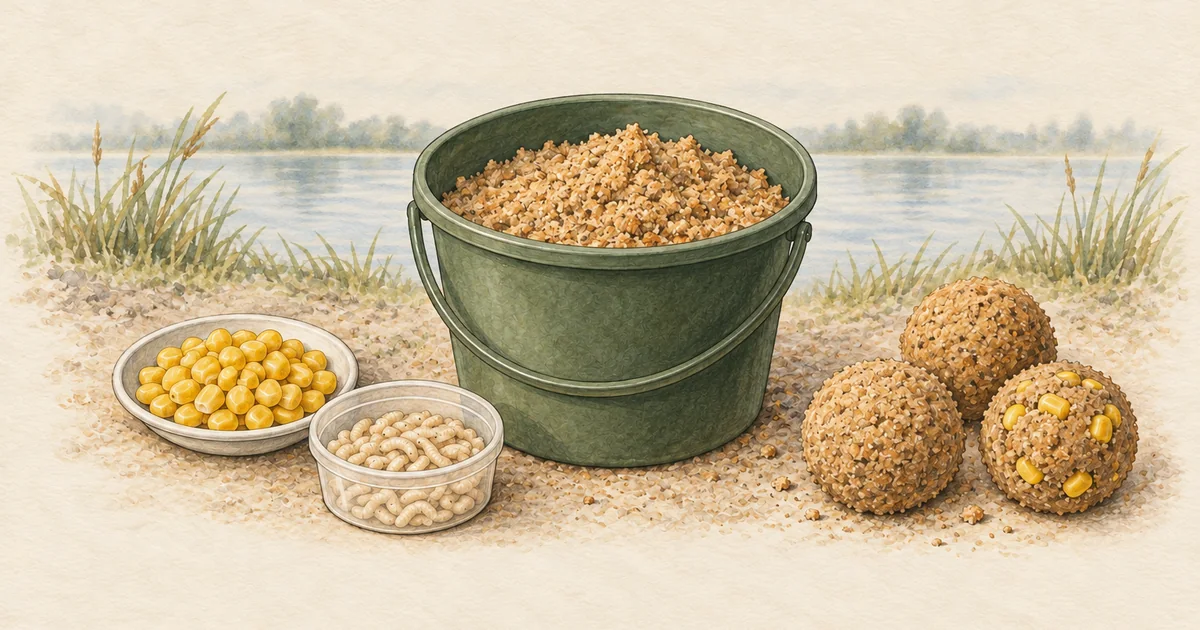
When groundbaiting, you put feed in the spot where your bait will lie later. It mainly attracts coarse fish such as bream, roach and carp and holds them there. Whatever is left in the bucket in the evening you take back home.
What groundbaiting does
The Anglerverband Niedersachsen has compiled the state of research in a fact check. According to it, feed attracts carp-like fish to the fishing spot and keeps them there, and the catch can rise many times over as a result. According to the same paper, predators respond only in exceptional cases or indirectly. For pike or zander on a lure you do not need groundbait.
Habituation works strongest with carp. A working group from the Humboldt-Universität and the IGB Berlin describes it as the species that is easiest to tie to a feeding spot. The type of feed is almost beside the point; even plain hard maize gathers carp ready to feed after a few days. It often takes a while for the carp to arrive: according to Fisch & Fang, tench, bream and other silver fish turn up sooner and are later driven off by the carp. The Berlin group found a downside in its experiment. Small carp kept feeding at the spot but took the hook less and less often, or spat it out straight away.
According to Blinker, carp are best attracted in spring and autumn, when there is little natural food in the water. More on this under The year at the water.
Groundbait, particles and live feed
According to a survey quoted in the fact check, German anglers feed grain such as maize or oat flakes in a good third of cases, and bread products, mainly breadcrumbs, in just under a third. The feed groups work differently.
| Feed | What it does | Suits |
|---|---|---|
| Groundbait made from meals and breadcrumbs | breaks up on the bottom into a cloud and attracts fish, hardly fills them up | roach, bream on the pole, float and feeder fishing |
| Particles: maize, hemp, tiger nuts | stays put and keeps the fish foraging for a long time | carp, barbel, tench |
| Live feed: maggots, casters, worms | makes the feed more tempting and breaks up balls faster | coarse fish, especially popular in spring |
| Boilies | boiled dough balls, little bycatch | Carp |
According to Fisch & Fang, small seeds such as hemp keep the fish at the spot for a long time, because they can hardly be picked up completely. For carp and barbel, Blinker puts coarse particles such as hemp or cracked maize into the feed, while for roach and bream it should be fine. If lumps remain in the groundbait, the fish, according to Blinker, soon fill up instead of searching the spot. The Berlin group found no catch advantage of fish-meal boilies over hard maize or tiger nuts; boilies only bring less bycatch. Hard maize and tiger nuts must be boiled before fishing; how that is done is covered under Maize & particles.
Whether it is a river or a lake decides the density. According to a Blinker article by the biologists of the Anglerverband Niedersachsen, river feed is heavy, often with soil, clay or gravel, so that it sinks quickly in the current and dissolves slowly. Pond feed is light and sinks slowly. Soil in the feed creates clouds but is not eaten and therefore does not fill the fish (Blinker).
Mixing in brief
Dry groundbait is moistened step by step; Blinker advises starting with too little water rather than too much. Then it stands for a few minutes (a Blinker basic course gives about ten), and lumps go through the riddle. One squeeze of the hand should produce a ball that can be thrown, survives the impact and breaks up only on the bottom (Blinker, Rute & Rolle). For current, Fisch & Fang describes a mix that feels airy and almost dry and still binds into a firm ball. Step by step, with resting times and aids, see Feed bucket and whisk.
How much and how often
German anglers feed little by comparison. According to the fact check, the average is 0,37 kilograms per fishing day, with almost half not feeding at all. Those who do feed put in 120 to 150 grams an hour on average. If you do not know the stock, start cautiously and increase only if needed, the authors of the fact check advise in Blinker. How the feed is spread depends on the method:
- Pole fishing: In a Blinker article, a pole angler starts by throwing a few orange-sized balls exactly onto the spot and then keeps adding small portions.
- Feeder fishing: Rute & Rolle starts with about five full feeders on a lake and 15 to 20 on a river, because the current carries the feed away.
- Carp fishing: Blinker advises starting sparingly and topping up after every bite, because in a large carpet of feed the fish do not find the hookbait.
Water temperature sets the frame. In winter and early spring Blinker considers a small feeding area decisive; with warmer water it can be wider. In spring, coarse feed rich in particles is out of place, because the fish still digest slowly. In summer, a lot of uneaten feed can contribute to oxygen depletion. During the spawning season you leave the fish in peace. For all methods the recommendation of the Anglerverband Niedersachsen applies: feed more only once fish have turned up at the spot.
Feed and water: the nutrient balance
Feed fertilises the water. The Bavarian questions for the angling exam (Fischerprüfung) therefore reject excessive feeding: nitrogen and phosphorus build up and water quality suffers. What matters for algae and turbidity is, according to the fact check, usually phosphorus. It enters the water with the feed and leaves it with every fish that is kept. On average, a German angler brings in 34 grams of phosphorus a year with feed and takes out at least 73 grams again with 13 kilograms of fish.
According to the fact check, phosphorus removal rises up to about two kilograms of feed per angler per day and falls after that; from about 2,5 to 3,5 kilograms the feed fertilises the water. As a simple rule of thumb the association says: if the amount of feed in kilograms stays below the mass of fish removed, groundbaiting is sustainable.
Not all waters are equally sensitive. The Berlin working group names smaller lakes under 25 hectares that are shallow, rather nutrient-poor and clear, where the water stands for a long time, a lot of fishing is done and little is taken out. The Landesanglerverband Sachsen-Anhalt advises doing without feed altogether in nutrient-poor waters, and quotes a calculation by the Institut für Binnenfischerei Potsdam: 100 kilograms of bread dough can use up 74 kilograms of oxygen as it decomposes. How oxygen and temperature in a lake are linked is covered under Water temperature and oxygen.
Take leftovers home. Mix only what you will use during the day. What is left in the bucket in the evening, you do not tip into the water as a final load but take home with you.
Where groundbaiting is restricted or banned
Limits are set out in state law, in protected area regulations and, most often, in the water rules (Gewässerordnung) of the association or club. In state law, four states regulate groundbaiting explicitly: Berlin, Saxony-Anhalt, Saarland and Rhineland-Palatinate. In the fisheries acts and regulations of the other twelve states, I found no state-wide groundbaiting rule in November 2026; there the water rules and the protected area decide. The four states and examples from water rules:
- Berlin: The Landesfischereiordnung (§ 18 para. 4) allows no more than 500 grams of groundbait, weighed wet, per person and fishing day. Feeding in the days before fishing is banned.
- Saxony-Anhalt: Statewide, § 15 of the fisheries regulation (Fischereiordnung) applies: “Groundbaiting for the purpose of catching fish is permitted, but may be restricted or prohibited by the fisheries authority if this conflicts with the management objective under § 41 Abs. 1 of the Fischereigesetz.” In Natura 2000 areas, according to the state ordinance (§ 11 Abs. 2 Nr. 5 N2000-LVO, reproduced in the state’s Natura 2000 portal), you may fish only without baiting in advance, that is, without a feeding spot laid before fishing.
- Saarland: Under § 10 Abs. 1 Nr. 3 of the state fisheries regulation (Landesfischereiordnung), “the use of dyed maggots and dyed groundbait as well as bloodworm” is prohibited.
- Rhineland-Palatinate: Here the rule is in the water act (Wassergesetz). Under § 24 LWG, introducing “natural attractants in small quantities for groundbaiting when fishing” needs no permit, as long as no significant harm to the water is to be expected. “This does not apply to introduction into drinking water reservoirs.”
- Brandenburg, waters of the Landesanglerverband: at most 2 kilograms of dry or wet feed on a fishing day, no bait boats or drones. For individual waters the association can restrict or prohibit groundbait. On four lakes in an FFH area, a district angling association has cut the amount to 0,5 kilograms per hectare, the Landesamt für Umwelt reports.
- Saxony, waters of the Landesverband Sächsischer Angler: On drinking-water reservoirs groundbaiting is prohibited, including with a feeder. On opencast mine lakes without a boat permit, remote-controlled bait boats are also banned.
- Westphalia and Lippe, association waters: On the lakes nobody may lay a feeding spot without fishing; while fishing, at most 3 litres of boilies are allowed. Bait boats are not permitted.
Read up beforehand. The list shows examples, not a complete overview. What applies at your water is set out in the water rules and the fishing permit. Laying a feeding spot days before fishing is expressly banned by several of the rules above.
Common mistakes
- Too much at once. The fish are full or cannot find the bait, and leftover feed eats up oxygen.
- Feed scattered instead of in one place. Feed and fish spread out. Always throw at the same point.
- Lumps in the groundbait. Coarse chunks fill the fish up, which is why the feed is riddled.
- Too much flavour. According to Fisch & Fang, an excess of scent and flavour additives can make the fish avoid the feed altogether.
- Bait the same colour as the feed. Blinker recommends a hookbait that stands out in colour from the carpet of feed.
- Uncooked particles. Hard maize and tiger nuts go to the water only boiled.
- Rules not read. The amount of feed, bait boats and bans are set out in the water rules and the fishing permit.
Frequently asked questions
Can I groundbait anywhere?
No. Whether and how much you may feed is set by state law, protected area regulations and above all the water rules of the manager. Some waters have daily maximum amounts, and on drinking-water reservoirs in Saxony groundbaiting is banned altogether. Before the first ball of feed, read the fishing permit (Erlaubnisschein).
How much feed is normal for a fishing day?
Anglers who feed in Germany put in 120 to 150 grams an hour on average, according to the fact check. Where a limit applies, for example 2 kilograms a day on association waters in Brandenburg, it is binding.
Does groundbait also attract predators?
Hardly. According to the fact check, predators respond only in exceptional cases or indirectly. Groundbait is a tool for coarse fishing.
Related
- Feeder fishing: laying a feeding spot with the feeder and reading bites on the tip
- Pole fishing: feeding with pinpoint accuracy using a rod without a reel
- Feed bucket and whisk: mixing groundbait, resting times, ball test
- Catapult: getting feed and particles out to distance
- Maize & particles: boiling, storing, presenting
- Maggots & larvae: live feed and hookbait
- Bream: the typical fish at a feeding spot
Sources
- Anglerverband Niedersachsen: Faktencheck Anfüttern (PDF) (Wirkung, Futterarten)
- BLINKER: Anfüttern zielgerichtet und verantwortungsbewusst (Fluss- und Teichfutter, vorsichtiger Beginn)
- Bayerische Landesanstalt für Landwirtschaft: Prüfungsfragen zur Fischerprüfung 2023/2024 (PDF) (übermäßiges Füttern, Stickstoff und Phosphor)
- Humboldt-Universität und IGB Berlin: Praxis, Was frisst der Karpfen? (Gewöhnung an den Futterplatz, Hartmais)
- Humboldt-Universität und IGB Berlin: Hakvermeidung von Karpfen (2013, PDF) (Karpfen meiden den Haken)
- Humboldt-Universität und IGB Berlin: Einfluss von Angelfuttermitteln beim Karpfen (2003) (empfindliche Seen)
- Landesanglerverband Sachsen-Anhalt: Entnahme von Fischen und Anfüttern (Verzicht in nährstoffarmen Gewässern, Sauerstoffverbrauch)
- BLINKER: Feederangeln, Friedfische füttern und fangen (grobes und feines Futter, Wasser)
- BLINKER: Angeln mit Futterkorb, ein Grundkurs (Ruhezeit, Klumpen)
- BLINKER: Futter für Friedfische richtig zubereiten (Händedruck-Probe, grobe Stücke sättigen)
- BLINKER: Brassen angeln, Abschnitt Stippen (Futterbälle zu Beginn und Nachlegen)
- BLINKER: Tipps für das Friedfischangeln im Frühling (Erde im Futter, wenig grobes Futter)
- BLINKER: Anfüttern beim Karpfenangeln (nicht zu großzügig füttern)
- BLINKER: Karpfen-Kickstart (Futterreste und Sauerstoff)
- BLINKER: Karpfenangeln, Tipps für eine erfolgreiche Fangstrategie (Frühjahr und Herbst, Partikel kochen)
- RUTE & ROLLE: Feedern für Einsteiger (Startfütterung, Kugel zerfällt am Grund)
- FISCH & FANG: 10 Tipps zum Heavy-Feedern im Strom (Futter für die Strömung)
- FISCH & FANG: Futter mixen für Friedfisch-Ansitze (Lebendfutter, Aromen)
- FISCH & FANG: Karpfenangeln, Futter mit Einlage (Hanf, Reihenfolge am Futterplatz)
- Fischereiamt Berlin: Landesfischereiordnung in Auszügen (§ 18 Abs. 4, 500 Gramm)
- Land Sachsen-Anhalt, Natura-2000-Portal: Begleitdokument Angelfischerei (PDF) (kein vorrätiges Anfüttern in Natura-2000-Gebieten)
- Landesrecht Sachsen-Anhalt: Fischereiordnung des Landes Sachsen-Anhalt (§ 15, Anfüttern)
- Saarland: Landesfischereiordnung (LFO) (§ 10 Abs. 1 Nr. 3)
- Landesrecht Rheinland-Pfalz: Landeswassergesetz (LWG) (§ 24, natürliche Lockmittel)
- Landesanglerverband Brandenburg: Gewässerordnung, Ausgabe 2019 (2 Kilogramm, Futterboote)
- Landesamt für Umwelt Brandenburg: Managementplanung FFH-Gebiet Heideseen bei Köthen (PDF) (0,5 Kilogramm je Hektar)
- Landesverband Sächsischer Angler: Gewässerordnung, Ausgabe 2024 (PDF) (Trinkwassertalsperren, Futterboote an Tagebauseen)
- Landesfischereiverband Westfalen und Lippe: Häufige Fragen (Futterplatz ohne Angeln, Boilies)
Text AI-assisted, drawings AI-generated. Sources opened and checked in October and November 2026, no graphic taken from the sources; Fig. 2 is calculated with the published estimation formula of the Anglerverband Niedersachsen.
All figures are guide values without guarantee. Whether and how much you may groundbait is governed by state law, protected area regulations and the water rules.