
Knowledge · Tackle
Catapult: Placing feed and bait accurately
With the catapult you send maggots, sweetcorn, pellets, boilies or balls of groundbait exactly where your bait lies, and further than you can throw by hand. How far the load flies and how tightly it lands depends on the pouch, the elastic and a movement that stays the same with every shot.
Design: handle, fork, elastic and pouch
A catapult consists of a handle with a fork, two lengths of elastic and a pouch that carries the load. At the water it is also called a slingshot, maggot catapult or sling. The pouch decides what load you can fire. How far it flies depends on the width of the fork and on the elastic.
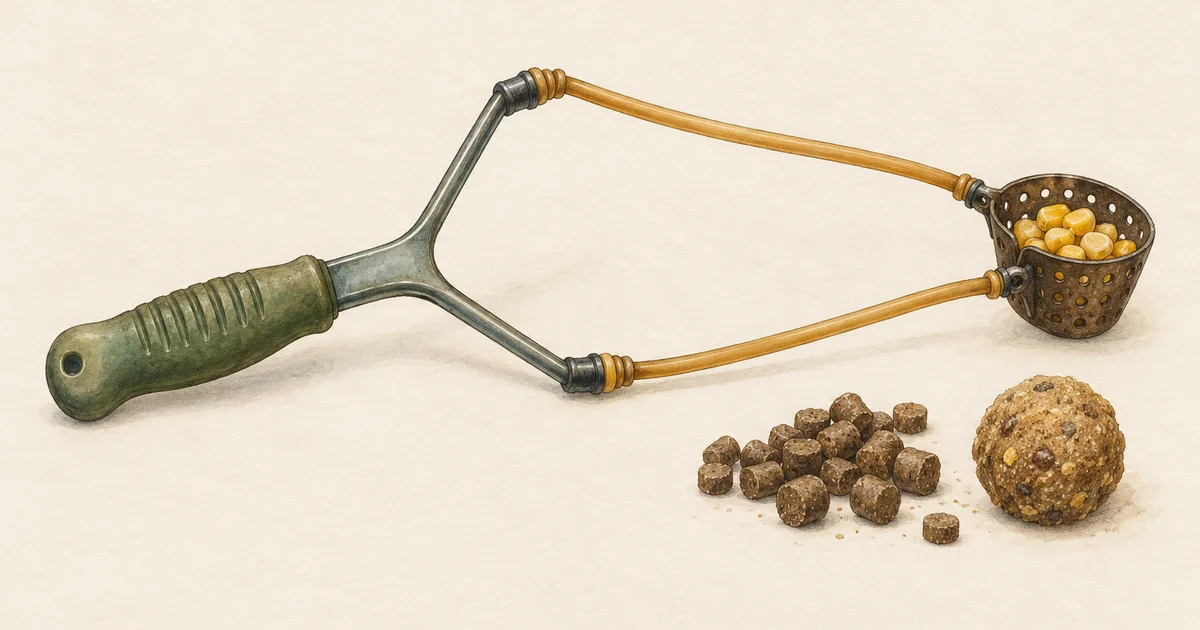
- Mesh pouch: for loose feed such as pellets or particles. A semi-rigid mesh keeps its shape and doesn’t squeeze the load when fired.
- Cup with a firm base: for balls of groundbait and boilies. A soft pouch crushes the ball when you draw it back. Only a pouch that stays wide under tension fires it out intact.
- Cup size: It should match the amount you want to send out with each shot. A cup that is too big means you overfeed without noticing.
Groundbait balls, particles and boilies: how far they fly
Heavy pieces carry further than light ones, and maggots weigh almost nothing. For sweetcorn and small particles the figures differ: Blinker sees them going hardly further than maggots, Rute & Rolle gives 15 to 20 m, up to 30 m with a tailwind. The table summarises the guide values from both magazines.
| Load | Range (guide value) |
|---|---|
| Maggots | 10 to 15 m |
| Sweetcorn, hemp, particles | 15 to 20 m, up to 30 m with a tailwind |
| Boilies, large pellets | 30 to 40 m |
| Groundbait ball, egg-sized and firm | up to 50 m |
You can also get larger boilies out well with the throwing stick. With a spod, a bait container cast by a powerful rod, any feed gets well over 100 m out, according to Rute & Rolle. Blinker puts the spod and throwing stick at up to about 80 m, depending on the caster.
For pellets the choice depends on the quantity: small portions for topping up go out with the catapult, larger amounts for the first baiting-up with a spod shovel. Under the pole, the long rod without a reel, the catapult is not the most accurate tool. According to Rute & Rolle, hemp and corn from a catapult end up scattered widely around the swim, whereas a pole cup on the rod tip puts them on the spot. More under Pole fishing.
Load, grip, stretch, release
- Loading: Hold the catapult so that the cup hangs straight down, and only then fill it. Otherwise maggots roll out while you are still loading.
- Gripping: One hand holds the handle, the thumb supports it, the arm is straight. The other hand takes the tab on the cup.
- Stretching: Push the fork forward instead of pulling the cup towards your body. Pulling easily throws the load off line. The fork stands across the stretched cup, otherwise the cup hits the frame and the feed flies apart at random.
- Releasing: Stretching, aiming and release happen in one movement. You have one, at most two seconds for this, otherwise small feed falls out of the cup.
An overloaded cup scatters more widely, especially with maggots and corn. Do not mix sizes in one shot either: light and heavy pieces fly at different speeds and land spread out.
Aiming and scatter
For every load to land in the same place, three things have to be the same with every shot: the direction, the angle upwards and the tension of the elastic. Otherwise you get a patchwork instead of a baited spot, and the fish spread out.
- Direction: Pick a marker on the far bank that does not move, such as a conspicuous tree, and aim at it with every shot.
- In front of the float: When float fishing you aim at the float. The groundbait ball should land about a metre in front of it, because it still glides forward as it sinks (Fig. 1). For the rig see Waggler rig.
- Distance: If you shorten the elastic, the catapult at full stretch will not shoot further than a fixed limit. That helps when feed should always go to a marker float at the same distance.
- On the pole: Stretch the elastic backwards over the rod, and the feed will fly in a straight line to the float.
Blinker describes what is achievable with practice like this: experienced pole anglers put maggots into an area of no more than 2 × 2 m at short range. Experienced match and carp anglers hit an area of 3 × 3 to 5 × 5 m at up to 50 m.
Zero in first: Before the first feed at the swim, fire a few practice shots at another target. That way misses do not spoil the swim.
Groundbait balls that survive the shot
A groundbait ball has to withstand the stretch, the flight and the impact. If the feed binds too weakly, the ball breaks apart in the air or on landing. The mix is right when light pressure shapes it into balls that hold together. For feeding for bream at distance, anglers shape balls about the size of a hen’s egg.
How to dampen feed evenly and remove lumps is covered under Feed bucket and whisk and Riddle. Maggots can also be fired as a ball: rolled into small balls with maggot glue, they leave the catapult just as they do from the feeder.
Throwing scoop, bait spoon and pole cup
For spots close to your own bank there are, besides the catapult, cups on a handle. Behind the names bait spoon, bait scoop and throwing scoop are two tools that work differently: with one you throw the bait from the arm, with the other you place it on a long handle (Fig. 3).
Throwing scoop: throwing bait from the arm
The throwing scoop is an open cup on a handle; Fisch & Fang also calls it a throwing spoon. You fill it, swing back and fling the load out with one movement of your arm. For bream, Blinker considers it the simplest way to spread pellets and hard maize, and immediately adds that it doesn’t reach far. A Blinker article on grass carp fishing uses it to lay feeding spots close to the bank and switches to the spod for distant spots. For maize at short range, another article mentions catapult and bait spoon in the same breath. How many metres a throwing scoop manages, none of the sources checked puts a figure on.
It does not put the feed on a precise spot. A Blinker article on carp fishing in spring criticises it for short casts and widely scattered feed, and so baits with a spod instead. Balls of groundbait have to survive the throw just as well as a shot from a catapult. According to Fisch & Fang, a loose mix that is mainly meant to form a cloud will survive neither a throwing scoop nor a catapult. To keep the balls together, the magazine uses less brown breadcrumb and bran and mixes in oat flakes. A loop on the handle catches the scoop if it slips out of your hand on the back swing, as a report in Fisch & Fang describes.
Baiting spoon on a landing-net handle
The second design is a spoon with a thread that you screw onto the handle of your landing net, known in English as a bait spoon. Angling Times describes it this way, and Rute & Rolle also screws a baiting spoon onto the end of a long landing net handle in one article. It is not used for throwing. You push the handle out over the spot and tip the spoon, and the feed drops quietly and precisely right there. It cannot reach further than the handle is long, though. Purpose-built baiting poles and their lengths are covered on the page Spod rod and spod.
Compared with a catapult and throwing scoop, you gain quiet. According to Angling Times, the baiting pole gets feed and even the rig to places where casts and catapult shots would have spooked the fish, for example under overhanging branches or on heavily fished waters. Only fill the spoon moderately: if it is too full, it loses its load before the target or goes under. In the dark, the same magazine suggests a reflective or glow-in-the-dark tape on the spoon, plus a bright head torch. Crosswind and drift push the handle off line, so keep correcting as you push it out.
Pole cup
On a pole, the pole itself is the handle. A small cup at the tip puts the feed exactly where you then lower the bait. Angling Times advises fitting it right at the front of the top section. If it sits around 15 cm further back, the feed lands short of the hookbait, i.e. closer to you. The magazine often fills it only a quarter full so that no feed jumps out as you ship the pole out. Another article in the same magazine shows how catapult and cup complement each other: first draw fish in with the catapult, then switch to the small cup once bites start coming, so that the feeding area gets tighter.
Which tool when:
- If the fish should hear the feed: catapult. Angling Times recommends it above all when fishing shallow water or when you want to draw fish in from other areas. Often the slap of the pellets alone is enough to bring them up off the bottom.
- If particles need to be spread quickly close to the bank: throwing scoop, as long as the spread does not bother you.
- If wary fish are close to the bank or under branches: baiting spoon on the landing net handle, or a baiting pole.
- If the feed should land exactly over the bait on the pole: pole cup.
- If the spot is further out than catapult and spoon can reach: spod or, for boilies, the throwing stick.
How much feed may go into the water
With a catapult it is quick to top up, often quicker than necessary. In the question catalogue of the Bavarian State Institute for Agriculture (Bayerische Landesanstalt für Landwirtschaft) for the angling exam (Fischerprüfung), excessive baiting counts as something to reject: it raises nitrogen and phosphorus in the water and worsens water quality. The Anglerverband Niedersachsen advises feeding again only once fish are in the swim.
Whether and how much you may feed is set by the water rules (Gewässerordnung) and the fishing permit (Erlaubnisschein). One example, as of October 2026: the water rules of the Landesanglerverband Brandenburg limit dry and wet feed to 2 kg per fishing day and allow the association to restrict or ban groundbait on individual waters. Elsewhere other rules apply.
Safety and weapons law
Fire only feed, and only onto the water, never towards people or animals, and wait if a boat or a swimmer is in the line of fire.
The Weapons Act (Waffengesetz) lists precision catapults among prohibited weapons in Annex 2. Annex 1 describes them as catapults “that, to achieve the highest possible kinetic energy, have an arm brace or a comparable device or are adapted for such a device”. According to Annex 2, the arm braces themselves are prohibited too. Whether a particular model falls under this is answered by the weapons authority of your district or city.
Common mistakes
- Firing groundbait balls from the soft pouch. The pouch squeezes the ball and it breaks up in flight. Balls need a solid cup on the catapult.
- Stretching differently with every shot. The distance changes with the tension, and the baited spot gets stretched out.
- Filling the cup to the brim or mixing sizes. Both increase the scatter.
- Feed that is too loose. A ball that does not bind scatters in the air.
- Topping up although no fish are in the swim. Too much feed loads the water with nutrients.
Frequently asked questions
How far does a groundbait catapult shoot?
The weight of the load matters most. As guide values, maggots go no more than 15 m, firm, egg-sized groundbait balls up to 50 m. Beyond that, a throwing stick or spod helps.
Which cup suits loose feed, and which suits groundbait balls?
Loose feed such as pellets or particles goes into a semi-rigid mesh pouch. Groundbait balls and boilies need a cup with a solid base that stays wide when stretched.
Why does the feed land beside the float?
Usually the direction, angle or tension changes from shot to shot. Aim at a fixed marker, always pull the elastic out the same distance, and let the ball land about a metre in front of the float.
When is a baiting spoon better than a catapult?
When wary fish are close to the bank. The spoon on the landing net handle places the feed quietly and precisely, but only reaches as far as the handle. The catapult reaches further and attracts fish with the splash, but scatters the feed more.
Related
- Feed bucket and whisk: mixing feed
- Riddle: removing lumps
- Throwing stick for boilies: when the catapult does not reach far enough
- Spod rod and spod: feed at distance, plus long baiting poles
- Feeder: getting feed to the bottom with the rig
- Feeder fishing: baited spot and procedure
- Carp fishing: feed during a session
- Line calculator: checking the line’s breaking strength
Sources
- Blinker: Wie verwendet man eine Futterschleuder beim Angeln? (Korb und Gummi, Reichweiten, Laden, Zielen, Trefferbild, Probeschüsse)
- Blinker: Brassen angeln: Die Grundlagen (Haltung, Futterbälle, ein Meter vor der Pose, Merkpunkt)
- Blinker: Angeln mit Pellets (Schleuder oder Futterschaufel)
- Blinker: Geklebte Maden: ein Ball voll Leben (Madenbälle aus der Schleuder)
- Blinker: Mit diesen Tipps fängt man große Brassen (Futterschaufel für Pellets und Hartmais, begrenzte Reichweite), Graskarpfenangeln (Wurfschaufel in Ufernähe, Rakete auf Weite), Hartmais: ein Köder für Kapitale (Schleuder oder Futterkelle auf kurze Entfernung), Praxis Karpfen: Fangen im April (geringe Wurfweite und hohe Streuung der Futterschaufel) und Angeln im Oktober (Rakete und Wurfrohr bis etwa 80 m)
- Fisch & Fang: Futter mixen für Friedfisch-Ansitze (Futterbälle für Wurfkelle und Katapult) und Erfolg durch Futterpatzer (Schlaufe am Griff der Futterkelle)
- Rute & Rolle: Karpfen: Füttern mit der Spod-Rute (Partikel 15 bis 30 m, Futterrakete über 100 m, Wurfrohr)
- Rute & Rolle: Stippen: Kurz oder lang? (Streuung, Futterbecher an der Kopfrute)
- Rute & Rolle: Perlensuche in Mecklenburg-Vorpommern (Futterschaufel am Kescherstab)
- Angling Times: How to feed accurately with a catapult (Spannen, Überladen, Gummi kürzen)
- Angling Times: Improve your accuracy with a pole catapult (Größen, Merkpunkt, Netzkorb, Kopfrute)
- Angling Times: 5 of the most effective methods of baiting for carp (Futterkelle zum Aufschrauben, nicht überfüllen), The best baiting pole tips for carp fishing (leises Ablegen, Zweige, Licht, Seitenwind), How to feed with a pole pot (Becher an der Spitze, zu einem Viertel füllen), Get the catapult out for commercial carp this spring (erst Schleuder, dann Becher) und 10 great tips for feeding your swim in the summer (Geräusch der Schleuder)
- Bayerische Landesanstalt für Landwirtschaft: Prüfungsfragen zur Fischerprüfung 2023/2024 (PDF) (übermäßiges Anfüttern)
- Anglerverband Niedersachsen: Faktencheck Anfüttern (PDF) (Nachfüttern)
- Landesanglerverband Brandenburg: Gewässerordnung (Futtermenge)
- Bundesministerium der Justiz: Waffengesetz, Anlage 1 (Begriff der Präzisionsschleuder)
- Bundesministerium der Justiz: Waffengesetz, Anlage 2 (verbotene Waffen, Nr. 1.3.7)
Text AI-assisted, drawings AI-generated. Sources opened and checked in October and November 2026; no graphics taken from the sources.
All figures are guide values without guarantee. How far and how accurately the catapult carries depends on the model, feed, wind and practice, and how much you may feed is governed by the water rules.