
Knowledge · Tackle
Throwing stick for boilies: Bait far and accurately
A throwing stick fires boilies without a rod and without a boat onto a baiting spot that lies too far out for the hand. How far and how accurately that works depends less on the stick than on ball size, hardness and a throwing movement that is the same every time.
Design and the right ball size
The device is a tube with a handle end and an opening at the other end. You load one or more balls, swing back and fling them out in one movement. Very light carbon tubes spare your arm after many casts. What matters is that tube and ball fit together: the boilies should roll through without jamming. The specialist sources reviewed here give no fixed guide values for which inside diameter suits which ball. The manufacturer’s specification for the tube in question is what counts.
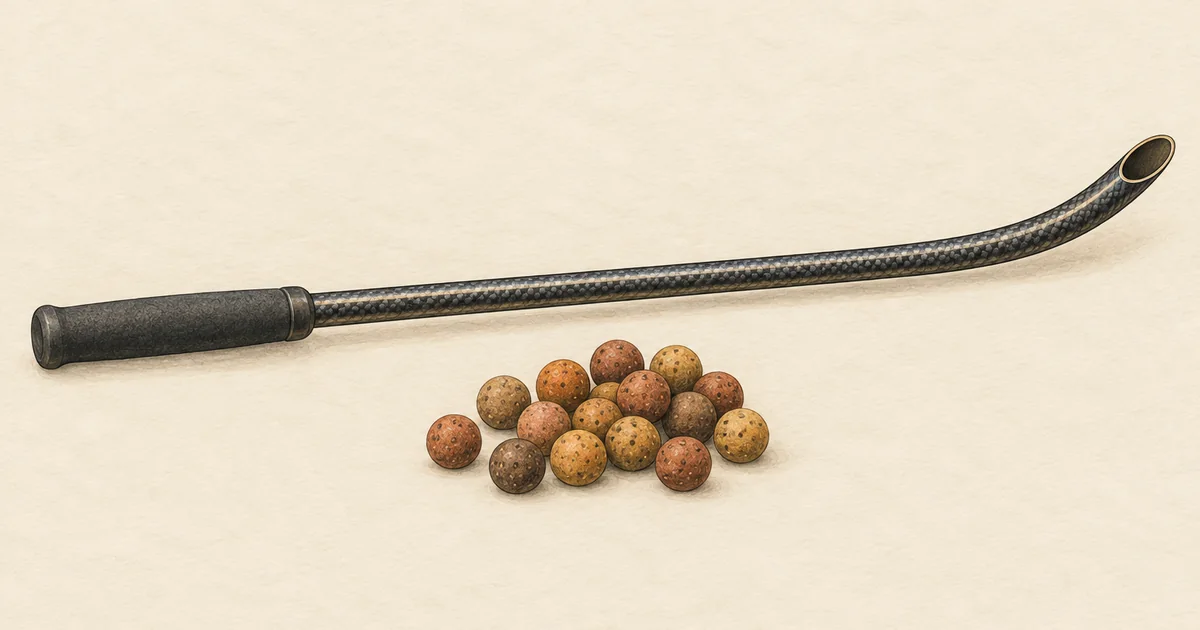
What is documented, on the other hand, is which balls throw well. Rute & Rolle gives 15 to 20 mm as the standard sizes of boilies that travel a considerable distance with a throwing stick or catapult. 20 mm is a popular choice because smaller balls do not fly as far. For an even spread, a uniform size such as 16 or 18 mm is recommended. According to Blinker, mini boilies cannot be fed with a throwing stick. Fisch & Fang says the same: the small balls are accelerated too hard in the tube and drift off sideways.
Preparing boilies
In the tube the ball picks up a lot of speed. That is why the boilies should all be the same size and very hard. Softer balls break into several pieces when you pull through hard. According to Fisch & Fang, anyone fishing softer balls reaches the limit of the throwing stick at around 80 m.
- Wet the tube: A wet tube stops the balls spinning as they leave and breaking apart.
- Go easy on liquid: Soaked boilies burst in the air. For the throwing stick they are only lightly moistened.
- Whole balls: Boilies are only cut in half when you are not baiting at distance with the throwing stick.
- Floating boilies: For fishing on the surface, they can also be sent out a long way with a throwing stick or catapult.
Cast and marker
Angling Times compares throwing to a golf swing: distance and accuracy come with practice. In angling terms that means standing the same way on every cast, swinging back equally far and pulling through equally hard.
For direction you need a marker. When casting, pick for example a conspicuous tree on the far bank so that you always hit the same spot. The same line applies to tube and rod: feed and hair rig fly towards the same tree. A float that stands out on the water also serves as a reference for further casts.
Wind can ruin the work. According to Fisch & Fang, a little crosswind is enough and concentrated baiting is out of the question. Claims by some manufacturers of well over 100 m range rarely match reality.
Scatter instead of a heap
No load lands exactly on one spot. That is no disadvantage: a few strays always occur, and scattered feed makes the fish move around between the morsels. A bait boat, by contrast, puts the load down in one thick heap, which is rarely what you want.
The noise can help. In lakes with little natural food and strong competition between the fish, carp take boilies hitting the water as a sign that there is food, according to Blinker. Gulls are a problem: they are considered the main reason the throwing stick is almost forgotten today.
Worked example: One kilogram of 20 mm boilies gives roughly 200 balls, according to Rute & Rolle. On the waters of the Landesanglerverband Brandenburg, an upper limit of 2 kg of feed per fishing day applies. That would be about 400 balls, and that for all the day’s feed, particles and groundbait included.
Throwing stick, catapult or spod
The throwing stick is a tool for boilies. The distances are guide values from the specialist press.
| Aid | Feed | Distance (guide value) |
|---|---|---|
| Throwing stick | hard boilies of the same size | up to around 80 m |
| Catapult | also hemp, wheat, maize | particles 15 to 20 m, 30 m with a tailwind |
| Spod | any feed, up to boilies | well over 100 m |
Even with small balls the tube’s range drops noticeably. Tiger nuts, particles and groundbait only go out with a catapult or spod. The page Catapult explains the designs and use of the catapult. A bait boat saves you the cast but is not permitted everywhere. The Landesanglerverband Brandenburg prohibits baiting with bait boats and drones; the Fischereiverein Hannover allows remote-controlled bait boats only outside the breeding and stocking season from 1 April to 15 July.
Amount of feed and water rules
More feed does not automatically bring more fish. At the right spot a small amount is enough to begin with. You can always top up; too much feed cannot be taken back and can ruin your chances. The Anglerverband Niedersachsen puts the consumption of the average German angler at 0,37 kg of feed per fishing day. According to its analysis, catches rise disproportionately up to about 2 kg of feed per angler per day. From around 2,5 to 3,5 kg, the angler adds phosphorus to the water on balance, taking the fish removed into account. How much specialist carp anglers put in per year is covered under Carp fishing.
Whether, when and how much you may bait is governed by state law, the water rules and the fishing permit (Erlaubnisschein). Three examples show how much this varies:
- Landesanglerverband Brandenburg: at most 2 kg of dry or wet feed per fishing day, no baiting with a bait boat or drone (water rules, 2019 edition).
- Landesanglerverband Sachsen-Anhalt: Feeding wild fish is prohibited; you may bait only while you are fishing. The penalty catalogue lists baiting in advance without fishing at the same time as an offence (water rules, last amended in April 2024).
- Fischereiverein Hannover: On one of the club’s artificial-lure waters, baiting is banned altogether (water rules, 2026 edition).
In winter it is recommended to prebait about 500 g of boilies with the throwing stick two to three days before the session. Before such baiting campaigns, check the rules for your water.
Common mistakes
- Small or mixed balls. Mini boilies drift off sideways, and mixed sizes land scattered. Choose a size from the range the specialist press mentions.
- Soft or soaked boilies. They burst on leaving the tube or in the air, and fragments land on the spot instead of balls.
- Dry tube. Without water in the tube the balls spin more and break more easily.
- No marker. Without a fixed line, feed and rig end up in two different places.
- Too much on the first day. Start small and keep to the limit in the water rules.
Frequently asked questions
How far can you get with a throwing stick?
The limit is around 80 m, because softer balls burst when you pull through harder. Manufacturers‘ claims of well over 100 m are rarely realistic. A crosswind scatters the balls further.
Is the throwing stick also good for maize and hemp?
No. Even with small boilies the tube loses a lot of distance. For particles such as hemp, wheat and maize, you use the catapult or the spod.
Why do my boilies break when I throw them?
Usually they are too soft or too wet. The tube needs very hard balls. It helps to dampen the inside of the tube and to moisten boilies only lightly with liquid.
Related
- Boilies: ingredients, sizes and why the ball is hard
- Catapult: the counterpart for particles and short distances
- Carp fishing: rig, choosing a spot and feed amounts through the year
- Hair rig: how the boilie sits beside the hook
- Boilie needle and boilie drill: pulling the ball onto the hair
- Carp rod: length and test curve for long casts
- Line calculator: checking the strength of the main line for the carp rig
Sources
- Rute & Rolle: Boilies: Es kommt auf die Größe an (15 bis 20 mm mit Wurfrohr auf Distanz, rund 200 Kugeln je Kilogramm) und Rute & Rolle: Karpfen: Füttern mit der Spod-Rute (Reichweite bei kleinen Kugeln, Schleuderweite für Partikel, Futterrakete über 100 m)
- Fisch & Fang: Karpfen auf große Entfernung (Herstellerangaben zur Weite, Seitenwind, gleich große und harte Kugeln, Grenze bei etwa 80 m, Futterboot legt einen Haufen), Fisch & Fang: Zielfisch Schleie: Boilies für alle (Miniboilies brechen seitlich aus) und Fisch & Fang: Auf der Pirsch (schwimmende Boilies mit dem Wurfrohr)
- Angling Times: 5 of the most effective methods of baiting for carp (Golfschwung, nasses Rohr, Ausreißer und Streuung, leichte Carbonrohre, Möwen), Are you using the right boilie? (20 mm fliegen weiter), How to choose the right boilie (16 oder 18 mm für gleichmäßige Verteilung) und Can you put too much liquid on your boilies? (getränkte Kugeln platzen)
- Blinker: Carp-Strategie: kleine Kugel, große Wirkung (Miniboilies nicht mit dem Wurfrohr), 10 Mythen zum Karpfenangeln im Winter (halbierte Boilies, Futtermenge), Karpfen-Kickstart (kleine Menge am richtigen Platz), Winter-Karpfen am Vereinssee (Vorfüttern mit 500 g) und Das Hörvermögen von Karpfen (Einschlaggeräusch als Fresssignal)
- Blinker: Brassen angeln: die Grundlagen (Baum am anderen Ufer als Orientierungspunkt) und Blinker: Methodisch zum großen Brassen (Pose als Orientierungspunkt beim Werfen)
- Anglerverband Niedersachsen: Faktencheck Anfüttern (PDF) (0,37 kg pro Angeltag, Fänge bis etwa 2 kg, Phosphor ab 2,5 bis 3,5 kg)
- Landesanglerverband Brandenburg: Gewässerordnung (2 kg pro Angeltag, Futterboote und Drohnen verboten), Landesanglerverband Sachsen-Anhalt: Gewässerordnung (PDF) (Anfüttern nur beim Angeln, vorrätiges Anfüttern als Verstoß) und Fischereiverein Hannover: Gewässerordnung 2026 (PDF) (Anfütterverbot am Kunstködergewässer, Futterboote in der Brut- und Setzzeit)
Text AI-assisted, drawing AI-generated. Sources opened and checked in October 2026; no graphics taken from the sources.
All figures are guide values without guarantee. Which amount of feed and which aids are permitted on your water is governed by state law, the water rules and the fishing permit.