
Knowledge · Tackle
Boilie needle and boilie drill: Bait onto the hair
With the boilie needle you draw boilies, pellets and other hard baits onto the hair of the carp rig, and the drill makes very hard baits go all the way through beforehand. This page covers which needles there are, when you have to drill, how the stop sits and what distance from the hook counts as a guide value.
Needle, drill and stop
The bait needle is a thin metal pin with a handle. At the tip sits a small hook on which you hang the loop at the end of the hair. The hair is the short length of line below the hook on which the bait sits. The tackle guide of the Fischereiverein Löningen for the angling exam already lists the bait needle as an accessory for putting baits on. According to Blinker, boilie needles usually have a plastic handle and often an eye that can be closed.
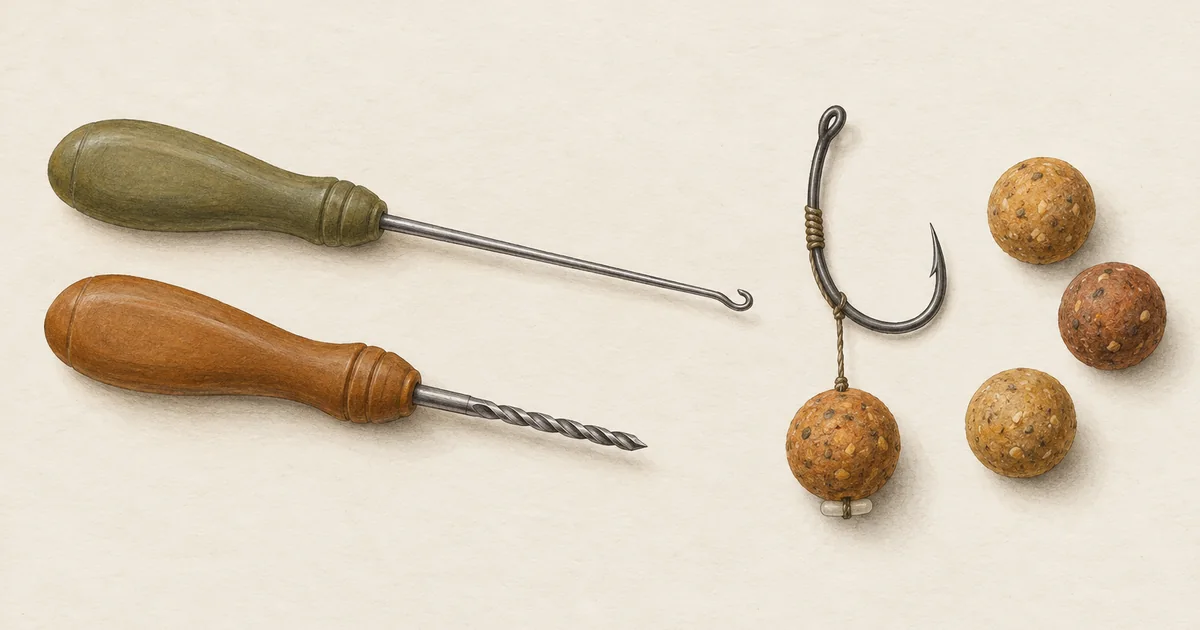
| Tool | Feature | What for |
|---|---|---|
| Needle with open little hook | the little hook stays open | simple shape, the loop can tear the bait |
| Latch needle | bar or flap over the little hook | the loop slides smoothly through the bait |
| Micro or splicing needle | very thin | small and soft boilies |
| Stringer needle | especially long | threading several boilies onto a PVA string |
| Boilie drill | longer and thicker than the needle | very hard baits, cork in pop-ups |
| Boilie stop | cross-piece in the hair loop | holds the bait on the hair |
Why the latch needle is widespread is explained by Fisch & Fang: a bar closes the needle as you pull it back. That way the loop slides through smoothly instead of tearing a wide channel in the bait or bursting it. The stringer needle threads several boilies onto a line of PVA, a material that dissolves in water. The boilie needle can also be used to prick a few holes in a PVA bag: without trapped air it sinks faster and dissolves more quickly.
When the drill is needed
The needle goes through an ordinary boilie. For especially hard baits the boilie drill is used. Angling Times counts rock-hard pellets and pop-ups, that is floating boilies, among the baits you drill right through before they go on the hair with a stop. Halibut pellets for carp are usually rock hard and therefore pre-drilled. A wafter, a bait balanced almost to hover, you also drill through before putting it on.
The second use is cork. If a pop-up floats poorly, it is drilled about halfway, a cork stick goes in and the rest is cut off. The drill should match the stick; 6 or 8 mm diameter are mentioned. For pop-ups with cork, the only fastening left is bait floss, a thread you pull through the bait with the boilie needle. With a bait screw, which leaves only one hole, cork and bait can come apart.
The drill has a drawback: it is usually thicker than a needle, and smaller boilies can break when threaded. So drill only where the needle will not get through.
Bait onto the hair in five steps
- Drill if needed. Drill hard pellets, pop-ups and wafters beforehand, but not ordinary boilies.
- Push the needle through. Spike the bait on the needle until the little hook lies free on the other side.
- Hang the loop. Hang the hair loop on the little hook and close the bar if your needle has one.
- Draw the bait on. Pull the needle back. The bait travels over the loop onto the hair, with the loop sticking out at the bottom.
- Set the stop. Put the stop crosswise through the loop and pull the bait back until it sits snug. That way the bait sits firmly on the hair.
Often the bait goes on the hair first and the hook is tied on only afterwards. That way you set the distance on the finished bait. How the hair is connected to the hook in the process is shown by the hair rig and the no-knot.
There are two tips on the loop. A loop that is a little too big does no harm, since it disappears in the bait. With small boilies, though, a thick loop knot can burst the bait from the inside. Then the loop is tied long enough that the knot stays outside, or very thin braid is used. Small loops can be laid around the shaft of the needle and pulled tight there to the size you want.
Hair length and distance from the hook
Blinker gives one centimetre as a guide value for the distance between hook bend and bait, a second article something less than the width of a little finger, that is 0,5 to 1 cm. In the early days of the hair rig three to four centimetres were usual. If the bait sits almost at the bend, however, hook and bait jam, and the hook finds less hold.
A hair for 16 mm does not suit two balls of 24 mm. So it pays to tie hooklengths for different bait sizes, put a matching boilie on each and mark the hooklengths you keep in stock. Which baits there are in which sizes is under Boilies and Pellets.
Small boilies, pellets and pop-ups
Small boilies break easily if the needle is too thick. A splicing needle helps here, which is actually meant for splicing hollow braided lines. Fisch & Fang recommends micro needles for small and soft boilies; with too large a needle they burst, in the worst case unnoticed.
For hard pellets there is, besides drill and stop, the pellet band, a small rubber ring that holds the pellet on the hair. A conspicuous stop can itself become a trigger: a large yellow stop on a brown pellet makes it visible from afar.
With pop-ups the needle is not without consequences. According to Blinker, a pop-up can fill with water through the puncture hole and lose its buoyancy. It is recommended to put one ready-mounted pop-up of each kind into a glass of water for a few hours and watch whether it stays up.
Careful with the needle tip
Needle and drill are sharp. Fisch & Fang recommends needles in conspicuous colours because they are easier to find again in bankside grass.
If something is stuck in the skin: according to the first-aid notes of the German Red Cross, only a doctor may remove foreign bodies from wounds. The Robert Koch Institute warns against clarifying tetanus protection only after an injury; small wounds in particular often never reach a doctor. What to do until then is under Hook injury and first aid. This text is no substitute for medical advice.
Common mistakes
- Needle too thick for small baits. Mini boilies split. A thin micro or splicing needle spares them.
- Drilling where the needle is enough. The thicker hole from the drill can burst smaller boilies.
- Hair too short. If the bait sticks to the hook bend, the hook cannot turn freely. One centimetre of distance is the usual guide value.
- Thick knot in the loop. It forces small boilies apart from the inside.
- Pop-up not tested. It soaks up water through the puncture hole and then lies on the bottom instead of above it.
Frequently asked questions
Can you do without a stop?
On an ordinary hair it is only the stop that holds the bait. An exception is the wafter on a micro swivel: with a 0,60 mm monofilament the bait sits so tight that it needs no stop.
Is a bait needle from predator fishing any use?
In a pinch, yes. For small boilies better take a thin needle, because one that is too thick will burst them.
What else is the needle good for?
If the hooklength swivel goes into the safety clip only with difficulty, the boilie needle helps. You can also use it to pull rubber tubing and a lead onto the line, and anglers tie small loops around its shaft.
Related
- Hair rig: hooklength, fixed lead and safety clip step by step
- No-knot: how the hair is made at the hook
- Boilies and pellets: kinds and sizes of baits for the hair
- Carp fishing: feed, choosing a spot and tackle at a glance
- Stops, beads and shrink tube: the other small parts of the rig
- Throwing stick for boilies: getting feed balls far out
- Line calculator: compare the breaking strain of hooklength and main line
Sources
- Blinker: Angler-Werkzeug, was muss noch mit ans Wasser? (Griff und Klappöse, Bohrer für harte Köder, Bohrer dicker, Ködernadel vom Raubfischangeln, Spleißnadel)
- Fisch & Fang: Mehr als eine Boilie-Nadel (Schließnadel, Stringernadel, Mikronadel, Farbe, Schlaufen und Schlauch mit der Nadel)
- Blinker: Die No-Knot Haarmontage (Reihenfolge beim Aufziehen, Stopper, Schlaufengröße, 0,5 bis 1 cm, Nadel am Clip) und Blinker: Haarlänge bei der Karpfenmontage (1 cm als Richtwert, früher 3 bis 4 cm, zu kurzes Haar, Vorfächer je Ködergröße)
- Blinker: Schleien mit Boilies fangen (kleine Boilies, Spleißnadel, Schlaufenknoten)
- Blinker: Angeln mit Pellets (vorgebohrte Heilbutt-Pellets, Stopper, Pelletband) und Blinker: Angeln mit Wafter (Wafter durchbohren, kein Stopper bei dicker Mono)
- Blinker: Angeln mit Pop-ups (Wasser im Stichloch, Glastest, Korkstift, Bohrer 6 oder 8 mm, Bait-Floss statt Köderschraube) und Blinker: PVA richtig einsetzen (PVA löst sich auf, Löcher mit der Boilienadel stechen)
- Angling Times: How to tie the knotless knot hair rig (harte Pellets und Pop-ups durchbohren, mit Stopper sichern) und Fisch & Fang: Fangen ohne Futter (gelber Stopper am Pellet)
- Fischereiverein Löningen: Gerätekunde zur Fischerprüfung (PDF) (Ködernadel als Zubehör)
- Deutsches Rotes Kreuz: Wundversorgung (Fremdkörper nur vom Arzt entfernen) und Robert Koch-Institut: Schutzimpfung gegen Tetanus (nicht erst nach der Verletzung impfen)
Text AI-assisted, drawing AI-generated. Sources opened and checked in October 2026; no graphics taken from the sources.
All figures are rough guides with no guarantee. How far out the hair should be and which needle suits depends on bait size, hardness and rig.