
Knowledge · Tackle
Stoppers, beads and shrink tube
A stopper holds the sliding float at the set depth, a bead protects the knot at the swivel, and a piece of tube keeps the hooklength away from the weight in the cast. Here you can read which small part belongs where in a rig and where it fails in practice.
Rubber stopper and thread stopper
A stopper is a sliding stop on the main line. On the sliding float, the sinking bait pulls the line through the eyes of the float until the stopper catches. The tackle guide of the Fischereiverein Löningen names line knots or valve rubber for this; the distance between stopper and bait sets the fishing depth. The whole rig is shown on the Float rig page, and the float designs are covered under Floats.
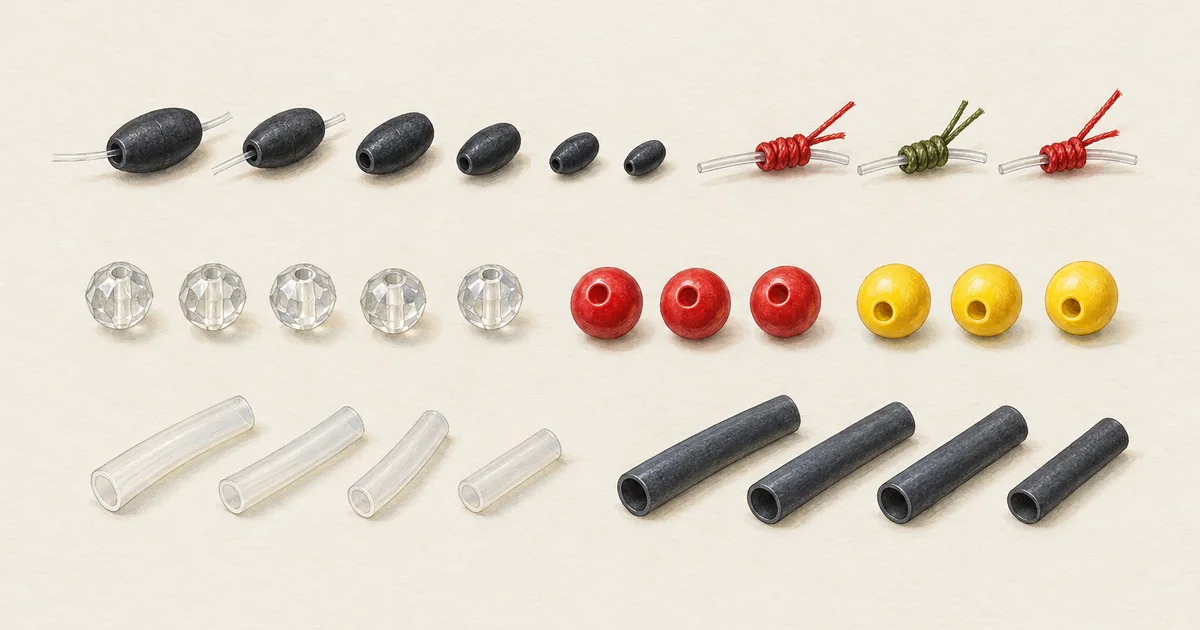
Rubber stoppers made of rubber or silicone sit on a wire loop, through which you slide them onto the line. Thread stoppers are thread knots, pre-tied on a thin tube: thread the line through, push the knot down, tighten. How to tie one yourself is explained on the Stopper knot page.
The thread stopper is recommended for the sliding float. Even very small rubber stoppers are too thick for the narrow rings of a match rod: they catch there and slip. The smaller thread knot slides better through the rings. It holds best on monofilament line, and sits less well on braid.
Stopper at the weight and the hooklength
Stoppers also limit weights. In the Texas rig, with heavy weights a float stop is placed behind the weight so that bait and weight stay close together. For carp fishing, the simplest way to fix a lead with a swivel is two stoppers or shot in front of and behind it on the main line. Because this often tangles and the lead is hard to change, the running lead and safety clip have become standard, as with the hair rig. Which lead shapes exist is covered under Fishing weights.
On a sea hooklength, a stopper keeps the beads above the hook in place. As a swallow guard for flatfish, a piece of cable tie about 3 cm long, drilled through the middle, sits across the line in front of the hook; the beads above it are secured with a line stopper so the cable tie does not wander.
Beads as buffer and knot protection
A thread stopper is so small that it would slip through the eye of the float on its own. A bead therefore belongs in between: the knot holds the bead, and the float stops at the bead. The bead has to meet two requirements. Its hole must be so narrow that the knot does not fit in, and its diameter so large that it does not pass through the float eye.
On the running lead, the bead sits between lead and swivel. There, a rubber bead protects the knot at the swivel and ensures that the line runs freely through the lead. In the baitfish rig with a float, a large rubber bead goes under the lead olive and above the snap swivel. The build is shown by the bottom running-lead rig and the baitfish rig.
Glass bead with a click
In the Texas rig the bead is part of the attraction. When you twitch the lure, the bullet weight hits the bead. Glass suits this better than plastic. According to Rute & Rolle, the clacking makes predators curious but in clear, heavily fished water it can also scare them off. With tungsten, which is much harder than lead, glass beads sooner or later shatter according to Blinker, and the fragments damage the leader without you noticing. Hard-rubber beads are then the better choice.
Attractor beads and luminous beads on a sea hooklength
At the sea, beads are meant to attract fish. For the flatfish hooklength, small coloured or self-luminous beads of about 6 mm in front of the bait are suggested; snood lengths and hooks for this are given under the surf rig.
More beads do not bring more bites. When fishing for flatfish, a few small beads are considered more effective than many large ones. They work best when the rig is moved and not lying still on the bottom. As a rule of thumb: the more movement in the water, the more eye-catching the rig can be.
On the question of luminous beads, the articles contradict each other. One article on flatfish fishing recommends self-luminous beads, while an article on sea tackle writes that luminous lures did not work in the Baltic Sea and suited Norway better. For Norway, the sea natural-bait rig shows luminous tube on the side arms.
Anti-tangle tube and silicone tube
An anti-tangle tube is a piece of silicone tube above the weight. On the running lead it protects against tangles when casting. It should be longer than the hooklength: two lines tangle more easily with each other than one line with a stiff tube.
There is one exception. If a soft braided hooklength hangs on a large ring swivel, no tube should stiffen that swivel. Free to move, the hooklength turns around the lead in the cast; stiffened, it swings alongside the rig and tangles more easily. A short piece of tube over the swivel of the lead, on the other hand, stops the hooklength from catching there.
Silicone tube also serves as a clamp. On the safety clip, a piece of it secures the lead. If the lead gets stuck on an obstacle while playing a fish, the tube slides back, the clip opens and releases the lead. On a hair rig, a short piece of silicone holds the hair against the hook shank.
Length and material
Not every bottom rig needs tubing. An article in Fisch & Fang on tench fishing manages at short and medium range with round or pear-shaped leads with a cast-in swivel. Only when you need to cast a long way does it name a lead with anti-tangle tubing, because it tangles less often.
For the length, what counts is the hooklength, not a fixed figure. A Blinker article on avoiding tangled carp rigs advises tying the hooklength no longer than 20 cm, and Fisch & Fang fishes braided hooklengths of 20 to 30 cm for tench. Worked through: a 20 cm hooklength needs tubing longer than 20 cm, a 30 cm hooklength tubing longer than 30 cm. Then during the cast the hook can only reach the tubing and not the bare main line. Material and lengths of the hooklengths themselves are covered under Carp hooklength.
Two different parts are sold under the name anti-tangle. The long tube is a piece of silicone that you thread onto the main line and that is stiffer than the line. The sleeve, on the other hand, is a short rubber piece that tapers towards one end. According to Blinker, you pull its wide end over the swivel, and it then keeps the hooklength away from the lead and the main line. A Blinker guide to pop-up rigs also calls this short rubber piece an anti-tangle tube. In the shop it therefore helps to describe the shape rather than just giving the name.
On the bottom the tubing should lie flat. A Blinker overview of carp rigs advises getting the tubing and the first two to three metres of main line down onto the bottom on heavily fished waters. Otherwise a carp swims into it, takes fright and bolts. If the tubing stands proud, you weigh it down with split shot or tungsten putty, a heavy mouldable paste. For rigs with a sub-surface float, another Blinker article recommends the opposite: a thick, conspicuous tube that rises almost vertically. The carp see it in time and never come into contact with the line in the first place.
When the line breaks
Tubing and beads must never prevent a fish from shedding the lead or the rig after a break-off. The Angling Trust, the English anglers‘ association, advises in its guidance that rigs should be built so that a fish is not left tethered after a line break and the lead comes free if it snags or tangles. A Blinker article on long-range rigs says the same: with clip rigs and a leader the lead must be able to come off, with heli rigs the hooklength.
On the safety clip this means pushing the rubber tail only lightly over the clip. Angling Times advises testing on the finished clip whether the lead pops out easily. How clip and leader work together is described on the page Leadcore and safety clip.
With the inline lead, through which the line runs and into whose insert the swivel is pulled, opinions differ. A Blinker article on lead rigs names as a drawback that a hooked carp would drag the whole rig along after a line break and in the worst case could die from it. It therefore recommends the safety clip. The overview of carp rigs in the same magazine, by contrast, describes a lead with an internal channel that sits firmly on the swivel via a short piece of rubber tubing. If the main line breaks, this article says the lead should come free of the line.
On the helicopter rig, where the hooklength rotates around the main line above the end lead, rubber beads hold the hooklength in position. According to Blinker the rig is only safe for the fish if these beads slide on the line: then a fish can shed the hook after a break-off. A swivel or a thick knot above the hooklength blocks this. For heli rigs on leadcore, Blinker also describes a split bead on a tapered rubber pin: if the fish breaks off, it pulls the bead over the pin and so gets rid of the leader. More on this under Fish-friendly tackle.
Shrink tube for fixed connections
Shrink tube contracts when heated and then sits tight on whatever it encloses. For a rotating spacer, you slide a piece over the last 3 cm of a wire up to the middle of a swivel and heat it until the swivel sits horizontally on the wire. The tube is sold in electrical shops.
On the carp hook, a piece goes over the eye. There it serves as a line aligner, changing the angle between hooklength and hook and able to set the hook more aggressively. Later many anglers replace the tube with a reusable moulded part serving the same purpose. On the spinner rig, a carp rig with a swivel on the hook, shrink tube secures the hook to the swivel.
For fish-friendly eel fishing, you build a small twig into the hooklength close in front of the hook so that the eel does not swallow the bait deeply. Instead of two silicone tubes it is usually held with shrink tube, which is shrunk over hot steam.
Thread first, then knot: On the sliding float, stopper, bead and float go on the line before the swivel; on the running lead, first the lead, then the bead. On the hair rig, tube, rubber cap and safety clip go on the line before the hooklength swivel is tied on. Whatever is missing afterwards can only go on the line after cutting it off.
Common mistakes
- Bead with too large a hole. The thread stopper slips in, and the float runs past the set depth.
- Rubber stopper on a fine float rod. It catches in narrow rings and shifts, and the depth is then wrong.
- Moving a thread stopper far when dry. Blinker advises wetting it if it is to move more than 10 to 20 cm. Otherwise friction heat can damage monofilament main line.
- Glass bead in front of a tungsten weight. The bead shatters, and its edges damage the hooklength.
- Anti-tangle tube shorter than the hooklength. Then the hooklength can wrap around the main line again in the cast.
Frequently asked questions
Where do I get suitable stopper beads?
Suitable beads with a very small hole are available in craft shops. The hole is what matters: before threading on the float, push the stopper against the bead and check whether it slips in.
Silicone tube or shrink tube?
Silicone tube only grips and can be pulled off again, for example on the safety clip. Shrink tube sits tight after heating and suits places where nothing should move any more, for example the hook eye.
Do luminous beads help in the Baltic Sea?
The sources disagree, as described above. Try coloured and luminous beads alternately at your spot, a few and small ones each time.
How long does the anti-tangle tubing need to be?
Longer than the hooklength. A 20 cm hooklength therefore needs tubing of more than 20 cm. That way the hook lands on the tubing during the cast and not on the bare main line.
Related
- Stopper knot: tying the thread stopper yourself
- Float rig: stopper, bead and float in the whole rig
- Bottom running-lead rig: running lead, bead and swivel on the bottom
- Texas rig: bullet weight and glass bead on the soft-plastic lure
- Hair rig: tube and safety clip on the carp rig
- Surf rig: beads and snoods on the flatfish hooklength
- Swivels, snaps and split rings: the connecting parts of the rig
- Line calculator: comparing the breaking strain of mainline and hooklength
Sources
- Fischereiverein Löningen: Gerätekunde zur Fischerprüfung (PDF) (Stopperarten, Angeltiefe)
- Blinker: Posenstopper binden (Gummistopper, Lochgröße, Bastelbedarf) und Blinker: Stopperknoten lassen sich ganz leicht selber binden (Bauarten der Stopper)
- Blinker: Stopperknoten, so einfach lässt er sich binden (Aufgabe und Maße der Perle, Anfeuchten, Schnurtyp)
- Blinker: Der schwebende Köderfisch (Gummiperle als Knotenschutz am Laufblei) und Blinker: Köderfischmontage zum Hechtangeln (große Gummiperle über dem Karabinerwirbel)
- Blinker: Texas-Rig, die Erfolgsmontage mit dem Klick (Glasperle, Stopper, Wolfram, Hartgummi) und Rute & Rolle: Carolina Rig vs. Texas Rig (Wirkung des Klackens)
- Blinker: Plattfisch-Vorfach (Perlen von etwa 6 mm), Blinker: Plattfischangeln, 10 Tipps (Zahl und Größe der Perlen), Blinker: Plattfisch in der Ostsee (Faustregel Wasserbewegung) und Blinker: Meeresangeln, kleine Helfer (leuchtende Köder in der Ostsee)
- Blinker: Schlucksperre für Plattfische (Schnurstopper fixiert Perlen und Kabelbinder)
- Blinker: Blei-Montagen zum Karpfenangeln (Stopper am Blei, Anti-Tangle-Schlauch, Clip, Inline-Blei nach Schnurbruch), Blinker: 5 Tipps gegen verwickelte Montagen (Schlauchlänge, Vorfach höchstens 20 cm, Ausnahme am Ringwirbel) und Blinker: Die No-Knot Haarmontage (Reihenfolge beim Auffädeln)
- Blinker: Die besten Montagen für Karpfen, die Haarmontage (Silikon am Haar, Schrumpfschlauch am Öhr), Blinker: Karpfen, das richtige Vorfach (Line-Aligner und Hakenwinkel) und Blinker: Spinner-Rig (Schrumpfschlauch sichert den Haken am Wirbel)
- Blinker: Englische Montagen für fischschonendes Aalangeln (Zweig im Schlauch, Wasserdampf) und Fisch & Fang: Drehbarer Abstandhalter (Schrumpfschlauch am Wirbel)
- Fisch & Fang: Haargenau auf Schleien (Schlauch bei weiten Würfen, Vorfach 20 bis 30 cm)
- Blinker: Karpfenmontage, die besten Rigs im Überblick (Schlauch am Grund, Beschweren, Blei mit Innenführung löst sich), Blinker: Das erste Mal Angeln mit Boilies (Sleeve über dem Wirbel) und Blinker: Angeln mit Pop-Ups, der komplette Leitfaden (kurzes Gummistück als Anti-Tangle-Tube, Knetblei mit Wolfram)
- Blinker: U-Posen-Raffinessen (dicker Schlauch an der Unterwasserpose)
- Angling Trust: Best Practice Guide for Freshwater Angling (PDF, englisch) (kein angebundener Fisch nach Schnurbruch) und Angling Times: The safe bolt rig (Gummikappe leicht aufschieben, Blei testen)
- Blinker: Werfen mit Vertrauen, Weitwurf-Rigs (Blei oder Vorfach muss sich lösen), Blinker: Helicopter-Rig für dicke Friedfische (gleitende Gummiperlen) und Blinker: 12 Fakten zum Heli-Rig (Perle über dem Gummistift am Leadcore)
Text AI-assisted, drawing AI-generated. Sources opened and checked in October and November 2026, no graphics taken from the sources.
All figures are guide values without guarantee. Which stoppers, beads and tubes suit depends on line, rod rings and rig.