
Knowledge · Tackle
Leadcore and safety clip: Making lead loss safe
A safety clip holds the fixed lead of a carp rig in place until it snags on an obstacle or the main line breaks, and then releases it. Without such a safeguard, a fish that has broken off drags the lead and the whole rig along with it. Inline leads and helicopter rigs need the same safety, just in a different place.
Why the lead has to come free
In a self-hooking rig the lead is fixed so that the carp hooks itself as it swims off. How this works is explained under Hair rig. The downside shows when the main line breaks above the lead: the fish is still on the hook, and the weight hangs on the other end of the hooklength. Blinker describes the consequence using the example of the inline lead: the carp drags the whole rig around with it and in the worst case can die from it.
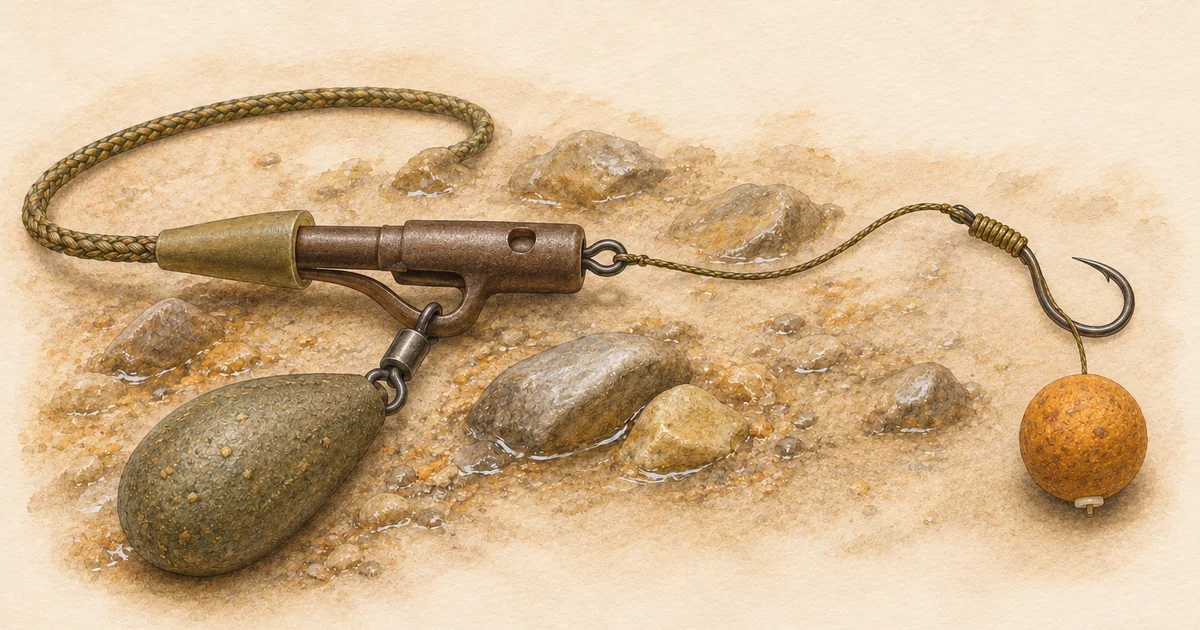
English sources call this “tethering”: the fish is tied up. The English angling body Angling Trust therefore advises building fixed and semi-fixed lead rigs only so that the weight can slide off freely in the event of a snag or tangle, and a line break does not leave a fish tethered. The safeguard also helps during the fight: if the lead gets stuck in an obstacle, it comes off, and according to Blinker the fish is not necessarily lost.
Principle: If the lead is snagged, it should come off. If the line breaks, as little as possible should stay with the fish: hook and short hooklength, but no lead and no leader.
Three systems compared
Safety clip. The swivel that joins the main line and hooklength sits in the head of the clip. A lead with a swivel goes into the clip, and a tail rubber or a piece of silicone tubing is pushed over it. If the lead snags, the rubber slides back, the clip opens and the lead drops off, as Blinker describes it. The lead’s swivel does, however, act as a hinge: after the bite a carp can move a little to the side before the full weight pulls on the hook. Blinker only sees this as a problem on difficult waters with very cautious fish.
Inline lead. Here the main line runs through the lead, and the connecting swivel is pulled into an insert in the lead. The weight acts on the hook immediately on the bite, and the lead casts well (Blinker). Angling Times calls the inline lead the first choice for solid PVA bags, that is, feed bags made of water-soluble film, and, rigged correctly, a safe, direct set-up. Over deep silt or weed, however, the hooklength can end up in the muck. Blinker, by contrast, sees the risk with the inline lead precisely when the line breaks. What Angling Times means by rigged correctly is not explained in the article. So stick to the principle above and check before use that the lead can come free.
Helicopter rig. The lead sits at the end of the leader, a strong end section in front of the main line, which Blinker gives as 50 to 100 cm. The hooklength hangs on a swivel with an O-ring that slides on the leader and is limited by two beads. Because only the lead sinks into the bottom and the bait sinks more slowly, according to Blinker it lies cleanly on sand, stones, silt and weed, and the rig casts a long way. On the other hand, it hooks less well: where a normal fixed lead is possible, Blinker prefers it. The chod rig is built almost the same way, only with a very short, stiff hooklength for buoyant baits (pop-ups), so the following section applies to it as well.
| System | Advantage | What to look for |
|---|---|---|
| Safety clip | lead releases on an obstacle | push the tail rubber on only lightly, test before casting |
| Inline lead | hooks directly, casts well, suits PVA bags | firm bottom, short hooklength; must come free if the line breaks |
| Helicopter | clean on any bottom, long cast | hooks less well; hooklength must be able to slide off the leader |
| Helicopter with drop-off clip | nothing catches in the weed | weight stays in the water with every hooked fish; use a lead-free substitute such as a stone |
Setting up the helicopter rig safely
With the helicopter rig, a clip on the lead is not enough. If the main line breaks above the leader, the fish is attached to the leader via the hooklength and swivel, and the lead hangs on that. For the fish to come free, the swivel and hooklength must be able to slide off over the top end of the leader. Angling Times assumes exactly this: the hooklength must be able to separate from the leader (Fig. 2).
How this is solved depends on the system. Blinker describes a slotted plastic bead that sits on a tapered rubber sleeve on the leader: if a fish breaks off, it pulls the bead over the sleeve and slips off the leader. According to Angling Times, ready-made safe heli leaders are available in all three leader types that come up further down: leadcore, lead-free braid and welded loop leaders.
The top bead sits tight but can still be moved. The deeper the lead can sink into a soft bottom, the higher you push it, according to Blinker up to 1 m above the lead. For the chod rig over weed, Angling Times gives one and a half times the height of the weed as the distance. The closer the bead sits to the lead, the better the rig hooks. After the cast, the line stays slack on the bottom, otherwise the rig stands at an angle in the water.
On waters with tall weed, some carp anglers use a drop-off clip. It releases the lead as soon as the fish is hooked, so that nothing gets caught in the weed during the fight (Blinker). This means a weight stays in the water with every fish. In this case Blinker advises a lead-free substitute such as stones; what EU law says about drop-off leads is covered further down. Where a leader is used, an article in Angling Times also gives as a guide a strong main line of at least 0,35 mm, or 0,40 mm near snags. Then a fish breaks off together with the leader less often.
Leadcore: braid with a lead core
Leadcore is a hollow braid with a lead wire in its core (Blinker). Fisch & Fang sums it up briefly: “braid outside, lead inside”. The material is stiff and lies flat on the bottom, according to a 2010 article in Fisch & Fang even in strong current; the magazine therefore named rivers above all as the place to use it. On the chod rig, a piece of it sits between the lead and the main line (Blinker).
In the rig, the leader has three jobs. It keeps the line in front of the lead on the bottom. It protects the end of the line from abrasion, for example when the swivel of the helicopter rig rubs against it during the fight or the line runs over obstacles (Angling Times). And on the helicopter rig, its weight and the curve of the line under water help push the hook into the mouth (Blinker). The trend is towards short leaders; longer ones give protection when fishing close to timber, where a fish could otherwise wear through the line on the edge of the snag (Angling Times).
Leadcore contains lead. How to handle lead cleanly and why it should be kept away from children is covered under Lead in angling. Angling Times also mentions waters where leaders are banned altogether. Whether leadcore, leaders or certain leads are allowed on your water is stated in the water rules and your fishing permit.
Lead-free alternatives
- Leaders without a lead core: Angling Times mentions lead-free braided leaders and welded loop leaders. They also sink quickly and lie on the bottom when the line is slack.
- Monofilament leader: On the chod rig, the leader can also be made of monofilament line (Blinker).
- No leader at all: The chod rig then runs directly on the main line; anglers call this “naked”. An article in Angling Times likes to use fluorocarbon for this in winter so that the rig lies less conspicuously. Without a leader, according to Angling Times, you need special chod beads or protective tubing so that the swivel does not damage the line, and a slack line.
- Tubing instead of a leader: On the helicopter rig, thin tubing can protect the main line from the rubbing swivel. Angling Times calls this a solution for waters where leaders are banned.
- Stone instead of lead: For systems that drop the weight, Blinker advises using stones. How the stone rig works and what iron, tungsten or bismuth change is covered under Fishing weights and Lead-free weights.
EU lead restriction: a signpost
On the legal situation, this is only a pointer, not legal advice (as of November 2026). With Regulation (EU) 2026/2501, applicable from 3 December 2026, the EU is ending the sale of weights, lures and lead wire containing 1 per cent lead by weight or more in stages. The page Lead in angling sets out the procedure and all cut-off dates. For clips and leaders, three points in the official text matter:
- Drop-off leads: The German official text calls them “Drop-Shot-Gewichte” and means weights intended to be released deliberately while fishing. Made of lead, they may no longer be sold from 3 June 2027. As a substitute, the regulation, relying on the chemicals agency ECHA, names other techniques or weights that are not designed to be dropped. Whether a lead that only slides off the safety clip in an emergency falls under this term is not stated explicitly in the text.
- Weights in the line: The regulation does not count weighting enclosed in or worked into a line or net as weights; in the Commission’s assessment, such weighting does not add to the risk to birds. It does not mention leadcore by name.
- Sale, not use: The regulation only governs use in commercial fishing. Member states may keep stricter rules on use that apply on 3 December 2026, and water rules can set their own requirements.
The text has been in the Official Journal of the EU since 13 November 2026. A corrigendum of 17 November 2026 set the first cut-off date at 3 June 2027.
Checklist before casting
- Tail rubber pushed only lightly onto the clip, then pull the lead off by hand: it must come free with little force (Angling Times).
- Hooklength weaker than the main line, so that as little line as possible is lost on a snag (Angling Trust). You can compare the breaking strain after the knot in the Line calculator.
- Main line checked for abrasion and damage, damaged sections cut off (Angling Trust).
- Helicopter and chod: swivel and top bead can be pulled off over the end of the leader, nothing jams.
- Helicopter: top bead as close to the lead as the bottom allows.
- In very snaggy spots, a weaker link to the lead considered so that less tackle is lost (Angling Trust).
- Checked in the water rules whether fixed leads, leaders and leadcore are allowed on this water.
Common mistakes
- Tail rubber pushed all the way on. Then the clip holds the lead fast even on an obstacle, and the safeguard no longer works.
- Hooklength stronger than the main line. On a snag, the main line then breaks instead of the hooklength, and more line and the weight stay in the water.
- Top bead cannot be pulled off. On the helicopter rig, the fish stays attached to the leader and lead after a line break (Fig. 2).
- Drop-off clip with lead. Every hooked fish leaves a weight behind in the water. Blinker then advises a lead-free substitute such as stones, and under the EU regulation drop-off leads made of lead may no longer be sold from 3 June 2027.
- Helicopter out of habit. Where a normal fixed lead is possible, it hooks better according to Blinker.
Frequently asked questions
What does “tethering” mean in carp fishing?
English sources use this term for the case where a fish remains tied to the rig after a line break because the lead does not come free. Safety clips and beads that slide off are meant to prevent exactly that.
Is leadcore covered by the EU lead restriction?
Regulation (EU) 2026/2501 does not mention leadcore. It expressly exempts weighting worked into a line. Regardless of that, water rules can ban leaders and leadcore.
Will I keep losing leads with a safety clip?
The lead should only come off if it gets stuck on an obstacle during the fight or the line breaks. It is different with a drop-off clip on the helicopter rig, which releases the weight as soon as the fish is hooked. In that case Blinker advises using stones.
Does the helicopter rig work without leadcore?
Yes. Angling Times mentions lead-free leaders and fishing directly on the main line, then with chod beads or protective tubing against abrasion. Even without leadcore, the hooklength must be able to slide off after a line break.
Related
- Hair rig: fixed lead, self-hooking effect and clip step by step
- Carp hooklength: material and rig accessories for the hooklength
- Fishing weights: lead shapes and the stone rig
- Lead-free weights: stone, iron, tungsten and bismuth
- Lead in angling: waterbirds, EU deadlines and hygiene
- Fish-friendly tackle: hooks, break-offs and supervision when sitting it out
- Stops, beads and shrink tube: small parts of the rig
- Line calculator: comparing the breaking strain of mainline and hooklength
Sources
- Blinker: Blei-Montagen zum Karpfenangeln, Inline-Blei und Safety-Clip (Clip und Inline-Blei, Risiko beim Schnurbruch, Gelenk)
- Blinker: Die Montage für überall, 12 Fakten zum Heli-Rig (Leadcore, Leader, Perlenabstand, Abwurfclip, abstreifbare Perle), Blinker: Chod-Rig, Karpfenmontage mit Charakter (Leadcore zwischen Blei und Hauptschnur) und Blinker: Kraut-Schleien per Chod-Rig (Leader aus Monofil)
- Angling Times: The safe bolt rig (Blei muss abgleiten, Gummikappe leicht aufschieben und testen, Vorfach schwächer als Hauptschnur) und Angling Times: Carp fishing leads and weights explained (Inline-Blei, PVA-Beutel, Grund)
- Angling Times: Tubing or leadcore, and how long should it be? (Leader, bleifreie Leader, Trennung vom Leader, Hauptschnur, Schlauch) und Angling Times: How to fish chod rigs for carp (Chod ohne Leader, Perlenabstand über Kraut)
- Angling Trust: Best Practice Guide for Freshwater Angling (PDF, englisch) (Blei muss freikommen, schwächeres Vorfach, Schnur prüfen)
- Fisch & Fang: Am dünnen Faden (Vorfachschnur mit Bleiseele, liegt flach auch in Strömung)
- EUR-Lex: Verordnung (EU) 2026/2501 der Kommission vom 12. November 2026, Blei in bestimmtem Fischereigerät und Berichtigung vom 17. November 2026 (Begriffe, Gewichte in Schnüren, Stichtage, Verwendung, nationale Regeln)
Text AI-assisted, drawing AI-generated. Sources opened and checked in November 2026; no graphics taken from the sources.
All information is a guide only, without guarantee. Which lead systems, leaders and weights are allowed on your water is set by state law, the water rules and your fishing permit; the legal position is as of November 2026 and is not legal advice.