
Knowledge · Tackle
Carp hooklength: Material, hair rig and rig accessories
The carp hooklength is the short piece of line between swivel and hook; on a self-hooking rig it also carries the hair with the bait. Its material decides whether it lies softly on the bottom, pushes the bait away from the lead or tangles on the cast. Small parts such as shrink tube and a rig ring set the hook so that it takes hold in the mouth.
Material: soft, coated or stiff
Blinker divides hooklength materials for carp into soft, stiff and coated.
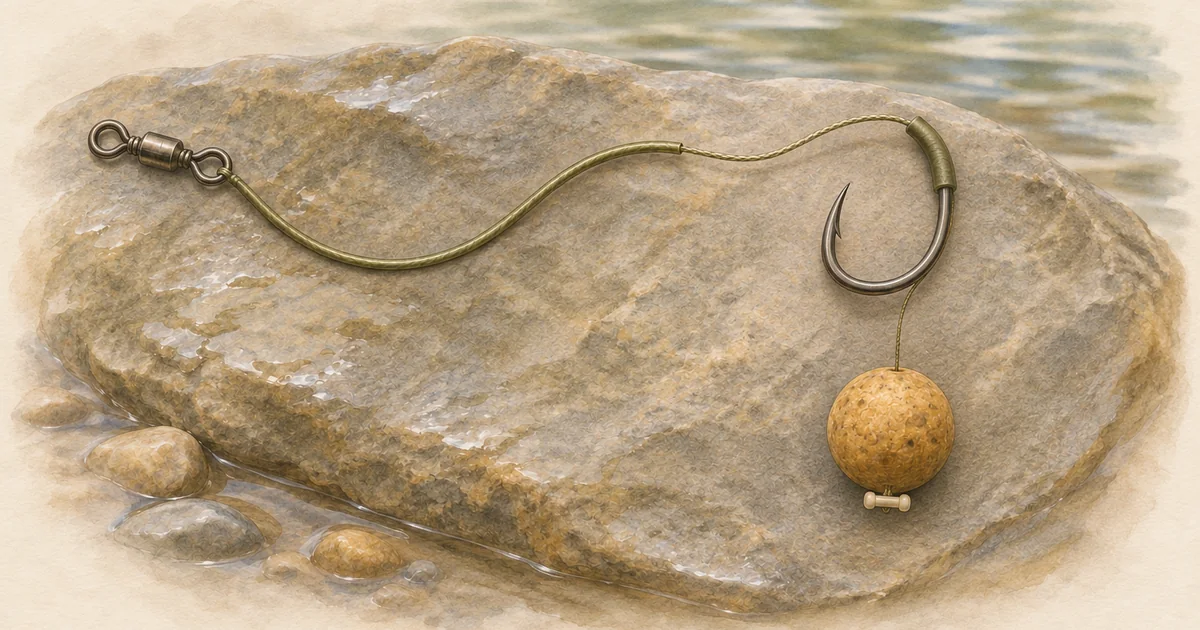
Soft braid
Braided hooklength without a coating hugs the bottom, the carp can suck in the bait easily, and the hook turns well into the mouth. Blinker considers a breaking strain of 25 lbs, around 11,3 kg, enough for the vast majority of waters. On the downside it tangles more easily, stands up less well to abrasion on mussels and dead wood, and the bait often ends up close to the lead.
Coated braid
Here a soft braided core sits inside a stiff coating, known in English as semi-stiff. If you strip the coating off at one point, you create a hinge: stiff against tangles, supple at the hook. According to Blinker this material often sinks quickly and is more abrasion-resistant than soft braid. Blinker sees it as a good choice in many situations, but not for the chod rig, a pop-up rig made from particularly stiff material.
Mono and fluorocarbon
A hooklength becomes stiff when it is made of monofilament line from about 0,40 mm, of fluorocarbon or of chod filament, a very stiff mono. It tangles less often, copes with abrasion and pushes the bait away from the lead. Once the carp has the bait in its mouth, it finds it harder to blow it out again. On the other hand, it finds it harder to suck in, and on contact the stiff material can spook wary fish. Blinker calls fluorocarbon practically invisible in the water, but it is less supple and holds less in the knot. How much of that invisibility really holds up is examined on the Fluorocarbon page.
Which material when
| If … | then … | because … |
|---|---|---|
| short casts or placed by boat, hardly any small fish | soft braid | the bait lies naturally |
| soft, silty bottom | soft braid, a little longer | stiff material sticks up when the lead sinks in |
| long casts, current, lots of silverfish or crayfish | stiff mono or fluorocarbon | it tangles less often |
| pop-up on a chod or spinner rig | stiff material | the rig must be able to rotate freely |
| mussels, dead wood | coated or stiff | soft braid is more likely to chafe through |
| all other cases | coated braid, end stripped | stiff on the cast, supple at the hook |
Tangles are also prevented by a heavier bait, a PVA bag and anti-tangle tubing that is longer than the hooklength. The exception at the large ring swivel is explained in Stoppers, beads and shrink tube.
Small parts on the rig
Hair and hair stop
The hair should be supple so that the bait moves naturally in the water; according to Blinker, thick mono is out of place here. Blinker says the easiest way to make it is with the no-knot, using the end of the hooklength itself. Between the bend of the hook and the bait, Blinker gives one centimetre as a good guide, and at most five millimetres for a pop-up, a buoyant boilie. If the hair is too short, hook and bait jam against each other and find no hold. How the bait goes onto the hair with a needle is shown in Boilie needle and boilie drill.
The hair stop, also called a boilie stop, is a small plastic part that sits crosswise in the hair loop and holds the bait. Two small baits on the same hair come apart when silverfish pluck at them, unless a silicone stop holds the package together.
Rig ring and micro swivel
On stiff mono the classic hair is of little use. The hook sticks out at all angles, and a thick loop knot can split soft baits. That is why a D-rig is tied there: the stiff hooklength forms a loop shaped like a D along the hook shank, and a small metal ring or a micro swivel slides on it. The bait hangs from it on waxed thread; according to Blinker, ordinary dental floss does the job just as well. This lets you change the bait size without retying, although bream can pull off a bait that is only held by a melted blob. A small rubber bead on the hook, the hook bead, keeps such rings in place.
Shrink tube, line aligner and putty
A piece of shrink tube over the hook eye is heated and turns the hooklength so that it leaves towards the hook point. As a line aligner, according to Blinker, it gives a more aggressive hook angle. Angling Times explains why: the tube moves the hook’s pivot point further away from the point. The hook only turns once more of it is in the mouth, and the point takes hold further inside the mouth. On the spinner rig the hook hangs in a swivel and is secured with a piece of tube, so it can be changed without cutting the hooklength.
The hooklength should lie on the bottom. If it sticks up, a feeding carp can easily catch it with a pectoral fin and take fright, Blinker warns. As a remedy the article suggests one or two small shot or putty on the hooklength. There is also putty enriched with tungsten. More on this under Lead-free weights and Lead in angling.
Carp hooks: eye, shank, bend
The eye must be fully closed, because a sharp edge at a gap can chafe through hair and hooklength. An in-turned eye, one that points towards the point, sets the hook more aggressively. If it is turned in to an extreme, the hook works during the fight and can tear a large wound. An out-turned eye is common on the chod rig with a pop-up, while a straight eye is seen as the all-round solution.
The eye must match the material. Blinker recommends hooks with a straight or forward-pointing eye on soft braid and hooks with a backward, that is out-turned, eye on stiff material, otherwise the hook angle is wrong. A slightly curved shank, known in English as a curve shank, transfers the force better to the point, according to the Blinker article. A wide bend, known in English as a wide gape, takes more tissue in the fleshy carp mouth but transfers the force less well. General information on bend shapes and size numbers is under Fishing hook.
There is no fixed rule for size, and a size 4 is not the same size from every manufacturer. As a guide, Blinker gives size 8 for a 12-mm pop-up on the spinner rig, size 6 for 15 mm and size 4 for 20 mm, and size 4 for an 18- or 20-mm boilie on the hair rig.
Length and breaking strain
Blinker gives 10 to 40 cm as the usual range and 15 to 30 cm as the best range. The article considers more than 50 cm too long. Another Blinker article recommends at most 20 cm to prevent tangles, and a short hooklength also helps the self-hooking effect. On a soft bottom it can be longer. Angling Times explains why: if the lead sinks into the silt, it pulls a short hooklength in with it, and the bait ends up hidden.
For breaking strain Blinker says no less than 15 lbs, about 7 kg; dedicated carp hooklengths usually have 25 to 35 lbs. Where mussels, stones or plants rub against the line, it can be more. The unit converter turns pounds into kilograms.
Worked example: A hooklength rated at 25 lbs holds around 25 × 0,454 kg = 11,3 kg. For braided main line Blinker gives 10 to 20 kg. If you have spooled up with 10 kg braid, the hooklength is stronger than the main line, and on a snag the main line may break first. In that case use a hooklength of 20 lbs, around 9,1 kg, or a stronger main line. What is left after the knots is worked out by the line calculator.
Fish welfare: lead loss and hook choice
If the main line breaks, no carp should stay tethered to a hooklength and lead. In its guidance, the English anglers‘ body Angling Trust therefore advises building the rig so that the lead can come free on a snag or a tangle, and recommends a hooklength with a lower breaking strain than the main line. That way as little line as possible is lost on a snag. How a safety clip and leadcore need to be set up for this is explained under Leadcore and safety clip.
On hook size there is a trial by researchers from Humboldt-Universität Berlin and the Leibniz-Institut für Gewässerökologie und Binnenfischerei (IGB), published in 2008. It was fished with a fixed lead, a 15 cm hooklength and three grains of sweetcorn on the hair, comparing size 6 and size 1 hooks. The small hooks caught more and bigger carp and caused less tissue damage. There was no difference in bleeding. Of 88 carp landed, none was hooked deep in vital organs; most were hooked in the lower jaw.
In the Bavarian question bank for the angling exam (Fischerprüfung), the single hook is the correct answer for cyprinids, the heavy-wire hook for barbel and carp, and size 8 or larger counts as ethical for carp. That is exam material, not a regulation. Which rigs and hooks are allowed on your water is set by state law and the water rules, see Fishing permit (Erlaubnisschein) and water map. More on hook shape and break-offs is under Fish-friendly tackle.
Tying it and checking before the cast
Tying a combi hooklength
- Cut to length: Cut off 30 to 35 cm of coated hooklength material.
- Strip: At one end, peel off about 10 cm of coating with your fingernails or a tool.
- Hair loop: Tie a small loop in the supple end.
- Attach the hook: Pass the coated end through the eye from the outside in, set the length of the hair and secure the hook with the no-knot.
- Line aligner: If needed, slide a piece of shrink tube over the eye and the whipping and shrink it tight with heat.
- Bait: Thread on the bait and secure it with a stop; the swivel or a loop goes on the other end, such as a figure-of-eight loop. Blinker straightens a kinked hooklength over hot steam.
Blinker recommends tying hooklengths at home for different bait sizes and bringing them to the water labelled on a rig board. Storage and designs are shown in Hooklength box and rig board.
Checklist before the cast
- Hook point: Set the point vertically on your fingernail and tilt it. If it slides, it is blunt. Check again after contact with mussels or stones.
- Eye: fully closed, no edge against the hooklength.
- Hair: bait sits firmly, stop crosswise in the loop, about 1 cm gap to the bend.
- Tube: line aligner is in place, the hair has not wrapped around the shank.
- Anti-tangle tubing: longer than the hooklength.
- Lead: comes off the clip with little force.
- Breaking strain: hooklength weaker than the main line.
Common mistakes
- Tying the hair too short. If the boilie sits tight against the bend, hook and bait jam. Pull the bait across the back of your hand: if the point finds no hold, the hair is too short.
- Stiff hooklength on silt. If the lead sinks in, the hooklength sticks up at an angle with the bait.
- A hair made of thick mono. The hook sticks out and the loop knot can split the bait. On a stiff hooklength the bait belongs on a ring.
- A hooklength that is stronger than the main line. Then more line stays in the water after a break-off.
- Simply fishing on after a snag. Mussels and stones blunt the point. One Blinker author calls sharpness the most important feature of his rigs and checks it before every cast.
Frequently asked questions
Which hooklength for your first carp sessions?
Soft braid with a simple hair rig. According to a Blinker article on the basics, it is enough on most lakes and rivers; stiff and combi hooklengths are mainly needed on difficult waters.
What colour should the hooklength be?
According to Blinker, dark colours such as green, brown or black have proved their worth. In coloured water carp hardly see the hooklength anyway. In clear, heavily fished waters a colour that matches the bottom, or fluorocarbon, can help.
Can I use dental floss instead of bait floss?
Yes. According to Blinker, waxed bait floss is nothing other than dental floss. Melted, it forms a blob that holds the bait on the ring.
Related
- Hair rig: fixed lead and hair tied step by step
- Leadcore and safety clip: how the lead comes free after a break-off
- Hooklength box and rig board: tying hooklengths in advance and storing them tangle-free
- Stops, beads and shrink tube: the other small parts of the rig
- Fishing hook: parts, size numbers and sharpness
- Fish-friendly tackle: hook choice and break-offs from the fish’s point of view
- Carp fishing: feed, choosing a spot and tackle at a glance
- Line calculator: compare the breaking strain of hooklength and main line
Sources
- Blinker: Karpfen, das richtige Vorfach: weich, steif oder ummantelt? (drei Materialgruppen, Stärken und Schwächen, 25 lbs, Öhrstellung je Material, Wahl nach Situation)
- Blinker: Karpfenmontage, die besten Rigs im Überblick (Kombi-Rig binden, Hakengröße zum Boilie, Länge, Tragkraft, Farbe, Fluorocarbon, Vorfach am Grund, Pop-up-Haar) und Blinker: Karpfenangeln Grundlagen (weiches Geflecht reicht meist)
- Blinker: Haarlänge bei der Karpfenmontage (weiches Haar, 1 cm, Handrücken-Probe, D-Rig, Rig-Board) und Blinker: Boilie anködern mit Miniwirbel (Mono-Haar, D-Rig, Zahnseide, Silikonstopper, Köderdiebe)
- Blinker: Der perfekte Karpfenhaken (Öhr, Schenkel, Bogen) und Blinker: Spinner-Rig (Haken im Wirbel, Hakengrößen zu Pop-ups)
- Blinker: Die Haarmontage (Silikon am Haar, Schrumpfschlauch, Wasserdampf), Blinker: 5 Tipps gegen verwickelte Montagen (Länge bis 20 cm, Schlauchlänge, schwerer Köder) und Blinker: Angeln mit Pop-Ups (Hook-Bead, Knetblei mit Wolfram)
- Blinker: 7 Fehler beim Karpfenangeln (Schärfe, Prüfen vor jedem Wurf, Haken samt Vorfach tauschen), Blinker: Karpfenschnur (Fluorocarbon als Vorfach, Geschmeidigkeit, Knotenfestigkeit) und Blinker: Karpfen-Kickstart (Tragkraft geflochtener Hauptschnur)
- Angling Times: How to land every carp you hook (Nagelprobe, längeres Vorfach auf weichem Grund, Drehpunkt des Line-Aligners) und Angling Times: The safe bolt rig (Blei löst sich, Vorfach schwächer)
- Angling Trust: Best Practice Guide for Freshwater Angling (PDF) (Blei muss freikommen, Vorfach schwächer, örtliche Regeln)
- IGB: The importance of hook size in recreational angling for large common carp (Fisheries Research 2008) (Hakengröße 6 und 1, Fang, Verletzung, Hakensitz), dazu der Volltext der Studie (PDF) (Versuchsaufbau)
- Bayerische Landesanstalt für Landwirtschaft: Prüfungsfragen zur Fischerprüfung 2023/2024 (PDF) (Fragen 4.045, 4.050, 4.051: Haken für Karpfen)
Text AI-assisted, drawings AI-generated. Sources opened and checked in November 2026, no graphics taken from the sources.
All information is for guidance only and without guarantee. Which hooklength suits depends on bottom, casting distance and bait; which rigs are allowed is set by the water rules.