
Knowledge · Tackle
PVA: Bags, string and mesh that dissolve in water
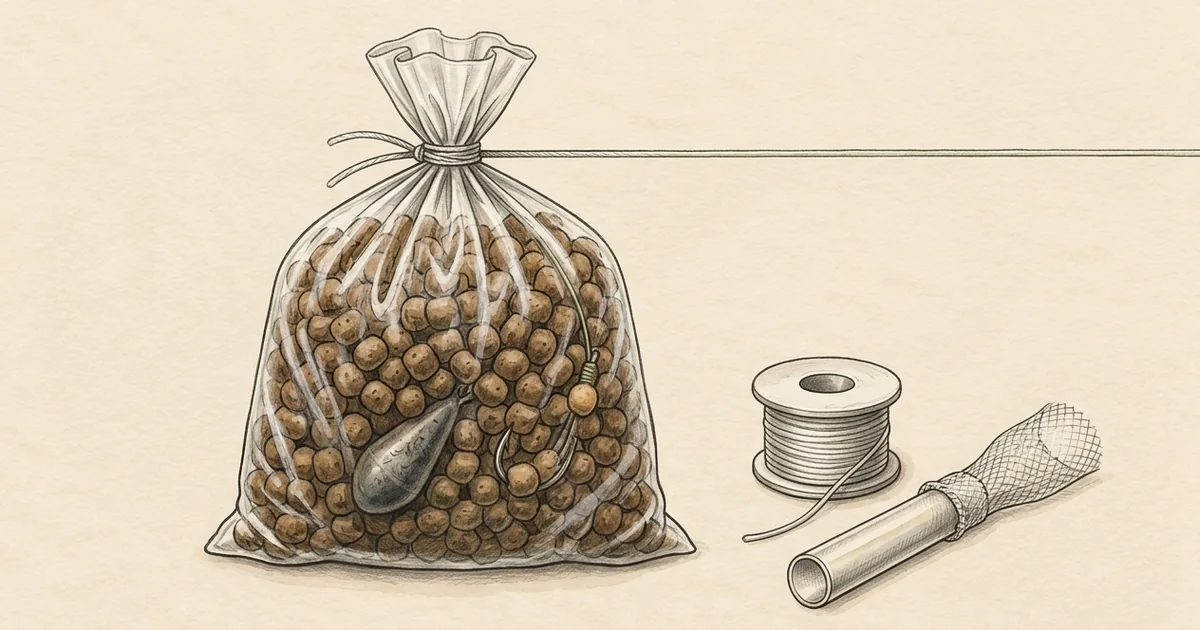
PVA is a plastic that dissolves in water. A PVA bag takes a small portion of feed down to the bottom together with the hookbait and often the lead too, and releases everything there, right next to the bait. Whether this works depends on a dry filling, the water temperature and the right type.
Material: polyvinyl alcohol
PVA stands for polyvinyl alcohol. It is made from a related plastic, polyvinyl acetate, whose acetate groups are split off chemically. Specialists call this hydrolysis or saponification. According to a review article in the journal Polymers, how far it goes determines the solubility: fully hydrolysed polyvinyl alcohol is highly crystalline and dissolves only to a limited extent, while partially hydrolysed polyvinyl alcohol with remaining acetate groups dissolves better. Blinker also writes that solubility depends on how it is treated during manufacture.
Warm water dissolves PVA faster. Numerous studies have shown this, writes a research group from the Korea Institute of Industrial Technology in the same journal; stirring also speeds up the process. Angling Times speaks of a few seconds to minutes, depending on water temperature. That is why there is summer and winter PVA. Summer PVA lasts longer in warm water so that it does not dissolve before the rig reaches the bottom. Winter PVA releases the feed quickly in cold water (Blinker). A water thermometer shows how warm it is at your swim.
Oil, on the other hand, does not attack PVA. The Lexikon der Chemie from Spektrum describes polyvinyl alcohol as insoluble in all common solvents and mentions oil-resistant hoses made of the material; Wikipedia describes it as resistant to oils and greases. That is why Blinker and Angling Times put oily attractants into the bag, but not water.
Store it dry
PVA absorbs moisture from its surroundings, writes the Korean research group. In practice, according to Blinker, high humidity alone is enough to start dissolving the bags or stick them together, after which they are useless. So keep PVA in a tightly sealed tub or a zip-lock bag, including on the bank when it rains. According to Angling Times, pre-tied bags also go into an airtight container.
Designs: bag, mesh, string, tape and foam
Blinker divides the range into three groups: string and tape, bags and mesh material. Angling Times also includes foam nuggets for the hook.
| Design | What it suits | Property |
|---|---|---|
| Solid bag made of film | small pellets, stick mix, crushed boilies, even the whole rig | compact, casts far, hook lies protected |
| Mesh from the tube | whole and crushed boilies, pellets, particles, maggots | quick to tie, dissolves faster than the film bag |
| Line | several boilies as a stringer | thin, the balls need gaps |
| Tape | stringers, tying bags shut | holds baits in position better, dissolves better than string |
| Foam nugget | Hook point | protects against weed, floats up once dissolved |
The solid bag is a pouch made of PVA film. Because the hook lies protected inside, it can be fished over almost any bottom, according to Angling Times. The mesh comes as a long tube on a plastic tube. You knot one end, pour feed in through the tube, compress it with the plunger, a stick that usually comes with it, and knot the second end (Blinker). Angling Times gives lengths of five and ten metres in one piece and diameters from 15 mm for two or three boilies up to 25 mm for larger portions.
On string or tape you thread several boilies with a long boilie needle and hang them on the hook; this is called a stringer. Leave space between the balls. If they stick together, the PVA cannot dissolve in the water, according to Blinker. The wider tape dissolves better because of its larger surface area and holds the balls more firmly in place. That is why Angling Times rates it ahead for long casts. You push the foam nugget onto the hook point before casting. It keeps weed away until it dissolves. If it has not been squashed, it dissolves quickly and floats up: then you know the rig is fishing (Angling Times).
What can go in the bag
The rule is short: dry or oily. Anything wet dissolves the film from the inside. Blinker warns that even particles that are too damp can dissolve the bag on the bank. This list helps when packing:
- Suitable: small, hard pellets. Angling Times gives a maximum of about 3 mm, because the bag can be packed tightly with them and flies further.
- Suitable: stick mix, a dry, fine feed for PVA, plus dry groundbait and whole or crushed boilies.
- Suitable: maggots, worth a try especially in winter, according to Blinker.
- Suitable: oily attractants and liquids that are considered PVA-friendly, i.e. do not dissolve the material. Blinker injects oil-based attractant into the finished bag with a syringe.
- Only with plenty of dry fine feed: tinned sweetcorn and other moist particles (Blinker).
- Not suitable: water-based liquids and feed mixed wet. According to Blinker, you also only dampen feed for mesh sticks slightly, so that it does not attack the mesh.
A carp angler in Angling Times advises using little powder: as it dissolves, it rises instead of staying on the bottom as a compact pile. He only uses sinking ingredients. How hard pellets are mounted on the hair is explained under Pellets.
Use in carp, feeder and river fishing
Carp
In carp fishing, the bait lies on a small pile of feed, the rig does not tangle during the cast and sinks less into weed or silt (Blinker). Because the carp feeds calmly on the feed, Blinker advises a short hooklength so that the self-hooking effect works quickly. Material and length are explained on the Carp hooklength page. A carp angler in Angling Times uses no lead under 3 oz, about 85 g: lighter leads could let the bag tip over on the bottom, and then the rig lies covered. When a solid bag dissolves, its contents cover the lead and hooklength, but not with a mesh bag, the article goes on.
If you have built up a larger baited area with the spod, you cast the bag over it. That way there is a denser portion at the bait, as an angler in Angling Times describes. For long casts, the same angler fishes with a shock leader, a stronger piece of line in front of the main line. You can compare breaking strains in the line calculator. Whether leadcore is allowed is stated in the water rules (Gewässerordnung); details under Leadcore and safety clip.
Coarse fish and feeder
Blinker also uses bags for tench over soft silt. They sink more slowly than a lead and, thanks to their large contact area, hardly sink into the mud. For a longer-lasting attraction, the author mixes ingredients that dissolve one after the other: stick mix for the first scent, then 2-mm pellets, then 6-mm pellets, and finally crushed boilies and small boilies.
For match fishing for carp, Angling Times describes small mesh bags as an alternative to the method feeder, the flat feeder from the Feeder page. In the mesh you can offer hard pellets instead of soaked ones, even 4 and 6 mm in size. A fast-dissolving mesh of 20 mm diameter is considered suitable there, with a lead of 1,5 oz (about 43 g) up to 40 m and 2 oz (about 57 g) beyond that. The unit converter helps with converting.
River
For barbel, Angling Times sets up the swim with heavy balls of feed. Then you fish with a lead and mesh bag first above the feed and afterwards cast step by step about one metre further downstream.
Tying a solid PVA bag, step by step
The sequence follows the compact version from Blinker, in which the whole rig sits inside the bag. Angling Times also describes bags with the lead at the bottom and the bait at the top.
- Work with dry hands and only take the bag you need right now out of the tub. Close the tub again straight away.
- Use a short hooklength. Blinker gives a maximum of 10 cm, Angling Times 4 to 6 in, i.e. about 10 to 15 cm. If it is longer, thread it through the bag, bait up only afterwards and push the hook into the bottom of the bag from the outside.
- Put a pinch of fine, dry feed into the bottom. That is where the hook point will sit later. If it spears a coarse piece of feed, missed bites are likely, according to Blinker.
- Put the bait and hook in, with the point facing the bottom of the bag.
- Top up with small pellets. Tap the bag on the palm of your hand as you do so to settle the filling.
- Put the lead in last and cover it with a little feed. The line leads out of the top of the bag.
- Twist the neck tight, squeezing the air out as you do so. Wrap PVA tape around it twice, tie a simple overhand knot and cut off the excess.
- Moisten just the corners slightly and press them against the bag. Rounded off, it flies further.
- Prick a few holes in it with the boilie needle. Trapped air escapes, the bag sinks faster and dissolves faster.
According to Angling Times, the bag is well packed when it feels as hard as a cricket ball, i.e. like a firm leather ball. Do not tie it too big: a fat bag costs a lot of casting distance.
Test the dissolving time beforehand: put a piece of empty film or mesh into a cup of water from the venue and time how long it lasts. Angling Times advises trying out the right dissolving time. If it goes very quickly, a bag may open while it is still sinking.
Environmental question: dissolved does not mean broken down
In the water, PVA disappears from view, but that does not mean it has left the water. A group at Arizona State University compares the dissolving to salt and sugar. Whether microorganisms then break down the dissolved plastic depends on the conditions.
PVA is considered biodegradable because microbes can decompose it under certain conditions. The review article in Polymers counts degradability among its properties. The researchers from Arizona add a caveat: bacteria that decompose PVA are rare in conventional sewage treatment plants and in the environment. Thorough breakdown in the activated sludge of a treatment plant requires microbes that have adapted to PVA.
These sources do not answer how PVA from fishing tackle behaves in a lake or river. The question is open. What you can do yourself: use it sparingly. Blinker points out that large amounts of feed burden a water and that one filled bag is often enough. Take cut-off scraps and bags that have become unusable home with you, like everything else for a clean fishing spot. How much feed you may put in is set out in the water rules (Gewässerordnung) and fishing permit (Erlaubnisschein), with examples under Groundbaiting.
Common mistakes
- Damp hands, wet feed. Even the damp surface of particles can start to dissolve the bag on the bank. Only pack tinned sweetcorn with plenty of dry fine feed.
- Water in the bag. Water-based attractants dissolve the film from the inside. Only oily or explicitly PVA-friendly additives go in the bag.
- Coarse feed on the hook point. If the hook spears a solid piece when you push it in, you get missed bites. Only fine feed goes at the bottom of the bag.
- Type does not suit the water. Winter PVA dissolves so quickly in warm water that the bag can open before reaching the bottom. Summer PVA dissolves poorly in cold water (Blinker).
- Air in the bag, bag too big. It sinks more slowly, dissolves more slowly and flies a shorter distance. Pack it tightly, tie it small, prick it with the needle.
Frequently asked questions
Is PVA the same as PVA glue?
Not necessarily. The abbreviation is ambiguous in the shops (Wikipedia). It stands for polyvinyl alcohol, but also for polyvinyl acetate, which according to the Lexikon der Chemie is found mainly in paints and adhesives. In angling, PVA means water-soluble polyvinyl alcohol.
Which attractants can PVA bags handle?
Oils and liquids that are labelled as PVA-friendly. Polyvinyl alcohol is resistant to oils and greases, whereas water-based liquids start to dissolve it. If in doubt, put a drop on a piece of film and wait.
Can I tie bags at home in advance?
Yes, Angling Times recommends it, storing them in an airtight container. A carp angler reports there that pre-tied bags get firmer over time. A floating bait changes its buoyancy after weeks in the bag, he says, but artificial corn does not.
Related
- Carp fishing: self-hooking rig, feed and choice of swim
- Carp hooklength: material, hair rig and rig accessories
- Boilie needle and boilie drill: baiting the hair and threading stringers
- Spod rod and spod: larger amounts of feed at distance
- Feeder: method feeder and other feeders compared
- Pellets: sizes, hardness and attachment
- Attractants, flavours and dips: what works in the water
- Line calculator: breaking strain of main line, shock leader and hooklength
Sources
- Blinker: Karpfenangeln mit PVA (Sommer- und Winter-PVA, Gruppen, Stringer, Band, Netz, feuchte Partikel, Liquids)
- Blinker: Das kommt mir in die Tüte, PVA richtig einsetzen (Montage im Beutel, Hakenspitze, Luftlöcher, Lagerung, Dosenmais, Maden, Vorfach, Futtermenge)
- Blinker: PVA-Bags mit Langzeitwirkung (Herstellung, Luftfeuchtigkeit, Schlammgrund, Futtermischung, Öl, Ecken)
- Angling Times: A guide to fishing with PVA (Bauformen, harter Beutel) und How to fish for carp using PVA (Wassertemperatur, Futter bis 3 mm, Netzmaße)
- Angling Times: Solid vs mesh PVA bags (Blei, Inhalt deckt Montage) und Foolproof guide to solid PVA bags (Pulver, Vorbinden, Binden, Schlagschnur)
- Angling Times: Using PVA bags rather than the method (harte Pellets, Netz, Blei, Test) und Use the lead and PVA to catch more barbel (Fluss)
- Polymers, Petru-Poni-Institut Iasi: Polyvinyl Alcohol-Based Membranes, a review (2025) (Herstellung, Verseifungsgrad, Abbaubarkeit) und Polymers, Korea Institute of Industrial Technology (2025) (Wärme, Feuchtigkeit)
- Arizona State University: Degradation of Polyvinyl Alcohol in US Wastewater Treatment Plants (2021) (Lösen, Abbau nur unter bestimmten Bedingungen)
- Spektrum, Lexikon der Chemie: Polyvinylalkohol (wasserlöslich, unlöslich in Lösungsmitteln, ölbeständig, aus Polyvinylacetat) und Polyvinylacetat (Lacke und Klebstoffe)
- Wikipedia: Polyvinylalkohol (Öle und Fette, Abkürzung, Verseifungsgrad, nur ergänzend)
Text AI-assisted, drawings AI-generated. Sources opened and checked in November 2026, no graphics taken from the sources.
All figures are guide values without guarantee. Which type of PVA is suitable depends on water temperature, feed and casting distance, and how much you may feed is set out in the water rules and fishing permit.