
Knowledge · Tackle
Water thermometer: Measuring temperature and finding fish
A water thermometer shows you where the water is just as warm as your target fish likes it and at what depth the thermocline lies. According to a practical article in Blinker, even one degree of difference between two spots in a lake can decide whether you catch. That is why you measure at several spots and in steps down to the depths.
What the temperature tells you about where fish hold
Fish take on the temperature of the water they are in, and their appetite depends on it. The Landesanglerverband Brandenburg (LAVB) describes two limits: if it gets warmer than the range a species tolerates, it becomes stressed and feeds less. If it gets colder, circulation and energy needs slow down, and hunger fades. Temperature, oxygen and pH also differ markedly from spot to spot at the same time, so a single reading says little about the whole lake. Why warm water holds less oxygen and how a lake stratifies is explained under Water temperature and oxygen.
The table translates readings into what the sources of the fish pages say about individual species. They are guideline values from specialist magazines and associations, not switches that turn biting on or off.
| Water | Species | What the sources say |
|---|---|---|
| below 4 to 7 °C | Wels catfish | stops feeding (Blinker) |
| deepest winter | Burbot | biggest appetite of the year (LAVB) |
| below 8 °C | Carp | bites still very hard to come by, more frequent above 10 °C (Rute & Rolle) |
| below 10 °C | Zander | sluggish, a slowly worked bait suits (Blinker) |
| around 10 °C near the bank | Eel | becomes active; much colder: winter torpor (Blinker) |
| 10 to 15 °C | Pike | preferred range, the bait can run faster (Blinker) |
| 8 to 16 °C | Brown trout | optimum range (Blinker) |
| 12 to 18 °C | Trout in general | active and hungry, from anglers‘ experience (LAVB) |
| above 20 °C | Brown trout, grayling | critical, too warm in the long run (Canton of Solothurn, Blinker) |
| above 20 °C | Carp | feeds more (LAVB) |
A Blinker article on trolling for pike turns the figure into a boat speed: in early spring and late autumn 1,0 to 1,3 knots, around 10 °C 1,5 to 1,8 knots, between 10 and 15 °C 2,0 to 2,5 knots. Whether you may troll on your water is stated in the water rules (Gewässerordnung) and the fishing permit (Erlaubnisschein).
Three designs
Stick and floating thermometers
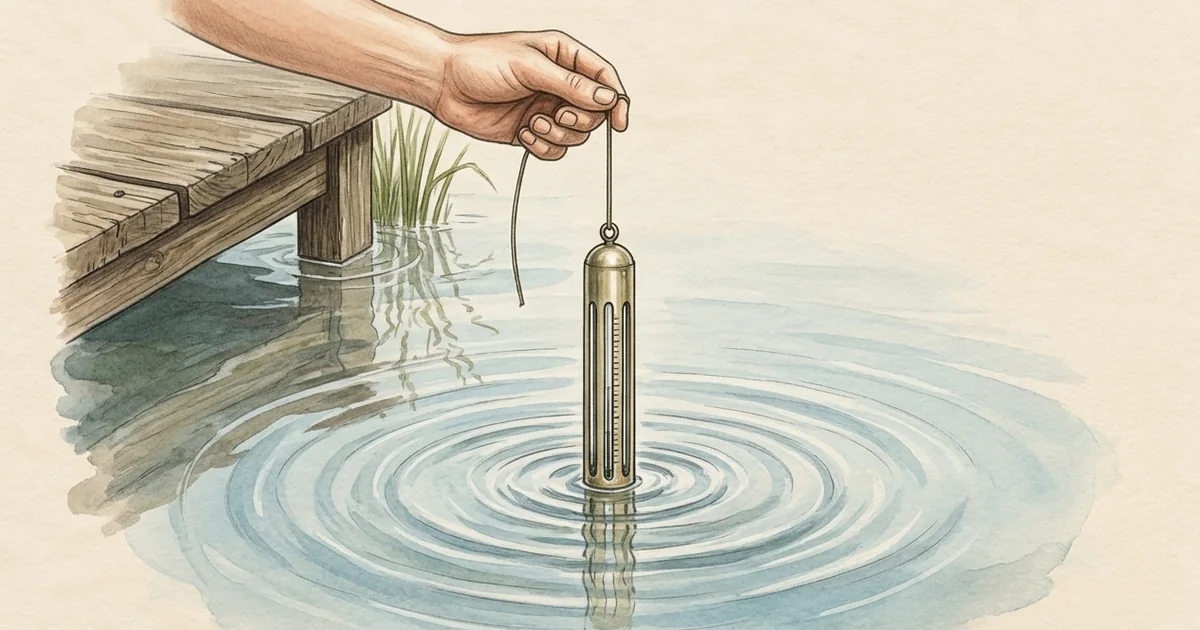
The simplest device hangs on a string in the water or floats on the surface. That is enough to start with: Fisch & Fang advises laying out an ordinary thermometer at different spots in a lake, and a carp angler in Rute & Rolle likewise measures at several spots along the bank in spring. The limitation: the device only shows the layer it happens to be hanging in.
Digital thermometer with cable probe
Here the probe sits at the end of a cable while the display stays in your hand. This lets you follow the temperature down step by step, from a boat, a jetty or through a hole in the ice. Blinker describes a variant: a small depth and temperature logger that is clipped into the swivel like a lure and cast out. As it sinks it records the temperature every 2 metres, and you read it after retrieving it.
In the monitoring network of the Bavarian State Office for the Environment (LfU), probes record the values every hour, and for checking, readings are taken by hand with calibrated bucket thermometers. Hold your own digital thermometer next to a second device now and then, too.
Fish finder with temperature display
According to Blinker, many fish finders can show the water temperature at the surface. That is the value right at the top, not the one at ten metres down. Even so, a sensitively set fish finder often shows the thermocline itself as a band, the more clearly the greater the temperature difference. How the transducer and display otherwise work is explained under Fish finder.
Measuring correctly: bank, open water and depth
Shallow water warms up faster than open water. For clear lakes, Blinker explains this by the sun shining through to the bottom there and heating it. In murky lakes, by contrast, the top layer of water already absorbs most of the radiation and so becomes warmer than the rest.
The wind distributes this warmth. According to a practical article in Blinker, large trout lakes in spring first warm up only a few centimetres deep, and the wind drives this water into shallow bays and onto the bank it is blowing towards. The trout then often cruise about one metre below the surface. Rute & Rolle sends carp anglers with a thermometer to the bank the wind is blowing onto. Fisch & Fang adds: from autumn to spring, carp tend to seek out the warmer zones, on very hot summer days the cooler ones. Which bank is warmer in winter is covered under The year at the water.
In summer, depth comes into play. The LfU calls the intermediate layer of a stratified lake the thermocline or metalimnion: there the temperature drops sharply, between warm surface water and cold deep water. According to Blinker, the depth and thickness of the thermocline depend on the season and time of day, and in deep lakes two or more can lie one above the other.
A temperature profile in six steps
- Mark the line or cable every 1 metre, for example with a knot or a piece of tape.
- First measure just below the surface, then deeper metre by metre until the probe reaches the bottom or you reach the depth you want.
- At each step, wait until the reading stops changing. The University of Rostock’s measuring instructions for oxygen probes call for the same: wait for the stable value first.
- Write down depth, temperature, time and spot, for example in the catch diary.
- For each metre, work out the difference from the value above. Where it is clearly larger than above and below, that is where the thermocline lies.
- Repeat the measurement at a second spot, for example over a shallow bay and over the deepest area.
Reading example with assumed values: at the surface the probe shows 21,0 °C, at 4 metres 20,3 °C, at 5 metres 19,5 °C. Then it drops quickly: 15,0 °C at 6 metres, 11,0 °C at 7 metres. Below that come 10,2 °C at 8 and 9,2 °C at 10 metres. Between 5 and 7 metres the temperature therefore drops by 8,5 degrees, a good 4 degrees per metre. Above and below, it is less than 1 degree per metre in each case. The thermocline here lies between 5 and 7 metres.
What you do with the profile depends on the oxygen. According to the LAVB, much less oxygen is dissolved in the deep water of nutrient-rich lakes in summer and early autumn, and most fish avoid these zones. At what depth your bait should then run is shown in an example under Water temperature and oxygen. If you measure from a boat, you will find the safety rules under Boat and life jacket.
Measuring oxygen and pH
For dissolved oxygen, the working instructions of the Zingst Biological Station of the University of Rostock name two types of device: the membrane-covered Clark electrode, which converts oxygen at a precious metal and measures the current, and optical probes (optodes), in which oxygen dims the glow of a dye. The instructions advise measuring directly in the water, calibrating to 100 per cent in moist air, noting saturation and water temperature, and regularly comparing with the Winkler titration. Temperature belongs with it because the saturation value depends heavily on it. A table on this is given under Water temperature and oxygen.
The time of day matters too. According to an article by the Leibniz Institute of Freshwater Ecology and Inland Fisheries (IGB) in the Nationalpark-Jahrbuch Unteres Odertal, oxygen saturation falls steadily at night without photosynthesis and reaches its lowest value shortly before sunrise. So if you measure on a hot afternoon, you will not see the critical moment.
For pH, according to the parameter sheet of the Lower Saxony Water Management, Coastal Defence and Nature Conservation Agency (NLWKN), 7 is neutral, below that acidic, above that alkaline, and surface waters are often between 7 and 8. If the value suddenly rises into the alkaline range, this can point to strong algal growth. In nutrient-polluted waters, a high pH also shifts ammonium towards ammonia, which is highly toxic to fish. For brown trout, the NLWKN states high mortality below pH 5,5. It gives its map values at 25 °C. So when measuring pH, note the water temperature as well.
Barometer and wind meter
A barometer measures air pressure, given in hectopascals; one hectopascal equals one millibar (Deutscher Wetterdienst). According to the LAVB, there is no consensus in research on any effect of air pressure on catch rates, and for pike no link was found. More under Weather, air pressure and wind.
Worked example: Near the ground, according to the DWD, air pressure falls by 1 hectopascal per 8,4 metres of altitude. If the reservoir lies 100 metres higher than your home, a barometer without altitude compensation will show around 12 hectopascals less there (100 divided by 8,4). According to Blinker, a change in the weather moves the pressure by only 10 to 20 hectopascals. So the drive alone looks on the display like an approaching low.
The technical term for a wind meter is anemometer. According to the DWD, the speed is derived from the rotation rate of the cup rotor, and a wind vane gives the direction. In spring, the direction tells you which bank the wind is pushing the warmed surface water towards. Weather at the water gives you the forecast for your day.
Official readings as a second source
Readings are also available from the federal and state governments. The LfU Bavaria’s monitoring network comprises 111 measuring stations on rivers and lakes; the first was set up in Augsburg in 1891, and the LfU links to current values from the Bavarian hydrological service (GKD). For the federal waterways, the Waterways and Shipping Administration provides daily updated data on Pegelonline, in November 2026 including water temperature at 141 gauges. The services go back no more than 31 days, and Pegelonline does not include state gauges. The Wasserportal Berlin also shows pH and oxygen. For the German Bight and the western Baltic Sea, the stations of the MARNET network of the Federal Maritime and Hydrographic Agency record the temperature automatically.
Note: Pegelonline and the Wasserportal Berlin label their current data as unchecked raw data. A measuring station in a flowing river also says little about a sunny bay a few kilometres away. Use official values for the trend over days and weeks, and measure again yourself on the spot.
Common mistakes
- Only measuring at the surface. Fish finders and floating thermometers show the top value. Only a stepped profile reveals where the thermocline lies.
- Taking one measuring point for the whole lake. According to the LAVB, temperature, oxygen and pH differ from spot to spot at the same time.
- Assuming the thermocline from last time. According to Blinker, its depth and thickness change with the season and time of day. Measure again on every trip.
- Reading too quickly. The Rostock measuring instructions, too, say to wait for the stable value first. A reading that is still moving is not a measurement.
- Comparing barometer readings from two places. Even 100 metres of difference in altitude shifts the display by around 12 hectopascals.
Frequently asked questions
How deep should water temperature be measured?
According to Blinker, lakes less than four to five metres deep are usually not stratified because the wind keeps mixing them. A few readings are enough there. In a deep lake in summer, measure metre by metre until, below the steepest drop, the temperature hardly falls any more.
Does the fish finder show the correct water temperature?
According to Blinker, it shows the value at the surface; for deeper water you need a probe on a cable.
Where can I find current water temperatures without my own thermometer?
For federal waterways on Pegelonline, for Bavaria from the hydrological service (GKD), for Berlin on the Wasserportal, for the North Sea and Baltic Sea from the BSH. Other states have their own portals.
From what water temperature is carp fishing worthwhile in spring?
Rute & Rolle says bites are still very difficult below 8 °C and become more frequent above 10 °C. Measure first in shallow, sunny bays.
Related
- Water temperature and oxygen: stratification, saturation and species limits
- The year at the water: what changes in the lake from spring to winter
- Fish finder: transducer, sonar cone and display types
- Plummet: measuring water depth without electronics
- Weather, air pressure and wind: what is proven about the weather
- Weather at the water: wind, rain and temperature for your fishing day
- Line calculator: line strength after the knot
- Inflatable boat and rowing boat: for measuring and fishing in open water
Sources
- Landesanglerverband Brandenburg, Beitrag des Instituts für Binnenfischerei: Beeinflusst das Wetter den Fangerfolg? (Stoffwechsel, Forelle, Karpfen, Quappe, Sauerstoff)
- Bayerisches Landesamt für Umwelt: Wassertemperatur (Messnetz, Sonden, Schöpfthermometer) und Der See im Jahreszeitenzyklus (Sprungschicht)
- Wasserstraßen- und Schifffahrtsverwaltung des Bundes: Pegelonline und Pegelliste mit Wassertemperatur (Rohdaten, 31 Tage, Zahl der Pegel)
- Senatsverwaltung Berlin: Wasserportal (Messgrößen, ungeprüfte Rohdaten) und Bundesamt für Seeschifffahrt und Hydrographie: Messnetz MARNET (Meeresmessstationen)
- Universität Rostock, Biologische Station Zingst: Arbeitsanweisung Sauerstoffsättigung (PDF) (Clark-Elektrode, Optode, Messablauf, Winkler-Titration) und Leibniz-Institut für Gewässerökologie und Binnenfischerei (IGB), Nationalpark-Jahrbuch Unteres Odertal: Temperaturtoleranz einheimischer Fischarten der unteren Oder (PDF) (Sauerstoffminimum vor Sonnenaufgang)
- NLWKN Niedersachsen: Parameterblatt pH-Wert 2021 (PDF) (Bedeutung, Bachforelle, Ammoniak, Orientierungswerte, Bezugstemperatur)
- Deutscher Wetterdienst, Wetterlexikon: Barometer, Luftdruck (Abnahme mit der Höhe) und Anemometer
- Blinker: Echoloteanzeige, Wassertemperatur und Sprungschichten (Echolot), So beeinflusst die Sprungschicht das Angeln und Im Frühling zeigt der Wind am Forellensee den Weg zum Fisch (Wind)
- Blinker: Schleppangeln auf Hecht (Geschwindigkeit nach Wassertemperatur) und Luftdruck beim Angeln (Schwankung bei Wetterwechsel)
- Blinker, Steckbriefe Wels catfish, Eel und Brown trout sowie Zanderangeln mit Gummifisch und Kanton Solothurn: Fischerei- und Betretungsverbot wegen Hitze, 13.07.2026
- Rute & Rolle: 5 Tipps für frühe Karpfen, Karpfen: unser Frühling, Karpfenangeln bei Fangwetter und Fisch & Fang: Dem Karpfen auf der Spur
Text AI-assisted, drawings AI-generated. Sources opened and checked in November 2026, no graphics taken from the sources.
All information is for guidance only and without guarantee. The temperature ranges of the species come from specialist magazines and association articles, official readings only apply to their measuring station, and every lake stratifies differently.