
Knowledge · Waters and fish behaviour
The year at the water
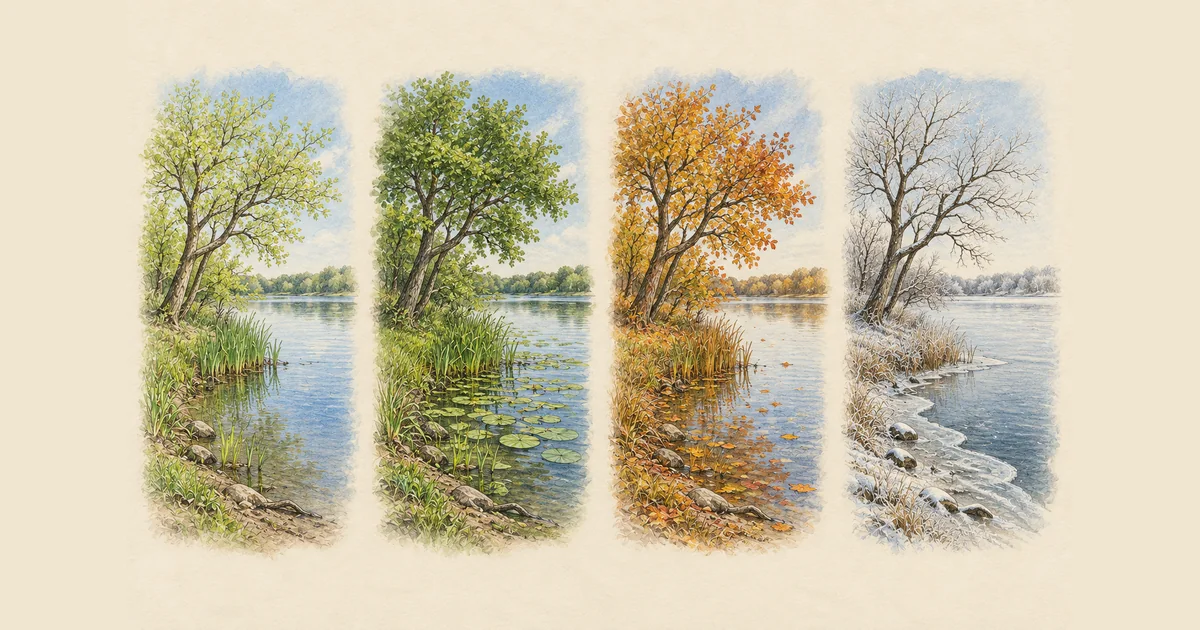
The year at the water follows the water temperature. It determines how a lake is layered, when fish spawn and when they feed. Here you go through spring, summer, autumn and winter, with guide values from specialist sources and tips for lakes and rivers.
The year at the water
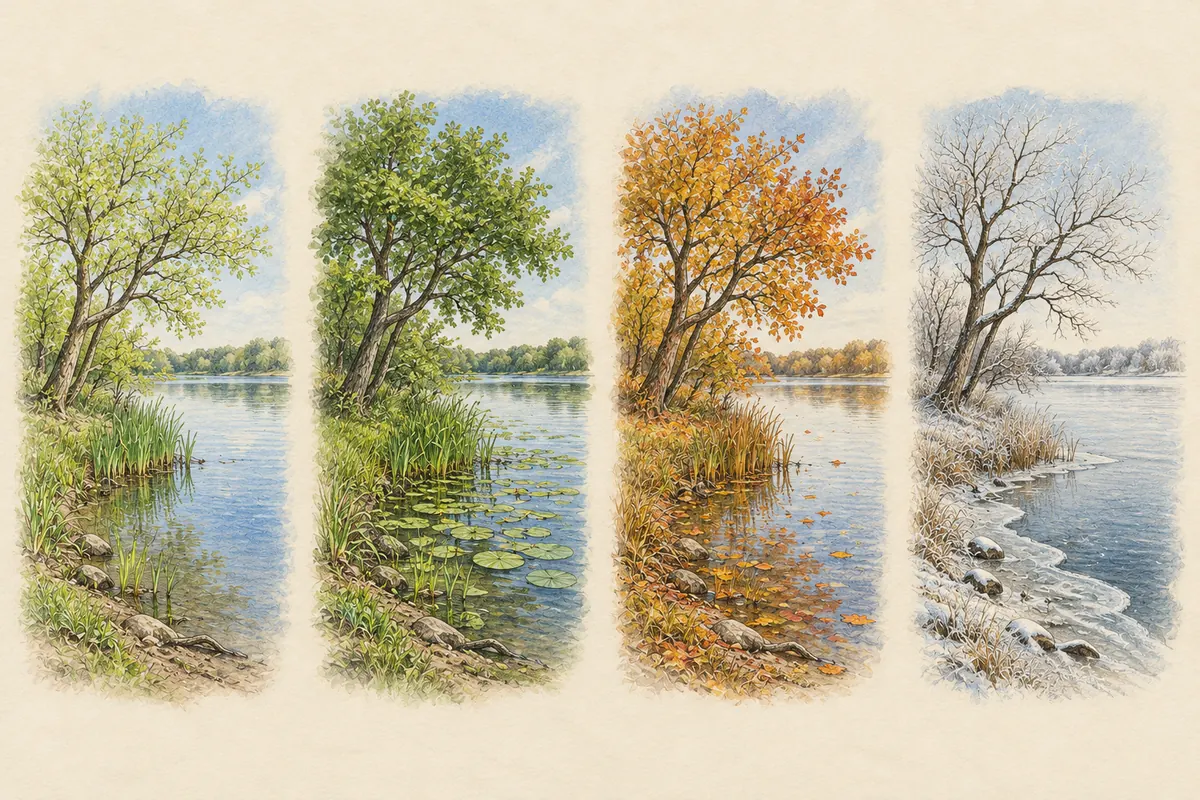
Fish are cold-blooded; their body temperature follows that of the water. According to the Landesanglerverband Brandenburg (LAVB), water above the range typical for the species causes stress and lowers activity and catchability; below it, circulation and appetite slow down. So every species has its own window. For trout the LAVB gives 12 to 18 °C as the range in which they are active and hungry; for carp, more than 20 °C increases food intake.
The calendar is only a rough aid, because the seasons shift from year to year and from region to region. More on warmth and oxygen is on the page Water temperature and oxygen, and the Catch calendar shows the months for each species.
Note: Measure the water temperature or watch what is happening in the water instead of going by the date alone.
Spring: warming and spawning
In deep lakes the wind mixes the whole body of water in spring (full circulation). According to the Lexikon der Biologie, nutrients and oxygen are exchanged between surface and depth in the process. After that the sun warms the shallows first. Blinker describes how carp, after a few warm days, move into the shallow water by the bank, where they can be reached with a float rod down to about a metre. Bites begin, according to Blinker, from about 8 °C, and at 10 to 12 °C the chances improve. In spring the feed should be put out sparingly and in a small area.
Many species now spawn in the shallows. According to the Landesfischereiverband Bayern (LFV), pike lay their eggs over shallow, vegetated banks, on flooded meadows or in ditches, and perch hang long strands of spawn on water plants and roots. The table shows spawning times according to the LFV fish encyclopaedia. They extend well beyond spring.
| Species | Spawning season | Season |
|---|---|---|
| Pike | February to May | Late winter, spring |
| perch | March to June | Spring |
| Roach | April to May | Spring |
| Zander | April to June | Spring |
| Tench | May to July | Early summer |
| Brown trout | October to February | Autumn, winter |
| Burbot | November to March | Winter |
Spawning describes nature; the closed season is a legal matter. It can differ and is set by your federal state (Bundesland), see Closed season and minimum size explained.
Summer: layering, oxygen and heat
Deep lakes stratify: warm, mixed water lies on top, cold water beneath. According to the Lexikon der Biologie, this layering exists only during stagnation in summer and in winter, because then there is no exchange between surface and deep water. The LAVB points out that the oxygen content in the deeper layers of nutrient-rich lakes and slow rivers is clearly lower in summer and early autumn than near the surface. Most fish avoid such zones or have hardly any appetite there.
For pike, the LAVB describes a falling catch rate with rising water temperature between 14 and 24 °C. During heatwaves you should therefore expect below-average catches. Activity shifts to dawn and dusk: the LAVB names morning and evening as the times of highest activity for most fish.
From practice, Blinker recommends for summer the time from about 4 to 10 o’clock in the morning and late evening; on overcast days the biting time lasts longer. Shade under water lilies, overhanging bushes, jetties and bridges attracts fish. The page Night fishing fits with this.
Note: Heat stresses fish. Keep the fight and unhooking short if you want to release the fish, and read Releasing a fish. In a thunderstorm rods do not belong at the water, see Thunderstorms and weather.
Autumn: mixing and feeding time
When the surface water cools, the layering breaks up. The Lexikon der Biologie describes for dimictic lakes of the temperate zones a wind-driven full circulation in spring and in autumn. Oxygen and nutrients are exchanged again right down to the depths.
For pike, Blinker gives 10 to 15 °C as a pleasant range. Then, it says, pike feed again throughout the day and can be caught even in a metre of water over dying weed and water lilies. In the Catch calendar, zander reach their main season from September, pike from October and perch in September and October. More on the species is under Pike, Zander and Perch.
Not all fish spawn in spring. According to the LFV, the spawning season of brown trout begins in October and runs until February, and for Alpine char it lasts from October to December. For this the brown trout moves into the tributaries and digs pits in the gravel in shallow, flowing areas. Here too, observe the closed seasons of your federal state.
Winter: cold and standstill
Water is densest at about 4 °C. As the Lexikon der Biologie describes, water at this temperature sinks to the bottom and forms an overwintering space for the creatures in the lake in winter. Below 5 °C the metabolism runs only very slowly according to Blinker; the fish are sluggish and hardly chase prey over longer distances. Baits are therefore offered quietly and close to where the fish stand, more slowly than in summer.
Where do the fish stand? In deep lakes, according to Blinker, mostly in the deepest areas, and pike in reservoirs sometimes at 20 metres. In a lake that is shallow throughout, about three metres deep for example, Blinker advises the bank the wind blows away from, because warmer water moves up from below there. In harbours and town waters the water is often a few degrees warmer. According to the LFV, bream overwinter in large shoals in deeper, sheltered spots, tench lie buried in the mud and the wels catfish rests without food. The burbot is the exception: the LAVB describes its hunger in the depth of winter as the greatest, and its spawning season runs from November to March according to the LFV.
Then there is the ice. The Senatsverwaltung für Umwelt in Berlin writes that under long-lasting ice cover, especially in small lakes and ponds, oxygen shortage and fish kills can occur. For people, the DLRG gives at least 15 to 20 centimetres of ice thickness before stepping onto it can be risked at all; dark patches indicate ice that is too thin. More can be found under Walking on ice and Ice fishing.
Running waters through the year
In a river, water level and turbidity come into it. In winter, according to Blinker, fish withdraw from the strong main current into calmer zones, such as groyne fields or harbours. Ice forms first where the water hardly flows; deep outer bends and stream mouths stay open longer. Rain and snowmelt cloud the water, and according to Blinker such phases in winter lure fish out of the depths into shallower areas. In high water the banks are slippery, see Bank and waders. Which fish live in which stretch of river is shown by Fish zones in the river, more on reading the current under Reading the current.
Common mistakes
- Fishing by the date instead of by the water: the seasons shift, and the temperature shows where the water stands right now.
- Working too fast in winter. Blinker advises fishing much more slowly than in summer and showing the lure at the spot where the fish stand.
- Staying in winter at the spots that produce in spring. According to Blinker, many fish move into deeper water and into areas with less current.
- Sitting it out at midday in high summer: Blinker describes that after the morning hours the fish close their mouths in high sun.
- Equating spawning time with closed season. The regulation and the fishing permit (Erlaubnisschein) are what count.
Frequently asked questions
When do which fish bite best?
That depends on the species and the water temperature. The Catch calendar sorts each species month by month; this page only explains why the chances shift through the year.
Why are fish sluggish in winter?
They are cold-blooded. According to Blinker, below about 5 °C the metabolism runs only very slowly, so the fish save energy and hardly hunt over any distance.
What happens in the lake in autumn?
The surface water cools, the layering breaks up and the wind mixes the whole lake. Oxygen and nutrients spread right down to the depths in the process.
Which fish spawn in autumn or winter?
According to the LFV, brown trout (October to February), Alpine char (October to December) and burbot (November to March) spawn in the cold season. Pike, perch and roach spawn in spring.
Related
- Water temperature and oxygen: layering in the lake and temperature ranges of the species.
- Weather, air pressure and wind: what is evidenced about the weather and what remains experience.
- Fish diet: what the species eat through the year.
- Catch calendar: catch chances and spawning times by species and month.
- Closed season and minimum size explained: why spawning time and closed season differ.
- Ice fishing: fishing on the ice.
- Fish zones in the river: which species stand in which stretch of river.
Sources
- Spektrum, Lexikon der Biologie: See (Stagnation und Zirkulation im Jahreslauf, 4-Grad-Wasser im Winter)
- Landesanglerverband Brandenburg, Beitrag des Instituts für Binnenfischerei Potsdam-Sacrow: Beeinflusst das Wetter den Fangerfolg? (Temperaturbereiche von Forelle, Karpfen, Hecht, Quappe, Sauerstoff im Sommer, Dämmerung)
- Landesfischereiverband Bayern: Fischlexikon (Laichzeiten, Laichplätze, Winterruhe der Arten)
- Blinker: 10 Tipps zum Angeln im Winter (Stoffwechsel unter 5 °C, tiefe Stellen, Fluss im Winter)
- Blinker: Hechtangeln im Winter, 5 Tipps für mehr Erfolg (Standplätze im Winter, tiefe Löcher, windabgewandtes Ufer)
- Blinker: Die 4 wichtigsten Gesetze fürs Angeln im Winter (langsam führen, Standplätze im Winter, Trübung)
- Blinker: 5 Tipps zum Angeln im Sommer (Beißzeiten und Schatten im Sommer)
- Blinker: Insiderwissen zum Angeln im April (Karpfen im Frühjahr ab 8 °C)
- Blinker: Fangen im Herbst, Insiderwissen zum Angeln im Oktober (Hecht bei 10 bis 15 °C im Herbst)
- DLRG Landesverband Hamburg: Eisregeln (empfohlene Eisdicke, dunkle Stellen)
- Senatsverwaltung für Mobilität, Verkehr, Klimaschutz und Umwelt Berlin: Fischsterben infolge von Eisbedeckung auf Berliner Gewässern (Sauerstoffmangel unter Eisdecke)
Text AI-assisted, drawing AI-generated. Sources opened and checked in October 2026; no graphics taken from the sources.
All figures are guide values without guarantee. Temperatures and timings vary with water, year and region. Fisheries law is state law, and the notes on ice do not replace safety training.