
Knowledge · Fishing methods
Night fishing
Night fishing means sitting at the water from dusk into the night, because eel, wels catfish, zander and burbot then go looking for food. You set up the swim in daylight, and bites are signalled by a glow stick, a bell or an electronic bite alarm. Whether you may fish at night is governed by state law (Bundesland) and the fishing permit (Erlaubnisschein).
Which fish feed at night
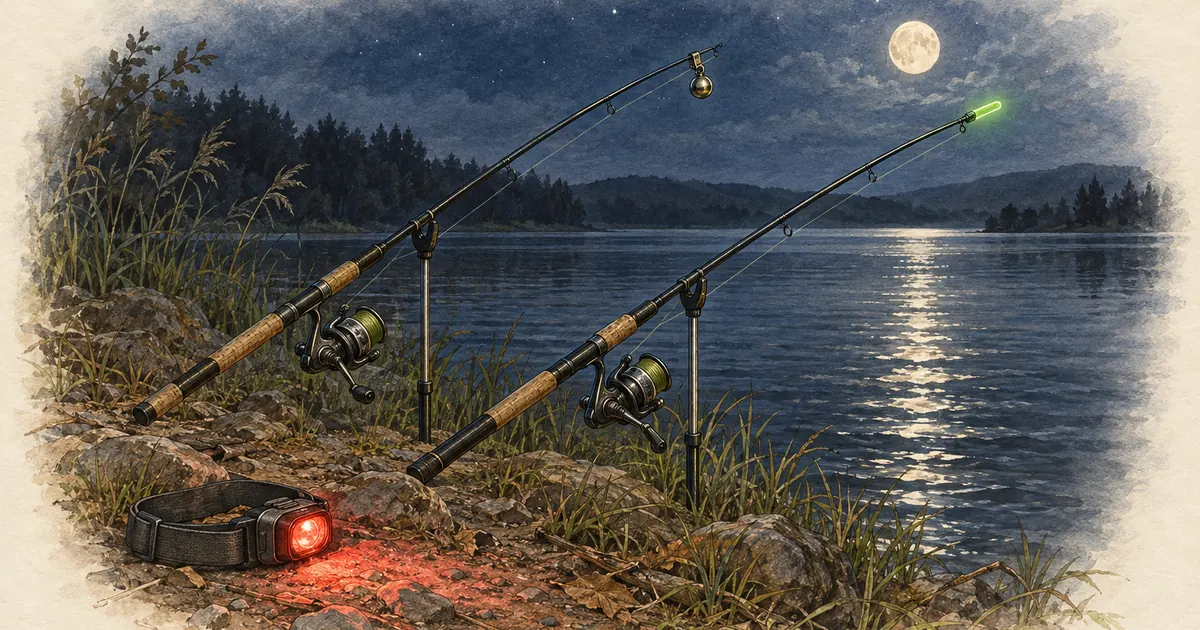
Eel and wels catfish find their food even without light. According to the Lexikon der Biologie, eels detect prey mainly through their sense of smell. The wels catfish has strikingly small eyes (Landesfischereiverband Bayern, LFV for short) and barbels, which the encyclopaedia describes as sensitive to taste. Zander rely on their eyes: because of a reflective layer in the eye, Blinker calls the zander a predator made for night hunting. Such a layer, the tapetum lucidum, increases the light yield when seeing in the dark (Lexikon der Neurowissenschaft).
| Species | Active | What to expect at night |
|---|---|---|
| Eel | nocturnal bottom fish (LFV) | leaves its hiding place, often bites close to the bank (Blinker) |
| Wels catfish | active at dusk and at night (LFV) | roams in search of prey fish (Blinker) |
| Zander | goes on the hunt at night (Blinker) | moves into the shallows, up to 50 centimetres deep (Blinker) |
| Burbot | feeds mainly at dusk and at night (LFV) | mainly in the cold season, longer resting phases at times in summer (LFV) |
| Carp | most active at dawn and dusk (FishBase) | searches the bank zone at night, especially when it is busy by day (Blinker) |
| Bream | searches shallow bank areas at night (LFV) | large bream over 65 centimetres often bite at night (Blinker) |
A Blinker editor names the time from sunset to midnight and the last hour before sunrise as the best phases, with a lull in between. Carp and large bream, he says, also take a bait in the middle of the night. Bite times and moon phase are shown by the Catch calendar. Whether you may fish for eel and burbot is governed by the federal state (Bundesland) and the fishing permit (Erlaubnisschein).
Setting up the swim in daylight
Arrive early enough that the rods are in place while it is still light. If you know the swim from dusk, you get fewer surprises in the dark, writes Blinker.
- Note the direction: Pick a point for each rod that you can still make out at night, such as a treetop against the sky.
- Note the obstacles: Weed, water lilies and trees fallen into the water can only be seen by day. On unfamiliar waters Blinker therefore advises somewhat sturdier tackle.
- Two bait spots: Put one bait on the drop-off, that is, the edge from shallow to deep water, and one in the shallows, where bream and zander move at night. For the bottom, the running rig with bottom lead suits.
- Within reach: The landing net lies assembled beside the rods, net towards the water. Disgorger, knife and lamp have a fixed place next to the seat.
- Clear paths: Bags and buckets stand behind the chair; between seat and water there is nothing to trip over.
Spotting bites in the dark
At night you can see neither line nor rod tip. According to Blinker, bank anglers almost always combine a visual signal with an audible one.
- Glow stick: A plastic tube that glows purely chemically once snapped (Wikipedia). It sits on the float or on the rod tip. In still water Blinker recommends a float as light as possible for the glow stick. Bright yellow or green lights suit depths over two metres. In the shallows down to one metre they can disturb fish; there the Blinker author uses red or blue.
- Bell: The eel bell belongs right at the top of the rod tip, where it shows the finest twitches (Blinker). With a clip it comes off quickly for the fight. With rods close together, bells with different tones help, or one glow stick each on the tip.
- Electronic bite alarm: It sits on the rod rest, beeps and lights up on a bite and, according to Blinker, is long since common far beyond carp fishing. A swinger keeps the line taut so that drop-back bites, where the fish swims towards the rod, are also noticed.
Light at the swim
For adaptation to the dark, the Lexikon der Biologie gives about 30 minutes. After that the rods of the retina take over seeing, and in dim light blue-green things appear brighter than red ones (twilight vision). For knots and unhooking, Blinker recommends red light: the eye reacts less sensitively to it, yet it is bright enough.
You do not shine a light on the water, not even during the fight, because glaring light scares the fish, according to Blinker. For landing, three glow sticks on the rim of the net mark the opening, two at the front and one on the handle. This is practical experience, not a measurement.
- Set up in daylight: Cast out your rods while it is still light and pick a marker for each one that will still stand out at night, for example a treetop against the sky. Set up the landing net straight away and lay it next to the rods with the net facing the water.
- Fit the signals: The bell goes right at the tip, along with a glow stick. That gives you one signal for the ear and one for the eye.
- Spot the bite: In the dark you can no longer see the line or the tip. The ringing and the twitching light give the bite away.
- Landing: Keep your lamp off the water, even while playing the fish. Three glow sticks on the landing net, two at the front of the rim and one on the handle, show you the opening.
What state law and the water rules (Gewässerordnung) govern
Night fishing is not allowed everywhere. Fisheries law is state law (Bundesland), and on top come the fishing permit (Erlaubnisschein) and the water rules (Gewässerordnung). Four examples:
- Saarland: The state fisheries regulation (Landesfischereiordnung) of 5 February 2020 bans fishing at night (April to October 23:00 to 5:00, November to March 19:00 to 7:00), on enclosed waters only from five hectares. The Fischereiverband Saar can lift the ban in justified cases (§ 10 LFO).
- Baden-Württemberg: The statewide night-fishing ban was lifted in February 2022; it still applies on Lake Constance and at the Rheinau power station (Landwirtschaftsministerium, 3 February 2022).
- Brandenburg: Where several fishing rights exist on the same stretch (Koppelfischerei), the hand-held rod is allowed only from one hour before sunrise to one hour after sunset (§ 7 BbgFischO, as of 24 August 2026). On the waters of the Landesanglerverband, night fishing is allowed, except on salmonid waters (Gewässerordnung).
- Bavaria: Fishing using electric light sources is prohibited (§ 15 AVBayFiG, version from 1 June 2025). What that means for a lamp and an illuminated float, you clarify with your club or the fisheries authority (Fischereibehörde).
In Bavaria and Brandenburg, hand-held rods that are set out must be supervised at all times (§ 16 AVBayFiG, § 7 BbgFischO). So stay awake and within reach of the rods. The state also regulates tents and fires:
- Tent: In Brandenburg, tents in open countryside may only stand on tent or camping sites (§ 22 BbgNatSchAG). The Landesanglerverband allows a weather shelter for at most two people that is not mainly used for sleeping and stays at most twelve hours in one place.
- Fire: In woodland and within 50 metres of the forest edge, fire and smoking are banned in Brandenburg (§ 23 LWaldG). In Bavaria, an open fire in woodland and within 100 metres of it needs permission (Art. 17 BayWaldG). Naked light is also banned there (paragraph 2), and smoking in woodland is not allowed from 1 March to 31 October (paragraph 3).
Note, as of October 2026: The examples only show the range. What counts is the current version in your state, the fishing permit and the water rules. The Fischereiamt Berlin expressly refers to the fishing hours on the permit; more under Fishing permit and water map.
Staying safe through the night
Walk the way from the car to the swim and from the seat to the water once in daylight. The DLRG names steeply sloping banks as a hazard on lakes and ponds, and in gravel pits banks can slip. It advises asking locals about a water’s dangers. Lines above the swim can only be seen by day, see Power lines and fishing rods.
Summer nights get cold too. After days above 20 °C the temperature at night can fall below 10 °C, writes Blinker, who then advises winter clothing. If you fish alone, tell someone where you are sitting and when you will be back, and carry a charged phone. More under Bank and waders and Thunderstorms and weather.
Consideration for neighbours and nature
- Noise: Set the bite alarm quiet. If others are sitting within earshot, take the bell off when reeling in, because with constant ringing the neighbours overhear their own bites, writes Blinker. In Brandenburg, activities that can disturb the night’s peace are banned from 22:00 to 6:00 (§ 10 LImschG).
- Reed bed: Coots, moorhens, reed warblers and reed buntings nest in the reeds (Wikipedia). The Bundesnaturschutzgesetz (§ 39) prohibits wilfully disturbing wild animals and cutting back reed beds from 1 March to 30 September. So do not shine a light into the reeds and do not cut yourself a space; more under Fishing a lake.
- Rubbish: The water rules (Gewässerordnung) of the Landesanglerverband Brandenburg prohibit leaving waste or equipment on the bank and require you to clean up the spot before fishing. Take spent glow sticks and bits of line back home with you.
Frequently asked questions
Which fish bite at night?
Mainly eel, wels catfish, zander and burbot, plus carp and large bream. According to Blinker, most bites come before midnight and shortly before sunrise.
Is an electronic bite alarm necessary?
No. A glow stick and an eel bell are enough to start with. The bite alarm helps on long sessions, but it does not relieve you of supervising the rods.
Is night fishing allowed in Germany?
That depends on the state and the water. In Saarland fishing at night is banned in principle; in Baden-Württemberg it has been allowed on most waters since 2022.
Related
- Bottom fishing: rig on the bottom and bite indication by day.
- Running bottom-lead rig: how the classic bottom rig is built.
- Worms and deadbait: the baits for eel, wels catfish and zander.
- Catch calendar: bite times and moon phase for your day.
- Bottom rod: length, casting weight and bite indication.
- Night fishing and weather shelter: official night rules, umbrella or tent.
Sources
- Landesfischereiverband Bayern: Fischlexikon (Aal, Wels, Rutte, Brachse)
- FishBase: Cyprinus carpio (Aktivität in der Dämmerung)
- Spektrum, Lexikon der Biologie: eels, Wels catfish, Hell-Dunkel-Adaptation, Dämmerungssehen; Lexikon der Neurowissenschaft: Tapetum lucidum (Sinne, Sehen im Dunkeln)
- Blinker: Mythen über das Nachtangeln, Fische im Dunkeln, Bissanzeiger, Aalglocken, Steckbrief Zander (Praxiserfahrung)
- Fischereiverband Saar: Saarländisches Fischereirecht (Landesfischereiordnung, § 10)
- Landwirtschaftsministerium Baden-Württemberg: Petri Heil beim nächtlichen Angeln (Nachtangelverbot)
- Land Brandenburg: Fischereiordnung, Fischereigesetz, Waldgesetz, Naturschutzausführungsgesetz, Landesimmissionsschutzgesetz (Angelzeit, Aufsicht, Feuer, Zelt, Nachtruhe)
- Freistaat Bayern: Ausführungsverordnung zum Fischereigesetz, Waldgesetz, Art. 17 (Lichtquellen, Aufsicht, Feuer)
- Landesanglerverband Brandenburg: Gewässerordnung (Nachtangeln, Wetterschutz, Abfall)
- Fischereiamt Berlin: Die Angelkarte und ihre Auflagen (Angelzeiten)
- Bundesnaturschutzgesetz, § 39 (Störung, Röhricht)
- DLRG: Gefahren in stehenden Gewässern (Ufer)
- Wikipedia: Leuchtstab, Röhricht (Knicklicht, Brutvögel)
Text AI-assisted, drawing AI-generated. Sources opened and checked in October 2026; no graphics taken from the sources.
All figures are guide values without guarantee. Whether and when you may fish at night is decided by state law, the fishing permit and the water rules; the text is no substitute for legal or medical advice.