
Knowledge · Nature & environment
Leaving your fishing spot clean
Leaving a fishing spot clean means more than pocketing your own sandwich bag. Cigarette ends, spent glow sticks, leftover groundbait and dog mess each harm the water and animals in their own way, and many water rules make a tidy spot compulsory. With a bag and two small tins in your kit, it takes hardly any effort.
What gets left on the bank
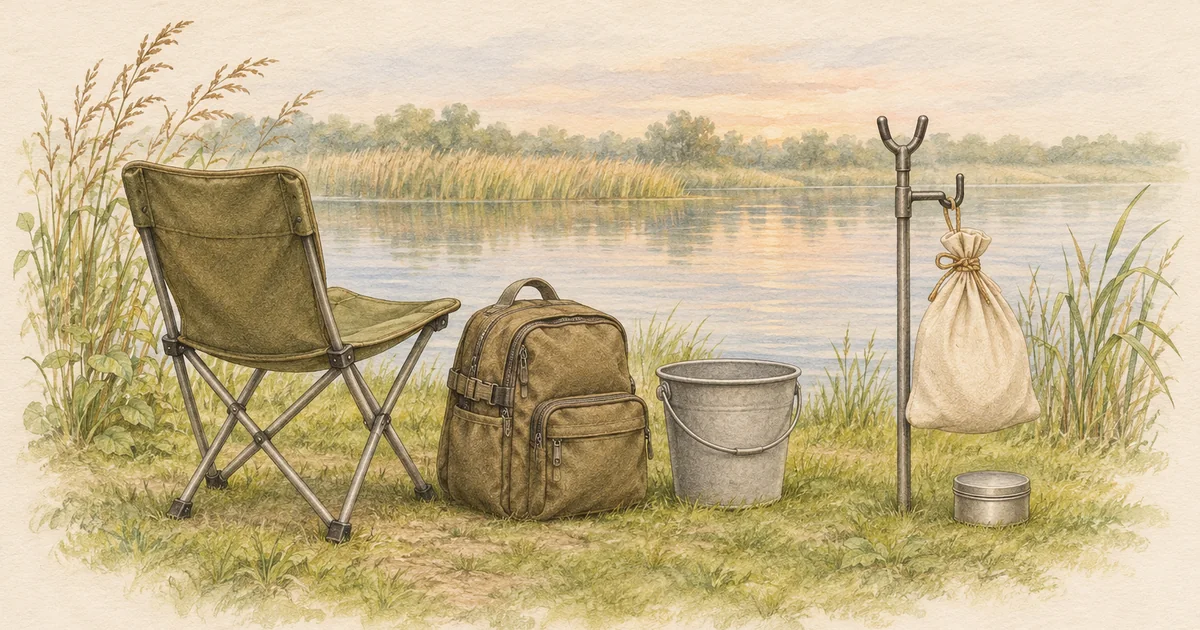
A day’s fishing produces more rubbish than you might think: film and boxes from bait, empty maggot boxes, leftover groundbait and barbecue scraps, cigarette ends, spent glow sticks, bottles. On long sessions, dog mess and toilet paper are added. What Lower Saxony’s water management, coastal and nature conservation agency (NLWKN) pulls out of the Jeetzel is mainly glass and plastic bottles, cans, plastic packaging and kitchen waste. Rubbish like this gets caught in aquatic plants and weirs and can block narrow points during floods.
Why small stuff does harm too
Cigarette ends
A cigarette end is plastic waste with toxins. Its filter is made of cellulose acetate, a plastic that hardly biodegrades, writes the Swiss Oekotoxzentrum. The nicotine passes easily into water: in rain, according to the Leibniz-Institut für Gewässerökologie und Binnenfischerei (IGB), around half has leached out after just half an hour. In Berlin waters, the nicotine content after rain averaged 148 nanograms per litre, and 1 470 in the Teltow Canal. 400 nanograms are considered harmless for freshwater animals with short exposure.
In the laboratory trial cited by the Oekotoxzentrum, just one butt per litre of water could kill half the test fish. The Umweltbundesamt (UBA) estimates that discarded filters in Germany put 160 to 1 600 tonnes of plastic permanently into the environment each year.
Packaging, rubber bands and glow sticks
Plastic usually breaks down only slowly in the environment. Over time, large pieces fall apart into microplastics, which can hardly be collected again (UBA). For birds, litter becomes a trap: the Landesbund für Vogel- und Naturschutz (LBV) considers many species at risk, from the red kite to the blue tit, because they eat rubbish or get tangled in it. White storks mistake rubber bands for earthworms; the swallowed bands block their digestion and the birds starve. So even the rubber band that held a glow stick on your rod tip goes back into your bag.
What is in a glow stick is often unknown: according to the Bundesinstitut für Risikobewertung (BfR), the packaging usually lists no ingredients. More on the glowing liquid and disposal under Glow sticks.
Leftover groundbait
Many fish hardly take feed that lies uneaten on the bottom. It rots and uses up the oxygen the animals in the water need to breathe, writes the Fischereiamt Berlin, advising sparing feeding. Usual quantities and the states‘ limits are covered under Groundbaiting and groundbait.
Dog mess and toilet
Faeces on the bank bring gut bacteria into the water as soon as rain washes them in. At the Schlachtensee and the Krumme Lanke in Berlin, inspections repeatedly found dog mess on the bank, and in 2015 the Senate assumed that faeces washed in after heavy rain were showing up in the bacteria measurements (Abgeordnetenhaus Berlin). For your own needs, the Deutscher Alpenverein (DAV) advises keeping at least fifty metres from any water, digging a shallow hole and ideally taking the paper away in a bag. These tips do not replace medical advice.
What the law says
Under the Circular Economy Act (Kreislaufwirtschaftsgesetz), waste for disposal may only end up in facilities approved for it (§ 28 KrWG), and a breach is an administrative offence (§ 69 KrWG). The Water Resources Act (Wasserhaushaltsgesetz) prohibits throwing solid substances into a water to get rid of them (§ 32 WHG). Which provision applies in an individual case and how high the fine is are decided by the states and local authorities. In 2019 North Rhine-Westphalia’s environment ministry recommended 100 euros for a flicked-away cigarette end or a discarded piece of packaging. The catalogue is not binding on the authorities.
At the water, the water rules (Gewässerordnung) come on top. Those of the Landesanglerverband Brandenburg (LAVB) prohibit leaving waste or equipment on the bank or throwing it into the water. If you fish from the bank, clean up your spot within a radius of four metres before fishing. If you don’t, fisheries inspectors (Fischereiaufseher) may treat you as if you had left the rubbish yourself. At the Neurather See, the water rules of the town of Grevenbroich require a clean spot before, during and after fishing. Anyone who breaks the rules risks losing their fishing permit immediately and without replacement.
Guide: The examples only show how differently the rules turn out. What applies on your water is stated in the fishing permit and water rules; more under Fishing permit (Erlaubnisschein) and water map.
What to pack
Clearing up only works if the containers are already in your tackle bag:
- Two rubbish bags: one for your own waste, one for what others have left behind, plus a pair of work gloves.
- Small tin with a lid: for bits of line, cut-off hooklengths and old hooks.
- Pocket ashtray: if you smoke.
- Dog poo bags: if the dog comes along.
- Bag and small trowel: for toilet paper and emergencies on long sessions.
- Groundbait bucket with a lid: whatever groundbait is left over goes back home in it.
From arriving to leaving
Arriving. Look around before you set up and pick up whatever is already lying about. On the Brandenburg association waters this is compulsory, and with the second bag it is quick.
Parking. The LAVB water rules do not give anglers the right to drive to the water. Park in public car parks or in areas designated by the association. At the Neurather See, driving or parking vehicles on the lake grounds is prohibited. Parking in front of property entrances and exits is not allowed anyway (§ 12 StVO), so keep driveways clear.
Fire and barbecue. Only barbecue where it is allowed. At the Neurather See, open fires, fire bowls and barbecues are prohibited on the lake grounds. In Bavaria, open fires in woodland and within 100 metres of it require permission, and nobody may throw away smouldering cigarette ends there (Art. 17 BayWaldG). More examples are under Night fishing.
Leaving. Finally, take a look at the ground around your chair and rod rests, because bits of line, rubber bands and spent glow sticks easily disappear in the grass. Leftover groundbait stays in the bucket. Spare maggots go back into the maggot box and into the fridge.
Line, hooks and lead
Line and hooks have a page of their own: how to collect leftovers and where they belong is covered under Disposing of fishing line and hooks. What lead means in the water and which substitutes exist is explained in Lead in angling.
Clearing up as a club
Clubs clear up a lot together. In the Landesverband Sächsischer Angler, every club holds work parties at its water every year. According to the association, most of the rubbish members collect on these occasions was not left by anglers at all. In Brandenburg, according to the water rules, the district angling associations and their clubs are responsible for looking after the banks. What a club expects of its members is covered under Finding and joining an angling club.
Frequently asked questions
Do I have to take other people’s rubbish with me?
That depends on the water rules. On the association waters in Brandenburg you clean up your spot within a radius of four metres before fishing, otherwise the rubbish counts as yours. Where nothing is regulated, the Fischereiamt Berlin believes it helps anglers‘ public image.
What does a discarded cigarette end cost?
That is set by the states and local authorities. In 2019 North Rhine-Westphalia recommended a fine of 100 euros to its authorities, but this is not binding. At the water, your fishing permit may also be at stake, as the example of the Neurather See shows.
May I tip leftover groundbait into the water?
Better not. Groundbait left lying rots on the bottom and uses up oxygen, writes the Fischereiamt Berlin. At the Neurather See, groundbaiting is banned altogether to protect water quality. Leftovers go home in the bucket.
What should I do with toilet paper?
Put it in a bag and take it home, as the DAV advises. If it has to be outdoors, then at least fifty metres from the water and buried.
Related
- Disposing of fishing line and hooks: collecting leftovers and throwing them away properly
- Lead in angling: effects in the water and alternatives
- Nature conservation on the bank: consideration for plants and animals at your fishing spot
- Groundbaiting and groundbait: quantities, nutrients and bans
- Glow sticks: glowing liquid, first aid and disposal
- Maggot box and worm tub: keeping bait fresh and getting rid of leftovers
- Night fishing: fires, tents and night-time quiet under state law
- Finding and joining an angling club: water rules and work parties
Sources
- NLWKN: Müll in Gewässern (2023) (häufiger Müll, Folgen)
- Leibniz-Institut für Gewässerökologie und Binnenfischerei: Gefährlicher Abfall: Zigarettenkippen schaden Gewässern doppelt (Nikotin in Berliner Gewässern)
- Oekotoxzentrum: Umweltschädlichkeit von Zigarettenstummeln, Infoblatt 2019 (PDF) (Filter aus Kunststoff, Giftigkeit für Fische)
- Umweltbundesamt: Kunststoffe in Böden (Factsheet, PDF) (Abbau, Mikroplastik, Zigarettenfilter)
- LBV: Weißstörche fressen versehentlich Gummibänder (Gefahr für Vögel durch Müll)
- Bundesinstitut für Risikobewertung: Knicklichter sind nichts für kleine Kinder (Inhaltsstoffe nicht angegeben)
- Fischereiamt Berlin: Die Angelkarte und ihre Auflagen (Futterreste und Sauerstoff, Abfall mitnehmen)
- Abgeordnetenhaus Berlin: Schriftliche Anfrage 17/16435 mit Antwort des Senats, 2015 (PDF) (Hundekot und Keime an Badeseen)
- Deutscher Alpenverein: Die Outdoor-Toilette (Abstand zu Gewässern, Papier mitnehmen)
- Bundesministerium der Justiz: Kreislaufwirtschaftsgesetz § 28 (Ablagern nur in zugelassenen Anlagen)
- Bundesministerium der Justiz: Kreislaufwirtschaftsgesetz § 69 (Ordnungswidrigkeit)
- Bundesministerium der Justiz: Wasserhaushaltsgesetz § 32 (keine festen Stoffe ins Gewässer)
- Bundesministerium der Justiz: Straßenverkehrs-Ordnung § 12 (Parken vor Ein- und Ausfahrten)
- Freistaat Bayern: Bayerisches Waldgesetz, Art. 17 (Feuer und Glut am Wald)
- Land Nordrhein-Westfalen: Umweltministerium veröffentlicht neuen Bußgeldkatalog für den Bereich Abfall (2019) (empfohlenes Bußgeld, nicht bindend)
- Landesanglerverband Brandenburg: Gewässerordnung, Ausgabe 2019 (Abfall, Platz säubern, Parken, Uferpflege)
- Stadt Grevenbroich: Gewässerordnung Neurather See, 2014 (PDF) (sauberer Platz, Feuer, Fahrzeuge, Futter, Entzug)
- Landesverband Sächsischer Angler: Pflege durch Vereine (Arbeitseinsätze, Herkunft des Mülls)
Text AI-assisted, drawing AI-generated. Sources opened and checked in November 2026; no graphics taken from the sources.
All information is indicative and without guarantee. What is allowed on your water and what fine you may face is governed by state law, your local authority and the water rules; this text does not replace legal or medical advice.