
Knowledge · Tackle
Fishing bag: Room for accessories and small items
A fishing bag brings lure boxes, tools and small items to the water and keeps them to hand there. For lure fishing a small shoulder bag is enough, for a session you need a big bag with compartments. In both, you organise with boxes, keep wet and sharp things apart, and carry the bag close to your body.
Three designs and their use
Angling kit contains many English words. The dictionary of the magazine Blinker translates tackle simply as Gerät, the tackle box as Gerätekiste and the carryall as a large bag for fishing tackle. In everyday use three kinds are easy to tell apart:
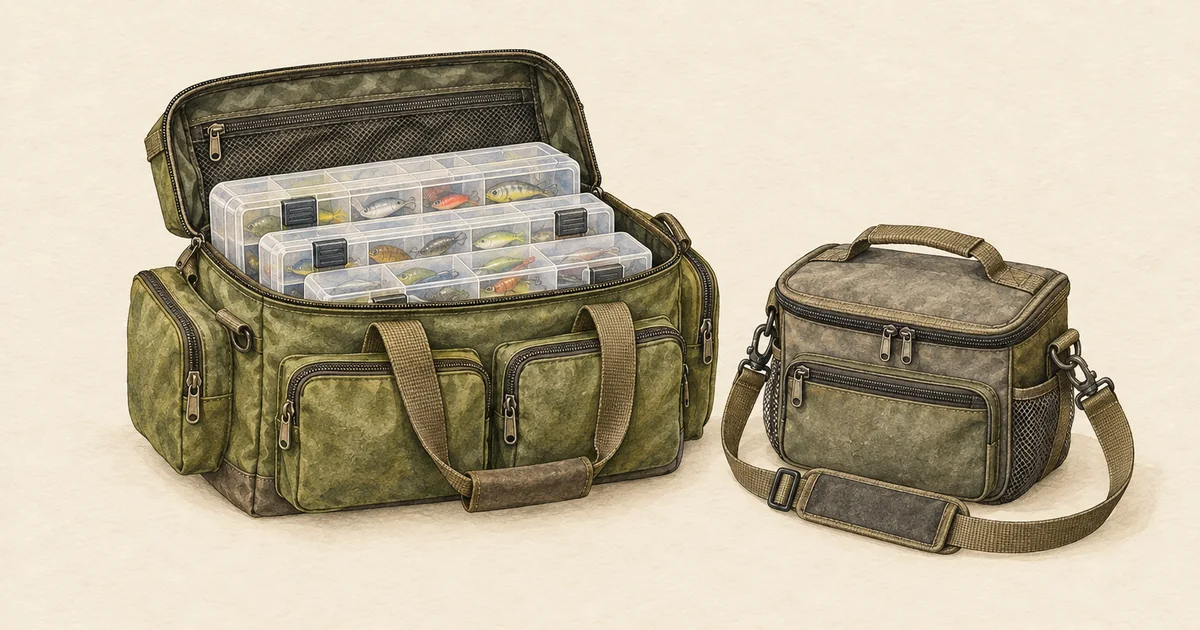
- Shoulder bag: small, on a strap, with room for a few lure boxes and the unhooking tool. It goes with you lure fishing when you change spot often.
- Session bag: large, with a firm base, main compartment and side pockets. When carp or feeder fishing it stands in the same place all day.
- Cool bag: insulated, only for a killed catch. It is not a container for accessories, more under Cool box and cool bag.
Besides these there are the tackle box and the rucksack. Rod sleeve and tackle box are the classics for getting kit to the water. The rucksack spreads the load over both shoulders and has a page of its own: Fishing rucksack.
The shoulder bag when lure fishing
When fishing with artificial lures you are constantly on the move. The British magazine Angling Times advises travelling light when lure fishing on the canal. After about six casts you move on, because if fish are there, they show interest on the first or second cast. In winter, for pike fishing with lures, a shoulder bag with lures and an unhooking tool is often enough, and wire cutters go with it.
What goes in: a few flat lure boxes, hooklengths, spare hooks and the tools for the fish. For the Bavarian angling exam (Fischerprüfung), the question catalogue of the Landesanstalt für Landwirtschaft (LfL) names a measure, a priest, a knife and a disgorger as tools that should be carried alongside the catching and landing gear for reasons of fair angling practice (Waidgerechtigkeit). The training material on tackle from the Fischereiverein Löningen lists auxiliary tools for landing, measuring, stunning, killing and unhooking as accessories. Both are exam material, not a list of what the states require. What the federal states actually prescribe is under Mandatory equipment, and what applies on your water is in the fishing permit (Erlaubnisschein).
At least as important as the contents is the position. You keep the disgorger, tape measure and unhooking mat ready so that nobody has to rummage in the bag after landing. In the air the fish risks oxygen deprivation and a drying mucous membrane. So pliers and tape measure sit in an outer pocket or on a loop, as with the rucksack, and the lure boxes inside. The handling after netting is described in Landing and unhooking a fish.
The big bag for the session
For carp fishing or feeder fishing, rigs, weights, bait, a lamp and rainwear all come together. Fisch & Fang advises that when night fishing for carp, you always put your things in the same place at each new swim, and a bag system helps with that. Scales, tape measure and wet weigh sling lie beside the unhooking mat so that nothing has to be searched for at night. Small items that are needed constantly, such as hooks, swivels and a boilie needle, go in a small box that lies to hand. The big box then stays shut.
There is a reason for lockable compartments: rats are about at night. Everything that smells, from your own food to the bait, should therefore be well sealed, in side pockets with a secure closure or in a bucket with a lid. For short night sessions, according to Angling Times, you tie the hooklengths at home, check the hook points and pack so that the rods are in the water quickly. Take only what you really need. Then you can move if the fish show up elsewhere. Light for the night: Headtorch and fishing lamp.
Order with boxes, wet and sharp kept apart
The bag is only the shell, order is made in boxes. The equipment guide mentioned above lists lure boxes for artificial lures and bait tubs for natural baits as separate accessories. How to divide compartments and separate soft lures from hard lures is covered under Lure box and tackle box. Maggots and worms belong in the maggot tub.
In the closed bag, moisture above all does harm. Blinker describes how salt from flavoured soft lures, together with residual moisture, attacks jig hooks, often unnoticed over the winter. So after fishing you pull the hooks out of the lures, rinse them with fresh water and store them dry and separately. Wet gear such as the landing net, unhooking mat or weigh sling does not belong between the boxes. A landing net dries after every session, otherwise it goes mouldy and stinks. At home you empty the bag and leave it open to dry.
Hooks and trebles never lie loose in the compartment. They easily catch in a finger, palm or face. What to do then is covered under Hook injuries and first aid. What the Weapons Act says about the knife is covered under Fishing knife. A killed fish does not go in the accessory bag or next to your food: the Bundesamt für Verbraucherschutz und Lebensmittelsicherheit (BVL) advises keeping fish apart from food that will not be heated again.
| What | Where | Why |
|---|---|---|
| Disgorger, pliers, tape measure | Outer pocket or loop | Fish only briefly in the air |
| Lures, hooks, swivels | closed boxes | no rust, no pricks |
| Landing net, unhooking mat | outside, separate | wet, otherwise mould |
| Bait and food | Compartment with a closure | Smell attracts animals |
| killed catch | Cool bag | apart from food |
Before setting off: Are all the boxes shut, is the unhooking tool on top or outside, and is there nothing wet from last time in the bag? The same equipment guide also counts a bag for rubbish as kit.
Weight and carrying
A full session bag quickly gets heavy, and it hangs on a strap. The Deutsche Gesetzliche Unfallversicherung (DGUV) gives simple rules for carrying at work: load close to the body, not carried on one side, heavy loads shared. The further the load is from the body, the longer the lever and the greater the strain. So carry it close to the body with an upright torso.
Applied to the walk to the water: you carry the shoulder bag diagonally across your torso, so it sits close and does not swing. You switch the big bag between sides, or you spread the kit over two pieces of luggage. With a lot of kit and long walks, a fishing trolley takes the load off. There is one more reason to take little: if you lug all your kit for one night, you easily stay stuck at a swim you should long since have left.
Health: The DGUV rules apply to the workplace and are applied here by analogy. If you have back trouble, get carrying heavy loads checked by a doctor. This text is no substitute for medical advice.
Dry bag and folding bucket for on the move
Waterproof dry bag
In a canoe, a kayak or on a belly boat, a water-repellent bag isn’t enough. A field report from 2006 on the website of the Deutscher Kanu-Verband (DKV) about the hatches of sea kayaks notes that even a cup of water in the stern makes all the luggage there slightly damp. The author therefore only puts loose into the storage space what is allowed to get wet, and packs everything else in waterproof bags.
Dry bags like these, known in German as Packsäcke, are waterproof sacks and bags. For fishing from a kayak, Rute & Rolle lists fishing papers, camera and a change of clothes as contents and notes that they come in all sizes. How long a dry bag stays watertight under water is only stated in the manufacturers‘ specifications. The sources used here give no independent test values.
In it goes whatever still has to work at the end of the trip. For winter trips, the DKV recommends a waterproof bag with a change of clothes in the boat, so that you can get out of your wet things quickly after a capsize. The bag must not get in the way when you get out of the capsized boat, so in a kayak it is best placed behind the seat (Fig. 2). According to the same advice, the phone belongs packed waterproof and within reach in the buoyancy aid. The DLRG likewise advises stand-up paddlers to stow a change of clothes waterproof and to take the phone in a waterproof case. An article in Blinker describes the kit on a belly boat in a similar way: a sealed container, strapped behind the backrest, holds food, fishing licence, spare battery, towel and camera. On lonely coasts too, according to Blinker, the phone belongs in a dry bag so that it works in an emergency. Safety on the water: Boat and life jacket; planning the trip: Fishing trip by canoe or kayak.
Folding bucket for water and groundbait
A rigid bucket is something extra to carry, while an empty folding bucket lies flat between the boxes. For feeder fishing in winter, according to a Blinker article from 2016, a small folding bucket with about 3 litres of groundbait is enough for the whole day, and afterwards it goes back into the bag folded up. With a rope tied on, it brings up water; that is how Blinker lists it in 2025 in the kit for herring fishing.
What the water at the unhooking mat is needed for, and how to scoop safely from a jetty or pier, is covered under Fishing bucket. For larger quantities of groundbait there are dedicated buckets, see Feed bucket and whisk.
Common mistakes
- Taking the big bag on a lure-fishing round. It tempts you to pack everything and slows every change of spot.
- Stowing the disgorger right at the bottom. Once the fish is on the mat, every minute spent searching is time it spends out of the water.
- Putting wet baits and the landing net into the closed pocket. Rusty hooks and a mouldy net follow.
- Loose hooks and open blades in the compartment. The next reach into the bag could end in a stab.
- Leaving feed and food open overnight. The smell draws rats to the swim.
Frequently asked questions
Is one bag enough for lure fishing and sitting out a session?
It works, but it is awkward. For a lure-fishing walk you then have to repack a few boxes and the tools from the big bag into a small one each time. If you do both often, keep the shoulder bag packed and ready.
Does a tackle bag have to be waterproof?
For a fishing rucksack, at least water-repellent material is considered sensible, because you are out in damp surroundings and dirt is then easier to remove. With a bag, the bottom is the critical spot, because it stands on wet grass or clay. If the lures are in closed boxes, they are protected as well. In a boat or canoe, everything sensitive also goes into a dry bag, see above.
Does the cool bag belong in the tackle bag?
Folded, yes. A folding cool bag even fits into the kit for lure fishing; what matters is good insulation and a zip that closes it properly. It is used separately from the tackle, with a coolant and the humanely dispatched catch.
What goes in the dry bag?
Everything that still has to work after the trip: a change of clothes, fishing papers, camera and the phone, unless it is packed waterproof in your buoyancy aid. According to the DKV, in a kayak you put the bag with your change of clothes behind the seat, so that it doesn’t get in the way when you get out after a capsize.
Related
- Bait box and tackle box: dividing the compartments, keeping soft plastics and hard lures apart
- Fishing rucksack: when the load should go on both shoulders
- Fishing trolley: for lots of gear and long walks
- Cool box and cool bag: getting the catch home cold and kept separate
- Disgorger pliers and artery forceps: the tools for the outer pocket
- Unhooking mat: lay the fish down gently before the pliers come out
- Fishing bucket: folding bucket on a rope, water for mat and hands
- Line calculator: working out breaking strain for the spare spool and hooklength in the bag
Sources
- Blinker: Ein Hechtansitz ist keine Pike-Session (Tackle, Tackle-Box, Carryall) und Blinker: Mit Sack und Pack, der perfekte Angelrucksack (Gerätekasten als Klassiker, Ösen für Zange und Maßband, wasserabweisend)
- Blinker: Fische landen mit Kescher, Lip-Grip und Co. (Abhakwerkzeug griffbereit) und Blinker: Achtung, scharfe Haken (Haken in Finger, Handfläche und Gesicht)
- Blinker: Gummifische aufbewahren (Rost an Jighaken, trocken lagern), Blinker: Kescher fürs Angeln (Kescher nach jedem Angeln trocknen) und Blinker: Die beste Kühlung, Fische richtig lagern (faltbare Kühltasche, Dämmung, Reißverschluss)
- Fisch & Fang: Nachtangeln auf Karpfen (Taschensystem, Werkzeug an der Matte, kleine Box, verschließbare Fächer gegen Ratten)
- Angling Times: How to fish with light lures on the canal (leichtes Gepäck, wenige Würfe je Stelle), Angling Times: Winter pike fishing with lures (Schultertasche, Drahtschneider) und Angling Times: How to make the most of a quick overnighter (vorbereitet packen, nur Nötiges mitnehmen)
- LfL Bayern: Staatliche Fischerprüfung, Prüfungsfragen 2023/2024 (PDF) (Frage 4.118: Längenmaß, Fischbetäuber, Messer, Hakenlöser) und Fischereiverein Löningen: Gerätekunde (PDF) (Zubehör für den Fang, Köderboxen, Abfalltüte)
- DGUV Information 208-053: Mensch und Arbeitsplatz, Physische Belastung (PDF, Juni 2024) (körpernah tragen, nicht einseitig, Lasten teilen, Hebelarm) und BVL: Hygienischer Umgang mit Fisch (Fisch getrennt von Speisen aufbewahren)
- Deutscher Kanu-Verband: Ovale Gepäck-Lukendeckel aus Weichplastik (PDF, 2006) (eine Tasse Wasser im Heck, Gepäck in wasserdichten Säcken) und Deutscher Kanu-Verband: Winterpaddeln (wasserdichter Beutel mit Wechselkleidung hinter dem Sitz, Handy in der Schwimmweste), DLRG: Stand-up-Paddling (Wechselkleidung wasserdicht, Handy in wasserdichter Hülle) und Rute & Rolle: Kajak von A bis Z (2022) (Dry Bags, Inhalt und Größen)
- Blinker: Belly-Boot, das 1. Mal im schwimmbaren Untersatz (dichter Behälter hinter der Rückenlehne) und Blinker: Angeln und Camping (Handy im Packsack)
- Blinker: Feederangeln, Tipps vom Deutschen Friedfisch-Meister (2016) (Falteimer mit etwa 3 Litern, flach in der Tasche) und Blinker: Silber satt, 18 Profitipps zum Angeln auf Hering (2025) (Falteimer mit Seil zum Wasserholen)
Text AI-assisted, drawing AI-generated. Sources opened and checked in October and November 2026, no graphics taken from the sources.
All figures are guidelines without guarantee. What belongs in your bag depends on the method, the water, and the requirements of state law and your fishing permit (Erlaubnisschein).