
Knowledge · Tackle
Fishing rucksack: Travelling light to the water
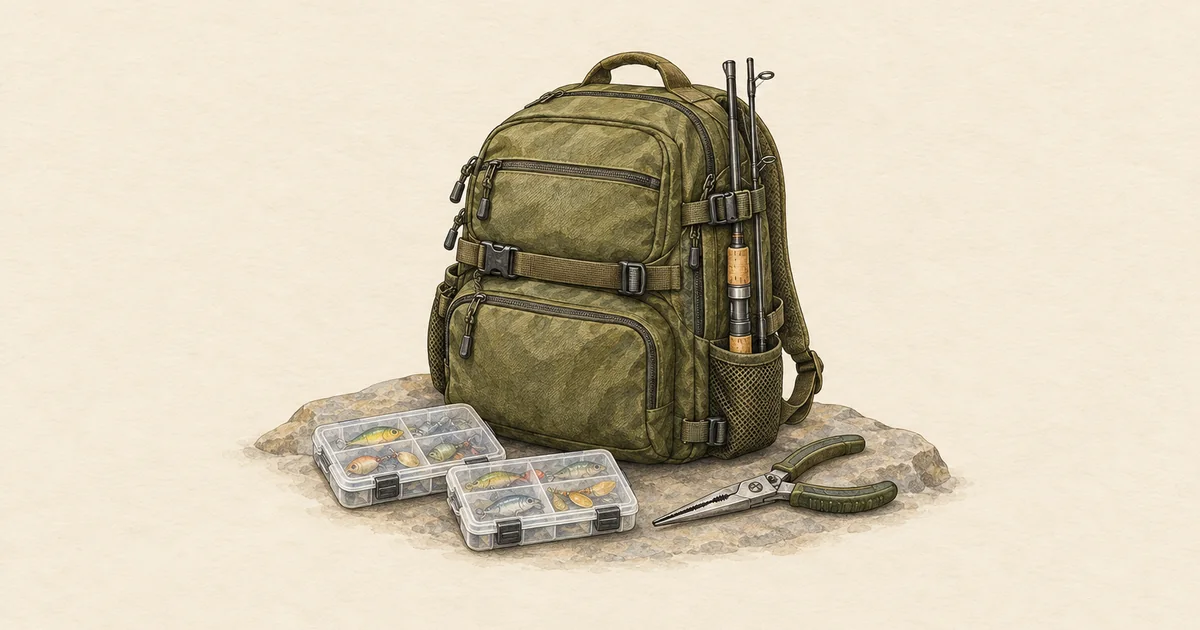
A fishing rucksack carries bait boxes, pliers and food on your back, the rod sits outside in a holder, and both hands stay free. This page covers which kinds of fishing it suits, what goes in it and how to pack it so your back copes with the long walk to the stream too.
What the rucksack is good for
The rucksack suits lure fishing best. Blinker bases this on the load: one rod, perhaps two, plus a manageable amount of small items. With so little on your back you can move swim, or even water, quickly. There is a second advantage: you can reach the water by bike or by bus and train too, and spots far from the car park come within reach.
Fly fishing on a small stream is similarly light. According to Fisch & Fang, a few hours at the water need only a fly rod, a few flies, a landing net, waders, polarised glasses and a few small items, including scissors, line and pliers. With so little gear the rucksack stays small.
If the route leads uphill to a mountain stream, every kilo counts. The Deutscher Alpenverein (DAV) writes about mountain hikes that a rucksack that is too heavy can become a safety risk. For size there are guideline figures in litres:
| Use | Volume | Source |
|---|---|---|
| short walk with a lure rod | from about 20 l | Spoon |
| day hike in the mountains | up to 30 l is usually enough | DAV |
| long day’s fishing with clothing, food and a chair | 30 to 60 l | Spoon |
Pike lures and lots of small items need bigger boxes than a short walk with small spinners. You also want adjustable straps, a back panel that lets air through and a fabric that at least repels water. It is often damp on the bank, and a rucksack like this is easier to clean after a muddy day.
What goes in it
Fewer lures are often better. When lure fishing, only a handful of the whole selection tends to get used. If you sort them beforehand, you search the box less at the water, and the lure stays in the water longer. An Angling Times guide to lure fishing for chub with surface lures manages with a rod, reel, landing net, mat and a rucksack with the bare essentials.
- Bait boxes: flat plastic boxes that fit the compartments. A fishing rucksack should take boxes like these, or the contents end up in a jumble. Designs, compartments and materials are described on the page Bait box and tackle box.
- Pliers and tape measure: on the outside in a mesh pocket or on a loop, so they are at hand as soon as you hook a fish. Which pliers free deeply hooked fish is covered under disgorger pliers, and measuring under tape measure.
- First aid: For a day trip the DAV lists plasters for blisters, a gauze bandage, disinfectant and tweezers as part of the kit. What applies when a hook is in the skin is covered under Hook injuries and first aid.
- Water: For a day trip the DAV allows at least one litre per person. The chub guide in Angling Times calls the water bottle one of the most important items, because you cover a lot of ground when lure fishing. How much you need in the heat is covered under Sun, heat and ticks.
- Landing net and mat: A landing net with a push-fit or telescopic handle and a folding mesh is compact and has few drawbacks at the water. Extra-wide tape measures the size of a kitchen roll double as an unhooking mat.
Note: On first aid and back health this page only repeats what the DAV, DGUV and Unfallkasse Nordrhein-Westfalen publish. It is no substitute for medical advice. In an emergency, call 112.
Packing and carrying with care for your back
Mountain sports and accident insurers give the same rule: heavy items belong close to the back. The DAV describes the rucksack’s centre of gravity as close to the body as possible and at about shoulder height. Unfallkasse Nordrhein-Westfalen advises packing heavy things close to the back and spreading the weight evenly across it. Following the DAV’s packing example, a fishing rucksack then looks like this:
- What you rarely need goes at the bottom, such as spare clothing.
- Directly against the back: water bottle, food and the heaviest box, for example the one with weights and jig heads.
- In front of it, the lighter bait boxes.
- Within easy reach in the lid or side pocket: first-aid kit, rain protection and small items.
On total weight, the DAV gives hikers an upper limit: no more than a quarter of your own body weight. It is just as important that the carrying system fits your height and back length.
Two shoulder straps share the load between both sides. For schoolchildren the DGUV, the Deutsche Gesetzliche Unfallversicherung (German statutory accident insurance), describes what happens when you carry on one shoulder only: one half of the body carries everything alone, and the trunk ends up leaning to one side. When a tackle bag is the better choice is covered on its own page.
Rod and landing net on the outside of the rucksack
Rods and landing net handles are almost always too long for the inside. It is best to strap them on the outside at the side, with loops fitted with a buckle or hook-and-loop strap that can be tightened and loosened. Some fishing rucksacks have a rod holder for this with a stop at the lower end that keeps the rod from slipping out. The DAV fastens trekking poles to the side in the same way.
What counts on a rucksack is the transport length. A telescopic rod can be pushed together with the reel and rig and carried on the outside of the rucksack; at the water you just pull it out. A dismantled travel rod often fits inside, so you need no separate case. Two-piece rods, on the other hand, are considered bulky.
On a bike or on steep ground you need both hands free, so everything has to sit on or in the rucksack. Look up as you go, because the tip of a strapped-on rod can stick out above your head. The Bavarian angling exam (Fischerprüfung) requires carbon rods to be kept away from overhead power lines. Distances and background are covered under Power lines and fishing rods.
With luggage in the water
When wading there is nowhere to put anything down, everything hangs on your body. How waders, belt and jacket work together and why pockets at chest height stay dry is covered under Waders, Wading belt and Wading jacket.
If you also wear a life jacket, two points from occupational safety help. According to the DGUV, loads worn on the body, such as shoulder bags, call for extra buoyancy. And straps can stop an inflatable vest from inflating. Which buoyancy rating suits and how the straps should lie is explained on the two linked pages. Current and undercut banks are covered under Bank and waders.
Common mistakes
- Taking the whole lure box along. When lure fishing, often only a handful of lures go in the water. The rest just adds weight.
- Heavy items on the outside, far from the back. That puts the centre of gravity far from the body, the opposite of what the DAV and Unfallkasse recommend.
- The first-aid kit right at the bottom. The DAV puts it where it is easy to reach.
- Just wedging the rod under one strap. Without a loop or stop it can slip out. That is what the stop on the holder is for.
- Slinging the rucksack over one shoulder. Then one half of the body carries everything alone, as the DGUV describes for school bags.
Frequently asked questions
How heavy can a fishing rucksack be?
The DAV is a useful benchmark: for hikers it gives no more than a quarter of body weight, which works out at 20 kg for 80 kg. A rucksack that is too heavy is expressly a safety risk there.
Does a two-piece rod fit on the rucksack?
You can strap it on, but two-piece rods are considered bulky. Telescopic and travel rods often fit in or on the side of the rucksack. The page Telescopic rod compares transport lengths.
Do I need a cooling compartment?
It is not essential. An insulated compartment keeps drinks and food fresh in summer. For a catch you take home, there is the cool box or cool bag.
Related
- Bait box and tackle box: compartments, sizes and order in the rucksack
- Tackle bag: the alternative for short walks
- Telescopic rod: push it together fully assembled
- Travel rod: many sections and short in the luggage
- Lure fishing: lure presentation and tackle in outline
- Hook injuries and first aid: what to do until the doctor arrives
- Waders: designs and safety when wading
- Line calculator: estimating breaking strain for the light lure rod
Sources
- Blinker: Mit Sack und Pack: Der perfekte Angelrucksack, 2025 (Spinnfischen, Fahrrad und Bus, Boxen, Außennetz für Zange, Rutenhalter mit Anschlag, Volumen, Träger, wasserabweisend, Kühlfach)
- Blinker: Mobil Angeln: Gönnen Sie ihrem Tackle eine Abnehmkur!, 2025 (Handvoll Köder, Tele- und Reiseruten am Rucksack, zweiteilige Ruten sperrig, kompakter Kescher, Maßband als Unterlage) und Blinker: Ruten-Kompaktklasse: Reise- oder Telerute? (Telerute montiert außen am Rucksack)
- Angling Times: Catch chub with surface lures, 2025 (kleines Gepäck beim Spinnfischen, Trinkflasche) und Fisch & Fang: Fliegenfischen am kleinen Bach, 2015 (wenig Gerät am Bach)
- Deutscher Alpenverein: Der richtig gepackte Wanderrucksack, 2023 (30 Liter, ein Viertel des Körpergewichts, Sicherheitsrisiko, Erste-Hilfe-Set, ein Liter Wasser, Packbeispiel, Schwerpunkt, Tragesystem)
- Unfallkasse Nordrhein-Westfalen: Rucksack statt Tasche für Laptop oder Notebook, 2014 (Gewicht gleichmäßig verteilen, Schweres rückennah)
- DGUV Information 202-109: Schulranzen (PDF), Februar 2020 (einseitige Belastung, Schweres dicht am Rücken) und DGUV Information 212-004: Rettungswesten und Schwimmhilfen (PDF), Juli 2022 (Auftrieb bei umgehängten Taschen, Gurtbänder)
- Bayerische Landesanstalt für Landwirtschaft: Prüfungsfragen zur Fischerprüfung 2023/2024 (PDF) (Kohlefaserrute von Freileitungen fernhalten)
Text AI-assisted, drawing AI-generated. Sources opened and checked in October 2026; no graphics taken from the sources.
All figures are guidelines without guarantee. How much you carry and how you adjust the rucksack depends on your body and the route, and this text is no substitute for medical advice.