
Knowledge · Tackle
Jig heads: Weight, shape and hook size
A jig head is a single hook with a cast-on weight and an eye, onto which you thread soft plastic lures. Head shape, weight and hook determine how fast the lure sinks, how it lies on the bottom and whether the hook takes hold on a bite.
Structure: head, eye, hook and bait keeper
The tackle guide of the Fischereiverein Löningen describes soft plastic lures as a plastic body on a single hook with a lead head. The weight sits at the mouth, the point protrudes from the back. Because head and hook are rigidly connected, only the part behind the shank, the straight section of the hook, moves.
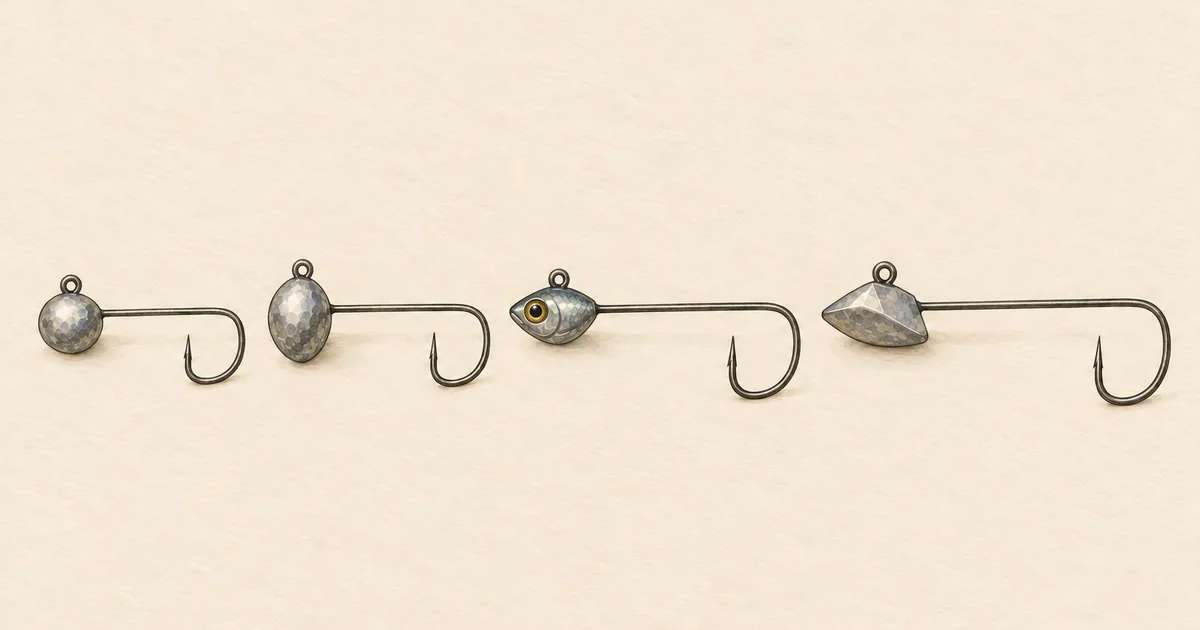
Behind the head sits the bait keeper so that the soft plastic does not slide back. Usual are a moulded collar, a barb on the shank or a small wire clip. Thick lead keepers are tricky with small baits, because the soft plastic can tear when you thread it on. Sharp-edged barbs often cut the soft plastic; a collar is considered gentler.
Where the eye sits
Jig heads can be sorted by the position of the eye. If it sits at the front on the nose, the hook hangs almost vertically, and the lure shoots steeply upwards when twitched. If it lies just in front of the centre of gravity, as with the round head and the fish head, the hook sits at an angle. If it sits exactly above the centre of gravity, as with the Erie head, the hook lies horizontally, and the lure starts off flat and stays close to the bottom. To test, hang the head without soft plastic on a snap, because in the water the soft plastic weighs almost nothing.
Comparing head shapes
The table summarises several articles on head shapes. One source tempers expectations: the weight and buoyancy of the soft plastic influence the action more than the shape does.
| Shape | Feature | Behaviour | Use |
|---|---|---|---|
| Round head | ball, eye in front of the centre of gravity | sinks fast, tips over easily on the bottom | all-round, vertically under the boat |
| Football | round head wider at the sides | tips over less often, heavier at the same diameter | bottom, bank with stones |
| Erie | flat underside, eye above the centre of gravity | slows the sink, tail points up on the bottom | deep water, soft bottom |
| Fish head | tapering to a point | little resistance in the current | strong current, trolling |
| Stand-up | straight underside, eye at the front | lure stands almost vertically | Soft plastic crab |
On the risk of snags on stones the sources contradict each other. For jigging from the bank, Erie and football heads are praised for their wide contact surface. Against that, an experienced zander angler reports that the angular Erie head wedges between stones and comes free less easily, and a round head is hardly inferior.
With the offset jig the point lies against the back of the lure, and it passes almost snag-free through timber and water lilies and should be as light as possible. Screw-in heads carry a wire spiral instead of the hook, which is twisted into the soft plastic at the front only. The lure stays soft but needs an extra treble. This stinger and the movable Cheburashka are described by the jig head rig.
Weight by bottom contact: count, feel, adjust
The head has to take the lure to the bottom, and you have to feel it touch down. The benchmark is the sink phase, the time the lure takes to flutter back to the bottom after being lifted. With the lift-and-drop retrieve, it is the reel, not the rod, that sets the lure moving: one to three turns of the handle lift it off the bottom. After that it should sink for roughly 1 to 3 seconds. If it takes longer, you switch to a heavier head.
- Still water: usually 5 to at most 15 g (Blinker).
- Perch: for a soft plastic of around 6 cm, a 10 g head is enough in most situations according to Rute & Rolle.
- Zander: 10 to 20 g is usual, and 15 to 20 g is fished most often.
- River: On shallow stretches of the Elbe, a field report manages with 15 g despite a strong current, while in the deepest groynes on the Rhine up to 35 g is fished.
Greater depth, fast drift and thick line, which offers more resistance in the water, call for more weight. A shad with a paddle tail also drags more than one with a V-tail. Thin braid allows lighter heads; for zander, 0,10 to 0,17 mm is mentioned. The line calculator shows the breaking strength that goes with it.
On basic approach the sources contradict each other. Beginners are rather advised to use the heavier head, because lure and bottom contact are easier to control that way. Another article warns in still water against cutting the sinking phase short with too much lead, because most bites come in that phase. Rute & Rolle, by contrast, deliberately over-weights for perch: a fast, audible impact is meant to trigger reaction bites.
Weight in ounces: If the packet gives a value in oz, work with about 28,3 g per ounce. 1/4 oz is then about 7,1 g, 3/8 oz about 10,6 g and 1/2 oz about 14,2 g. More values are given by the unit converter.
Count the sink time and watch the line
Instead of a formula in grams, a measurement at the water helps: lift the lure and count until it lands again. Practical guide values lie between one and three seconds. The lure has landed when the tightened line goes slack and you feel the impact in the rod. A line that sags can also show a fish that has taken the lure on the drop, though. For that the line must be tight: close the bail arm straight after the lure hits the water, because slack line and big bows take away your control.
| Observation | Possible cause | What to try |
|---|---|---|
| Sinking takes clearly longer than 2 to 3 seconds | head too light for the depth, drift or thick line | choose a heavier head |
| No landing felt, the line does not go slack | head too light, current or line bow pushes the lure away | heavier, bail arm closed, tighten the line |
| Lure hardly comes off the bottom | head too heavy | use a lighter head |
| Landing is clear, but missed bites and fish coming off | lure too heavy to be sucked in | so light that bottom contact is just kept |
| Frequent snags between stones | too heavy or unsuitable head shape | fish lighter, check the eye position |
The factors that determine the weight include current pressure, wind strength, fishing depth, lure size and line diameter. So there is no fixed number of grams. An exception to the rule “as light as possible” is shipping canals and deep lakes, where, in a zander angler’s experience, over-weighted lures caught better. Trying five grams more does no harm there.
The sink time also tells you something about the water. The longer the sinking phase, the deeper it is, and up a drop-off the lure falls for less time than down one. You feel in the rod how the head lands: hard on stone, dull on sand, soft in mud.
Hook size, wire thickness and bend
If the jig hook is too big for the lure, the soft plastic loses its action, and the stiff shank stops the fish from folding and sucking in the lure. A hook that is too small also causes missed bites. As a rule of thumb, the shank length is about a third of the lure length.
There are no fixed figures. The information varies: in 2009 it was 4/0 for 10 cm and 6/0 for 15 cm, earlier 3/0 to 4/0 for 12 cm. Today, with an extra treble, 3/0 is given for 8 to 10, 4/0 for 11 to 14 and 5/0 for 15 to 18 cm. So hold the head against your lure at the side before buying.
A wide hook bend is recommended so that enough space remains between the lure’s back and the point. The hook then holds more securely and is less likely to pull out during the fight. When holding it up, the bend should clearly stick out beyond the back. For zander, with their hard, bony mouths, a thin but sturdy hook wire is advised, because it penetrates more easily. Cheap heads with weak hooks are often to blame for missed bites and lost fish.
To thread it on, hold the head against the outside of the lure and note the spot on the back where the bend lies. Then push in centrally at the nose and slide the soft plastic straight over the shank until the point comes out at that spot (Fig. 1). Before the first long cast, check how it runs right at your feet. If very soft lures keep sitting crooked, a screw-in head is easier to get straight.
Lead, tungsten and other materials
Jig heads are still mostly cast from lead. Tungsten is denser: a head of the same weight comes out smaller and is also harder, which makes the feedback while working the lure more direct. In return it costs a lot more, and every snag-off costs money. Tin, steel, bismuth and brass are less dense than lead and come out larger at the same weight.
Lead and EU rules: The EU has restricted lead in fishing tackle with Regulation (EU) 2026/2501, which applies from 3 December 2026. It concerns the sale of fishing tackle containing 1 per cent lead or more, not recreational angling with lead. When which lead may no longer be sold is set out on the page Fishing weights. What applies at your water is set out in the fishing permit (Erlaubnisschein) and water rules.
In the tackle box, lead heads turn white. According to Rute & Rolle, lead reacts with water and air in the process, pure lead especially strongly, and superglue encourages the coating. The magazine advises opening the box to dry after every day’s fishing and storing soft plastics separately from the heads.
Common mistakes
- The hook is too big for the lure. The soft plastic runs stiffly, and the fish has trouble getting the lure into its mouth.
- Fishing too heavy in still water. The head shortens the sink phase, in which most bites come.
- Round head with an upright eye on a groyne and rock revetment. There, Erie or football heads are advised, or an eye that points obliquely forward so that the lure lifts off faster; experiences with the Erie differ (see above).
- Choosing by feel instead of measurement. Without sink time and watching the line, it stays unclear whether the head is too light or too heavy.
- Storing the lure on the head long term. Lead and plasticisers react with each other, and the soft plastic turns white at the head or splits.
Frequently asked questions
Are tungsten jig heads worth it?
At the same weight they are smaller, so the lure runs a little better. But where you leave a lot of heads on the bottom, the higher price weighs heavily.
How often can a soft plastic be re-threaded?
Not often. The barb of the bait keeper tears a hole in the soft plastic when you pull it off, and after that the lure holds less well. A drop of superglue on the shank helps. After one or two head changes a lure is usually regarded as used up.
Which shape snags least often?
The sources do not agree on this: one praises Erie and football heads on a stony bank, another sees more snags with the Erie. Between wood and weed an offset jig or the Texas rig is more likely to help.
How can I tell that the jig head is too light?
You feel no impact on the bottom, and the line does not go slack. Then the head is too light; if the lure is hard to lift off, it is too heavy.
Which hook size suits which soft plastic?
As a rule of thumb, the hook is about a third as long as the lure. With an extra treble, Blinker gives 3/0 for 8 to 10 centimetres, 4/0 for 11 to 14 and 5/0 for 15 to 18. A comparison when buying is worthwhile; sizes differ from maker to maker.
Related
- Jig head rig: threading step by step, stinger treble and hooklength
- Soft plastic (shad): how the lure is built and worked
- Spinning: the retrieve, lift-and-drop and twitching at a glance
- Spinning rod: casting weight to suit head and lure
- Zander rod: stiff for soft plastic on the bottom
- Fishing hook: hook sizes and shapes
- Braided line: thin mainline for jigging
- Line calculator: breaking strain of main line and hooklength
Sources
- Blinker: Jigköpfe: Formenvielfalt verständlich erklärt (Kopfformen, Sonderformen, Absinkphase, Gewicht, Hakendraht, Hakenbogen, Köderhalter)
- Blinker: Die richtigen Bleiköpfe zum Angeln Gummifischen (Lage der Öse, Fischkopf, Köderhalter, 12-cm-Köder, Hakenqualität)
- Blinker: Jiggen: Diese 10 Fehler sollte man vermeiden (Gewichte, Kopfform am steinigen Ufer, Bisse beim Absinken)
- Blinker: Spinnangeln: Jiggen mit Gummiködern (Hakengrößen, Lauf prüfen, Einsteiger)
- Blinker: Das erste Mal mit Gummifisch auf Zander (Köderhalter, Gewichte, Wolfram, Schnur) und Blinker: Welche Jigköpfe passen zu meinen Gummifischen? (Form und Auftrieb, Football)
- Blinker: Bleiverbot beim Angeln: Das plant die EU (Ersatzwerkstoffe)
- EUR-Lex: Verordnung (EU) 2026/2501 der Kommission vom 12. November 2026, Blei in bestimmtem Fischereigerät und Berichtigung vom 17. November 2026 (Verkauf statt Verwendung, Grenze 1 Prozent)
- Rute & Rolle: So reinigst Du Jigköpfe richtig! (Belag, Lagerung), Schrauben statt stechen (Kopfwechsel, Einschraubkopf) und Barsch-Special, Teil 2 (Barschköpfe)
- Fischereiverein Löningen: Gerätekunde (PDF) (Aufbau) und Wikipedia: Gummifisch (Aufbau, nur ergänzend)
- Blinker: Die 9 größten Fehler beim Zanderangeln (Absinkphase, Erie-Kopf an Steinen, Überbleien), Fehlbisse vermeiden (Kopf so leicht wie möglich) und Winterzander (Absinkzeit und Gewässertiefe, Aufprall)
- Rute & Rolle: Die Faulenzermethode (Gewicht nach Absinkzeit und Aufsetzen) und Zander-Tipps für die Steinpackung (Gewicht und Hänger)
Text AI-assisted, drawings AI-generated. Sources opened and checked in November 2026, no graphics taken from the sources.
All figures are guide values without guarantee. Which head suits depends on the water, current, lure and target fish, and whether lead is allowed is governed by state law and the water rules.