
Knowledge · Rigs & setups
Jig head rig
A jig head is a hook with a moulded lead head and an eye for attaching it. With a soft plastic on it, it is worked in hops across the bottom when spinning for zander and perch. Whether you feel the bottom and the lure runs straight usually comes down to the head weight and how the lure is threaded on.
What you need
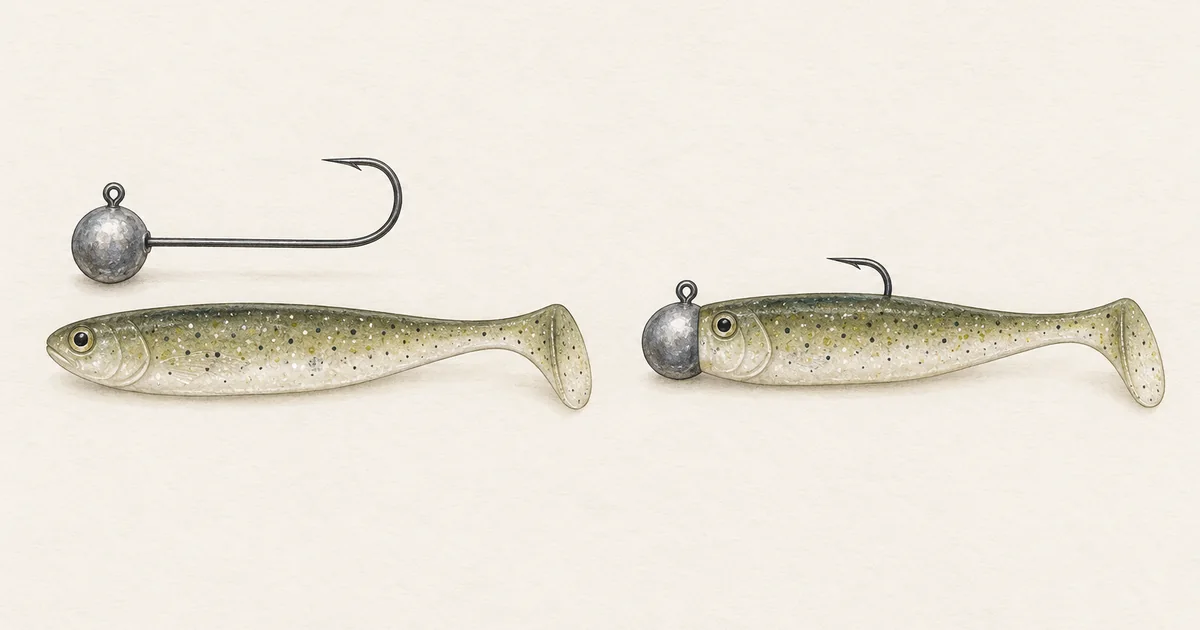
- Jig heads in several weights, with hooks matched to the bait length
- Soft plastic baits, for example a shad with a paddle tail, twister, pintail or V-tail
- a leader of fluorocarbon or monofilament, or of steel or titanium on waters with pike
- a clip; according to Blinker a swivel is unnecessary because a soft plastic shad does not spin around its own axis
- a stiff spinning rod with a braided main line
Construction: head, eye and hook
On a jig head the hook is cast into the lead, so head and hook form one rigid unit. A bait keeper behind the head holds the soft plastic, for example a collar, a barb or a wire clip. According to Blinker, the shape of the head also helps decide how the bait sinks and lies on the bottom:
- Round head: the all-rounder with the lowest water resistance. It sinks fastest on a slack line and tips over easily on the bottom.
- Erie head: the flat underside slows the sink, and on the bottom the tail points upwards.
- Football head: a round head that is wide at the sides and tips over less on the bottom.
- Stand-up head: the bait stands almost upright, intended mainly for the soft plastic crayfish.
A second article in the magazine considers weight more important than shape; whether a bait stands on the bottom depends on the buoyancy of the soft plastic.
Lead: Jig heads are also made of tungsten, which is smaller for the same weight. The EU has adopted the restriction on lead in fishing tackle with Regulation (EU) 2026/2501, which applies from 3 December 2026 (as of November 2026). It governs sales, not recreational angling. Weights and lures containing lead up to 50 grams may no longer be sold from 3 December 2029, heavier ones up to 1 kilogram from 3 December 2031, and lead wire and drop-off leads from as early as 3 June 2027. What applies at the water is set by the water rules and the fishing permit (Erlaubnisschein).
Guide values for head weight and hook size
The head weight must suit depth and current: the bait should reach the bottom, and you must be able to feel it touch down. The measure is the sink phase, the time from lifting to touching down. Blinker gives 1 to 3 seconds, Rute & Rolle one to two, and elsewhere two to three. If it takes longer, you use a heavier head; if it is shorter, a lighter one.
| Situation | Head weight | Source |
|---|---|---|
| shallow still water | 7 to 10 g | Rute & Rolle |
| zander, usual range | 10 to 20 g | Spoon |
| fast river, 12 cm bait | start with 24 g, then 21 or 18 g | Spoon |
| strong current | 25 g and more | Rute & Rolle |
| wind and strong current | up to 30 g | Spoon |
Thick line, fast drift and a paddle tail, which brakes more than a V-tail, also call for more weight. Heavy heads, however, mean more snags, so at stone revetments Rute & Rolle advises fishing as light as possible.
As a rule of thumb for hook size, Blinker gives a hook length of about a third of the bait length. With a stinger hook, 3/0 then suits 8 to 10 centimetres, 4/0 suits 11 to 14 and 5/0 suits 15 to 18. According to Rute & Rolle, sizes differ between manufacturers: what one calls 6/0 is 8/0 at another.
The hook should come out of the back level with the bend of the hook. According to Blinker, a deviation of two to three millimetres does not matter, but 10 or 15 millimetres does. A hook that is too long stiffens the bait and causes missed bites; with one that is too short, the fish has to take the bait far into its mouth.
Rigging a soft plastic shad in five steps
- Hold against the bait. Hold the jig head against the side of the bait, with the lead head at the nose. The exit point is level with the bend of the hook (Fig. 1).
- Mark. Lightly scratch the spot on the back with the hook point.
- Pierce in the middle. Place the point at the front of the bait’s head, exactly between both flanks, and pierce it there.
- Slide on straight. Carefully guide the bait over the bend and shank until the point comes out again at the mark.
- Check. The bait should sit straight and without a bulge on the shank. If it is crooked or bunched up, pull it off and start again.
If the point comes out too far to the side, the bait sits crooked and works worse, according to Blinker. A drop of superglue on the shank before you slide the bait on makes the soft plastic hold more firmly.
Stinger hook for missed bites
If fish only suck cautiously at the tail of the bait, a stinger hook helps. That is a treble hook, a hook with three points, on a short wire with a small loop. The loop lies over the eye or hangs in the clip. Blinker recommends steel, because a pike can never be ruled out, and the rule of thirds: jig hook at the end of the first third of the bait, treble at the end of the second. With a stinger the jig hook can be shorter, and the bait then moves more freely. Rute & Rolle pushes only one point shallowly into the soft plastic so that it comes free once the fish is hooked.
Blinker uses it with baits from 12 centimetres in length and gives sizes 6 or 8 for zander. Rute & Rolle uses 2 or 1 on pike baits of 14 to 16 centimetres.
Drawbacks: the risk of snags rises, so Blinker places the treble on the back of the bait. It can tangle in the leader during the cast. The Bavarian exam questions for the angling exam (Fischerprüfung) describe artificial lures with single hooks as kinder to fish than those with trebles. Keep pliers ready for unhooking, see Landing a fish and unhooking it.
How many hooks are allowed is governed by state law and the water rules. In Bavaria the limit is five points of attack, meaning hooks, per hand-held rod; a treble counts as one. What applies to you is in your fishing permit (Erlaubnisschein).
Leader and knots
Braided line is easily damaged on a sharp-edged bottom. Blinker therefore adds about 100 centimetres of fluorocarbon or monofilament of 0,25 to 0,45 millimetres in front of it. For perch Blinker gives 0,20 to 0,30 elsewhere, and for zander 0,30 to 0,40 millimetres.
Where pike occur, a bite-proof leader belongs in front of the bait, and the Bavarian exam questions mention steel, for example. A pike specialist in Fisch & Fang considers fluorocarbon acceptable only where no pike are to be expected. For perch and zander baits, thin steel with a breaking strain of 3 to 4 or 6 to 7 kilograms is enough according to Blinker, and from about 9 kilograms for targeted pike fishing. Steel kinks easily, titanium does not, but it can break without warning after some use. If a pike bites through, it keeps the bait in its mouth (fish welfare).
According to Blinker, you tie the leader to the braid with the double grinner, described here as the double uni knot, or with the Albright knot.
Use and presentation
According to Rute & Rolle you catch zander mostly near the bottom, and perch often. Pike and, at sea, cod also take the jig head, but fishing for cod in the Baltic Sea is banned in 2026 (more under sea fishing). The horse mackerel too takes small soft plastic baits on a jig head in harbours: Blinker reports from Normandy on baits of 4 to 7 centimetres on very light heads. When jigging, a twitch of the rod tip lifts the bait; when reeling and dropping, turns of the handle do it with the rod held still. Most bites come while the bait is sinking on a tight line, more under spinning.
As drawbacks Blinker mentions that the rigid construction limits the movement of the bait and that the jig head snags easily. Between wood and weed the Texas rig suits better, and for a bait held in one spot the dropshot rig.
Cheburashka or fixed jig head
The Cheburashka is a weight with a slot through which a wire clip runs. The leader hangs on one side, the hook on the other. The difference from a fixed jig head, according to Blinker:
| Feature | Fixed jig head | Cheburashka |
|---|---|---|
| Construction | hook moulded into the lead, a rigid unit | hook moves freely in the wire clip on the weight |
| Lure action | lure movement restricted by the rigid design | the weight touches down, the lure tips over to the side |
| Changing weight | pull the lure off and thread it onto another head | swap the weight on the clip, the lure stays on the hook |
| Use | compact and one-piece, but prone to snagging | fished weedless in weed beds; if the clip is lost, the weight is useless |
A Blinker author describes the weedless action on a bodden: two metres of water, a 5-gram weight, bites mostly on the drop on a slack line. That is a personal account, not a measured value.
Common mistakes
You can’t feel the bottom. Check in this order:
- Bow in the line? With slack line you won’t feel the bite, according to Rute & Rolle. Take up loose line and let the lure sink on a taut line: when the line goes slack, the lure is on the bottom. In wind, Rute & Rolle says, lower the rod tip towards the water.
- Head too light? If you can’t feel the touchdown, the head is too light, according to Rute & Rolle. Use the next heavier head (guide values in the table above) until the lure can hardly be lifted off the bottom any more.
- Line? Braid hardly stretches, so bites and touchdowns come through better than with a monofilament main line, according to Rute & Rolle.
The soft plastic runs crooked. It should sit straight on the shank, without a bulge. Check:
- Exit point marked? If the hook comes out too early, it sticks out well away from the plastic. If it comes out too late, the lure is bunched up and slides down the shank.
- Pierced in the centre? The plastic is bent by about 180 degrees when you thread it on. If the point comes through too far to the side, it sits crooked and runs worse.
- Tail free? The rear part of the lure must be able to move freely.
Remedy: pull the lure off, line it up again, mark it, thread it on.
Frequently asked questions
Which head shape is suitable to start with?
The round head. Blinker calls it the all-rounder that suits almost all soft plastic baits and is enough for classic zander fishing.
Can the jig head be tied on directly?
Yes. Blinker considers this impractical, though, if you change the bait often.
How does the Cheburashka differ from the jig head?
On the Cheburashka the hook hangs loosely in a wire clip on the weight. The bait moves more freely, and the weight can be changed without taking the bait off.
Why can’t I feel the bottom in the wind?
Wind pushes a bow of line into the water, and slack line transmits the touchdown poorly. Lower the rod tip towards the water and take up line. In wind and strong current a heavier head helps, up to 30 grams according to Blinker.
Related
- Carolina rig: soft plastic bait with a separate weight
- Zander and perch: the target fish in profile
- Line calculator: breaking strain of main line and hooklength
- Knots: all knots with instructions
Sources
- Blinker: Jigköpfe: Formenvielfalt, Welche Jigköpfe passen?, Welche Gummifisch-Montage? (Kopfformen, Gewicht, Haken, Cheburashka), Cheburashka-Jig (Aufbau, Einsatz im Kraut), Spinnfischen an der Küste der Normandie (Stöcker im Hafen)
- Blinker: Das erste Mal mit Gummifisch auf Zander, Fehler beim Aufziehen, Zanderangeln: Die 12 wichtigsten Fragen (Gewichte, Aufziehen, Austrittspunkt, Stinger, Vorfach, Knoten)
- Blinker: Angeln mit Stinger, Raubfischvorfächer im Vergleich (Drittel-Regel, Drillinge, Stahl, Titan)
- Rute & Rolle: Die Faulenzermethode, Grundkurs Spinnfischen Teil 2, Zander: Tipps für die Steinpackung, So vermeidest Du Fehlbisse (Gewichte, Absinkphase, Drillinge, Schnurbogen, Wind, Geflecht)
- Fisch & Fang: Die Wahrheit über Fluorocarbon (Fluorocarbon und Hecht)
- LfL Bayern: Prüfungsfragen 2023/2024 (PDF) und AVBayFiG, § 16 (Hechtvorfach, Drilling, Anbissstellen)
- EUR-Lex: Verordnung (EU) 2026/2501 der Kommission vom 12. November 2026, Blei in bestimmtem Fischereigerät und Berichtigung vom 17. November 2026 (Stichtage, Verkauf statt Verwendung)
- DAFV: EU-Bleibeschränkung für Angelgeräte, Fangregeln Ostsee 2026 (Blei, Dorsch)
- Wikipedia: Gummifisch (Jigkopf, Jiggen)
Text AI-assisted, drawing AI-generated. Sources opened and checked in October and November 2026, no graphics taken from the sources.
All figures are guide values without guarantee. How many hooks, which leader and whether lead is allowed are governed by state law and the water rules.