
Knowledge – Fish
Horse mackerel (Stöcker, Bastardmakrele): Features, season, baits
The horse mackerel (Trachurus trachurus), also called scad, is a shoaling fish of the jack family. It is the only species of this family that lives permanently in north-western European waters. In summer it moves into the North Sea and to the Norwegian coast.
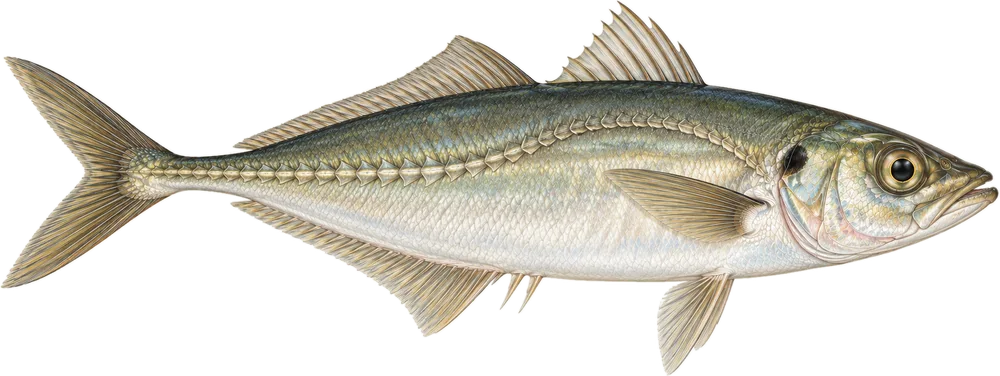
In short: You catch horse mackerel best in August, above all in the evening and at night. Good spots on the coast: open water, just under the surface and sandy ground. Proven lures: small soft plastics and mini plugs on ultralight tackle, plus a herring paternoster rig. A lateral line with a row of large, keeled bony scutes, and a black spot on the gill cover. The IUCN classes the species worldwide as Vulnerable. Step by step: Fishing for horse mackerel.
- A row of large, keeled scales along the whole lateral line
- Black spot on the gill cover
- Two free spines in front of the anal fin
Catch chances through the year
- Hardly any chance
- Possible
- Good
- Peak season
- Spawning (observe the closed season)
Editorial assessment for waters in Germany, not a measured value and no guarantee. Spawning time is not the same as the legal closed season.
Species profile and sources in the catch calendarAll species compared month by monthThe rules of your federal state
How to recognise it
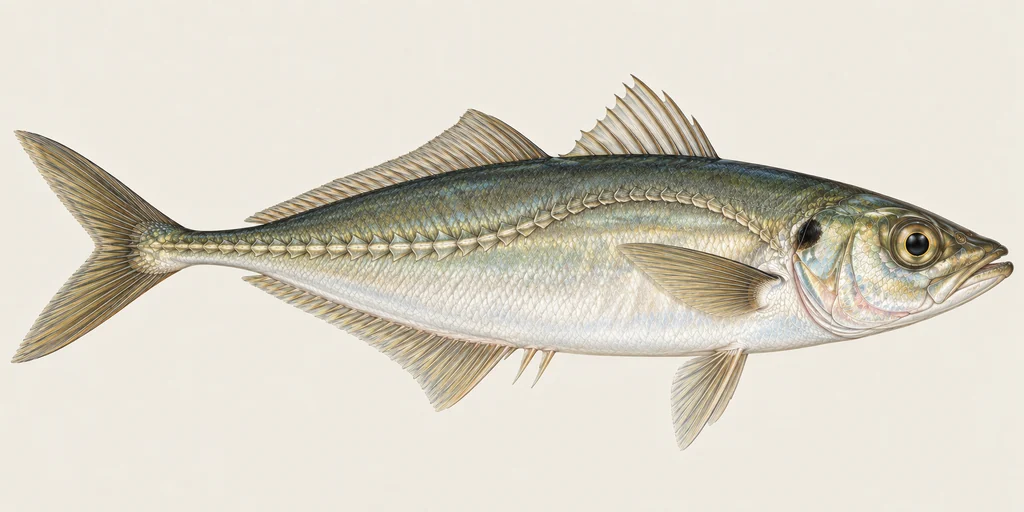
The horse mackerel has an elongated, mackerel-like body. The back is blue-green, grey or almost black, the flanks silvery, the belly white. There is a distinct black spot on the gill cover.
The lateral line is unmistakable. Along its whole length it is lined with a row of tall, plate-like scales that carry a keel. In front of the anal fin there are two free spines, and the first dorsal fin is tall.
Most horse mackerel measure 15 to 40 centimetres. According to ICES the species can reach about 60 centimetres, FishBase gives up to 70 centimetres and 2 kilograms. An age of 40 years has been reported, but age determination is considered uncertain. After the first three years of life the horse mackerel grows only slowly.
You are most likely to confuse the horse mackerel with the mackerel. The sure difference is the row of keeled bony scutes along the lateral line, which the mackerel lacks. In addition the horse mackerel has the black spot on the gill cover and the two spines in front of the anal fin.
Other jacks turn up in the North Sea only as rare strays.
Side by side
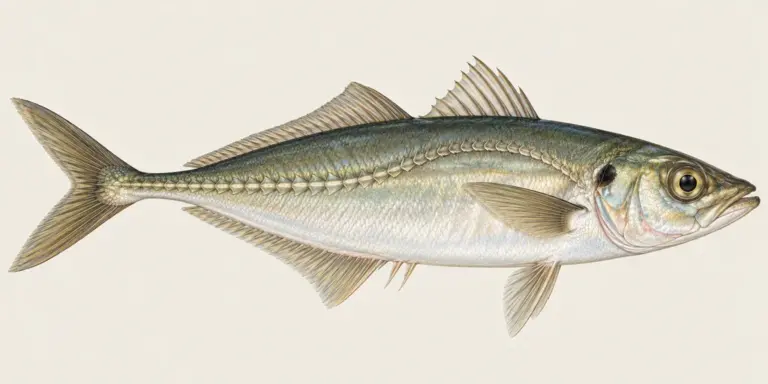
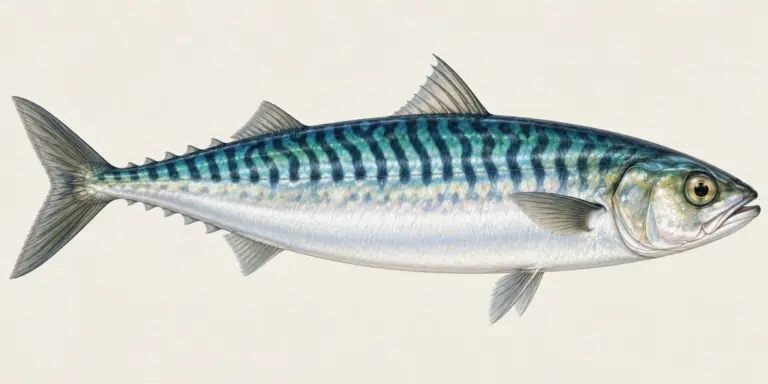
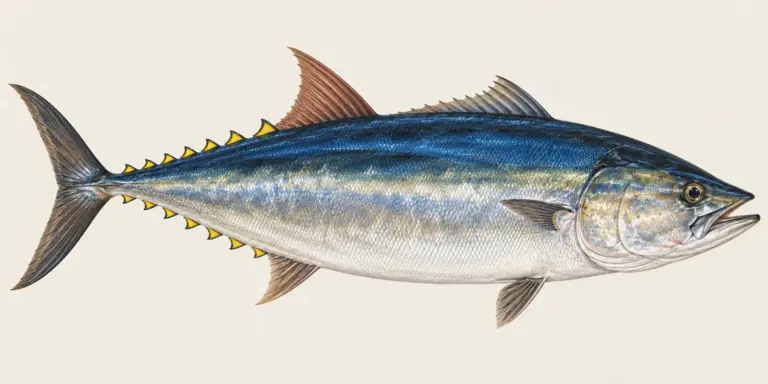
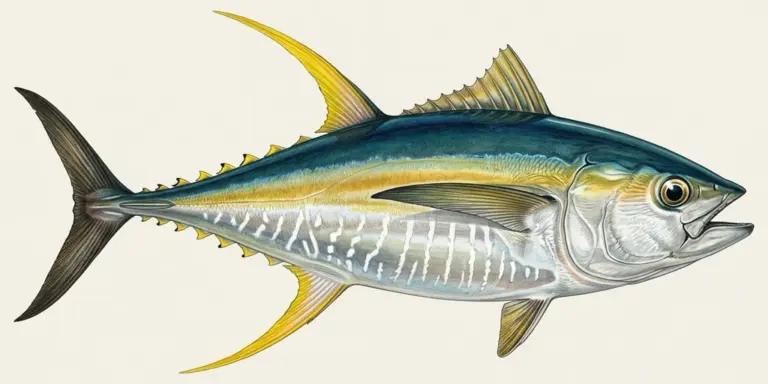
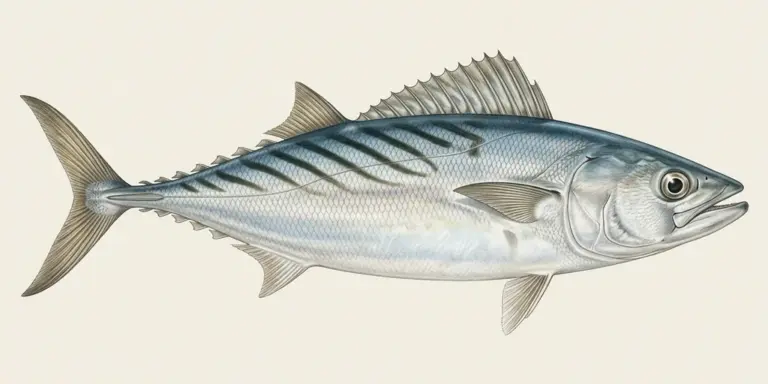
AI-generated illustrations.
Where it holds
The horse mackerel lives in the eastern Atlantic from Norway to South Africa, as well as in the Mediterranean, the Black Sea, the North Sea and the Baltic Sea. It is a warmth-loving species and reaches the edge of its range in the northern North Sea.
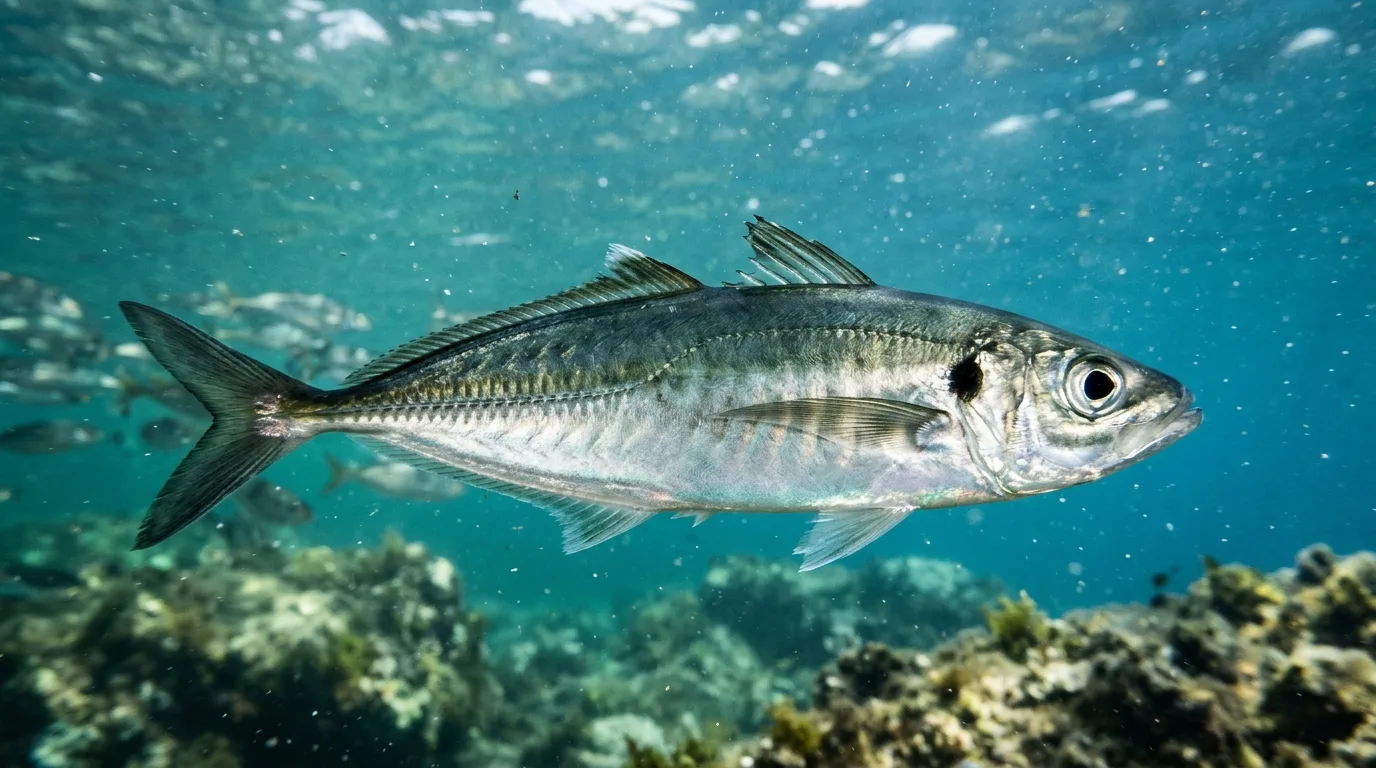
The species is pelagic, that is it lives in open water, in large shoals over the shelf, usually down to 200 metres. By day the shoals stand near the bottom and in mid-water, and at night they spread out just above the bottom.
In the North Sea the highest densities are found in summer in the south-east. In the central North Sea it is largely absent. According to the Red List you meet it in summer particularly in the German North Sea too. On the Norwegian coast it is a regular summer visitor as far as northern Norway, most often on the south coast.
Holding spots in the picture
Choose the season and time of day: the picture shows where the species stands then. Spots outlined in red apply only in the chosen season. Tap a fish or a spot in the list to bring it closer. The picture is schematic and AI-generated, every water is different.
Catch chances in springpossible
Catch chance in summergood
Catch chance in autumnpossible
Catch chance in winterhardly any
- J
- F
- M
- A
- M
- J
- J
- A
- S
- O
- N
- D
Spawning season
No main time Your best chances are at dusk and in the dark. In harbours the shoals hunt at night where lamps shine on the water.
No main time Your best chances are at dusk and in the dark. In harbours the shoals hunt at night where lamps shine on the water.
Active time Your best chances are at dusk and in the dark. In harbours the shoals hunt at night where lamps shine on the water.
Active time Your best chances are at dusk and in the dark. In harbours the shoals hunt at night where lamps shine on the water.
On the coast
Sandy bottom
Horse mackerel (scad) is found here only in spring, summer and autumn.
Open water, mid-water
Horse mackerel (scad) is found here only in spring, summer and autumn.
Just below the surface
Horse mackerel (scad) is found here only in spring, summer and autumn.
Horse mackerel travel in large shoals through open water, close to the coast gladly over sandy bottom. By day the shoals stand at the bottom and in mid-water, at night just above the bottom. When they hunt small fish, you often hear and see them at the surface.
Spring: chances according to the catch calendar are slim in March, possible in April and May. In spring the horse mackerel migrate into the North Sea.
Summer: chances according to the catch calendar are good in June and July, peak season in August. In high and late summer they are most numerous in the North Sea, especially in the south-east.
Autumn: chances according to the catch calendar are good in September, possible in October, slim in November. From October they leave the North Sea towards the English Channel.
Winter: chances according to the catch calendar are slim. In winter they have almost vanished from the North Sea.
Depth: horse mackerel live in open water over the shelf, mostly down to 200 metres.
Size comparison: AI-generated drawing, schematic.
How it migrates and spawns
Juveniles feed on plankton such as krill and copepods. Larger horse mackerel increasingly hunt near the bottom and eat small fish, for example young herring, cod and whiting, plus crustaceans and squid.
According to ICES, the North Sea stock spawns mainly in May and June in the southern North Sea, including off the German coast. A female releases 5 to 16 batches of eggs over several months. The horse mackerel becomes sexually mature at 16 to 25 centimetres, usually at two to four years old.
After spawning the fish disperse into the German Bight. From October they move through the Strait of Dover into the warmer waters of the English Channel and the Celtic Sea. A second, western stock enters the North Sea from the north in summer.
When it bites
The season follows the migrations. In spring the horse mackerel arrive in the North Sea, and in high summer and late summer they are most numerous. From October they leave the North Sea, and in winter they have almost vanished there.
In harbours the shoals move around at night and hunt where artificial light falls on the water. Your best chances are therefore at dusk and in the dark.
Today’s catch index needs JavaScript. Season and spawning time are in the catch calendar.
You will find the monthly overview of all species and the water temperature check in the catch calendar.
What you catch it with
Step by step: Fishing for horse mackerel: tips on lures, rigs and tackle – season, spots, lures, tackle and rules on one page.
The horse mackerel is most fun on ultralight tackle. Blinker describes harbour fishing in Normandy with a spinning rod of 1 to 8 grams casting weight and small soft plastics on light lead heads. Fish were caught with slim soft plastic shads and twister tails of 4 to 7 centimetres.
Mini soft plastic shads and small plugs also catch fish, as does a herring paternoster rig with small flies or feathers. In Norwegian fjords it also takes the hook alongside mackerel.
Play it carefully. The mouth is soft and the hook easily pulls out. A soft rod and a finely set drag help.
Fish the cones of light: At night in the harbour, look for the areas where lamps shine on the water. That is where the shoals hunt.
Careful along the lateral line: The keeled scutes along the lateral line are serrated, hence the Norwegian name Taggmakrell. Hold the fish by the back and not along the lateral line.
Suitable lures
Small soft plastics and mini crankbaits on ultralight tackle, plus a herring rig.
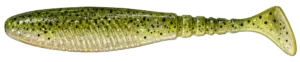
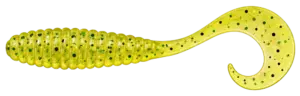
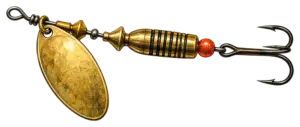
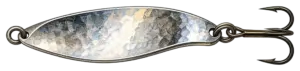
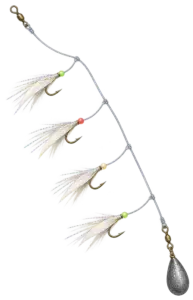
AI-generated illustrations. A click opens the lure’s page.
Rigs for these lures: Jig head rig.
Soft mouth: play it carefully.
How to fillet and prepare horse mackerel
As with herring and mackerel, the fat content varies over the year: horse mackerel carry the most fat in autumn after feeding and the least at spawning time. The fillets are usually smaller and leaner than those of a mackerel of the same size, so before smoking you salt them more sparingly. Otherwise you can fry, grill or bake them in the oven.
Handle the catch carefully, as the bony scutes and spines can cause injury. The scutes sit firmly on the muscle, especially towards the tail, and do not come off during normal scaling. After a brief scalding or steaming the connective tissue loosens, and skin and scutes can then be pulled off together. Without cooling the flesh quickly turns soft, so horse mackerel go on ice straight after capture (Storage and hygiene).
As a sea fish it can carry roundworm larvae, which die when it is cooked through thoroughly. If you want to eat it raw, for example as sushi, freeze it first at minus 20 degrees Celsius for at least 24 hours.
What you need to observe
Closed seasons, minimum sizes and harvest slots are set by the federal states (Bundesländer) and by the fisheries authorities of the neighbouring countries on the coast (Denmark, Norway, Poland). They vary by type of water, stretch of coast and time of year. We only give figures together with the date and source; the fisheries regulation of your federal state and your fishing permit (Erlaubnisschein) are always what is binding. You will find a list of links to the official sources in the catch calendar.
A fish of legal size that you want to keep you stun and kill at once, in line with animal welfare rules. Protected, undersized fish or fish too large under a harvest slot you unhook, if possible still in the water and with wet hands, and release gently. What exactly applies is regulated by state law and your fishing permit (Erlaubnisschein).
In Norway, minimum sizes (Mindestmaße) apply to all sea anglers; the Fiskeridirektoratet gives binding information. Germany’s Red List classes horse mackerel as common and not threatened, while the IUCN rates it as vulnerable worldwide. According to ICES, the spawning stock in the north-east Atlantic is below the reference value and fishing mortality above it. So only take as many fish as you can use.
What closed season, minimum size and harvest slot mean and where to find them is explained on the page Closed season and minimum size explained.
Frequently asked questions (FAQ)
How do I tell horse mackerel from mackerel?
By the lateral line. The horse mackerel has a row of large, keeled scales there; the mackerel does not. It also has a black spot on the gill cover.
When are horse mackerel in the North Sea?
From spring until autumn. From October they move into the English Channel and the Celtic Sea, and in winter they are hardly to be found in the North Sea.
What do I use to catch horse mackerel in the harbour?
At night with an ultralight spinning rod and small soft plastics of 4 to 7 centimetres, ideally where light falls on the water.
Sources
The rating of catch chances is an editorial assessment. The facts come from these sources, and the text is worded in our own words. The illustration is an original design by Angel Momente in the style of a natural history plate (AI-generated, see the AI notice).
- ICES FishMap: Horse mackerel, Trachurus trachurus (Verbreitung, Laichzeit, Wanderung Nordsee)
- FishBase: Trachurus trachurus, Atlantic horse mackerel (Merkmale, Größe, Bestände)
- Store norske leksikon (L. A. Vøllestad, Universität Oslo): hestmakrell (taggmakrell)
- Blinker: Farbenfrohe Fänge beim Spinnfischen an der Küste der Normandie (Stöcker im Hafen)
- Blinker: Korsika, Angeln auf der Insel der Chancen (Stöcker am Leichtgerät)
- Blinker: Norwegen, geheimnisvolle Gestalten aus dem Romsdalsfjord (Artenliste mit Bastardmakrele)
- Fiskeridirektoratet: Minimum sizes for salt water species (Mindestmaße für Meeresangler)
- Rote-Liste-Zentrum: Artensteckbrief Holzmakrele, Stöcker (Rote Liste Meeresfische 2025)
- FAO (Torry Research Station, Torry Advisory Note 93): Handling and processing scad
- Bundeszentrum für Ernährung (BZfE): Fisch und Meeresfrüchte, Gesundheit und Umwelt
- LAVES Niedersachsen: Parasiten in Fischen und Fischereierzeugnissen – ein Problem?
- LAVES Niedersachsen: Sushi selber machen – so gelingt es sicher!
Created with AI support from the sources listed. Figures only appear in the text if a source gives them. Last updated: 27 October 2026. Found a mistake? Write to us. Who is behind this site: About me.
More in the lexicon
- All fish species at a glance
- Catch calendar – month, water temperature and profile for 93 species
- Line calculator – breaking strain after the knot, drag guideline, backing
- Angling methods