
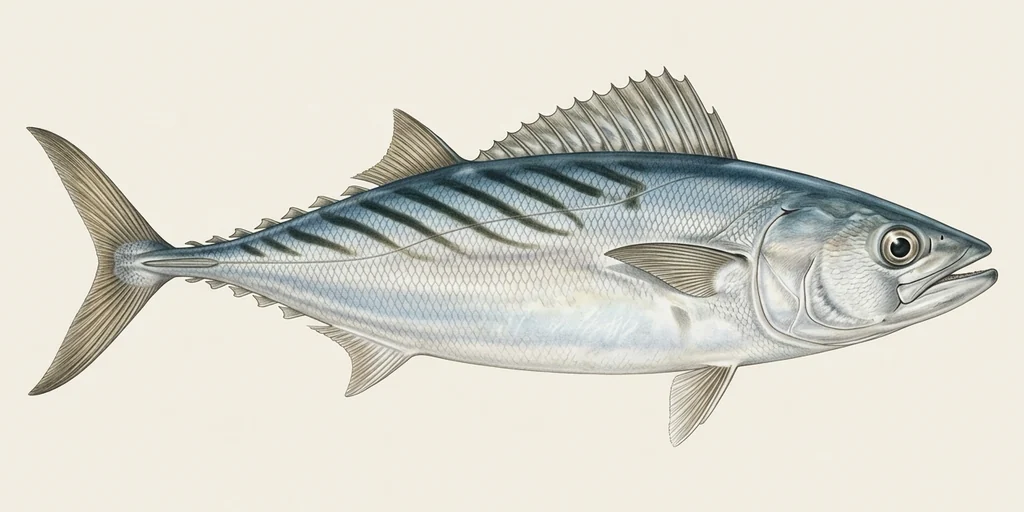
Knowledge – Fish
Bonito (pelamid): Features, difference from the skipjack
The bonito (Sarda sarda), also called pelamid or Atlantic bonito, is a small tuna from the Atlantic, the Mediterranean and the Black Sea. It travels in shoals along the coasts and hunts sardines, anchovies and mackerel. It is not the same as the skipjack tuna from the tin of tuna.
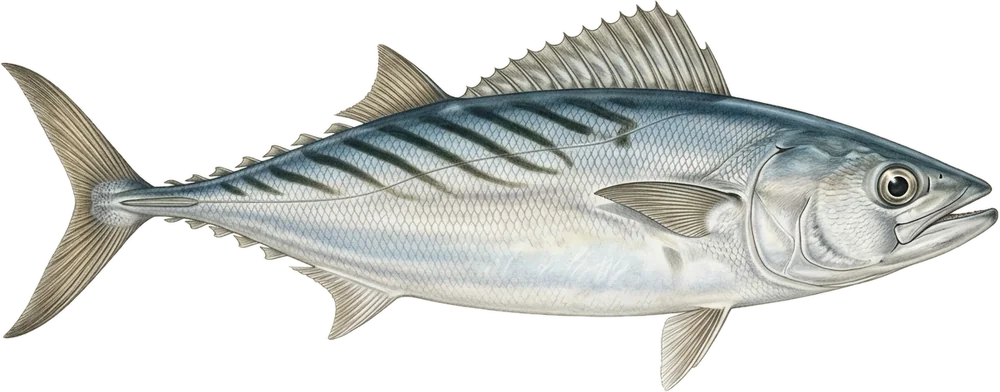
In brief: According to the catch calendar the best time is from May to October. Good spots on the coast: open water just below the surface. Proven baits: small metal lures and plugs for spinning or trolling, feather lures, also strips of fish. Do not confuse it with the skipjack tuna (Katsuwonus pelamis): the bonito has oblique stripes on the back, the skipjack lengthwise bands on the belly. Step by step: Bonito fishing.
- Five to eleven dark stripes running obliquely forwards and downwards across the back and upper flank
- Steel-blue back and silvery underside without lengthwise bands on the belly
- Long first dorsal fin reaching almost to the second, with small finlets behind it
Catch chances through the year
- Hardly any chance
- Possible
- Good
- Peak season
- Spawning (observe the closed season)
Editorial assessment for the home area (Mediterranean and eastern Atlantic), not a measured value and not a guarantee. The rules of the country you are visiting are binding.
How to recognise it
The body is elongated and slightly flattened from the sides. On the slender tail stock there is a strong keel on each side between two smaller ones. The back and upper flanks are steel blue, the underside silvery. Typical are five to eleven dark stripes that run obliquely forward and down across the back, more steeply than in other species of the genus Sarda.
The first dorsal fin is long and reaches almost to the second. Behind it there are usually eight small finlets, and behind the anal fin usually seven. The body is covered with very small scales; on the chest there is an armour of larger scales, the corselet. The mouth is fairly large and carries conical teeth. There is no swim bladder.
According to ICCAT the bonito reaches at most 91,4 centimetres fork length (snout to the fork of the tail fin) and 5,4 kilograms in the Atlantic, and 85 centimetres and 5 kilograms in the Black Sea. FishBase gives 50 centimetres as the usual length and 11 kilograms as the highest published weight. It grows very fast in its first year and lives for five years at most.
In German the name causes confusion. The bonito of the Mediterranean coasts is Sarda sarda, also called pelamid or false bonito (Unechter Bonito). The skipjack tuna (Katsuwonus pelamis) belongs to a genus of its own, lives in the open ocean and is marketed, among other things, as tinned fish.
The stripe pattern lets you tell them apart reliably: the bonito has oblique dark stripes on the back. The skipjack has a dark purple-blue back without stripes and instead four to six striking dark lengthwise bands on the lower flank and belly. Except for the corselet and the lateral line it is scaleless.
According to ICCAT, bonito shoals are sometimes mixed with other small tunas, which are called spotted tunny and auxid in English. Anyone fishing the Mediterranean for hunting shoals should identify each catch individually.
Side by side
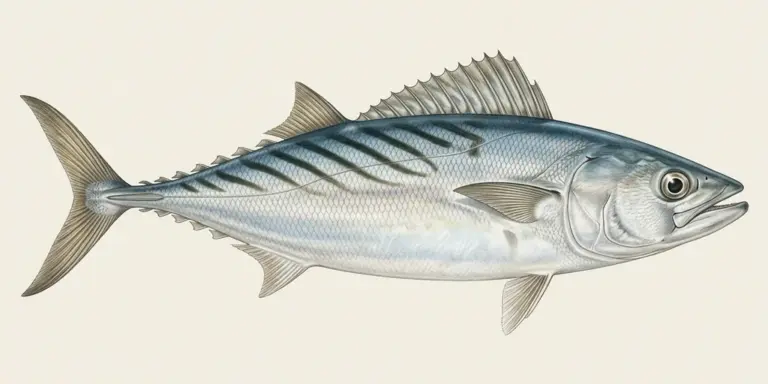
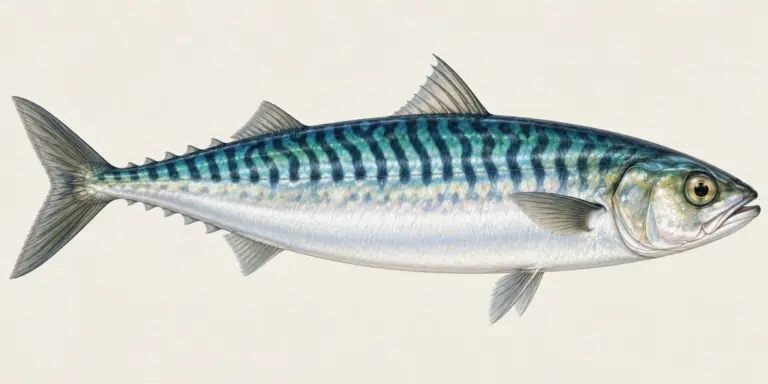
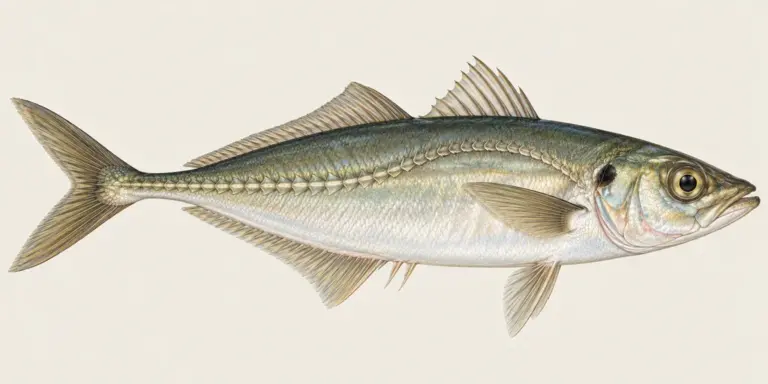
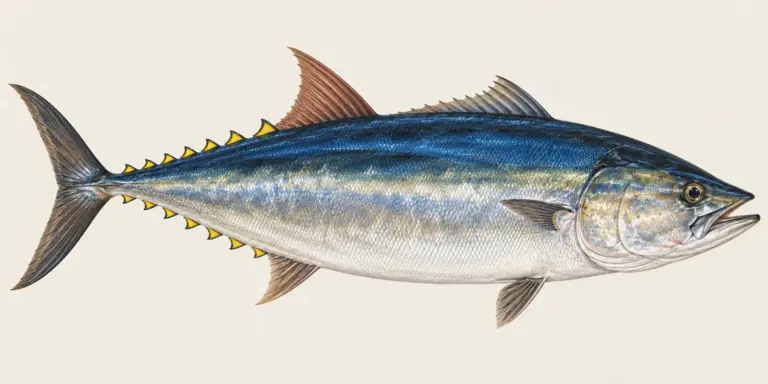
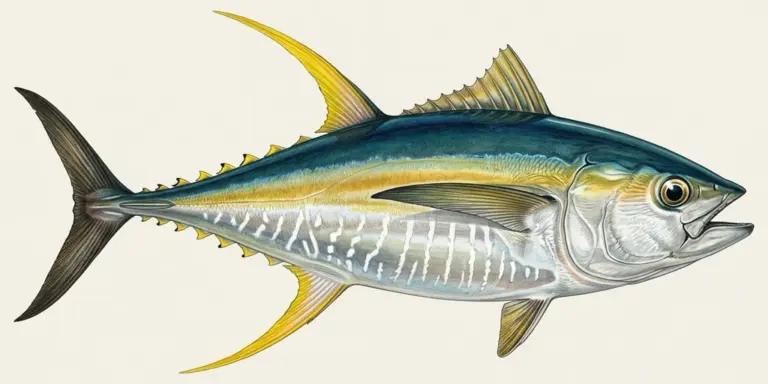
AI-generated illustrations.
Where it hunts
The bonito lives in the tropical and subtropical Atlantic, in the Gulf of Mexico, the Mediterranean and the Black Sea. In the eastern Atlantic its range extends, according to ICCAT, from Oslo to Port Elizabeth in South Africa. It is largely absent from the Caribbean.
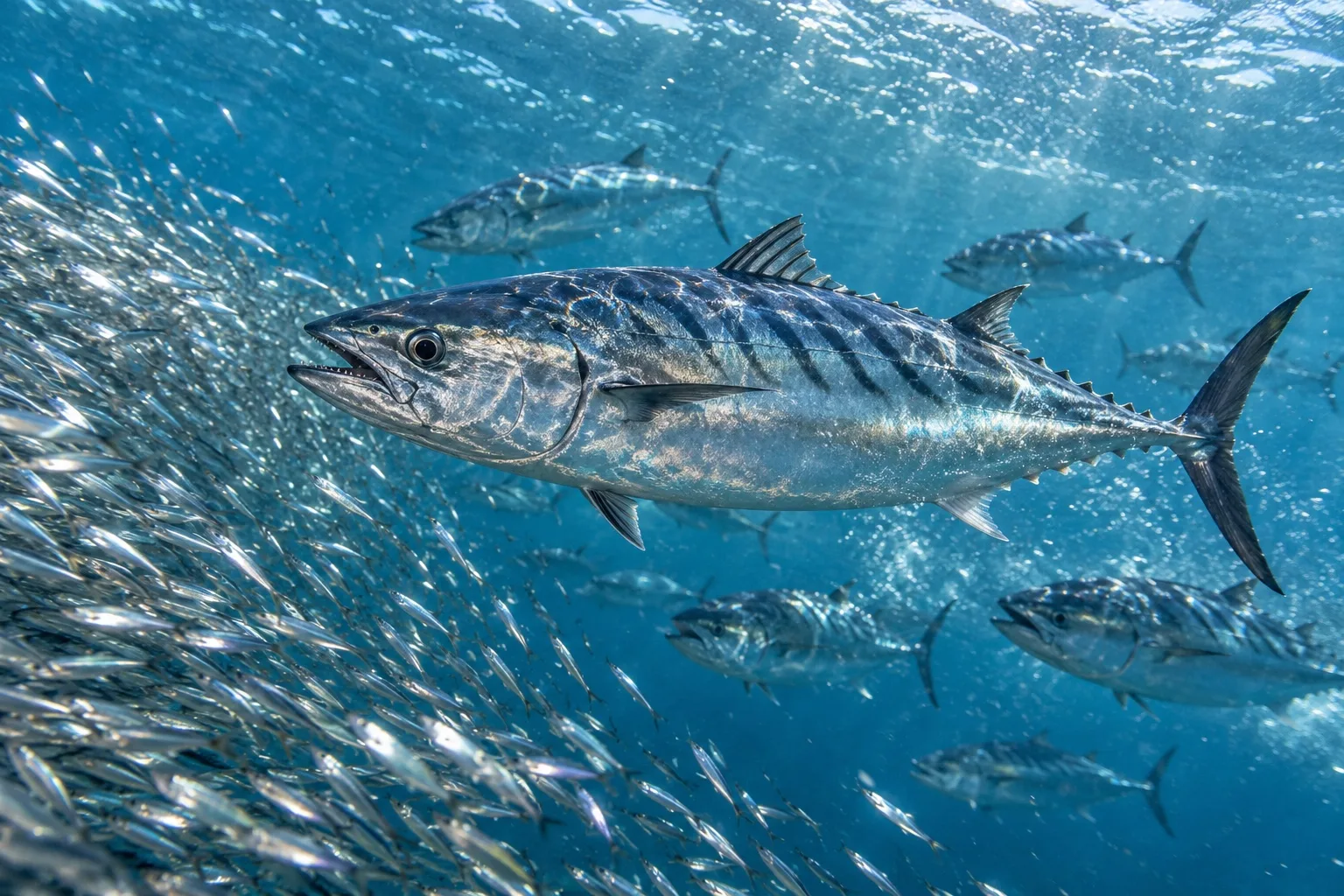
It is a shoaling fish of coastal open water over the continental shelf and occasionally enters river mouths. FishBase gives depths of 80 to 200 metres. It tolerates water temperatures of 12 to 27 degrees and salinities of 14 to 39 per mille.
Holding spots in the picture
Choose the time of day: the picture shows where the species holds. We do not show German seasons for travel fish; the bars give the chance of a catch for each month. Tap a fish or a spot in the list to bring it closer. The picture is schematic and AI-generated, and every water is different.
Chance of a catch per month according to the catch calendar
- J
- F
- M
- A
- M
- J
- J
- A
- S
- O
- N
- D
Spawning season
Active time It feeds mainly in the early morning hours and in the evening, usually close inshore.
No peak time It feeds mainly in the early morning hours and in the evening, usually close inshore.
Active time It feeds mainly in the early morning hours and in the evening, usually close inshore.
No peak time It feeds mainly in the early morning hours and in the evening, usually close inshore.
On the coast
Open water, mid-water
Bonito (pelamid) is here all year round.
Just below the surface
Bonito (pelamid) is here all year round.
Bonito travel in schools through open water over the shelf and follow the coasts. There they hunt sardines, anchovies and mackerel. Occasionally they come as far as river mouths.
Size comparison: AI-generated drawing, schematic.
How it feeds and spawns
Bonito hunt small shoaling fish such as sardines, anchovies, sprats, sand eels, horse mackerel and mackerel, as well as squid and prawns. They also eat their own kind and can swallow relatively large prey. According to ICCAT they feed mainly early in the morning and in the evening, usually close to the coast. Inshore shoals tend to consist of small fish.
The bonito spawns several times per season, three to four times, on the coast during the warm months. In the Mediterranean the spawning grounds lie around the Balearics, off Algeria and Sicily, in the Aegean and in the Black Sea. It becomes sexually mature at about 40 centimetres fork length.
When and where the season is
Tagged fish show long movements along the coasts. To spawn, bonito migrate from the Atlantic into the Alborán Sea and from the Aegean into the Black Sea, then back by the same route. In the western Mediterranean they stay all year according to some studies, and mature fish move from the coast out to the open sea to spawn. On average tagged bonito cover about 2,6 kilometres a day, a few over 35 kilometres.
Spawning takes place in the Mediterranean and off Morocco mainly in May and June according to FishBase, and off Algeria as early as March to May. In the warm months the spawning grounds are close to the coast. For planning the day, the early morning hours and the evening count.
How it is caught
Step by step: Bonito fishing: tips on bait, rigs and tackle – season, marks, bait, tackle and rules on one page.
According to ICCAT, commercial fishers catch bonito mainly with purse seines, handlines, small longlines and gill nets. Rod and reel, trolling and sport fishing also appear in the catch statistics. For anglers the interesting shoals are those that hunt close to the coast in the morning and evening.
Anglers report catching bonito by trolling small lures and by spinning with slim metal lures onto hunting shoals. A strip of fish can also work, since sardines and anchovies are the main prey. The closely related skipjack is trolled, according to FishBase, with light tackle, plugs, spoons, feather lures or strips of fish.
Early start or late start: According to ICCAT, bonito feed mainly early in the morning and in the evening close to the coast. Plan shore and boat trips for those times.
Look at the stripes: Oblique stripes on the back mean bonito, lengthwise bands on the belly mean skipjack. Different rules may apply to the two species.
Suitable lures
Small metal lures and plugs for spinning or trolling, feather lures, also strips of fish.
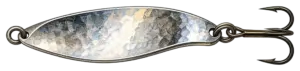
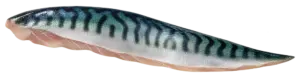
AI-generated illustrations. A click opens the lure’s page.
What applies locally
The bonito is one of the small tuna species for which the International Commission for the Conservation of Atlantic Tunas (ICCAT) collects data in five stock areas. It rates the state of the stocks in the Mediterranean and the north-eastern Atlantic as very uncertain, and one study sees overfishing in the north-eastern Atlantic. The IUCN lists the species worldwide as not threatened (Least Concern, assessment of 2021).
For fishing in the Mediterranean and on the Atlantic coast, the rules of the country concerned apply, for example on minimum sizes (Mindestmaß), catch limits, licences and protected areas. We do not give specific figures; the fisheries authority on the spot (Fischereibehörde) is binding. Check before the trip whether you need a permit for sea fishing.
Frequently asked questions (FAQ)
Is the bonito a tuna?
Yes, a small one. It belongs to the family of mackerels and tunas, and ICCAT lists it among the small tuna species.
What is the difference between the bonito and the skipjack tuna?
The bonito (Sarda sarda) has oblique dark stripes on the back and lives close to the coast. The skipjack tuna (Katsuwonus pelamis) has lengthwise bands on the flank and belly and lives in the open ocean.
When do bonito bite best?
According to ICCAT they feed mainly early in the morning and in the evening, usually close to the coast.
Sources
The rating of catch chances is an editorial assessment. The facts come from these sources, and the text is worded in our own words. The illustration is an original design by Angel Momente in the style of a natural history plate (AI-generated, see the AI notice).
- FishBase: Sarda sarda, Atlantic bonito
- FishBase: Spawning List, Sarda sarda
- ICCAT Manual: Atlantic Bonito (2021)
- FishBase: Katsuwonus pelamis, Skipjack tuna
- Wikipedia: Echter Bonito
Created with AI support from the sources listed. Figures only appear in the text if a source gives them. Last updated: 27 October 2026. Found a mistake? Write to us. Who is behind this site: About me.
More in the lexicon
- All fish species at a glance
- Catch calendar – month, water temperature and profile for 93 species
- Line calculator – breaking strain after the knot, drag guideline, backing
- Angling methods