
Knowledge – Fish
Atlantic bluefin tuna: Features, return
The Atlantic bluefin tuna (Thunnus thynnus) is the largest tuna species. After decades of overfishing it has been appearing regularly off Norway and in the Skagerrak again since about 2012. For anglers in Norway, Sweden and Denmark it is off limits.
In short: Protected all year for sea anglers in Norway; in Sweden and Denmark fishing for bluefin tuna is banned. Not a target fish for anglers in the North Sea, the Baltic Sea and Norway. What to do if you catch one by accident: Bluefin tuna as bycatch.
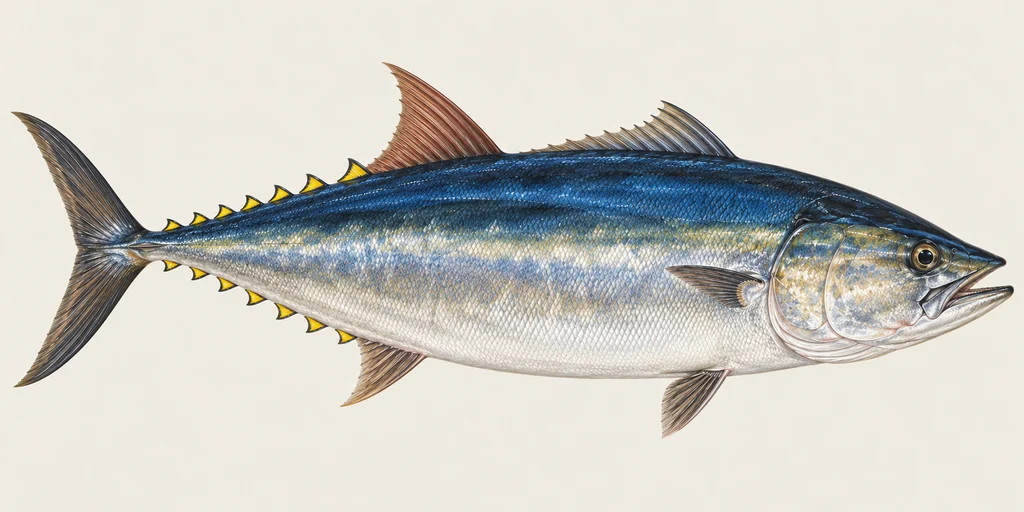
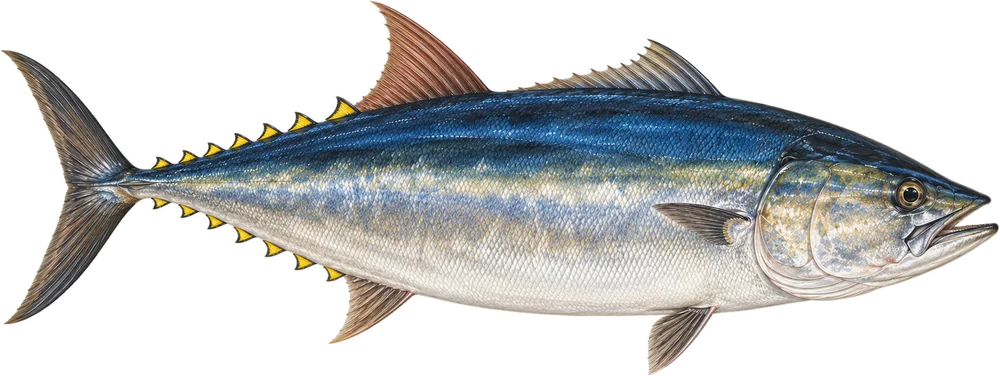
- Second dorsal fin higher than the first, reddish brown
- Very short pectoral fins
- Yellow finlets edged with black behind the dorsal and anal fins
Catch chances through the year
- Hardly any chance
- Possible
- Good
- Peak season
- Spawning (observe the closed season)
Editorial assessment for waters in Germany, not a measured value and no guarantee. Spawning time is not the same as the legal closed season.
Species profile and sources in the catch calendarAll species compared month by monthThe rules of your federal state
How to recognise it
The Atlantic bluefin tuna has the spindle-shaped body of the mackerels and tunas, deepest roughly in the middle of the first dorsal fin. The back is dark blue to blue-black, the flanks shimmer like mother-of-pearl, the belly is silvery white. On fresh fish you can see colourless cross lines and rows of dots there.
The front dorsal fin turns yellow or bluish. The rear one is reddish brown and higher than the front one. The pectoral fins are very short. Behind the second dorsal fin and the anal fin there are 8 to 9 small finlets above and below, dark yellow with a black edge. The front part of the body is covered by a corselet of fused scales.
FishBase gives a typical length of around two metres, maximum values of 4,58 metres and 684 kilograms, and a maximum age of 32 years. Store norske leksikon reports registered animals of up to 40 years. Thanks to a special network of blood vessels, tunas keep their body temperature a few degrees above the water temperature and so hunt in cold water too.
In Norwegian waters the Atlantic bluefin tuna is the only tuna species that regularly migrates so far north. Other tunas such as the yellowfin tuna usually stay clearly smaller according to FishBase and carry stripes, bands or dots typical of the species.
It shares its body shape and finlets with the mackerel, its main prey, but not its size.
Side by side
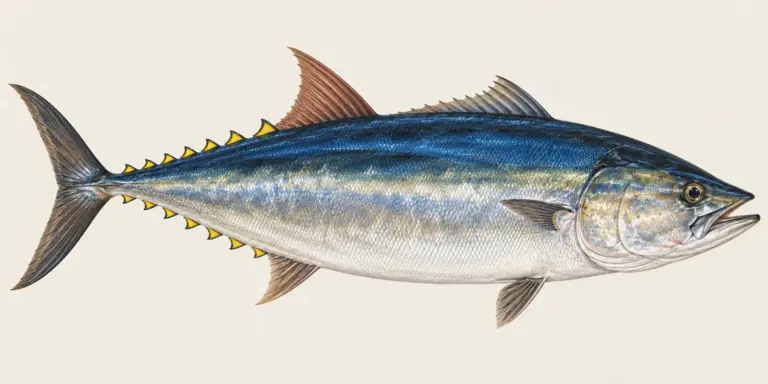
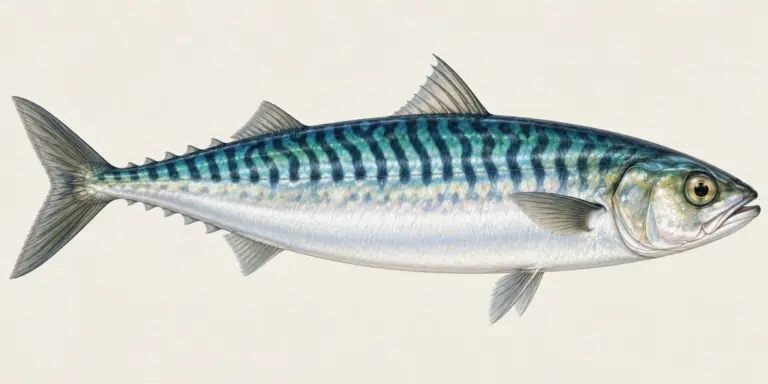
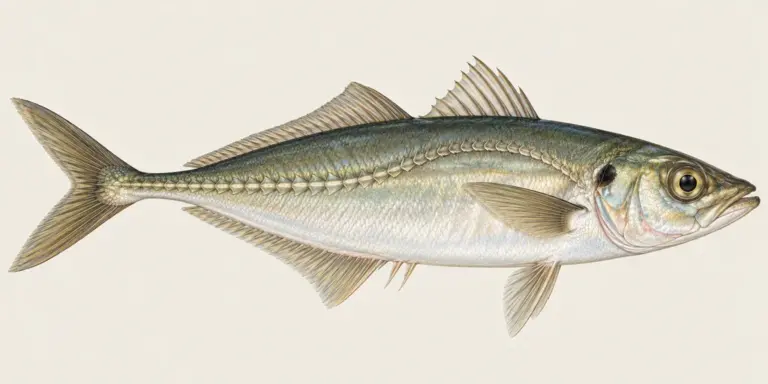
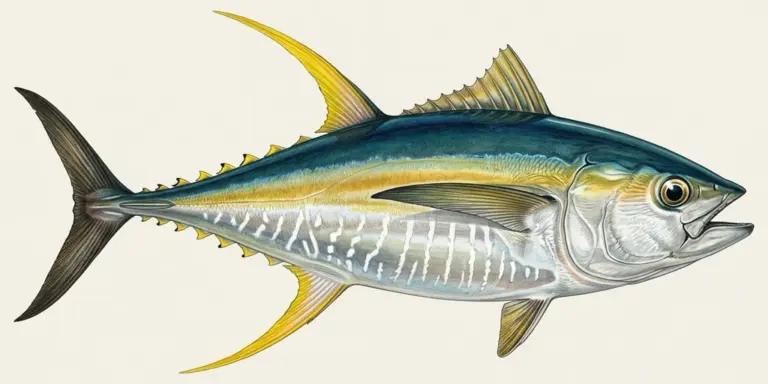
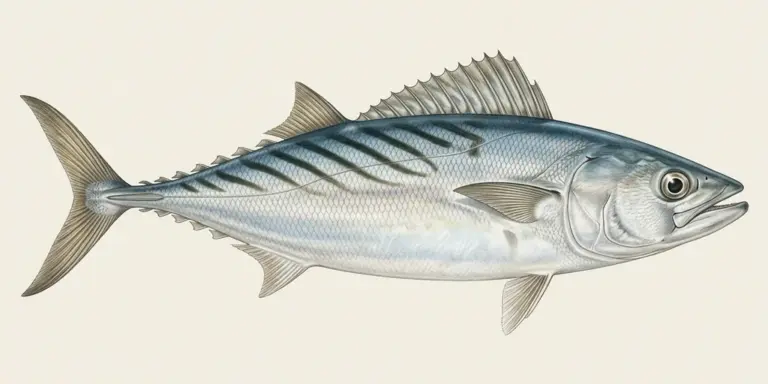
AI-generated illustrations.
Where it lives and migrates
The Atlantic bluefin tuna lives in the North Atlantic, the Mediterranean and the southern Black Sea. In the eastern Atlantic its range reaches from the Lofoten Islands to the Canary Islands. It is an open-sea fish that comes to the coasts seasonally, usually swims in the top 100 metres and can dive to more than 1000 metres.
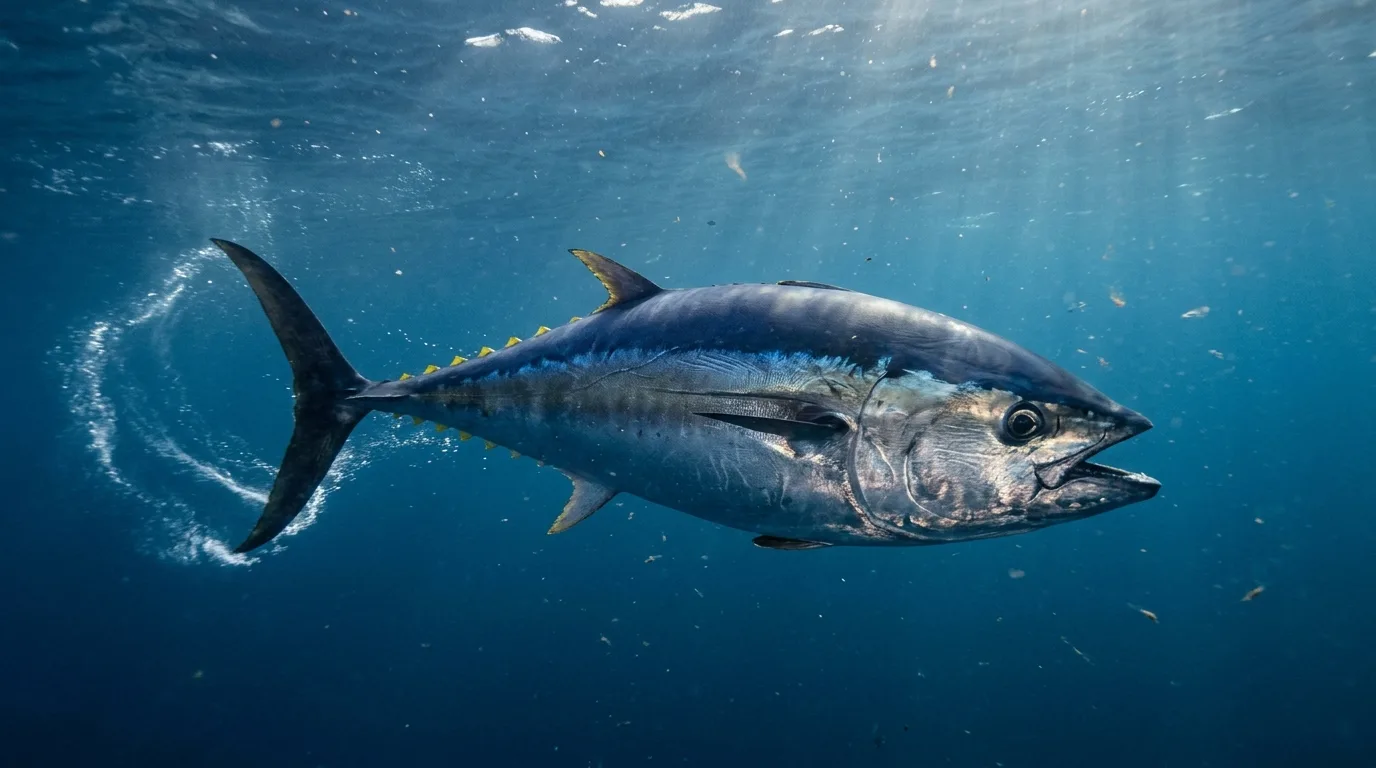
Until the end of the 1970s it was a regular visitor off Norway, then it stayed away. Since 2012 it has been returning. Today it turns up periodically from the Skagerrak up to the north, in some years as far as Finnmark. Satellite tags from the Havforskningsinstituttet show that the animals stay in Norwegian waters for 68 days on average. Some apparently feed there into the winter.
On the Swedish west coast it is a rare summer visitor, but it has been recorded as far as the Öresund and the southern Baltic Sea. In recent years it has become more frequent there again.
Holding spots in the picture
Choose a season and time of day: the picture shows where the species sits then. Tap a fish or a spot in the list to bring it closer. The picture is schematic and AI-generated, every water is different.
On the coast
Open water, mid-water
Bluefin tuna (Atlantic bluefin tuna) is found here all year round.
Just below the surface
Bluefin tuna (Atlantic bluefin tuna) is found here all year round.
The bluefin tuna is a fish of the open sea that comes close to the coast at certain times. In the north it often hunts there in groups, chasing mackerel, herring and other shoaling fish.
Summer: Off Norway it is seen most often from July to September.
Autumn: In Scandinavian waters it stays until November, and some fish feed there into winter.
Depth: It usually swims in the top 100 metres but can dive to over 1000 metres.
Size comparison: AI-generated drawing, schematic.
How it hunts and spawns
The Atlantic bluefin tuna often hunts in groups. Off Norway it feeds mainly on mackerel, plus herring, blue whiting and other shoaling fish as well as squid and crustaceans. According to the Havforskningsinstituttet it swims at up to 70 km/h and can cross the Atlantic in 50 days.
The eastern stock that migrates to Norway spawns in May and June at three main spawning grounds in the Mediterranean. A second stock spawns in the Gulf of Mexico. After spawning, the long migration to the feeding grounds in the north begins. Eastern Atlantic bluefin tuna become sexually mature at about four years old and are then more than a metre long.
Young tuna grow quickly, about 30 centimetres a year. Later growth slows down sharply.
When it arrives in the north
For anglers in the North Sea, the Baltic Sea and Norway there is no season, as the species is protected. The calendar therefore shows zero throughout.
The Atlantic bluefin tuna is seen most often off Norway from July to September. According to the Swedish marine authority it stays in Scandinavian waters from August to November.
You will find the monthly overview of all species and the water temperature check in the catch calendar.
What you do if you hook one
As bycatch: Fishing for Atlantic bluefin tuna? – why the species is not a target fish and what you do if you catch one by accident.
The Atlantic bluefin tuna is not fished for deliberately in our area. In Norway it is protected all year for sea anglers, in Denmark and Sweden fishing for it is banned. In Sweden this expressly applies even if the fish would be released. An accidentally caught tuna must be released immediately in Denmark and Sweden.
Catches for research purposes are only made with a special permit. In the Skagerrak and Kattegat the Swedish agricultural university (SLU Aqua) and DTU Aqua from Denmark, together with the WWF, have caught, tagged and released tuna. Since 2020 the Havforskningsinstituttet has fitted a total of 25 Atlantic bluefin tuna off Norway with satellite tags.
Report a sighting: In Sweden the marine authority asks for finds of tuna to be reported on the species portal. Note the place, date and estimated size.
Tackle aimed at tuna stands out: The Swedish marine authority asks for anglers with tackle clearly intended for tuna to be reported to the coastguard.
Suitable lures
We deliberately show no baits for this species.
Protected all year in Norway, fishing banned in Sweden and Denmark: do not target it, release an accidental catch immediately.
What you need to observe
The Norwegian Directorate of Fisheries lists the Atlantic bluefin tuna among the species that are protected all year for sea anglers (as of November 2026). Protected species must not be fished for. You will find the current version at the Fiskeridirektoratet.
In Sweden recreational fishing for Atlantic bluefin tuna is banned, and an accidental catch is released immediately. The rules also apply to foreign anglers in Swedish waters (as of November 2026). Details are given by the Swedish Agency for Marine and Water Management.
In Denmark, according to the environmental agency, recreational and sport anglers cannot legally fish for Atlantic bluefin tuna, and an accidental catch must go straight back into the water (Miljøstyrelsen). Since January 2026, a tuna that bites in Danish salt water must be reported in the RecFishing app on the day it is caught, even if you have released it (leaflet from the Landbrugs- og Fiskeristyrelsen). Exceptions have only existed through separate regulations for individual years: in 2025 the agency used Bekendtgørelse Nr. 1032/2025 to allocate permits by lottery to catch and land one tuna each in the Skagerrak, Kattegat and Øresund, limited to September and October and to participants in the DTU Aqua tagging project. For 2026 the Danish legal database contains no such regulation (as of November 2026).
In English waters there is a narrow exception in 2026. The Marine Management Organisation issues about 140 to 150 permits to recreational anglers to hook a tuna and release it again; the 2026 season runs from 13 July to 30 November. Permits only go to owners of a motor boat of at least five metres registered in the United Kingdom, and the tuna may neither be lifted out of the sea nor landed. In addition, around 30 commercial fishers catch four tonnes each with rod and reel (as of November 2026, MMO).
In all EU member states the multiannual plan for bluefin tuna applies, Regulation (EU) 2023/2053. Under it, a member state with its own tuna quota regulates angling through a separate share and permits for boats; at most one tuna per boat and day is allowed, and it may not be sold (Articles 23 and 24). A member state may also allow a few sport fishing boats in the North-East Atlantic to catch, tag and release tuna, but only within a scientific project of a research institute (Article 25). A tuna weighing less than 30 kg or shorter than 115 cm to the fork of the tail may not be caught by anglers either (Article 19). According to Regulation (EU) 2026/249, only eight member states have their own quota for the eastern stock: Spain, France, Italy, Greece, Croatia, Malta, Cyprus and Portugal. The other EU states, including Germany, share a small amount that is for by-catch only (as of November 2026). This is an overview, not legal advice: the fisheries authority (Fischereibehörde) of your coastal federal state will tell you what applies to you.
Closed seasons, minimum sizes and harvest slots are set by the federal states (Bundesländer) and by the fisheries authorities of the neighbouring countries on the coast (Denmark, Norway, Poland). They vary by type of water, stretch of coast and time of year. We only give figures together with the date and source; the fisheries regulation of your federal state and your fishing permit (Erlaubnisschein) are always what is binding. You will find a list of links to the official sources in the catch calendar.
Internationally the stock is managed by the International Commission for the Conservation of Atlantic Tunas, ICCAT. The IUCN has classed the Atlantic bluefin tuna as not threatened worldwide since 2021. The Thünen Institute gives its status as potentially threatened for Europe and as severely threatened for the Mediterranean, noting that this assessment needs to be updated. On the Red List of German marine fish the Atlantic bluefin tuna is listed as a non-established, unstable visitor.
What closed season, minimum size and harvest slot mean and where to find them is explained on the page Closed season and minimum size explained.
Frequently asked questions (FAQ)
May I fish for Atlantic bluefin tuna in Norway, Sweden or Denmark?
No. Norway lists it as protected all year for sea anglers, while Sweden and Denmark ban fishing for it. An accidental catch is released immediately.
Since when have there been tuna off Norway again?
After being absent from the end of the 1970s, the Atlantic bluefin tuna has been returning since 2012. It stays in Norwegian waters for a little over two months on average.
How big does the Atlantic bluefin tuna get?
Usually around two metres. FishBase gives maximum values of 4,58 metres and 684 kilograms.
Sources
The rating of catch chances is an editorial assessment. The facts come from these sources, and the text is worded in our own words. The illustration is an original design by Angel Momente in the style of a natural history plate (AI-generated, see the AI notice).
- FishBase: Thunnus thynnus, Atlantic bluefin tuna (Größe, Merkmale, Biologie)
- Thünen-Institut, Fischbestände online: Blauflossenthun, atlantischer (Roter Thun)
- Havforskningsinstituttet: Makrellstørje (Bestände, Laichzeit, Rückkehr nach Norwegen, Satellitenmarken)
- Store norske leksikon (L. A. Vøllestad, Universität Oslo): makrellstørje
- Havs- och vattenmyndigheten: Blåfenad tonfisk (Vorkommen in Schweden, Markierung, Schutz)
- Havs- och vattenmyndigheten: Regler för blåfenad tonfisk (Freizeitangeln verboten)
- Fiskeridirektoratet: Meeresangeln in Norwegen, Regeln (ganzjährig geschützte Arten)
- Rote-Liste-Zentrum: Artensteckbrief Roter Thun (Rote Liste Meeresfische 2025)
- Miljøstyrelsen (Dänemark): Regler for lyst- og fritidsfiskeri (Fiskeri efter almindelig tun)
- Landbrugs- og Fiskeristyrelsen (Dänemark): Nye krav til registrering for lyst- og fritidsfiskere (RecFishing-Meldepflicht seit Januar 2026, Tun in ganz Dänemark)
- Retsinformation: Bekendtgørelse nr. 1032 af 25. juli 2025 om lystfiskeri efter almindelig tun i 2025 (Losverfahren, ein Thun je Genehmigung)
- Retsinformation: Suche „lystfiskeri efter almindelig tun“ (Verordnungen für 2021, 2022 und 2025, keine für 2026; abgerufen am 20.11.2026)
- Marine Management Organisation (GOV.UK): Bluefin tuna catch and release recreational fishery (CRRF) within English waters (Saison 2026, Bedingungen)
- Marine Management Organisation (GOV.UK): Bluefin tuna fisheries 2026 (Zahl der Genehmigungen für Freizeitangler)
- Marine Management Organisation (GOV.UK): Bluefin tuna (BFT) fisheries in 2026 (kommerzielle Rutenfischerei)
- EUR-Lex: Verordnung (EU) 2023/2053, Mehrjahresplan für Roten Thun im Ostatlantik und Mittelmeer (Artikel 19, 23 bis 25)
- EUR-Lex: Verordnung (EU) 2026/249, Fangmöglichkeiten 2026 bis 2028 (Anhang, Roter Thun östlich 45° W)
Created with AI support from the sources listed. Figures only appear in the text if a source gives them. Last updated: 20 November 2026. Found a mistake? Write to us. Who is behind this site: About me.
More in the lexicon
- All fish species at a glance
- Catch calendar – month, water temperature and profile for 93 species
- Line calculator – breaking strain after the knot, drag guideline, backing
- Angling methods