
Knowledge – Fish
Fishing for bluefin tuna
You may not fish for bluefin tuna in Norway, Sweden or Denmark: the huge open-sea fish is closed to anglers there. Here you can read how to recognise it, where it lives and what to do if one takes your bait anyway.
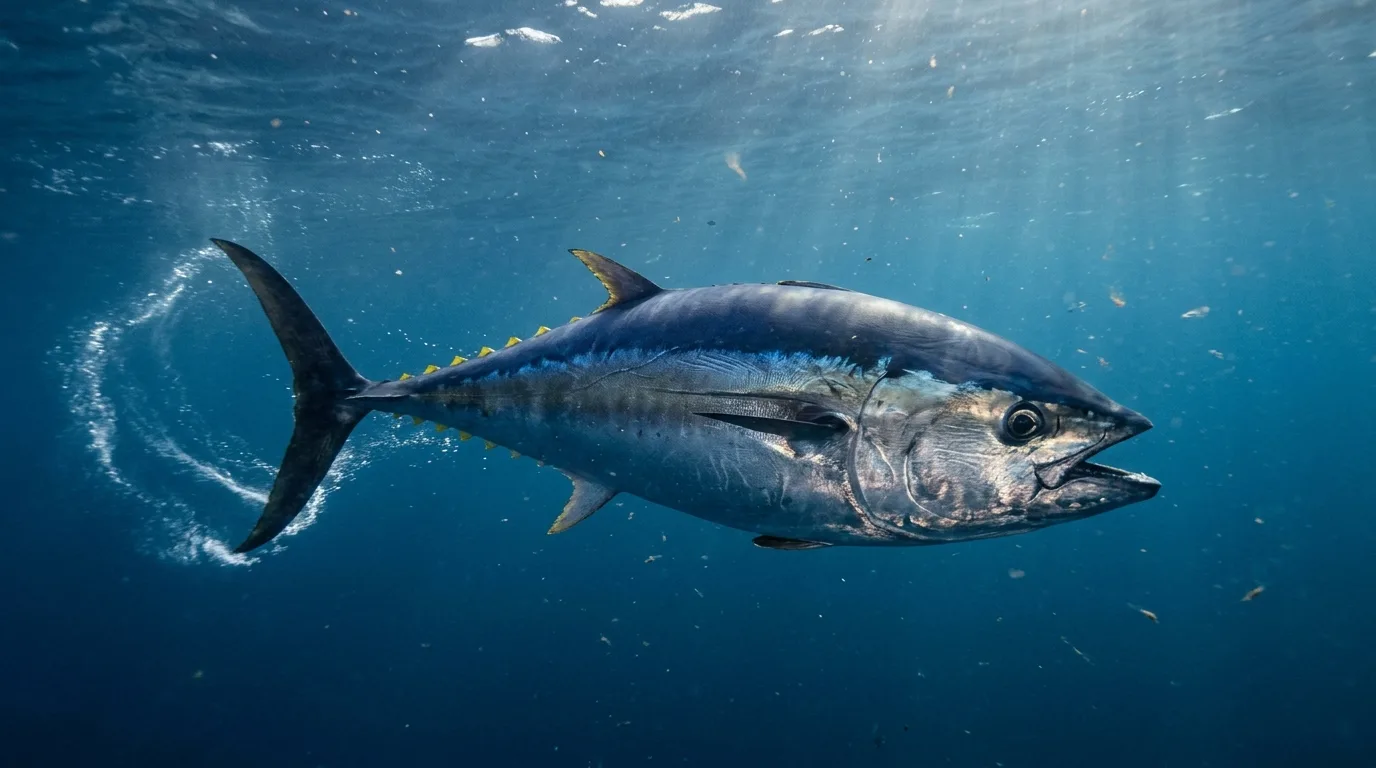
In Norway the bluefin tuna is protected all year round from sea anglers, in Sweden and Denmark recreational anglers may not fish for it, and Germany has no tuna quota of its own in 2026. It is not a target species.
Quick to recognise
The largest species of tuna: spindle-shaped, dark blue to blue-black on top, pearly on the sides, silvery white on the belly. Behind the dorsal and anal fins sit dark yellow finlets edged in black. A length of around two metres is usual.
Why it is not a target fish
After decades of overfishing it has been returning regularly to Norway and the Skagerrak only since around 2012. In Sweden the fishing ban applies expressly even if you want to release the fish, and it applies to foreign anglers too. EU law only provides for angling for it through a separate recreational quota of a member state or in research projects with tagging and release, and Germany has no quota of its own in 2026 (as of November 2026). In England, recreational anglers may fish for it in 2026 only with a permit and from a UK-registered boat, and the tuna stays in the water. The Thünen-Institut regards it as potentially threatened in Europe and as endangered in the Mediterranean; the IUCN has listed it worldwide as least concern since 2021.
Where it lives
On the coast
It is an open-sea fish that usually stays in the top 100 metres and at times comes close to the coast. Off Norway it is seen most often from July to September; records reach as far as the Öresund and the southern Baltic Sea.
| All year round | open water, just below the surface |
|---|
Holding spots in the picture
Choose a season and time of day: the picture shows where the species sits then. Tap a fish or a spot in the list to bring it closer. The picture is schematic and AI-generated, every water is different.
On the coast
Open water, mid-water
Bluefin tuna (Atlantic bluefin tuna) is found here all year round.
Just below the surface
Bluefin tuna (Atlantic bluefin tuna) is found here all year round.
The bluefin tuna is a fish of the open sea that comes close to the coast at certain times. In the north it often hunts there in groups, chasing mackerel, herring and other shoaling fish.
Summer: Off Norway it is seen most often from July to September.
Autumn: In Scandinavian waters it stays until November, and some fish feed there into winter.
Depth: It usually swims in the top 100 metres but can dive to over 1000 metres.
Size comparison: AI-generated drawing, schematic.
Do not confuse
No other tuna comes into Norwegian waters as regularly. Other tunas, such as the yellowfin tuna, are usually much smaller and can be recognised by their own stripes, bands or spots. It shares body shape and finlets with the mackerel, but not its size.
If it bites anyway
In Denmark and Sweden a tuna caught by accident must be released at once. Leave it in the water, remove the hook quickly and let it go without delay. In Denmark, since January 2026 you enter such a catch in the RecFishing app on the same day, even if the fish is already swimming away. In Sweden the marine authority asks for tuna sightings to be reported in the species portal, with place, date and estimated size.
Rules
For the bluefin tuna our overview of the states gives no figures for minimum size (Mindestmaß) or closed season (Schonzeit). That does not mean you may catch or keep it: protection is governed by state fisheries law and nature conservation law (Landesfischerei- und Naturschutzrecht).
On the coast the rules of the coastal states apply, partly with their own catch restrictions: North Sea coast, Baltic coast of Schleswig-Holstein and Baltic coast of Mecklenburg-Western Pomerania.
The regulation and your fishing permit (Erlaubnisschein) are what count. Lake Constance, the Rhine and the coast, for example, have their own rules: Fishing waters in Germany.
Text AI-assisted, summarised from these pages: Bluefin tuna (profile), Releasing a fish.