
Waters · Germany
Fishing on the Baltic in Mecklenburg-Western Pomerania
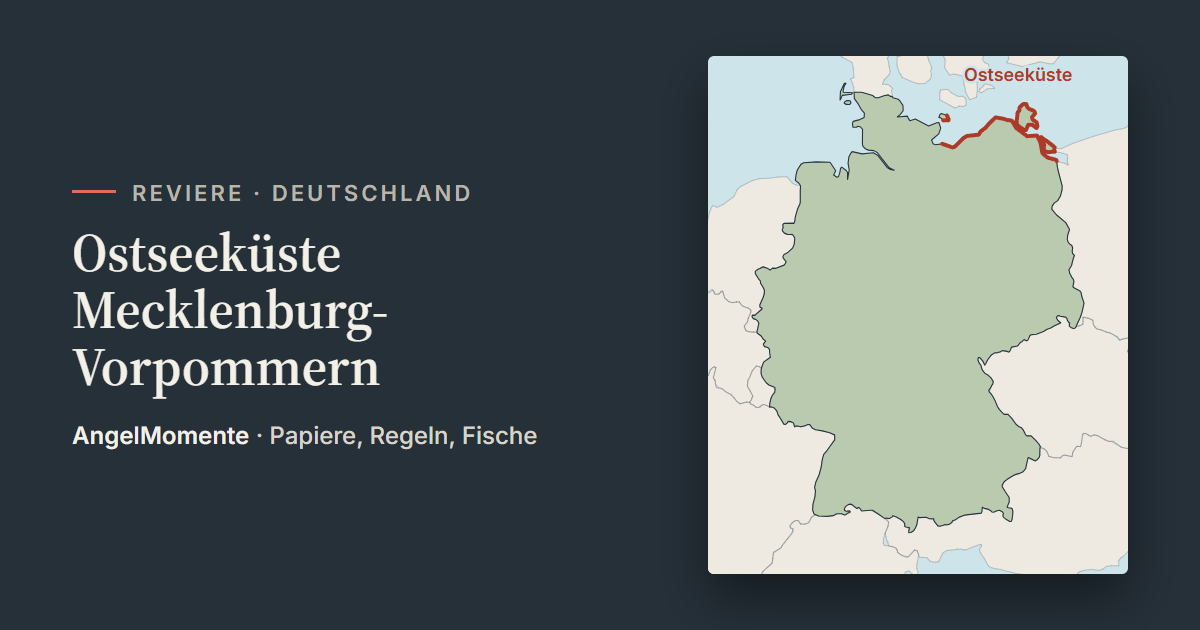
The Baltic coast of Mecklenburg-Western Pomerania stretches from Wismar Bay to Usedom. Behind the outer coast lie boddens and lagoons with slightly salty water, where pike and zander live alongside herring and flounder. For each of these waters you need three documents, and new catch rules have applied since 29 September 2026.
- Papers
- Fishing licence (Fischereischein), M-V fishing levy (Fischereiabgabe) and coastal angling permit (Angelerlaubnis)
As of October 2026
At a glance
- Papers
- Fishing licence (Fischereischein), M-V fishing levy (Fischereiabgabe) and coastal angling permit (Angelerlaubnis)
| Fish | Minimum size | Closed season | Catch limit | Note |
|---|---|---|---|---|
| Pike | 60 cm | 1.3.–30.4. | 1 per day | return over 90 cm |
| Zander | 45 cm | 23.4.–22.5. | 3 per day | 40 cm in the Stettiner Haff, Peenestrom and Darßer Boddenkette |
| Perch | 20 cm | none | 15 a day | |
| Sea trout | 48 cm | 15.9.–14.12. | 3 per day | beyond 4 nautical miles also 1.6.–15.9.; Unterwarnow 15.12.–31.3. no keeping |
| Atlantic salmon | 60 cm | 15.9.–14.12. | 1 per day | only with adipose fin clip (EU 2026); beyond 4 nautical miles also 1.6.–15.9. |
| Cod | – | Fishing ban 2026 | – | EU law, release immediately |
| Eel | 50 cm | Fishing ban 2026 | – | general ruling (Allgemeinverfügung) until 31.12.2026 |
| Herring | – | none | – | paternoster with up to 6 single hooks |
| Garfish | – | none | – | |
| Flounder | 25 cm | none | – |
Küstenfischereiverordnung M-V (in force since 29.9.2026), EU law for 2026 and Allgemeinverfügungen of the LALLF. As of October 2026. What counts is the regulation and your fishing permit (Erlaubnisschein).
Location and waters Outer coast, boddens, Achterwasser and Szczecin Lagoon
- Outer coast: The coastal waters of the state include the Baltic Sea up to the limit of German sovereignty, the 12-nautical-mile zone (LALLF).
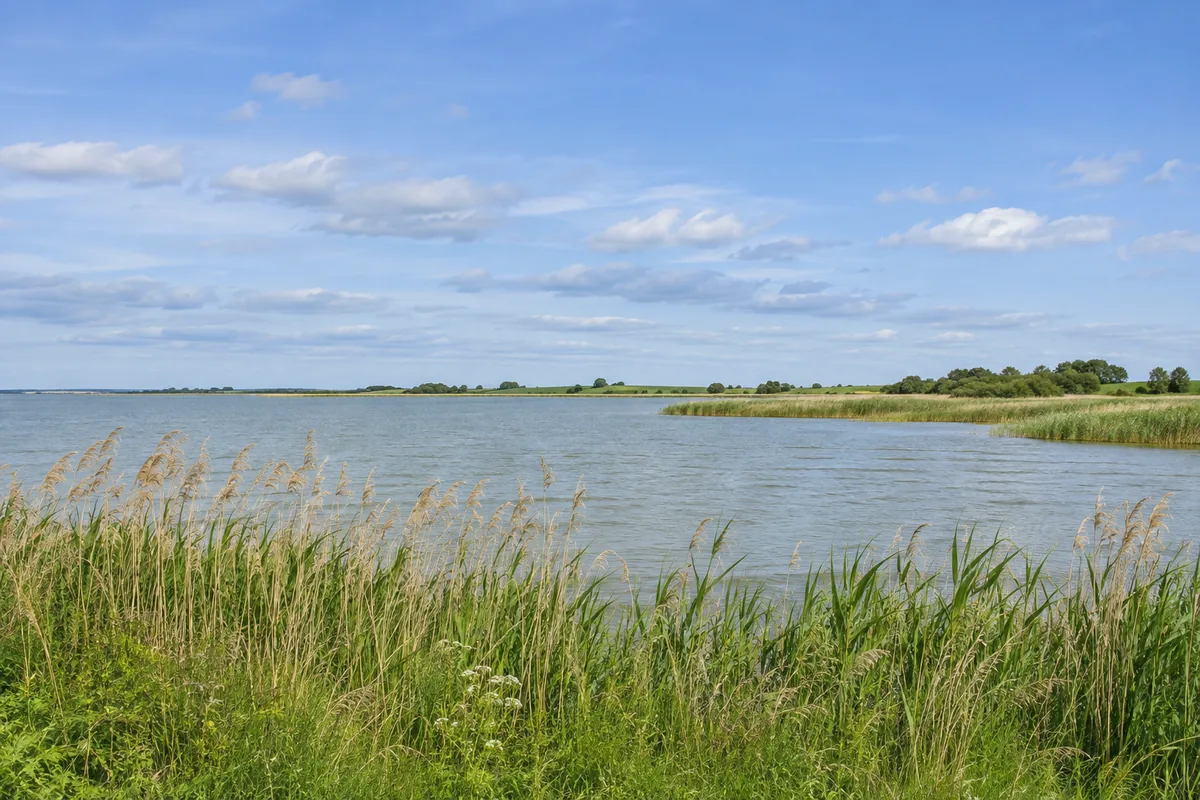
- Inner coastal waters: These include, among others, Wismar Bay, the Salzhaff, the Strelasund, the Jasmunder Bodden, the Greifswalder Bodden, the Peenestrom, the Achterwasser and the Szczecin Lagoon. Boddens, Achterwasser and lagoon together cover about 1600 km² (IGB, Projekt Boddenhecht).
- Darß-Zingster Boddenkette and West Rugia: In the Darß-Zingst part the bottom is mostly mud, off West Rugia it is more sand with more salt (Nationalparkamt Vorpommern).
- Greifswalder Bodden: the largest bodden, 5,6 m deep on average, 13,5 m at most (Institut für Ostseefischerei).
The two big islands have profiles of their own: Rügen and Usedom. How boddens work in general is explained under Fishing in boddens and fjords.
Fish and best time Pike, zander, perch, herring and sea trout
- Pike, zander, perch: freshwater fish that have colonised the boddens. Bodden pike stay close to their home spots (IGB).
- Herring: The herring of the western Baltic migrates every spring into the Greifswalder Bodden to spawn, its most important spawning ground (Institut für Ostseefischerei).
- Sea trout: feeds in the Baltic and runs up small and medium-sized rivers of the state to spawn, up to 140 km inland (Landesforschungsanstalt M-V).
- Flatfish: Flounder regularly occurs in the Baltic off the national park (Nationalparkamt). For the Greifswalder Bodden the Institut für Ostseefischerei also lists plaice and turbot.
- Cod: banned for anglers in 2026. A cod caught by accident goes straight back into the sea (Verordnung (EU) 2025/2454, Artikel 10).
According to angling diaries from 2020 and 2021, anglers on the Baltic caught mostly herring and flatfish in the first four months. In May and June more garfish took the hook, in late summer more mackerel. In the boddens herring led in spring and garfish in May, and later in the year the share of perch and zander grew (Thünen-Institut, 2023). For individual species the catch calendar helps.
Papers and permit Fishing licence, tourist fishing licence, angling permit
You always need three documents: the fishing licence (Fischereischein), proof of payment of the fishing levy (Fischereiabgabe) and the angling permit (Angelerlaubnis). The state office LALLF also sells the permit, the levy and the tourist fishing licence (Touristenfischereischein) in its online shop. You get the levy there as a PDF that you print out or keep on your phone (LALLF, Aktuelles). The exam and the licence are explained on the page Mecklenburg-Western Pomerania.
- Fishing licence: mandatory from the age of 14. Licences from other states are valid if you do not live in M-V (LALLF). Without an exam, from 14 you can get the tourist fishing licence for up to 28 days. It includes the fishing levy and can be extended within the same calendar year, also online (LALLF).
- Fishing levy: 10 euros for the current calendar year. Guests pay it too, even if they have already paid at home (LALLF, Merkblatt).
- Angling permit for the coastal waters: The state issues it as a day ticket for 24 hours (6 euros), a weekly ticket for 7 days (12 euros) and an annual ticket for the calendar year (30 euros, 10 euros under 18). It is available online and from issuing points on the coast (LALLF, Angelerlaubnis).
- Third-party fishing rights: In the Unterwarnow and Breitling (Hansestadt Rostock), in parts of the Usedomer See and west of the Harkenbäk, the state’s ticket is not valid (LALLF, Angelerlaubnis).
Special rules Pike up to 90 cm, three rods and eel ban in 2026
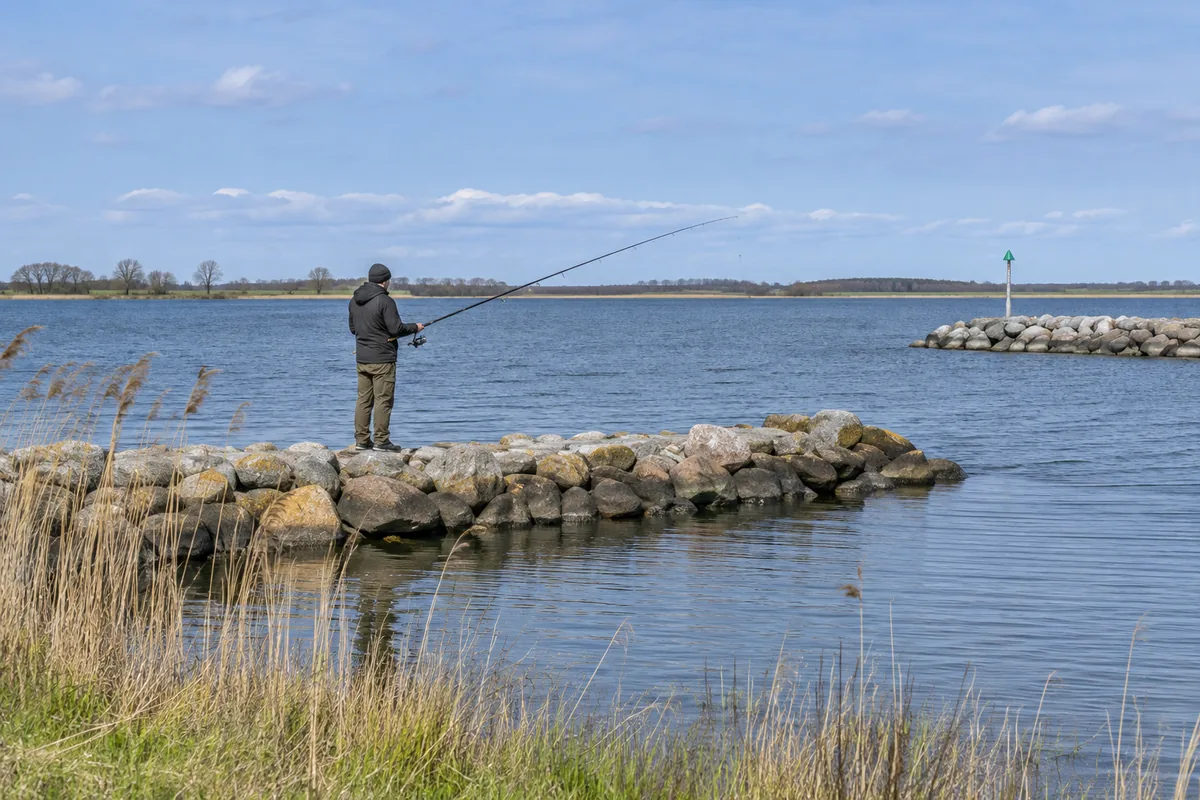
- Sizes and daily bag: The values are in the box “At a glance”. You may not keep pike over 90 cm when fishing with a hand-held rod. A maximum of three hand-held rods is allowed, for personal use only. For herring and mackerel a paternoster rig with up to six single hooks is allowed.
- Eel: From 1 January to 31 December 2026 angling for eel in coastal waters is banned. An eel caught by accident goes straight back, gently (Allgemeinverfügung des LALLF vom 4. Mai 2026). EU law draws the boundary with inland waters slightly differently here than the state does (LALLF, Aktuelles); if in doubt, ask there.
- Salmon: You may keep one salmon with a clipped adipose fin per day, after which salmon fishing is over for that day. Every other salmon goes back into the sea. Fish you keep are landed whole (EU regulation, Article 11).
- Sea trout: More than four nautical miles from the baseline it is also protected from 1 June to 15 September. In the Unterwarnow with the Breitling you may not keep a sea trout from 15 December to 31 March (Allgemeinverfügung des LALLF vom 2. Dezember 2025).
- RecFishing app: Anyone fishing at sea has registered in the European Commission’s app since 2026 and enters catches of cod, eel and salmon, including fish that were put back (LALLF, Aktuelles; Portal Fischerei, Fragen und Antworten).
- Protected zones: Within 500 m of many river mouths fishing is suspended from 1 August to 28 February, in spawning protection zones from 1 April to 31 May, and in the Greifswalder Bodden, in the Strelasund and between Hiddensee and Rügen already from 1 March.
- Boat: In the Strelasund, in the Rassower Strom with the Wieker Bodden and in the Having you must anchor while fishing; drifting with a drift anchor is allowed. From 15 September to 15 March, fishing from a moving boat is banned in some stretches of coast, for example between Hiddensee and Rügen.
- Vorpommersche Boddenlandschaft National Park: In the core zone and the red zone angling is banned, and trolling in the whole park. From the shore you fish only on designated beaches, wearing waders only in the shallows in front of them (Nationalparkamt, Angeln).
- Winter quarters: In five harbours and river mouths of Western Pomerania you may fish only from 10 am to 6 pm in the winter half-year and must document every day of fishing. In the Neuendorfer Wiek restrictions to protect pike apply from 1 November to 28 February (LALLF, Aktuelles). The areas are named by LALLF.
As of October 2026. Sizes, closed seasons, daily bag and boat rules come from the Fünften Verordnung zur Änderung der Küstenfischereiverordnung, in force since 29 September 2026 (Pressemitteilung des Ministeriums). At the start of October the LALLF table still gave 50 cm for pike and 45 cm for sea trout; the regulation prevails. The eel ban and the EU rules for cod and salmon apply for 2026.
Cutters and rental boats Fishing cutters and rental boats
In November 2026 I found no deep-sea cutter with scheduled day trips in Mecklenburg-Western Pomerania. Small cutters take anglers out on the Peenestrom and the Achterwasser, and rental boats are available on the Bodden and the outer coast. I checked these operators on their own websites. Dates, prices and available boats are only listed there.
- Warnemünde: Sportbootverleih Warnemünde – 15 hp fishing boats without a licence for three to four anglers, larger boats only with a licence.
- Stralsund (Strelasund): Bootsvermietung mit Biss – rental and fishing boats for the Strelasund and the Kubitzer Bodden, with separate times for the herring season in spring.
- Rügen (Glowe): Bootsverleih Glowe – boats in Glowe marina on the Baltic and in Martinshafen on the Jasmunder Bodden, up to 15 hp without a licence. Boats are only handed out after booking ahead.
- Wolgast (Peenestrom): Angeln Usedom – 15 hp fishing boats without a licence, with a briefing before you set off. With the cutter “Möwe” they also run guided trips on the Peenestrom, the Achterwasser and the Greifswalder Bodden.
- Lassan (Peenestrom): Cutter trip on the “Buttje” – guided fishing trips for up to six anglers on the Peenestrom and the Achterwasser, half-day or full-day.
Without a licence you may drive boats up to 15 hp. The rules above apply to fishing from a boat, including anchoring in the Strelasund and on the Wieker Bodden. Some websites still list cod or eel as target fish: both are banned for anglers in 2026. If a website shows no current date, ask before you travel.
Safety
A large part of the bodden area is shallower than two metres (IGB). The wind regularly raises and lowers the water level by more than 1,5 m, and wind flats fall dry (Nationalparkamt). What belongs in the boat is explained under Boat and life jacket.
Related
- Fishing in bays and fjords and Fishing on the coast and in the surf
- Fishing in Mecklenburg-Western Pomerania and Fishing in Germany
- In the fish lexicon: pike, sea trout, herring, salmon and eel
- Closed season and minimum size explained and Returning fish
- Weather, air pressure and wind and Weather at the water
Sources
- Fünfte Verordnung zur Änderung der Küstenfischereiverordnung Mecklenburg-Vorpommern vom 11. September 2026 (GVOBl. M-V S. 1083)
- LALLF: Allgemeinverfügung zum Aalfangverbot (AmtsBl. M-V/AAz. 2026 S. 253) und Allgemeinverfügung zur Meerforelle in der Unterwarnow (AmtsBl. M-V/AAz. 2025 S. 659)
- Ministerium für Klimaschutz, Landwirtschaft, ländliche Räume und Umwelt M-V: Pressemitteilung Nr. 305/2026 (29.09.2026)
- LALLF Mecklenburg-Vorpommern: Angelerlaubnis, Fischereidokumente, Touristenfischereischein, Schonbezirke und Winterlager, Aktuelles, Online-Shop für Fischereidokumente
- Verordnung (EU) 2025/2454 des Rates zu den Fangmöglichkeiten in der Ostsee 2026, Artikel 10 und 11; Portal Fischerei: Fragen und Antworten zum Meeresangeln (Stand 5. Februar 2026)
- Nationalparkamt Vorpommern: Angeln im Nationalpark, Die Boddengewässer, Die Ostsee
- Leibniz-Institut für Gewässerökologie und Binnenfischerei: Empfehlungen für das künftige Management des Boddenhechts (2023)
- Thünen-Institut für Ostseefischerei: Eine Charakterisierung der marinen Angelfischerei in Deutschland (Zeitschrift für Fischerei, 2023) und Fischen und Forschen im Greifswalder Bodden (ForschungsReport 1/1999)
- Landesforschungsanstalt für Landwirtschaft und Fischerei M-V: Meerforelle und LALLF: Besatzmaßnahmen
Guide without guarantee, as of October 2026. The authoritative texts are the coastal fisheries regulation of Mecklenburg-Western Pomerania, the general rulings of the LALLF, the national park rules, EU law for the Baltic and the details on your angling permit.