
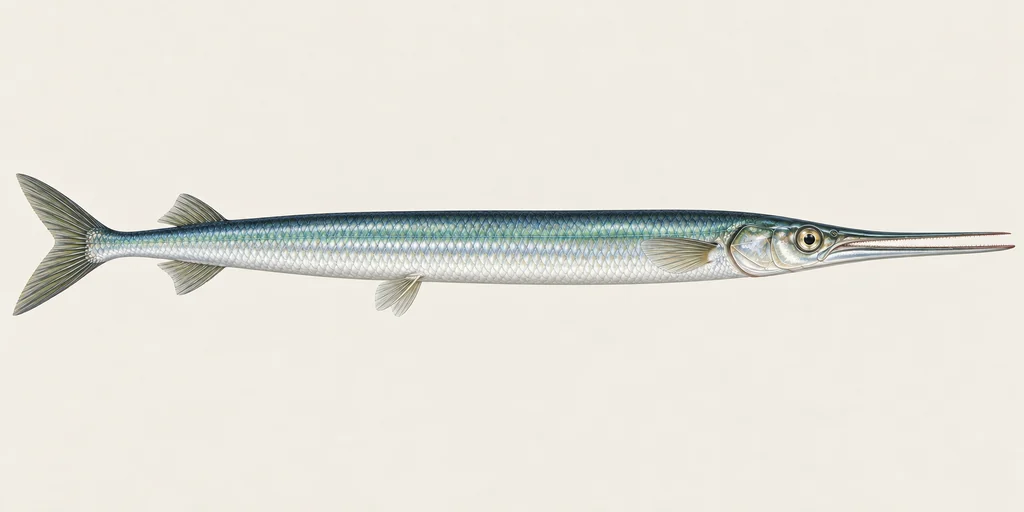
Knowledge – Fish
Garfish: Features, season, baits and green bones
The garfish (Belone belone) is a very slender shoaling fish that hunts just below the surface. In spring it moves to the coasts of the North Sea and the Baltic Sea and spawns there over eelgrass and seaweed. The long beak and the green skeleton are striking.

In brief: You catch garfish best from May to July, mainly during the day. Good spots on the coast: just below the surface. Proven baits: slim coastal spoons; on a float also strips of cut bait. Step by step: Fishing for garfish.
- Strongly elongated, beak-like jaws with pointed teeth; the lower jaw is slightly longer
- Very slim body, dorsal and anal fins set far back, just before the caudal peduncle
- Green bones, coloured by the harmless pigment biliverdin
Catch chances through the year
- Hardly any chance
- Possible
- Good
- Peak season
- Spawning (observe the closed season)
Editorial assessment for waters in Germany, not a measured value and no guarantee. Spawning time is not the same as the legal closed season.
Species profile and sources in the catch calendarAll species compared month by monthThe rules of your federal state
How to recognise it
The garfish is long and narrow. Both jaws are extended into a beak, the lower jaw is slightly longer, and the teeth are comparatively large and widely spaced. The back is dark blue, dark green or bluish green, the flanks gleam silvery with a greenish or violet sheen, and the belly is silvery white. Behind the dorsal and anal fins there are no finlets, that is, no small extra fins.
The skeleton is green or bluish green. The cause is the pigment biliverdin, a breakdown product of the red blood pigment.
Most fish stay under 85 centimetres. DTU Aqua gives the largest measured garfish as 97 centimetres, FishBase says 104 centimetres, with about 45 centimetres as the usual size. The maximum weight is mostly 1,2 to 1,3 kilograms, and individual fish weigh up to 1,8 kilograms. According to Blinker, garfish caught on our coasts average about 60 centimetres and, even as large fish, hardly weigh more than a kilogram. Very young garfish do not yet have a beak. It grows with them and from about 15 centimetres resembles that of the adults.
Side by side: garfish or Atlantic saury?
| Feature | Garfish | Atlantic saury |
|---|---|---|
| Finlets | none, dorsal and anal fins without separate finlets | 5 to 6 behind the dorsal fin, 5 to 7 behind the anal fin |
| Beak | long and strong, with large, widely spaced teeth | thin and fragile |
| Size according to FishBase | up to 104 cm, usually about 45 cm | up to 50 cm, usually about 32 cm |
Adult garfish are easy to recognise by the beak. At most you could confuse them with the Atlantic saury (Makrelenhecht; called makrelgedde in Denmark). Unlike the garfish, it has finlets behind the dorsal and anal fins. Very young garfish larvae have no beak yet and look like small sand eels, but sand eels have a very long dorsal fin running from the pectoral fin to the base of the tail.
Where it holds
The garfish is widespread, from the north of Norway via Iceland to North Africa. In Denmark it lives mainly close to the coast and in fjords, but also in the more open waters of the Kattegat, the Skagerrak and the Baltic Sea. Few fish species cope as it does with both the salty Atlantic and the low-salinity Baltic.
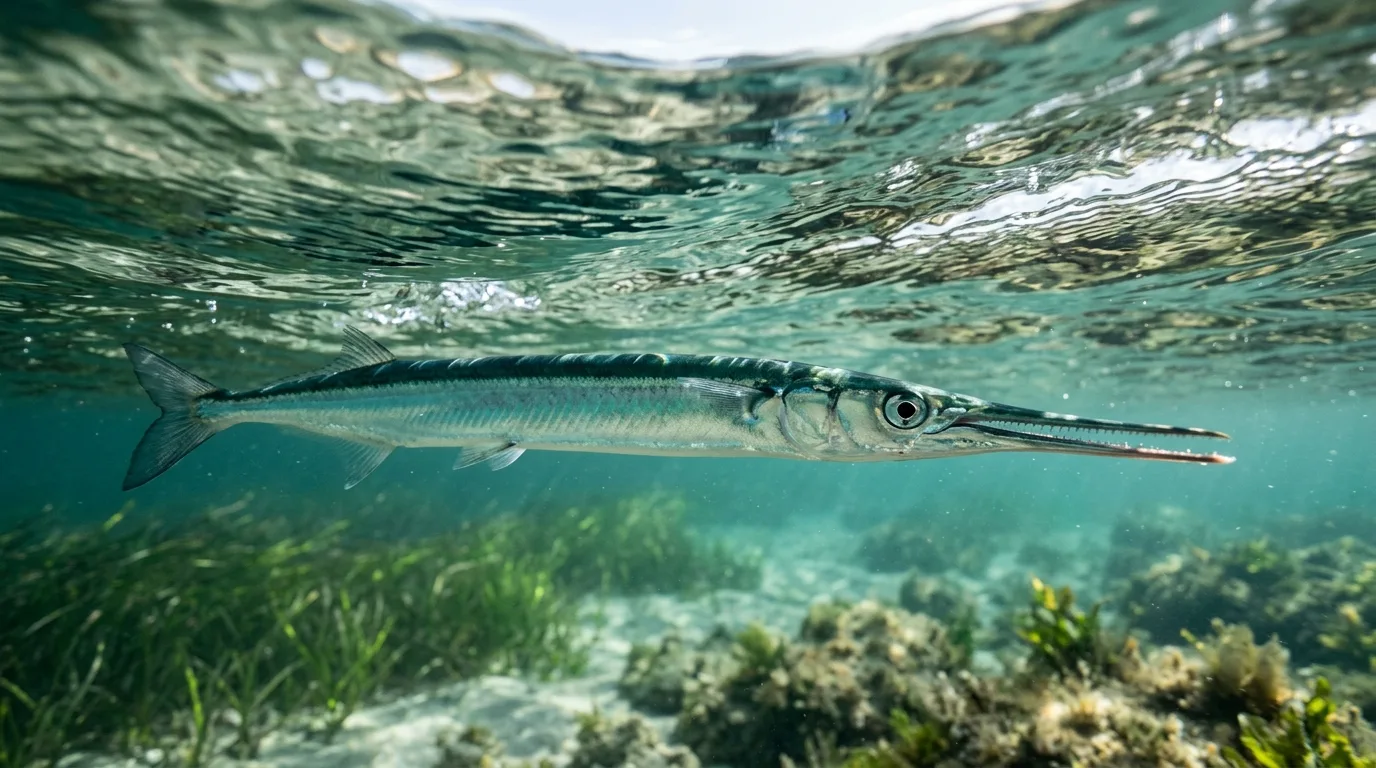
Garfish travel in shoals just below the surface. To spawn they seek out shallow water with seaweed or eelgrass, to which the eggs stick. After spawning, according to Blinker, they hunt over stony, weedy mixed ground. From the shore you can reach them at piers, sea bridges and jetties with medium-deep water.
Holding spots in the picture
Choose the season and time of day: the picture shows where the species stands then. Spots outlined in red apply only in the chosen season. Tap a fish or a spot in the list to bring it closer. The picture is schematic and AI-generated, every water is different.
Catch chances in springpossible
Catch chance in summergood
Catch chance in autumnhardly any
Catch chance in winterhardly any
- J
- F
- M
- A
- M
- J
- J
- A
- S
- O
- N
- D
Spawning season
No main time Garfish hunt by day and are more active in sunshine than on dark days.
Active time Garfish hunt by day and are more active in sunshine than on dark days.
No main time Garfish hunt by day and are more active in sunshine than on dark days.
No main time Garfish hunt by day and are more active in sunshine than on dark days.
On the coast
Seagrass, gravel and stones in the shallows
Garfish are found here only in spring.
Sandy bottom
Garfish are found here only in spring.
Stony mixed ground
Garfish are found here only in spring and summer.
Deep, colder water
Garfish are found here only in summer.
Just below the surface
Garfish are found here only in spring, summer and autumn.
Garfish are shoaling fish and usually swim just below the sea surface. They are on the coast only in the warm season. From the shore you reach them at breakwaters, piers and landing stages.
Spring: according to the catch calendar, chances are slim in March, possible in April and good in May. In spring the shoals come to the coast and spawn in shallow water over seagrass meadows. They stay over mixed and sandy ground.
Summer: according to the catch calendar, chances are good in June and July and possible in August. Over the summer garfish stay on the coast, preferably over mixed ground. From July to September they stand rather over deeper water.
Autumn: chances according to the catch calendar are slim. With the end of summer the shoals move off into deep, distant areas of the sea.
Winter: chances according to the catch calendar are slim. Garfish spend the winter in deep, far-off areas of the sea.
Depth: Garfish swim just below the surface. You present the bait at a depth of about a metre at most, on a float with a hooklength of no more than a metre.
Size comparison: AI-generated drawing, schematic.
How it hunts and spawns
Garfish are fast predators. They eat smaller fish such as herring, sand eels and sticklebacks, plus crustaceans and squid. Young fish feed on copepods and insects from the water surface. When fleeing predators such as tuna and porpoise they leap out of the water, and after the strike they do the same.
They spend the winter mainly west and south of Ireland. In spring the shoals move to the coasts, and after spawning they look for food further out. The eggs stick with sticky threads to seaweed, eelgrass and stones, and the larvae hatch after about three to five weeks. Depending on size, a female lays 6.000 to 35.000 eggs (DTU Aqua), while the Swedish authority gives 1.000 to 45.000.
On age the sources differ: the Swedish authority gives sexual maturity at two years, while DTU Aqua suspects three to four years and 60 to 70 centimetres. In Sweden most of the animals caught are two to four years old, the oldest ten to eleven.
When it bites
In Denmark the garfish arrive between mid-April and mid-June according to DTU Aqua and stay through the summer. According to the catch reports of Danish anglers, the first arrivals are larger than the later ones. Warm spring water brings them earlier: in the last weeks of April 2025 anglers caught as many garfish per hour as they usually do only in May.
As a rule of thumb: when the rape is in flower, the garfish are there. On the German and Danish Baltic that is mid to late May, and on the North Sea they arrive somewhat later. Blinker gives May and June as the main time, and in DTU Aqua’s garfish barometer the peak in 2024 fell in May. The shoals mostly stay on the coast until June or July. After that there are only scattered garfish over deeper water, often smaller fish; according to Blinker the season on the Baltic usually ends in late August. Between August and November the shoals move back into the Atlantic. Anglers report that sunny weather catches better than dark, cold days.
Today’s catch index needs JavaScript. Season and spawning time are in the catch calendar.
You will find the monthly overview of all species and the water temperature check in the catch calendar.
What you catch it with
Step by step: Fishing for garfish: tips on bait, rigs and tackle – season, spots, bait, tackle and rules on one page.
From the shore spinning is the usual method, with an ordinary spinning rod. Slim coastal spoons of about 20 grams and no more than ten centimetres long are suitable, worked briskly. The lighter the tackle, the livelier you can work the lure. Hooks grip badly in the horny jaw, so they must be very sharp. Against missed bites some anglers swap the treble for a smaller, sharp hook on monofilament line about two centimetres behind the lure, while others tie on a thick silk thread in which the teeth get tangled.
The second method is float fishing with a float or a water bubble, good from piers and from a boat. Narrow, small strips of cut bait from oily fish such as mackerel or herring serve as bait. If the fish are wary, a ragworm or half a prawn on the hook is worth trying. According to Blinker there is at most one metre of hooklength between float and hook, so the bait drifts just below the surface; the set-up follows the float rig. Slim floats are preferable to conspicuous ones, and the water bubble allows long casts. Fly anglers use a fast-sinking line and colourful streamers.
Garfish often take the bait at about one metre depth, fight fiercely after the strike and jump. Boat anglers drift a few hundred metres off the coast and fish with a trolling, spinning or float rod. How to land fish safely is covered under Landing and unhooking fish and killing them under Stunning and killing fish.
Sharpen your hooks: The jaw is hard and horny. Blunt hooks do not hold, and the fish shakes itself free in its leap.
The early season counts: According to analyses of the catch reports of Danish anglers, the first garfish of spring are larger than those that arrive later.
Light tackle: The lighter the rod, the livelier you work the lure and the more bites you get. This applies to spinning and float fishing.
Suitable lures
Slim coastal spoons; on a float also strips of cut bait.
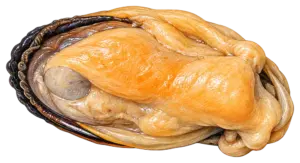
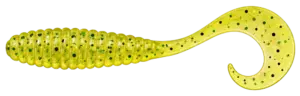
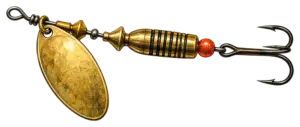
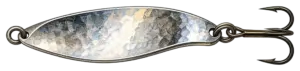
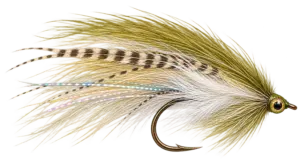
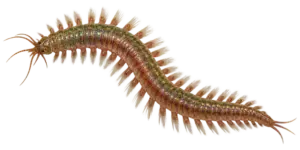
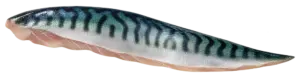
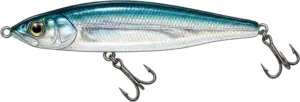
AI-generated illustrations. A click opens the lure’s page.
Rigs for these baits: Sbirolino rig, Float rig, Natural bait rig for the sea.
What to do with garfish in the kitchen
FishBase lists the garfish as a food fish that comes onto the market fresh or frozen and can be fried, grilled or baked. The skeleton is green, which is due to the pigment biliverdin.
How to gut and fillet it is described under Gutting fish and Filleting and boning fish; for storage see Storage and hygiene.
What you need to observe
Closed seasons, minimum sizes and harvest slots are set by the federal states (Bundesländer) and by the fisheries authorities of the neighbouring countries on the coast (Denmark, Norway, Poland). They vary by type of water, stretch of coast and time of year. We only give figures together with the date and source; the fisheries regulation of your federal state and your fishing permit (Erlaubnisschein) are always what is binding. You will find a list of links to the official sources in the catch calendar.
A fish of legal size that you want to keep you stun and kill at once, in line with animal welfare rules. Protected, undersized fish or fish too large under a harvest slot you unhook, if possible still in the water and with wet hands, and release gently. What exactly applies is regulated by state law and your fishing permit (Erlaubnisschein).
Whether species-specific rules apply to the garfish is set by the coastal fisheries regulation (Küstenfischereiverordnung) of the federal state (Bundesland) concerned. The IUCN lists the species as least concern, and in Denmark there are no catch quotas according to DTU Aqua because the garfish plays hardly any part in commercial fishing. Many federal states expressly prohibit live baitfish; for garfish you use strips of cut bait or artificial lures anyway.
What closed season, minimum size and harvest slot mean and where to find them is explained on the page Closed season and minimum size explained.
Frequently asked questions (FAQ)
When do garfish come to the coast?
In Denmark between mid-April and mid-June. On the German Baltic, the flowering of rape, mid to late May, is the sign. Warm spring water brings them earlier.
Why are the bones green?
The skeleton contains biliverdin, a breakdown product of the red blood pigment.
How do I avoid missed bites?
With very sharp hooks, slim lures worked briskly, and a small hook or silk thread behind the lure in which the teeth get caught.
Sources
The rating of catch chances is an editorial assessment. The facts come from these sources, and the text is worded in our own words. The illustration is an original design by Angel Momente in the style of a natural history plate (AI-generated, see the AI notice).
- FishBase: Belone belone
- Blinker: Steckbrief Hornhecht
- Havs- och vattenmyndigheten: Horngädda (Laichzeit, Wanderung, Lebensweise)
- DTU Aqua, Fiskepleje.dk: Hornfisk (Laichgebiet, Laichzeit ohne Monatsangabe)
- Wikipedia: Gewöhnlicher Hornhecht
- DTU Aqua, Fiskepleje.dk: Tidlige hornfisk i år (Hornfiskebarometer, April 2025)
- DTU Aqua, Fiskepleje.dk: Hornfiskebarometer (Fangstjournalen, Mai 2024)
- Blinker: Tipps zum Hornhechtangeln (Posenköder Fetzen, Seeringelwurm, Garnele)
- Blinker: Hornhecht angeln, 10 Tipps für die Silberpfeile (Hauptzeit Mai/Juni, Größe und Gewicht der Fänge)
- Naturalis, Fishes of the NE Atlantic and Mediterranean: Familie Belonidae (Hornhechte)
- Naturalis, Fishes of the NE Atlantic and Mediterranean: Scomberesox saurus (Makrelenhecht)
- FishBase: Scomberesox saurus (Makrelenhecht, zur Unterscheidung)
- Blinker extra: Die Fische der Ostsee und wie man sie beangelt (Stand 2007)
Created with AI support from the sources listed. Figures only appear in the text if a source gives them. Last updated: 27 October 2026. Found a mistake? Write to us. Who is behind this site: About me.
More in the lexicon
- All fish species at a glance
- Catch calendar – month, water temperature and profile for 93 species
- Line calculator – breaking strain after the knot, drag guideline, backing
- Angling methods