
Knowledge · Fishing methods
Spinning
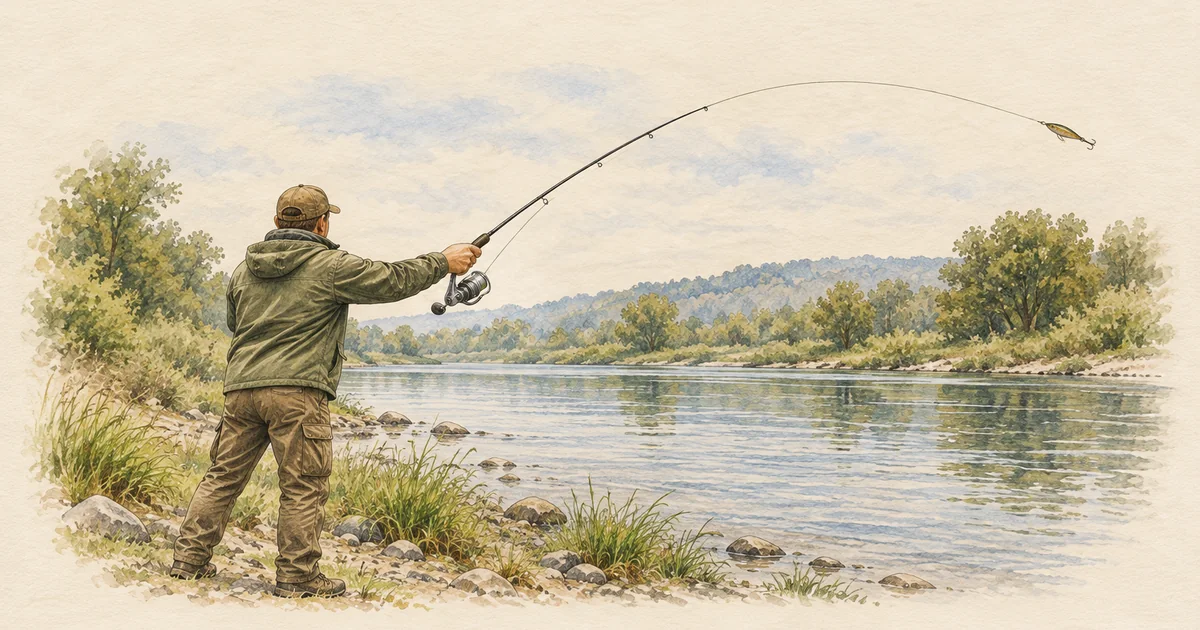
In spinning you actively search for predators: you cast a lure, retrieve it and work it so that it imitates a prey fish. Pauses are part of the retrieve, because with zander most bites come while the lure is sinking.
What spinning is about
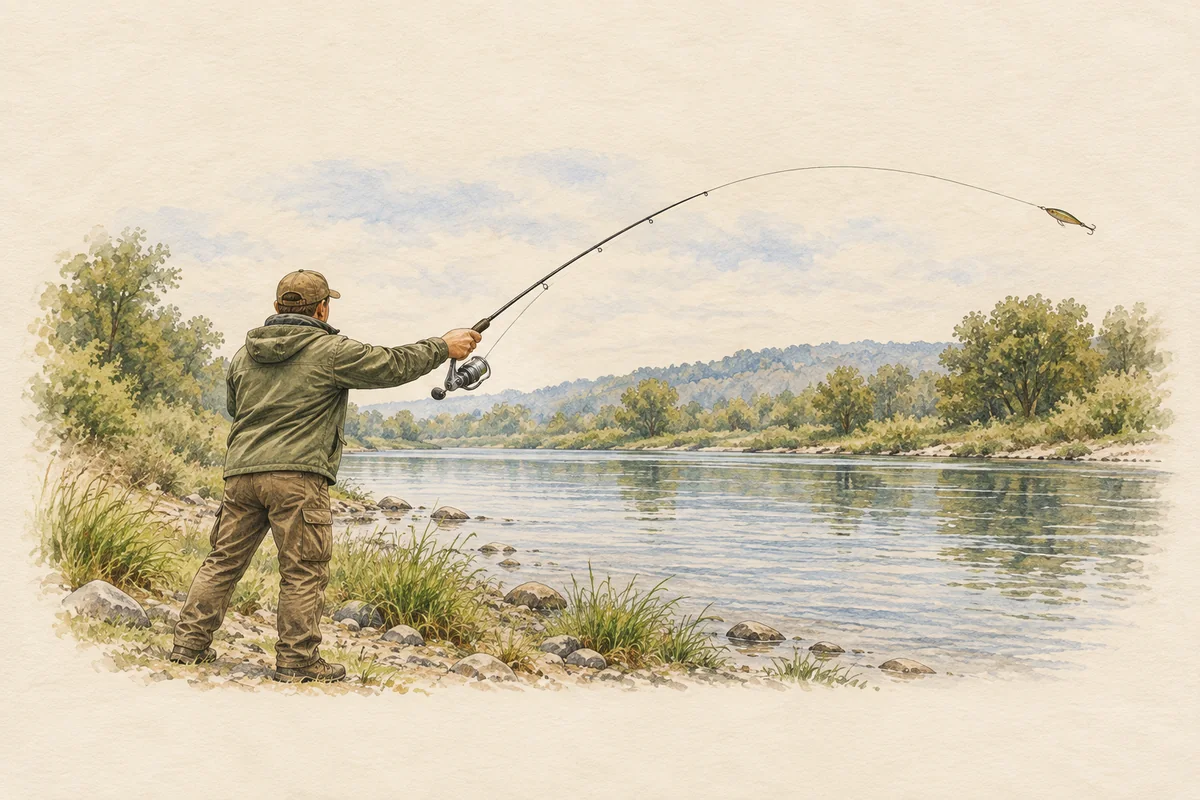
Spinning is an active method. You do not stay in one place but fan out the water with casts and change spots. If a fish shows, it is often worth staying longer, according to Wikipedia. The Bavarian exam questions for the angling exam (Fischerprüfung) name the way the lure is worked as the most important point for catching fish.
Because you are working the lure all the time, you feel it in the rod. As a first target fish Rute & Rolle recommends perch: it lives in almost all waters, and smaller ones are fairly easy to outwit. Pike and zander are rarer, and according to the magazine zander can be very picky. The light spinning rod for perch and salmonids has, according to the exam questions, a casting weight of up to about 30 grams; more about the rod is under Spinning rod.
Four lure groups, four ways of running
The design determines how a lure works in the water (Fig. 2). How you work it depends on that.
Spinner: The metal blade spins around the body as you reel in. It creates pressure waves that predators sense with their lateral line, even in murky water (Blinker). According to Blinker, a round, spoon-shaped Colorado blade creates a lot of pressure but brakes strongly and belongs in murky, calm water. The narrow willow blade spins tightly, brakes less and runs deeper; it suits current and deeper spots. Because the blade spins, the line twists. The Bavarian exam questions recommend one or more swivels to counter this. If you briefly slow the line with your finger just before the lure lands, the rig straightens and the spinner lands without tangling in the leader.
Spoon: The bent piece of metal wobbles; according to the exam questions it is a wobbling metal attractor lure. Wide models rock slowly and strongly and, according to Blinker, belong in still water or weak current. Slim models you retrieve faster; they imitate a fleeing fish and stay in the strike zone even in current. If you work a spoon too fast, the wobble is lost and it spins. According to the magazine, thin-walled spoons also run in less than a metre of water, and a 36-gram model reaches more than 6 metres of depth.
Crankbait: It imitates a fish made of wood or plastic and wobbles as it does so, as the exam questions describe it. The diving lip at the head takes it down and gives it its action (Wikipedia). If a large lip sits almost horizontally, it dives deep quickly according to the exam questions and is not suited to shallow spots with obstacles. Models that hang in the water during a pause are called suspenders; with them it is often only the standstill that triggers the bite (Wikipedia).
Soft plastic (shad): It is made of soft plastic, the twister included, and usually sits on a lead head with a hook. Rute & Rolle stresses that the soft plastic can be offered at any depth and catches even with a simple wind-in. Threading it on, head weight and stinger treble are covered under Jig head rig, further shapes under Soft baits.
Working the lure: speed, pauses, jerks
- Steady retrieve: You wind at an even pace. Pauses in winding, in which a soft plastic flutters down, or a change of speed add variety. According to Rute & Rolle, the steady retrieve often beats the other methods, for example with pike.
- Twitching: Short flicks of the wrist make a crankbait dart off line in jerks. According to Blinker they are done with feel; wild thrashing has nothing to do with it.
- Reel-lift jigging (Faulenzen): The rod stays still, only the reel moves the lure. As soon as it touches down, you make one to three turns of the handle, it shoots up and sinks back. Bites come almost only on the drop. You choose the head weight, according to Rute & Rolle, so that the lure takes about two to three seconds to sink.
- Jigging: Here you accelerate the lure with the rod, which moves from the nine o’clock to the eleven o’clock position. On the drop you take up slack line, because with sagging line you will not feel the bite.
- Dragging: The soft plastic hops slowly over the bottom, which brings many snags on branches and stones.
- Raising the spoon in stages: You lift the spoon in two or three steps and let it sink again on a taut line.
The pace follows the water temperature. As a rule of thumb Blinker gives: retrieve slowly in cold water, wind briskly in warm water. According to Rute & Rolle, pike are subdued in summer and often sluggish in winter. When the water drops to 10 to 15 degrees in autumn, pike feed all day again, according to Blinker. For this time the Bavarian exam questions name soft plastics of 15 to 20 centimetres.
Pauses are part of the retrieve. Blinker advises letting the lure now and then hang still or sink instead of winding it in evenly. With zander the bites mostly come during the drop, and according to AngelWoche you have only a few tenths of a second before the fish spits the lure out again.
Depth, current and choosing a spot
First you work out which layer you are fishing. According to Rute & Rolle, trout, asp and above all pike tend to stand higher up, zander usually and perch often on the bottom. You find the depth by counting: on the first cast you count the seconds until the lure is on the bottom. If it takes 20 seconds, on the next cast you count to 10 and then start winding, and it runs at roughly half the water depth.
- Cast and count: As soon as the lure hits the water, count the seconds silently until it reaches the bottom.
- Note the bottom: Say it takes 20 seconds. That number now stands for the full depth at this spot.
- Count half: Cast to the same spot and this time count only to 10.
- Wind in: Now start your retrieve. The lure comes back to you roughly halfway between the surface and the bottom.
In running water the current comes into it. Retrieving against the current, you can wind considerably slower according to Blinker; with the current you have to work faster so that a spinner runs at all. From the bank you can combine both: you cast upstream and at first wind briskly. The spinner drifts off, and the more it turns broadside, the slower you wind. That way it draws a semicircle in front of your feet.
Plan the casts as a fan: first close to the bank, then further out, then offset to the side. In spring, after the closed season (Schonzeit), pike according to Rute & Rolle first stand in dense reed, move into the shallows as the temperature rises and later to the first drop-offs. There, crankbaits with a running depth of one to two metres catch fish, and in reed lures with weed protection. Zander are considered active at dusk and at night; on dark days or in cloudy water they bite by day too, according to AngelWoche. More on the species is under Pike, Zander and Perch, and the Catch calendar shows suitable times.
Guide values for getting started
The values come from the trade press and exam materials and are guide values, not rules:
- Rute & Rolle recommends two lures for beginners: the jig spinner, a lead body with a small metal blade, in 4 to 10 grams, and the soft plastic.
- For perch Rute & Rolle advises soft plastics of 5 to 7 centimetres on jig hooks in sizes #1, #0 or 1/0. Heads of 3 to 12 grams cover the lake, on a river up to 20 grams as well.
- Spinner sizes according to Blinker: trout and perch size 0 to 2, zander 3, pike 3 to 5 and larger.
- Braided line is thin enough for zander at 0,10 to 0,14 millimetres according to AngelWoche. In hard frost water in the line can freeze and break it, say the Bavarian exam questions.
- Where pike occur, AngelWoche puts on a thin steel leader; it does not bother zander. Details under Pike leader.
Common mistakes
- Always the same speed: If the bites stay away, change speed and pauses. Blinker calls too even a retrieve a common mistake.
- Winding in too fast: According to Blinker, pike prefer a slow, natural movement. A spoon worked too fast rotates and no longer wobbles.
- Spinner without a swivel: The twist twists the line, costs casting distance and can lead to a line break during the fight (Blinker).
- Hesitant strike: When in doubt, Rute & Rolle advises a short strike, better once too often than once too few.
- Treble hooks for no reason: The exam questions describe lures with single hooks as kinder to fish. According to AngelWoche, a stinger treble is only worth it for missed bites and increases the number of snags.
Law: Which lures and how many hooks are allowed is set by state law and written in the water’s rules (Gewässerordnung). Closed seasons (Schonzeiten) and minimum sizes (Mindestmaße) of the target fish are explained under Closed season and minimum size, and the permit is described on the page Fishing permit and water map.
Frequently asked questions
Do I need lots of different lures?
No. Rute & Rolle advises beginners to start with two lures, the jig spinner and the soft plastic. Spinners work even with an even wind-in, which is why they count as beginner-friendly.
What is the difference between twitching and reel-lift jigging (Faulenzen)?
With twitching you move a crankbait with short flicks of the wrist. With lift and drop the reel moves a soft plastic on the bottom while the rod stays still.
When is the best time for spinning?
That depends on the water and the species. Pike are active after the closed season in spring and in autumn, zander more at dusk. The Catch calendar shows the times.
How do I find out at what depth my lure is running?
On the first cast count the seconds until the lure reaches the bottom. If on the next cast you count only half and then start winding, it runs at roughly half the depth according to Rute & Rolle. With a crankbait the diving lip also determines the depth.
Related
- Spinning rod: choosing length, casting weight and action
- Jig head rig: threading on, choosing the head weight
- Spinner: blade shapes and sizes
- Spoon: the metal spoon at a glance
- Hard baits: crankbaits and surface lures
- Soft plastic (shad): structure and use
- Pike leader: steel, titanium or hard mono
- Carolina rig: bait on the bottom
- Ultra-light fishing: lures of a few grams on fine tackle
Sources
- Bayerische Landesanstalt für Landwirtschaft: Prüfungsfragen zur Staatlichen Fischerprüfung 2023/2024 (Köderarten, Wirbel, Wurfgewicht, Herbst, Frost, Einzelhaken)
- Blinker: Spinnangeln, Blinker und Spinner richtig fischen (Blinker, Blattformen, Tempo, Strömung)
- Blinker: Spinnfischen mit dem Spinner (Drall, Spinnergrößen)
- Rute & Rolle: Grundkurs Spinnfischen, Teil 1 (Einsteigerköder, Gewichte, Haken)
- Rute & Rolle: Grundkurs Spinnfischen, Teil 2 (Schichten, Zählen, Führungsarten)
- Rute & Rolle: Spinnfischen auf Hecht im Frühjahr (Jahreszeit, Frühjahrsstellen)
- Blinker: Welche Fische beißen im Oktober (Hecht im Herbst)
- Blinker: Einsteiger-Guide Hecht (typische Fehler)
- Blinker: Wobbler, 2. Teil (Twitchen)
- AngelWoche: Zeit für Zetti, 6 Tipps für Zander (Absinkphase, Geflecht, Dämmerung)
- Wikipedia: Spinnfischen (Tauchschaufel, Suspender)
Text AI-assisted, drawing AI-generated. Sources opened and checked in October 2026; no graphics taken from the sources.
All figures are guide values without guarantee. Follow the water’s rules and state law, especially on permitted lures, hooks and catch restrictions.