
Knowledge · Fish biology
Senses of fish
The senses of fish pick up light, water movement and dissolved substances. How a fish uses them to perceive prey or an angler depends on its species and the conditions in the water. Here you learn which organs are behind this and what you can draw from it for the bank and the bait.
Sense organs at a glance
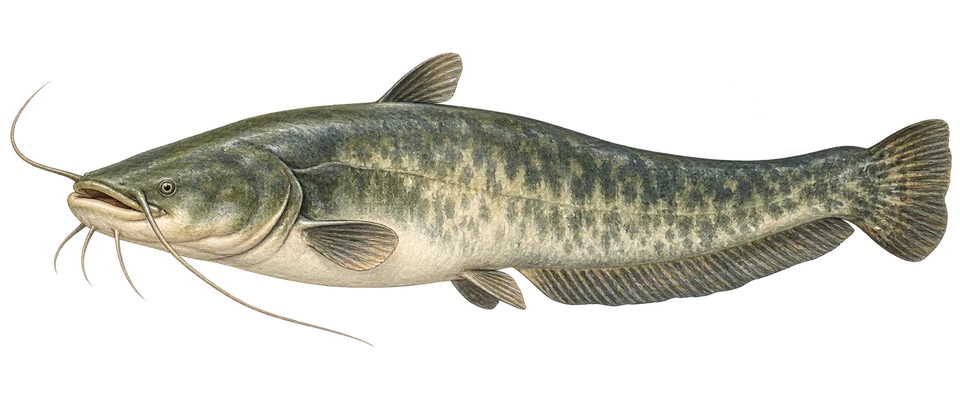
This overview covers five sensory areas. In the wels catfish their organs can be shown well; other species have partly different equipment. Barbels additionally carry organs of touch.
- Sight
- Eyes pick up light, outlines and, depending on the species, colours.
- Hearing
- The inner ear picks up sound; the swim bladder can help.
- Lateral line
- Sensory cells on the head and body detect moving water.
- Smell
- Olfactory organs in the nose detect substances dissolved in the water.
- Taste
- Taste buds test substances, in some species also outside the mouth.
1 · Eye. The eye takes in light. Visual acuity and colour discrimination differ between fish species.
2 · Inner ear. It detects the movement of sound particles. In the wels catfish, Weberian ossicles and the swim bladder support the perception of sound pressure.
3 · Lateral line. Sensory cells detect water movement. The arcs at top right stand for the movement of a prey fish.
4 · Olfactory organ. Water flows past the olfactory organs behind the nostrils. Dissolved substances provide chemical stimuli.
5 · Barbels. In the wels catfish the barbels carry taste buds and touch receptors. Depending on the fish species, taste buds also occur on other parts of the body.
Lateral line: feeling water movement
The lateral line reports currents and pressure fluctuations. It runs along the head and body and also works without light. With it a fish can notice the water movements of an animal swimming past and feel obstacles at a distance. That is why this perception is also called the distant-touch sense.
The individual sense organs are called neuromasts. Inside them sit hair cells whose fine projections reach into a soft cupula. When water moves the cupula, the cells are stimulated. Canals and their openings form the visible line on the flank in many fish.
An aquarium experiment described in the DAFV brochure shows this in the wels catfish: young animals pursued small prey fish at night. After the lateral line was switched off, they attacked less often and later and caught fewer. This shows a contribution to hunting; it does not prove the catching success of particular artificial lures.
Hearing: the inner ear detects sound
Fish hear with inner ears in the head. Sound sets water particles in motion. The body moves with them, while the denser ear stones in the inner ear react differently. This relative movement stimulates hair cells. Fish do not need an outer ear for this.
A gas-filled swim bladder can additionally respond to sound pressure and transmit vibrations towards the ear. How much this contributes to hearing depends on the species and on the distance or connection to the ear. The mere presence of a swim bladder therefore says little about hearing ability.
In cyprinids and catfish, Weberian ossicles connect the swim bladder to the inner ear. Cyprinids include, for example, carp and roach. This connection explains a special form of sound transmission. Uniform hearing limits for all fish cannot be derived from it.
Sight: light, colours and contrasts
Eyes provide information about outlines and brightness. Rods in the retina serve brightness perception, cones colour vision. To focus, bony fish move their rigid lens towards the retina. So they adjust focus differently from humans.
The pike, perch and zander examined had cone pigments for medium and long wavelengths, that is the green and red range. In the roach, blue-sensitive and partly UV-sensitive cones were added. The study compared animals from a clear and a brown lake in Finland. Its findings apply to these animals examined.
The absence of special blue cones does not automatically make a blue lure invisible. Colour difference, brightness and contrast are different features. An object can stand out from the background as a lighter or darker outline even if the fish perceives its colour differently from you. For choosing a lure this is more telling than a blanket list of „visible colours“.
Looking upwards
Through a smooth water surface the world above the water appears in a round window of view. Outside this window the surface reflects the underwater world. The drawing assumes a flat, bare bank. A fish far enough from the bank can also have a person lying down in the window.
Even someone who makes themselves small can stay within the window of view. Whether the fish notices the person or reacts to them is not answered by the drawn light path. Movement, outline and cover have to be considered separately. As a practical tip, Blinker recommends slow movements, cover and avoiding your own shadow when stalking bankside trout.
What the 48 degrees in the drawing mean
LEIFIphysik gives roughly 48 degrees between the vertical line of sight and the edge of the window of view. This is half the opening angle of the cone through which light from above the water surface reaches the fish. The angle describes the refraction of light at a smooth surface, not a flight distance.
Smelling, tasting and touching
Smelling through the nose
Olfactory organs test substances dissolved in the water. For this fish usually have paired pits with folded olfactory epithelium, that is a tissue with olfactory sensory cells. Water flows past them. In the wels catfish the DAFV describes well-developed nostrils and orientation by scents when searching for food.
In the eel, according to the Landesfischereiverband Bayern, the organs of smell and taste are strongly developed. No general distance at which it finds a bait follows from this. A sensitivity to a particular substance measured in the laboratory cannot be translated directly into a range in the water.
Tasting with taste buds
Taste buds sit in the mouth, in some fish species additionally on barbels, fins or other parts of the body. Smell and taste both detect chemical stimuli but have different sense organs. In the wels catfish experiments described, the external sense of taste was particularly relevant for dead or resting food; moving prey the animals could still follow via flow traces.
Touching with barbels
Barbels are skin projections at the mouth with taste buds and touch receptors. They combine chemical perception with touch. According to the DAFV the wels catfish has six of them. On the upper jaw sit two long barbels, on the lower jaw four shorter ones. These organs help it orient itself in cloudy water. It smells through the nose, with the barbels it can additionally taste and touch.
Differences between five species
The examples describe concrete features. They are not a ranking of the senses: a conspicuous organ does not yet explain how strongly it determines behaviour in every situation.
| Species | Special feature | Assessment |
|---|---|---|
| Wels catfish | Barbels for touch and taste | Orientation even in cloudy water. |
| Eel | Strongly developed chemical senses | No fixed bait range can be derived. |
| Pike | Cones for medium and long wavelengths | Examined in animals from two Finnish lakes. |
| Zander | High estimated light sensitivity | Highest in the species comparison examined. |
| Roach | Also blue-sensitive cones | UV cones were found in only one of the two samples. |
On the bank and when choosing bait
Approach bankside fish quietly and use available cover. Blinker recommends this for stalking trout and names vibrations and your own shadow as possible disturbances. This is a practical recommendation for this situation, not a measured flight limit for all fish species.
With a spinner or soft plastic (shad) you can consider movement and outline as well as colour. A dark lure can stand out against the bright surface when seen from below. The technical report on colour vision sees so far no reliable basis for large, general catch advantages of individual lure colours.
Typical fallacies are: a blue lure is invisible, crouching makes you invisible, or a strongly developed sense of smell guarantees a bite. Perceiving, classifying as food and actually eating are different steps. The wels catfish experiment also only shows that certain senses contribute to hunting prey.
Note: A finding on the wels catfish is not a general rule for zander or eel. Light conditions and water colour are part of the picture; the page Weather, air pressure and wind covers the conditions in the water in more detail.
Frequently asked questions
Can fish hear?
Yes, fish detect sound with their inner ears. The movement of water particles stimulates sensory cells there. A swim bladder can additionally support hearing, depending on the species.
Can fish see people on the bank?
Under the conditions drawn, even a person lying down can stay in the window of view. Whether the fish notices them does not depend on the light path alone. Cover and calm movements remain sensible practical tips.
Is a blue lure invisible to pike?
That cannot be derived from the absence of special blue cones. Brightness and contrast can still make the lure stand out from the background, even if its colour is perceived differently.
How do fish smell underwater?
Water carries dissolved substances to their olfactory organs. There olfactory sensory cells respond to chemical stimuli. According to the LFV Bayern, the eel has strongly developed organs of smell.
What are barbels for on the wels catfish?
Its six barbels carry organs of touch; barbels also have taste buds. With them the wels catfish can explore its surroundings in cloudy water. The barbels do not replace its nostrils.
How do fish find prey in cloudy water?
They can also use water movements or dissolved substances. In the night experiment described, young wels catfish followed the flow trace of their prey. Which signals help is species-specific.
Do all fish have the same senses?
The sensory areas covered are equipped differently. For example, the Weberian apparatus supports hearing in cyprinids and catfish; in the roach, additional short-wavelength cone types were found.
Related
- Fish biologyBody structure, senses and spawning season
- Fish portraitsPortraits of river, lake and sea fish
- BaitsNatural baits, artificial lures and flies
- Fishing methodsMethods for different target fish
The position of the organs is explained by Body structure and fins. How to work artificial lures is covered under Lure fishing.
Sources
- Spektrum, Lexikon der Biologie: Seitenlinienorgane (Neuromasten und Wahrnehmung von Wasserbewegungen).
- Spektrum, Lexikon der Biologie: Ferntastsinn (Beutebewegungen und Hindernisse).
- DAFV: Der Europäische Wels, Juni 2026 (PDF) (S. 52–53: Riechen, Seitenlinie und Geschmack im Jagdversuch).
- Journal of Fish Biology, 2019: An overview of fish bioacoustics and the impacts of anthropogenic sounds on fishes (Innenohr, Teilchenbewegung und artspezifischer Beitrag der Schwimmblase).
- Spektrum, Lexikon der Biologie: Weber-Knöchelchen (Schallübertragung bei Karpfenfischen und Welsen).
- Spektrum, Lexikon der Biologie: Akkommodation (Scharfstellen der Augenlinse).
- Journal of Fish Biology, 2019: Photoreceptors and eyes of pikeperch, pike, perch and roach from a clear and a brown lake (Studienabstract: Sehzellen und Lichtempfindlichkeit; DOI 10.1111/jfb.13759).
- Blinker: Wissenschaftlich untersucht: Welche Farben sehen Raubfische? (Fachbericht: Farbe, Kontrast und Grenzen der Ableitung für Köder). Der ursprüngliche Bericht ist auch beim Fachgebiet Integratives Fischereimanagement als PDF verfügbar (Blinker 07/2024).
- LEIFIphysik: Fischsicht (Sichtfenster unter idealisierten Bedingungen).
- Spektrum, Lexikon der Biologie: chemische Sinne (Riechorgane und Geschmacksknospen).
- Landesfischereiverband Bayern: Fischlexikon (Aal: Geruch und Geschmack; Rotauge und Karpfen: Familienzugehörigkeit).
- Spektrum, Lexikon der Biologie: Barteln (Geschmacksknospen und Tastkörperchen).
- DAFV: Der Europäische Wels ist Fisch des Jahres 2026 (Barteln und Orientierung im trüben Wasser).
- Blinker: Auf leisen Sohlen, Pirschangeln auf Forelle (Praxistipps zu Deckung, Schatten und Bewegung).
Text AI-assisted, drawing AI-generated. Sources opened and checked in October 2026; no graphics taken from the sources.
All figures are guidelines without guarantee. How strongly a sense determines behaviour differs from species to species and from water to water.