
Knowledge · Rigs & setups
Carolina rig
In the Carolina rig a bullet weight runs freely on the line and a swivel stops it, and only behind that follows a long leader with an offset hook and a soft plastic bait. Weight and bait are separate: the weight stays in contact with the bottom, while the bait sinks slowly after it and moves freely. Here you will find the construction, guide values, presentation and limits of the rig.
What you need
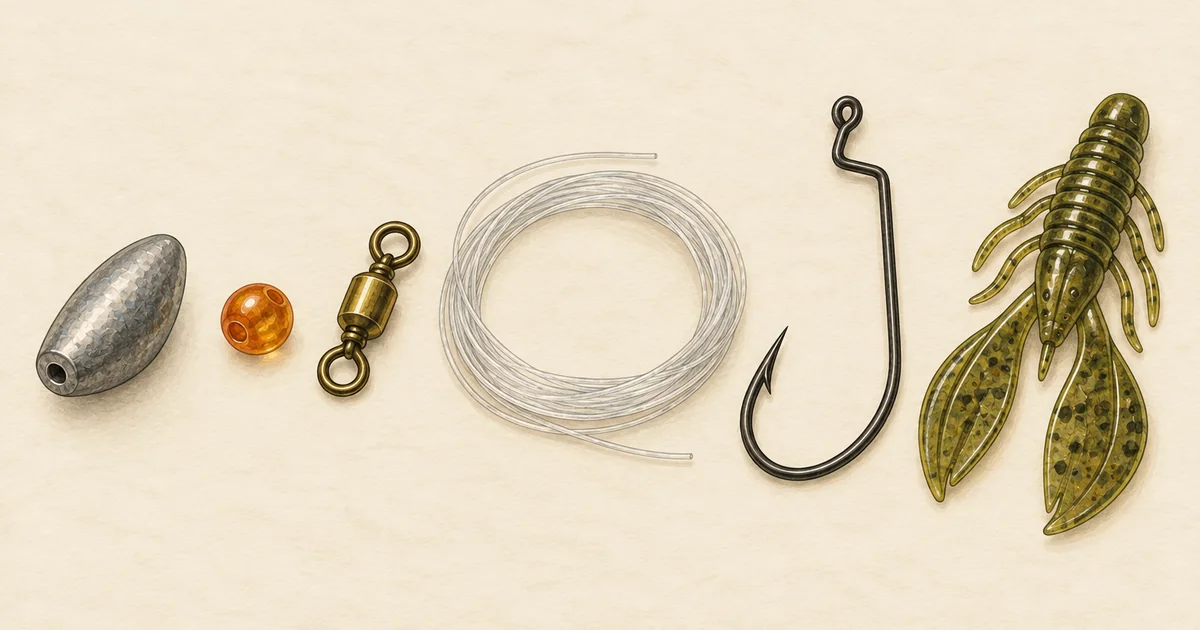
- a braided main line, 0,10 to 0,14 millimetres for perch and zander according to Blinker
- a bullet weight, that is, a bullet-shaped running lead
- a bead of glass or rubber and a small swivel
- leader line of fluorocarbon, which is abrasion-resistant and hard to see in the water
- an offset hook: bent into a Z shape behind the eye, so that the point later lies hidden in the bait
- a soft plastic bait such as a soft plastic crayfish, soft worm or a slim shad from the soft baits
For the rod Blinker gives 1,80 to 2,10 metres, a fast tip and up to 40 grams casting weight. More under spinning rod and in the line comparison.
Lead and tungsten: Bullet weights are also made of tungsten, which is harder than lead. The EU has adopted the restriction on lead in fishing tackle with Regulation (EU) 2026/2501, which applies from 3 December 2026 (as of November 2026). It governs sales, not recreational angling. Weights and lures containing lead up to 50 grams may no longer be sold from 3 December 2029, heavier ones up to 1 kilogram from 3 December 2031, and lead wire and drop-off leads from as early as 3 June 2027. What applies at the water is set by the water rules and the fishing permit (Erlaubnisschein).
Construction: weight and bait kept apart
From rod to hook come the bullet weight, bead, swivel, leader and hook with bait. The weight slides freely on the main line, with its wide side facing the hook. The bead protects the knot, and the swivel stops both and, according to Fisch & Fang, prevents line twist.
According to Blinker, this rig differs from the Texas rig only in the distance between weight and bait: with the Texas rig the weight slides right up to the hook, here the swivel keeps it away. This is reminiscent of the running ledger rig. A fish feels less resistance when sucking in the bait than with a jig head, writes Fisch & Fang. Compared, according to Rute & Rolle and Blinker:
| Feature | Carolina rig | Texas-Rig |
|---|---|---|
| Weight | kept apart from the bait | slides right up to the hook |
| Sink of the bait | longer, depending on the leader | shorter |
| Cast | less accurate | more accurate |
| Bite detection | harder | easier |
| Weed and wood | over shallow weed | also in cover |
Tying the Carolina rig in seven steps
- Add a running section. Blinker ties about a metre of 0,30 to 0,40 millimetre monofilament to the braid, thicker the heavier the weight. Because the weight slides on this section, it is thicker than the leader to the hook. For the connection Blinker names the FG knot, the improved Albright knot or the double uni knot.
- Thread on the rubber stopper and the weight. The stopper keeps the weight away from the connecting knot, and the point of the weight faces the rod.
- Thread on the bead.
- Tie on the swivel, according to Blinker with the clinch knot.
- Tie the leader into the second eye of the swivel, also with the clinch knot.
- Tie on the offset hook, again with the clinch knot. According to Blinker, a loop knot gives more play, for example the non-slip loop knot.
- Rig the bait, with the hook point lying hidden in the soft plastic. The steps are described under the Texas rig.
Knots for braid are described, for example, on the page on the Palomar knot.
Guide values for leader, weight and hook
As a starting length for the leader Blinker gives about 50 centimetres. An article in Blinker sorts it by season: 20 to 30 centimetres in summer with hard twitches, 45 to 60 as an all-round length. For winter, clear water and slow presentation it suggests 80 to 100 centimetres. Rute & Rolle gives 40 to 160 centimetres.
On a short leader every movement of the rod reaches the bait more strongly. On a long one the bait moves more freely and sinks for longer. The leader itself stays thin so that the bait falls weightlessly: Blinker gives 0,20 to 0,28 and elsewhere 0,22 to 0,30 millimetres.
For the weight, Fisch & Fang grades by depth: 2 to 4 grams up to two metres, 12 to 16 grams from six metres. Because according to Blinker the weight hardly affects the movement of the bait, it can also be heavier.
You choose the hook according to the bait length: Fisch & Fang gives size 1 to 1/0 under 10 centimetres and 3/0 to 4/0 from 15 centimetres. Blinker recommends sharp, fine-wire offset hooks and slim, soft baits from which the hook reliably comes free on the strike, rather than deep-bodied soft plastic shads.
Pike in the water: The pike has very sharp catching teeth, the Landesfischereiverband Bayern describes. Fisch & Fang therefore accepts only steel or titanium as a leader. According to Blinker, fluorocarbon only counts as pike-proof from about 0,90 millimetres and then hardly suits small baits. Where pike occur, a steel or titanium leader therefore belongs at the hook. Whether a bite-proof leader is compulsory is set out in the water rules.
Presentation and bite detection
The simplest way is to inch the rig slowly across the bottom, the bait following the weight. According to Blinker it can also be worked through open water: retrieved steadily like a spinner or twitched like a crankbait.
When twitching, the weight jumps ahead and lands first, while the light bait glides on even further according to Blinker and then lies offset. Give the bait time to sink after each hop, because according to Blinker most bites come in that phase.
The separation costs bite detection. Rute & Rolle sees the Texas rig ahead here. Fisch & Fang advises watching the line: if it shifts where it enters the water, a fish is on the bait. Then lower the rod tip and strike firmly. A brightly coloured line and polarised glasses help you see it.
When and where the rig catches
Blinker describes the Carolina rig as a rig for still water and gently flowing rivers. Its strength is the bottom: the harder the bottom, the louder the weight strikes the bead according to Fisch & Fang. That suits the zander: the Landesfischereiverband Bayern describes it as a fish of deep, turbid waters with a hard bottom.
According to Blinker, the separation gives completely different casting distances. This is not undisputed: another article in Blinker finds that the compact Texas rig casts better and further. Rute & Rolle searches with the Texas rig and fishes the spot found with the Carolina rig only afterwards. Several sources stress that the slowly sinking bait also attracts sluggish fish.
Dense weed and wood set the limits. The hook point does lie hidden, but it is hard to cast the rig accurately into a gap. Over flat carpets of weed it works well according to Rute & Rolle; in the middle of cover the Texas rig has the advantage.
As baits Blinker names crayfish, worms, lively soft plastic shads and insect imitations. According to Blinker, highly buoyant baits run some distance above the bottom. It is fished mainly for perch and zander, and according to Blinker also for pike.
Common mistakes
- Twitched on too early: The sink phase with the most bites is wasted.
- Waiting only for a tug: Many bites show on the line, not in the rod.
- Glass bead in front of tungsten: The hard weight shatters glass beads over time, and a chipped bead then damages the line. Blinker recommends hard rubber beads here.
Frequently asked questions
Glass bead or rubber bead?
Glass clacks when the weight strikes it and is meant to make predators curious. Rute & Rolle warns that in clear, heavily fished water the sound can also scare them off. Hard rubber does not click, and Blinker recommends such beads before tungsten anyway.
Can you do without the swivel?
Yes. Blinker replaces it with a tight, sliding stopper knot. This way the distance between weight and bait can be changed at the water. The rule of thumb from there: the closer the weight sits to the bait, the more active the bait becomes.
Does the Carolina rig only catch in winter?
No. In winter it is worked very slowly, in summer according to Fisch & Fang quickly in hops with a heavier weight. For this Blinker uses a short leader of 20 to 30 centimetres.
Related
- Texas rig: weight directly in front of the hook, for weed and wood
- Dropshot rig: bait above the weight, worked on the spot
- Jig head rig: weight and hook in one piece
- Spinning: working the bait at a glance
- Line calculator: breaking strain of main line and hooklength
- Catch calendar: when perch, zander and pike bite well
- Closed season (Schonzeit) and minimum size (Mindestmaß) explained: sort this out before fishing for predators
Sources
- Blinker: Carolina-Rig: Bleib flexibel, Das perfekte Carolina-Rig für Barsch in 8 Schritten und Carolina-Rig: Wie lang darfs denn sein? (Aufbau, Schritte, Schnurstärken, Vorfachlängen, Rute, Führung am Grund und im freien Wasser, auftreibende Köder, Zielfische)
- Blinker: Texas-Rig: Die Erfolgsmontage mit dem Klick, Offset mit Gummifisch und Fluorocarbon Vorfach für Hecht (Vergleich mit dem Texas-Rig, Wolfram, Köderform, Hechtvorfach)
- Fisch & Fang: Zielfisch Barsch: Die Amis kommen und Zielfisch Hecht: Stahl der Wahl (Wirbel, Haken, Blei, Bisserkennung, Hechtvorfach)
- Rute & Rolle: Carolina Rig vs. Texas Rig (Vorfachlänge, Vergleich der Montagen, Glasperle)
- EUR-Lex: Verordnung (EU) 2026/2501 der Kommission vom 12. November 2026, Blei in bestimmtem Fischereigerät und Berichtigung vom 17. November 2026 (Stichtage, Verkauf statt Verwendung)
- Deutscher Angelfischerverband: EU-Bleibeschränkung für Angelgeräte (Stand 4. Mai 2026)
- Landesfischereiverband Bayern: Fischlexikon (Zander und Hecht)
Text AI-assisted, drawing AI-generated. Sources opened and checked in October 2026; no graphics taken from the sources.
All figures are guide values without guarantee. What is allowed at your water is governed by state law and the water rules.