
Knowledge · Knots
How to tie a non-slip loop knot
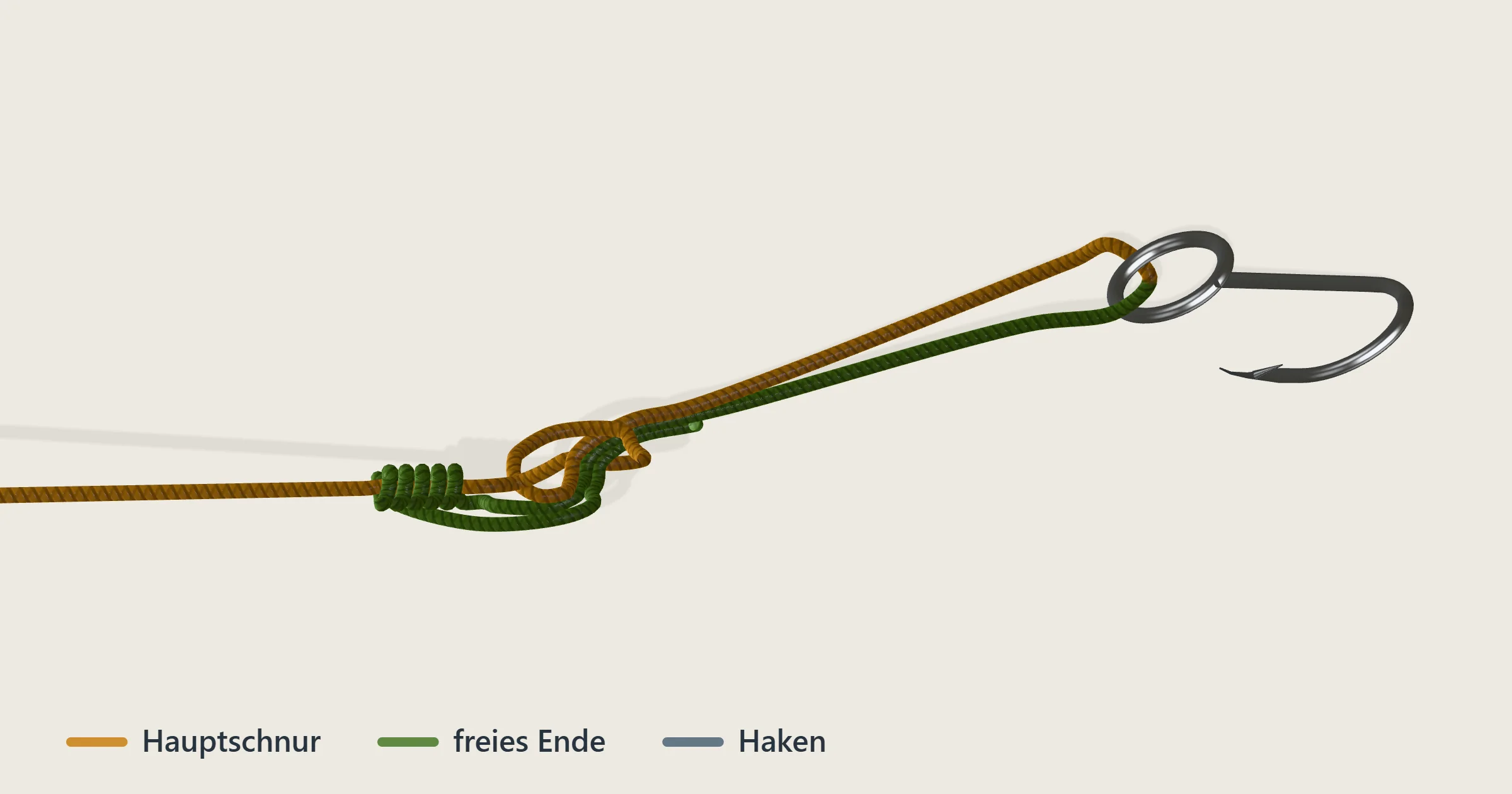
The Non-slip loop knot forms a firm, open loop at the lure. The lure hangs freely in it and can move more naturally than on a tightly pulled knot.
What is the non-slip loop knot good for?
The knot goes back to Lefty Kreh; in English it is called the Non-Slip Mono Loop or Kreh Loop. On the loop, a fly or lure moves more naturally. Animated Knots stresses that the end of the line points towards the hook and therefore picks up no weed when retrieving. The magazine Blinker describes the same principle in general for loops on lures: the bigger the loop, the more play the lure has.
Tying the non-slip loop knot: step by step
- Lay an overhand knot. Tie an overhand knot in the line some distance from the end and do not pull it tight. NetKnots gives a distance of about 10 inches, which is around 25 cm.
- Through the eye. Pass the end through the eye of the lure.
- Back through the overhand knot. Pass the end back through the open overhand knot. The distance between lure and overhand knot determines the size of the loop; set it now while everything is loose.
- Wrap around the main line. Wrap the end around the main line. NetKnots gives four to five turns. Animated Knots scales by line strength: seven turns for 6 to 8 lb, five for 8 to 12 lb, four for 15 to 40 lb.
- Once more through the overhand knot. Pass the end back through the overhand knot, again on the same side.
- Moisten and seat. Moisten the knot and pull slowly on the end until the turns close up loosely. Then pull loop and main line apart until the knot sits, and trim the end.
Common mistakes
- Overhand knot tightened too early: It must stay open until the end has gone through twice.
- Wrong side: On the second pass the end must enter the overhand knot on the side where it came out before.
- Loop set too late: Once tightened, its size can no longer be changed.
Pull test and knot strength
First check that the turns lie neatly side by side and the line is undamaged. Then pull steadily on both sides of the connection. For practice use a blunt ring; do not pull with bare fingers on an open hook or on thin line. If an end slips or the knot distorts, tie it again. A pull test does not measure breaking strength, it only shows gross tying faults.
Material, diameter and tying technique affect every connection. The line calculator gives you a rough guide using cautious knot factors of our own.
Related knots
If the lure should sit firmly on the line, use the Palomar knot or the Uni/grinner knot.
Used in the rig: Carolina rig. Also used in ultralight fishing.
Note: The numbers of turns in the sources refer to line strength in pounds (lb), not to diameter. Read the figure on your spool or try it out.
Sources
- Animated Knots – Non-Slip Mono Knot
- NetKnots – Non-Slip Loop Knot (Kreh Loop)
- Blinker – Angelknoten binden: Der Schlaufenknoten
Sources opened and checked on 2 October 2026. Texts in our own words, sketch drawn independently; no graphics taken from the sources. You will find all knots in the overview of fishing knots.
All figures are guide values without guarantee. Follow the line manufacturer’s instructions.