
Knowledge · Fishing methods
Ultra-light fishing
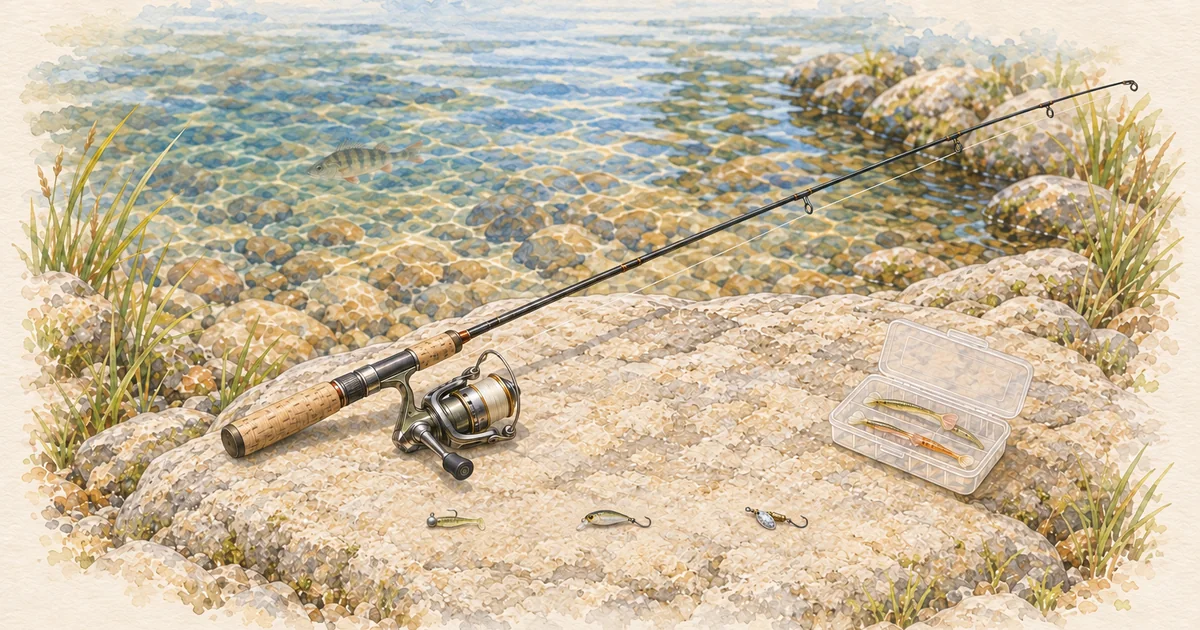
Ultra-light fishing is spinning with lures of just a few grams on very light tackle. Fine-wire hooks matter here: perch often push onto the light lure from behind and are hooked before you feel a bite.
What sets UL apart from ordinary spinning
UL stands for ultralight. It means a form of spinning in which lure, line and rod are as light as possible. There is no fixed limit. Rute & Rolle gives a casting weight of 0,5 to 7 grams for UL rods, Blinker puts 0 to 5 grams in the UL class, 10 grams at most. Lengths, action and handle are compared on the page Spinning rod; the perch version is covered under Perch rod.
Lure weight and casting weight have to match especially well here. A lure of 1 to 3 grams cannot load a stronger rod, writes Blinker: it hardly bends on the cast, does not spring back, and the lure drops into the water short. For a jig and soft bait totalling under 5 grams, Blinker says you need a rod that loads fully with so little weight. According to Rute & Rolle, fine tackle forgives mistakes in choosing rod or reel less than fishing with heavy lures does. Below 0,3 grams even aimed casting becomes difficult.
Line, leader and snap
Rute & Rolle spools the reel for brown trout with 0,06 to 0,08 millimetre braid of four to five kilos breaking strain, with an abrasion-resistant fluorocarbon leader of 0,20 millimetre at most in front of it. Anyone fishing even finer goes down, according to Blinker, to 0,04 millimetre braid and a leader of 0,14 to 0,16 millimetre. Monofilament line of 0,16 or 0,18 millimetre also works. Above 0,20 millimetre, mini crankbaits run badly according to Blinker.
Thin line brings two advantages. According to Blinker, a fine rod casts light jigs a few metres further only with thin braid, and a thick line on the water surface slows the sinking of small lures. Because braid has no stretch and is usually coloured, Blinker adds about a metre of fluorocarbon in front of it as a buffer.
A small snap with a round bend sits on the leader. Rute & Rolle leaves out a barrel swivel, which only adds weight and bulk. Blinker ties mini crankbaits on with a loop so that they can move freely; you can tie such a loop with the non-slip loop knot, for example. With lines this thin the drag must be finely adjustable, respond quickly and not judder (Setting the reel drag).
Lures under 7 grams
| Baits and lures | Weight according to source | Typical use |
|---|---|---|
| Micro jig with a small soft bait | 1 to 3 g | perch, slowly near the bottom |
| Jig spinner | 7 g at most | searching for perch, for distance |
| Spoon | 1,5 to 4,5 g | trout in still water |
| Mini crankbait, 2 to 5 cm | 1 to 3 g | trout, chub, perch in shallows |
| Insect imitation | under 0,5 g | trout in a stream |
The micro jig is a small lead head with a hook (jig heads) onto which goes a pintail, a twister or a small shad. A pintail on a light jig spins slightly as it sinks, which according to Blinker looks natural. The jig spinner weighs, in small sizes, 7 grams at most according to Blinker; to get its blade turning, it hangs on a ball-bearing swivel. With 5 or 7 grams, Blinker searches large areas for perch.
Mini crankbaits weigh 1 to 3 grams in the smallest sizes; another Blinker article gives 2,5 to 5 centimetres and up to 7 grams. Most run hardly deeper than a metre. Short, fat models resemble the crankbait, slim ones the twitchbait.
On the nymph, the sources disagree. Rute & Rolle considers nymphs and the smallest streamers no longer castable even with the finest UL tackle and presents them on a dropshot rig, in front of a root or in a pool. Blinker, by contrast, casts heavy gold-head nymphs directly, on a very fine rod with the thinnest braid.
Letting it sink and working it
Light jigs sink slowly, which is their advantage. Without current, Blinker fishes jigs of 1 to 3 grams even at 4 metres deep, but needs patience in the first sinking phase. After that, one turn of the handle is enough for two to three seconds of sinking, because even a small size 1000 reel picks up around 60 centimetres of line per turn. When the line goes slack, the jig is on the bottom. In shallow water it should, according to Blinker, weigh little more than 1 gram so that a sinking phase remains at all.
Deeper it gets harder. For 2 to 4 metres Blinker gives up to 7,5 grams, for 5 to 8 metres 10 grams, in current even more. Then the rod should be longer and stronger, and you leave the UL range.
You count sinking mini crankbaits down: count the seconds until the line goes slack, and on the next cast start winding two seconds earlier, so the lure runs in a different layer of water. Floating models you let drift in the current to places you cannot cast to, for example under branches, and only reel them in from there.
Thin, sharp hooks. According to Blinker, perch often slide onto the light lure from behind and hang on without you feeling a bite. Fine-wire hooks penetrate even without a strike.
Perch, trout and chub
Perch: In late summer, perch in many waters hunt only in the first and last light, according to Blinker. In the long time between, the author catches them with very slowly worked small lures that flutter naturally to the bottom. According to the DAFV’s Fish of the Year brochure, perch only ten centimetres long already chase artificial lures of the same length or longer. More on the species under Perch fishing.
Trout: On a stream, according to Blinker, you search the water with casts to the far bank, metre by metre. In small spots the trout has to grab quickly, so there you work the mini crankbait briskly and evenly. In a trout lake the fish have more time to inspect it, and then twitching pays off, that is jerking with pauses. For spoon and sbirolino on the pond there is a page of its own: Trout fishing on a pond.
Chub: Big chub hunt fish and, according to Blinker, can be targeted with small crankbaits. You let the current carry a floating crankbait under overhanging branches or to driftwood, where chub like to stand. The fish is wary: by the third catch from a shoal at the latest the rest become suspicious, and then you are better off changing spot (Chub fishing).
Limits and fish welfare
Small lures are not taken only by small fish. Blinker advises a landing net even for micro jigging because a pike now and then gets involved, and puts some wire in the lure box. When a wire leader is needed is explained on the page Pike leader. Where a lot of weed grows or there are many snags, you should reconsider using ultra-fine tackle, according to Blinker, for the sake of fair angling practice.
Artificial lures with a single hook are kinder to the fish than those with trebles, as stated in the exam questions for the angling exam in Bavaria (LfL). With jig spinners with a twin hook you can, according to Blinker, turn the hook upwards in weed.
Law: In many waters a predator closed season applies, during which fishing with artificial lures is often prohibited, writes the DAFV. That also covers tiny UL lures. When and where it applies is regulated by state law and the fishing permit; introduction under Closed season and minimum size.
Frequently asked questions
What rod do I need for UL fishing?
Rute & Rolle fishes streams with rods 1,80 to 2,10 metres long with a casting weight of 0,5 to 7 grams, a fairly fast blank and a sensitive tip. It must not be too soft; even 50-centimetre brown trout take small lures.
Can I fish deep with UL tackle too?
Down to about 4 metres without current, with jigs of 1 to 3 grams and patience, reports Blinker. For more depth or current you need heavier lures and a stronger rod.
Do I need a swivel in front of the lure?
Usually not. A small snap is enough; a barrel swivel disturbs the action of tiny lures. The exception is the jig spinner, whose blade needs a ball-bearing swivel.
Related
- Spinning rod: rod classes, action and handle compared
- Perch rod: lengths, tip and reel size for perch
- Fishing ponds in Germany: find trout lakes near you for light spinning
- Perch lures: lure sizes through the year
- Braided line: properties and use
- Brown trout fishing: lures and approach on a stream
- Chub: appearance and way of life
- Trout fishing on a pond: spoon, sbirolino and trailed float
Sources
- Rute & Rolle: Leicht auf Forellen mit UL-Baits am Bach (13.05.2017; Wurfgewicht, Schnur, Snap, Nymphe am Dropshot)
- Blinker: Spinnrute, welche Rute passt zu meinem Zweck (05.11.2025; UL-Klasse)
- Blinker: Ultralight auf Barsche jiggen (25.09.2026; Jig-Gewicht, Absinken, Haken)
- Blinker: 3-Stufen-Plan für Micro-Köder (27.09.2026; Gewicht und Tiefe, Hecht als Beifang)
- Blinker: Mini-Turbine für Brutfisch-Fresser (05.07.2025; Jig-Spinner)
- Blinker: Köder-Praxis, alles über Mini-Wobbler (09.03.2016; Gewicht, Tiefe, Führung, Rute)
- Blinker: Forellen angeln mit Mini-Wobbler (27.08.2025; Schnur, Treibenlassen, Anzählen)
- Blinker: Steckbrief Döbel (05.08.2022; Wobbler, Hindernisse, Scheu)
- Blinker: Ultra Ultralight mit der Spinnrute (10.04.2025; Goldkopfnymphe, Schnur, Bremse, Kraut)
- Blinker: Spoon-Angeln und Seite 2 (aktualisiert 20.08.2025; Spoon-Gewicht, Schnurwiderstand beim Absinken)
- DAFV: Der Flussbarsch, Fisch des Jahres 2023 (Kunstköder, Raubfischschonzeit)
- LfL Bayern: Staatliche Fischerprüfung, Prüfungsfragen 2023/2024 (Einzelhaken)
Text AI-assisted, drawing AI-generated. Sources opened and checked in October 2026; no graphics taken from the sources.
All details are guideline values without guarantee. Closed seasons, minimum sizes and permitted lures are regulated by state law and the water rules.