
Knowledge · Tackle
Perch rod: Light, sensitive and matched to small baits
A perch rod is a light spinning rod for lures of a few grams and for a fish with a soft mouth. This page deals with length, casting weight and tip for drop shot, jig and small crankbaits, with the compromise when one rod has to do everything, and with why the fine rod only really works with thin line.
Ultralight, perch rod, all-round: the classes
Basic terms such as casting weight and action are explained in the overview Fishing rods, and all spinning rod classes are shown under Spinning rod. For perch, three light groups come into question.
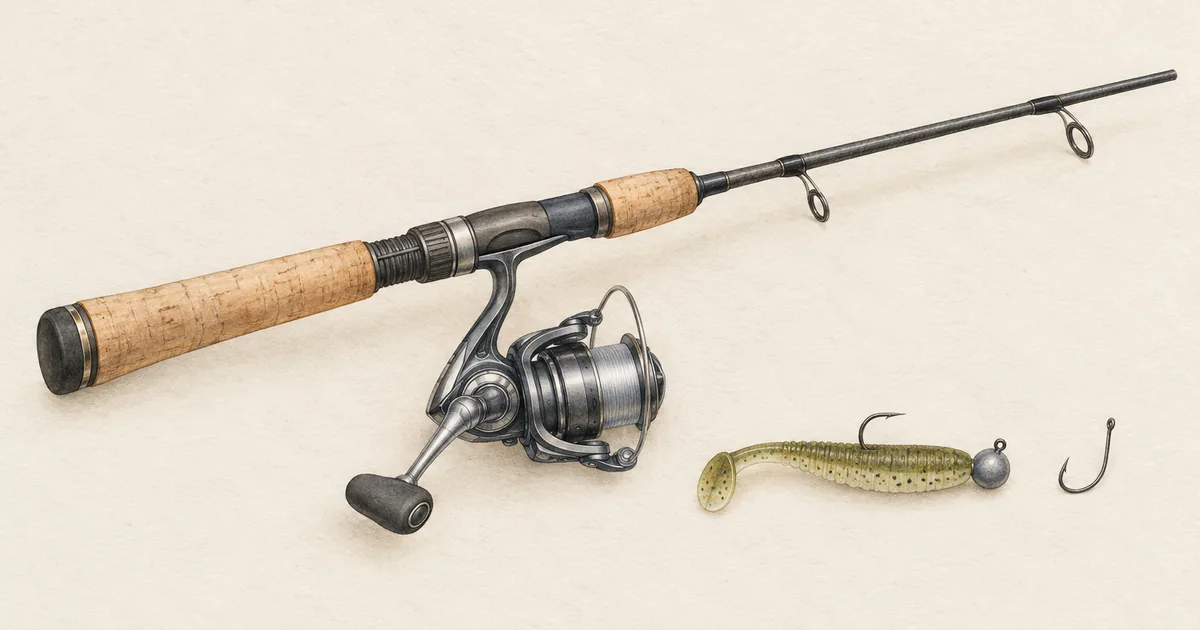
- Ultralight (UL): Blinker gives 1,50 to 2,10 m and 0 to 5 g, at most about 10 g. The rods often weigh well under 100 g and are meant for small waters and short casts. More on the technique is under Ultralight fishing.
- Perch rod: For this group the same overview gives 1,80 to 2,40 m and 5 to 25 g, with a sensitive tip.
- All-round perch rod: a rod of about 2 m with a casting weight of under 5 to at most 15 g is considered sufficient for most perch methods.
If the length is given in feet on the blank: 6 ft is 1,83 m, 7 ft is 2,13 m and 8 ft is 2,44 m. Other values are converted by the Unit converter.
One rod for jig and crankbait: the compromise
According to Fisch & Fang there is no rod that does everything equally well in perch fishing; the magazine reckons with at least three rods for a season. Rod I, 1,80 to 2,10 m with fast action and up to 15 g, works small crankbaits, spinners, spoons and mini soft plastics and is also good for drop shotting. Rod II is short, somewhat stiffer and carries up to 25 g for larger crankbaits, shads and soft jerkbaits; it also suits vertical fishing. Rod III measures 2,40 to 2,70 m and 30 to 40 g, and casts shads long distances and at rock revetments.
Anyone who wants to buy only one rod needs a middle course. The all-round rod of about 2 m with under 5 to 15 g covers most methods; for shallow zones and mid-water 2,10 m with 5 to 25 g is also given. In greater depths it is 2,70 m and 40 g. The price of the compromise: very light heads under 5 g hardly load a rod of 5 to 25 g on the cast, which is what the UL class is for. Fig. 2 shows where the classes overlap.
What matters is the whole weight you cast. The table collects which weights the sources give for each technique.
| Tackle and technique | Weights according to sources | Suitable rod |
|---|---|---|
| Mini jig, ultralight | heads 1 to 3 g without current, even at 4 m depth | UL rod, 1,50–2,10 m |
| Jig in summer | heads 2 to 7 g with 3 to 7 cm soft plastic | around 2,10 m, 5–25 g |
| Jig at depth | about 10 g to 10 m depth, below that 12 to 15 g | 2,70 m, around 40 g |
| Drop shot with worm | rod up to 11 g, tungsten weight 15 g for distance | light rod around 2 m |
| Small crankbaits, spinners | light lures, rod up to 15 g | 1,80–2,10 m, fast |
| Twitching with a crankbait | crankbait from 10 cm, rod around 25 g | 2,10–2,55 m, parabolic |
Length: short lever or long cast
A rod of 1,80 to 2,10 m works like a short lever. That suits everything worked on the spot with small wrist movements: Texas rig, shaky head and dropshot rig. For the canal, the British Angling Times recommends a light rod of 6 to 7 ft, that is 1,83 to 2,13 m, with a casting weight of under 10 g, plus a size 2000 reel and braid rated at 10 lb (about 4,5 kg). Fine tackle, it says, brings more perch there than heavy gear.
It may be longer in open water. There the lure can be worked better with a longer blank. That a longer rod casts further from the bank is covered at Spinning rod.
From a boat, short rods are considered handier, and if in doubt you reach for the shorter model: the long leverage of a long rod transfers wrist movement more strongly to the lure, which is not wanted with perch. For vertical fishing a short, fairly stiff rod of about 1,80 m is given, and for casting from the bank 2,40 to 2,70 m with about 40 g and a not-too-stiff tip. For drop shot from the bank the soft rod may measure up to 2,40 m. Suitable reels: 2000, and for long casts a 3000 model because of the larger spool diameter.
Tip and action by technique
The tip decides how finely you feel the bait and how well the perch stays hooked in the fight. Some dropshot rods have a softer tip spliced in, that is, inserted into the blank as a separate piece. The table compares what the sources say about the soft and the stiff tip.
| Feature | Soft, fine tip | Stiff tip |
|---|---|---|
| Typical use | Dropshot, fine movements | sharp, precise presentation |
| In the fight | fewer lost fish | safe with a sharp hook |
| Limit | Bites hard to see in wind and waves | more lost fish according to the overview |
Dropshot and finesse rigs
For drop-shot, dedicated rods of 1,80 to 2,40 m rated 5 to 30 g with a particularly sensitive tip are recommended, and for Texas and Carolina rigs finesse rods of 1,80 to 2,30 m rated 3 to 30 g. A soft rod with a casting weight of no more than 30 g and 1,80 to 2,10 m is considered good for drop-shot and vertical fishing. There is a limit: on a canal with a lot of shipping, some anglers prefer a light spinning rod up to 11 g, because bites are hard to see on the very sensitive tip in wind. What sets a dedicated drop-shot rod apart from a perch rod is covered further down.
Jig and soft plastic
Opinions differ on jigging, lifting and letting the lure sink on the bottom. For perch with their soft mouths, a soft, sensitive rod with a fairly soft tip is considered favourable, because fewer fish come off in the fight. Against that, the specialist press says this is outdated: a stiffer blank guides the lure more precisely, and with sharp hooks and a decisive strike you land the fish with it too. Both agree on one thing: the tip should give in the fight. Which head weight suits which depth is explained on the page Jig heads.
Twitching with small crankbaits
When twitching, you strike a slim crankbait with short jerks of the rod tip so that it darts sideways. For beginners, 2,10 to 2,55 m, around 25 g casting weight and a soft, parabolic action are given. Others prefer to twitch with a short rod and downward strokes. The page Twitchbait shows suitable lures.
Fine rod, thin line
The overview of spinning rods pairs UL rods with light reels of size 500 to 1500 and very fine braid. Thin line also helps under water: according to Rute & Rolle, a soft plastic runs deeper on thinner line with the same head and speed. So you get by with the light heads that the perch rod is built for. Thin does not mean careless, though: anyone fishing with thin line needs a drag that starts without a jerk.
- Main line: 0,06 mm braid is given for drop shot with a worm, around 0,12 mm for twitching, 5 kg breaking strength for drop shot in a river and 5 to 7 kg for jigging. Light colours make delicate bites visible. Why braid hardly stretches and carries more for its thickness is covered under Braided line.
- Hooklength: perch are considered line-shy, and older fish in particular see through visible braid. A transparent piece of fluorocarbon or monofilament therefore goes in front: the clearer the water, the longer, usually 1 to 2 m. 0,35 to 0,40 mm is given for jigging, 0,20 to 0,25 mm on 1 to 1,5 m in summer and 0,20 mm for drop shot.
- Breaking strength: how much of it remains after the knot and which drag setting goes with it is worked out by the line calculator. You will find the values for perch on drop shot and when spinning there by target fish and method.
Pike as bycatch: when perch fishing, pike, zander or asp bite now and then. An all-round perch rod should therefore bend under load right up to the tip ring and have backbone below. A pike bites straight through thin monofilament line, including a fine fluorocarbon hooklength, with its teeth. Where pike occur, the specialist press advises a wire trace, more under Pike trace.
Drop-shot rod and standard perch rod
On the drop-shot rig the weight lies on the bottom and the bait sits above it, quivering on the spot. The rod should move it with small twitches without shifting the weight, and show bites on a tight line. When twitching from a drifting boat, Fisch & Fang insists that the weight always keeps contact with the bottom. The standard perch rod, by contrast, is built for lures that you work actively.
The fine tip
A 2024 Blinker article describes most drop-shot rods like this: a very fine tip in a bright colour, which makes bites easier to see, and a semi-parabolic action. So the rod bends to about halfway (terms under Fishing rods). A special form is the solid-tip rod. Its tip section is not hollow like the rest of the blank but solid carbon fibre throughout, and much softer than on an ordinary spinning rod (Blinker, 2025). If you work the bait slowly on a tight line, this solid carbon tip gives on the bite and the perch feels hardly any resistance, which matters with wary fish in winter.
Whether soft or stiff also depends on the distance. According to Fisch & Fang the soft tip lets the perch suck in the bait without feeling resistance. This helps in vertical fishing, where there is only a short distance between the bottom and the rod tip. A stiffer tip signals the bite more clearly and comes into its own from the bank, when the bait is far out.
Length from the bank and from the boat
The 2024 Blinker article considers 2,10 to 2,70 m suitable for both boat and bank; the Blinker overview of spinning rods mentioned above suggests 1,80 to 2,40 m. For casting at distance, Blinker recommends a long, not too stiff rod that keeps a lot of line above the water. The solid-tip article names 2,5 m and up to 28 g for this. For small baits it recommends around 2 m and no more than 7 g. A tackle list in Fisch & Fang distinguishes by location: 1,80 m and 18 g for vertical fishing, 2,40 m and 24 g from the bank. Pure vertical fishing with soft plastics has its own dimensions, shown under Vertical rod.
Line and strike
Opinions on line differ widely. Blinker (2024) names a size 2000 to 3000 reel with 0,12 to 0,16 mm braid, which will also hold a zander. There the strength depends on the fish you can expect. Fisch & Fang uses a 2000-size reel with clear braid of only 0,052 to 0,08 mm. Thinner braid gives closer contact with the bait there, which can then be shaken on the spot more precisely. As above, a fluorocarbon leader goes in front of it; the Line calculator shows the breaking strain after the knot.
The strike also differs from jigging. Fisch & Fang advises lowering the rod tip on the bite instead of jerking it up, so that the perch can suck the soft-plastic worm in completely. Only when the line tightens do you set the hook, and by winding briskly rather than with a sharp strike.
When a dedicated rod is worth it
To start with, the perch rod is enough; Fisch & Fang explicitly considers the light rod up to 15 g suitable for drop-shotting too. A Blinker author says he caught considerably more after switching from a light spinning rod to a drop-shot rod with a spliced-in tip. That is a personal report, not a comparison test. According to the solid-tip article, twitchbaits, jig spinners and dart jigs do not belong on the soft tip, because it absorbs every quick jerk.
- If you mostly work plugs, spinners and soft plastics actively and only drop-shot now and then: the standard perch rod.
- If you fish on the spot for a long time and the perch are biting hesitantly: a drop-shot rod with a soft or solid carbon tip.
- If you cast a long way from the bank: rather 2,40 to 2,50 m and a tip that still shows the bite at distance.
- If you fish vertically from a boat: a short rod of around 1,80 m with a soft tip.
- If wind and boats keep moving the tip: better a firmer light spinning rod, as described above for the canal.
Landing a perch gently
Because of the soft mouth, many perch are lost in the fight. A rod that is not too stiff, a drag that is not too hard and a brisk, sensitive fight are recommended. You will find the starting value for the drag under Setting the reel drag.
Perch carry spiny rays, which is what the question catalogue for the angling exam (Fischerprüfung) in Saxony-Anhalt asks about, for example (more features under Perch). For the perch grip, the thumb goes into the mouth and the index finger goes from outside under the lower jaw. That way the grip is secure and the mucous membrane stays untouched. Hold the perch like this only with no hook in its mouth, with wet hands and, when it lies almost horizontally, with the other hand under the belly, otherwise the weight overstretches the jaw. Remove the hook beforehand with a disgorger; the procedure is shown under Landing and unhooking a fish.
The perch, like the zander, lacks the connection between swim bladder and gullet through which other species release gas quickly. If it is brought up quickly from great depth, the swim bladder expands strongly; the exam materials call this swim bladder bloat (Trommelsucht). Blinker advises not fishing deeper than 10 m for perch and pausing during the fight. Whether you may take a perch home or must return it is regulated by your federal state (Bundesland): minimum size (Mindestmaß) and closed season (Schonzeit) are in the state fisheries regulation and in the fishing permit (Erlaubnisschein), more under Closed season and minimum size explained and Returning a fish.
Common mistakes
- Mini lures on a rod of 5 to 30 g. In practice, according to the specialist press, it works better from just over 10 g.
- Expecting one rod to do everything. Between a mini jig and a long-cast shad lie several rod classes; a middle course means compromises.
- The softest dropshot tip for every water. On a heavily used canal and in wind, bites are hard to recognise with it.
- Twitchbait on a solid carbon tip. The soft tip absorbs the jerks, so the lure hardly darts aside.
- Stiff rod and hard drag. Because of the soft mouth, more perch are then lost in the fight.
- Thick braid on the fine rod. The light bait flies shorter and runs shallower than it should.
- Visible braid directly at the lure. Perch are considered line-shy; a transparent hooklength belongs in front.
- Thin fluorocarbon in pike water. If a pike takes, it breaks off, bait and all.
Frequently asked questions
Is an ordinary spinning rod enough for perch?
Yes, for lures from just over 10 g. UL and perch rods are built for jigs and soft plastics of 1 to 5 g. According to the specialist press, a rod of about 2 m with under 5 to 15 g covers most perch methods.
How long should a perch rod for the canal be?
Angling Times gives 6 to 7 ft, that is a good 1,80 to a good 2,10 m, and under 10 g casting weight. That is within the range of the all-round perch rod. On narrow water, feel counts for more than casting distance.
Which reel size suits the perch rod?
For UL rods, sizes 500 to 1500 are given; a dropshot article gives 1000 or 2500 for a light rod of around 2 m. What the numbers mean is explained under Fixed-spool reel.
Do I need several rods for jig, drop shot and crankbait?
Not necessarily. An all-round rod of about 2 m with under 5 to 15 g covers many methods, with compromises at the margins. For very light lures or long casts with shads, dedicated rods are more precise.
How long should the hooklength be on the perch rod?
Usually 1 to 2 m of fluorocarbon or monofilament in front of the braid is enough, and in clear water it can be longer. Perch are considered line-shy and see through visible braid.
Related
- Spinning rod: classes, balance and designs of the spinning rod
- Perch: features, holding spots and baits
- Dropshot rig: construction, weight spacing and presentation
- Ultralight fishing: lures under 7 g and fine tackle
- Perch lures: which lure when for river perch
- Jig heads: head weight by depth and current
- Zander rod: the stiffer rod for heavier jigs
- Line calculator: breaking strain after the knot and drag setting
Sources
- Blinker: Spinnrute: Welche Rute passt zu meinem Zweck? (Längen und Wurfgewichte der Klassen, Rollen, weiche Spitze)
- Blinker: Raubfischrute: Wichtige Kriterien für die Auswahl (Allround-Barschrute, kurzer Hebel, steifer Blank, Beifang)
- Fisch & Fang: Grundlagen zum Barschangeln (drei Ruten, Länge, Boot, Rolle, Schnur) und Fisch & Fang: Jiggen auf Barsche (Vertikal- und Wurfrute, Schnur, Vorfach)
- Blinker: Barschangeln im Sommer (Rute 2,10 m und 2,70 m, Jigköpfe, Vorfach)
- Angling Times: How to fish with light lures on the canal (Rutenlänge, Wurfgewicht, Rolle und Schnur am Kanal)
- Blinker: Dropshot-Angeln mit Wurm auf Barsch und Zander (Rute im Kanal, Rolle, Schnüre, Gewichte) und Blinker: Dropshotting direkt im Wohnzimmer der Barsche (eingespleißte Spitze, Schnüre, Wechsel zur Dropshot-Rute)
- Blinker: Barsch-Alarm: Ultralight auf Barsche jiggen (Jig-Gewichte, Gesamtgewicht unter 5 g)
- Blinker: Twitchen auf Dickbarsch (Twitchrute, Geflecht) und Blinker: Barschangeln: 10 Tipps für Deinen Erfolg (Aussteiger, Bremse, Stahlvorfach)
- Blinker: Bissfeste Mono-Vorfächer: Unsichtbar auf Hecht (Hechtzähne) und Blinker: Der Barsch-Griff (Griff am Unterkiefer)
- Blinker: Barotrauma bei Fischen: Wie tief darf ich angeln? (Schwimmblasengang, 10 m, Drillpausen)
- Rute & Rolle: Barsch-Special, Teil 2: Gummi und Blech (Lauftiefe und Schnurstärke), Taktik für die Tiefe (Kopfgewicht nach Tiefe) und Barsch 3.0: Tauwurm mit Finesse-Rigs (Dropshot-Rute, Vorfach)
- Blinker: Dropshot, alles was du über die Montage wissen musst (2024) (Spitze, Aktion, Länge für Boot und Ufer, Wurfgewicht, Rolle, Geflecht, Rute für Distanz)
- Blinker: Solid-Tip-Rute im Einsatz (2025) (Vollcarbonspitze, Einsatz und Grenzen, Längen und Wurfgewichte)
- Fisch & Fang: Zielfisch Barsch, die neue Tanz-Methode (2010) (weiche und harte Spitze, Ruten für Boot und Ufer, Rolle, Geflecht, Anhieb)
- Land Sachsen-Anhalt: Fragenkatalog zur Fischerprüfung (PDF, Stand April 2022) (Stachelstrahlen, Trommelsucht)
Text AI-assisted, drawings AI-generated. Sources opened and checked in November 2026, no graphics taken from the sources.
All figures are guideline values without guarantee. Which perch rod suits depends on bait weight, technique, fishing spot and water; the print on the rod and the law of your federal state (Bundesland) are what count.