
Knowledge · Tackle
Vertical rod: Short and directly beneath the boat
A vertical rod is a short, stiff rod for fishing directly beneath the boat: the lure hangs vertically under the rod tip and dances just above the bottom, mostly for zander and perch. This page covers which length, reel and line suit it, what the echo sounder does and which rules can apply on the water.
The method: lure plumb beneath the boat
In vertical fishing you do not cast. You let a soft plastic shad on a jig head sink to the bottom on a tight line and move it only with the rod tip. On the river zander are the main quarry, and perch also sit close to the bottom. Lures of 10 cm and up are fished, such as soft plastic shads or the V-Tail.
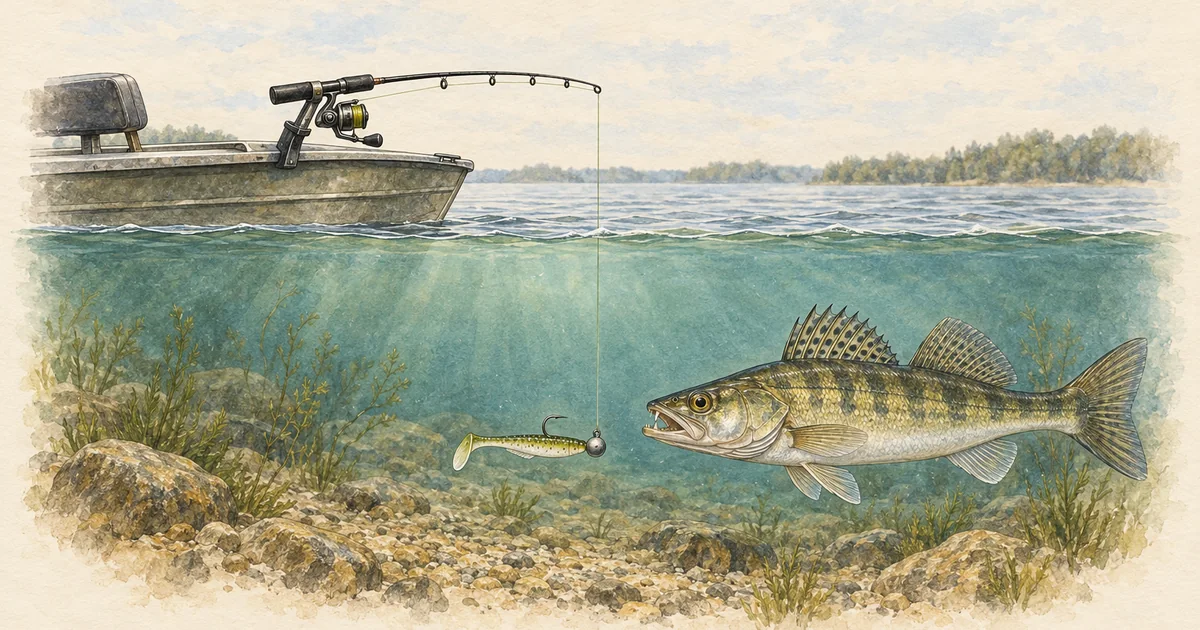
The presentation goes in four steps: let down, lift 30 to 50 cm with the tip (Blinker), hold for five to ten seconds, lower again. The bites come on the way down. Elsewhere the same article says at most 10 to 30 cm. Fisch & Fang gives 10 to 20 cm, varies the height of the jumps and the pauses and sometimes starts the lure with a hard jerk, while another article warns against jerky lifting.
In harbours and at groynes you steer straight to the spot and stay there. In the main current the boat drifts across the flow; after the first bite the bow goes against the current and the motor brakes the drift. A variable-speed electric motor that holds the boat in place even in a crosswind is helpful.
Rule of thumb for the head weight (Fisch & Fang), valid for braid of 0.08 to 0.12 mm: down to 5 m depth in little wind and current 17 g, from 5 to 10 m 21 g, deeper 28 to 35 g. In more wind or current add about 4 g. On the river, according to Blinker, it is at least 20 g, up to 50 g depending on the spot. Shapes and hooks are shown on the page Jig heads.
Length, tip and backbone
Most vertical anglers fish rods of 1.80 to 2.00 m. Fisch & Fang sets the limit at 2.10 m and calls for a hard, fast rod. For the spinning rod, 2.40 m is quoted for jigging from a boat. Boat rods are short because from a boat you mostly fish vertically or troll, and you do not need to cast.
On casting weight the figures differ. According to Blinker it is 14 to 28 g (article from 2019). An article from 2016 advises beginners to take a rod around 30 g and advanced anglers a second one at 65 g for bigger lures. The light one should have a tip action and carry its power in the backbone, the strong lower part of the blank, so that the strike gets through. The heavy one bends parabolically and absorbs the head-shakes of big zander so that a hook sitting shallow does not tear out. The terms are explained in the overview Fishing rods.
| Feature | Light vertical rod | Heavy vertical rod |
|---|---|---|
| Casting weight | around 30 g | around 65 g |
| Action | Tip action | parabolic |
| Braid, breaking strain | 6 kg | 9 kg |
| Reel | Size 1000, under 190 g | one size bigger |
Guide values from the 2016 article. The grip is part of it: rod butt against the forearm, tip just above the water. That leaves room upward at the bite, and the strike drives the hook into the hard mouth of the zander.
Fixed-spool reel or baitcaster
The reel is a matter of taste; both designs are considered suitable. The author of an equipment article uses a trigger-grip rod with a small baitcaster because his other hand is usually on the motor tiller. The baitcaster sits on top and needs a specially ringed rod, the fixed-spool reel hangs beneath.
The reel should be small, light and strong, with a drag that works without jerks. Line capacity and gear ratio are secondary: 100 m of line is enough, and the tip moves the lure, not the handle. You set the drag as described under Setting the reel drag.
Braid and leader
Only braided line comes into question, because only it reports the bottom and the way the lure is working accurately and passes the strike on directly. Thick line offers the current a lot of resistance, makes it harder to work the lure directly beneath the boat and forces you to heavier heads. Diameters of 0.08 to 0.12 mm are quoted. Over mussels and stones the author uses coarser braided line, which stands up better to abrasion.
Where there are no pike in the water, he names a leader of fluorocarbon of 0.24 to 0.30 mm; with pike, flexible steel wire, see Pike trace. The breaking strain should match the main line; a 20 kg leader on 6 kg braid makes no sense. He leaves out a swivel because nothing twists on a vertical line. The breaking strain after the knot is worked out by the line calculator.
The echo sounder as an aid
To find where the predators lie, you need an echo sounder. Depth and the nature of the bottom are said to be decisive; more fish sit on bottom with plenty of structure. Good spots include the transition from the stone revetment to the river bed, along which zander move.
Live sonar, which shows fish and lures almost photo-like in real time, is controversial. The angling working group in the Deutscher Angelfischerverband gave no recommendation for or against it in April 2025. It sees too little reliable data for a rule, though some water managers have already made one. On Lake Lucerne in Switzerland, such transducers have been banned since 1 September 2023 (Canton of Schwyz). What applies on your water is in the water rules and the fishing permit (Erlaubnisschein).
Boat, water rules and life jacket
Whether you may fish from a boat is decided by the water manager. One example is the water rules of the Landesanglerverband Brandenburg (2019 edition): boats and belly boats are permitted for fishing there unless otherwise stated, including an electric motor up to 1 kW. On the association’s salmonid waters boats are in principle not allowed, and the board can restrict boats and combustion engines. That applies only to this association. What counts for you are the fishing permit and water map.
The Brandenburgische Fischereiordnung (§ 4 para. 2, as of August 2026) bans trolling from boats that are moving under engine power or sail. Whether braking the drift with the motor falls under this, the wording leaves open. Ask the lower fisheries authority (Fischereibehörde); in other states the rule is in the state fisheries regulation (Landesfischereiverordnung).
On inland and sea waterways, § 5 of the Sportbootführerscheinverordnung exempts from the licence requirement, among others, people who operate a pleasure boat with a combustion engine of at most 11.03 kW or an electric motor of 7.5 kW. Further conditions and exceptions are in the text. The booklet Sicherheit auf dem Wasser from the Federal Ministry of Transport, BSH and WSV advises keeping a distance from commercial shipping and staying to the right or outside the fairway, which matters for any drift in the main current. According to the booklet, even good swimmers wear a life jacket. More under Life jacket and Boat and life jacket.
Common mistakes
- Holding the rod with no support on the forearm. With no counter-pressure on the forearm, the bite pulls the tip down and the strike is short by centimetres.
- Fishing too light. In a strong drift the head floats away as soon as you lift it, and you keep giving line.
- Line too thick. It catches the current and needs more lead than necessary.
- Ripping the lure up again and again. Especially in the cold season that tends to scare fish off.
- Screwing a heavy reel onto the light rod. It becomes a mini dumbbell that strains your arm all day.
Frequently asked questions
Does an ordinary spinning rod work too?
You do not need much for vertical fishing. The specialist press does, however, quote lengths up to 2.10 m, and ordinary spinning rods are usually longer. What matters is a hard, fast rod with which you feel the bottom and the lure.
How heavy does the jig head have to be?
Heavy enough that the lure stays vertically beneath you and you feel the bottom. The rule of thumb starts at 17 g; in strong current it is up to 50 g.
Do I absolutely need an echo sounder?
For finding where the fish lie it is considered necessary, or at least a great help. Whether it is allowed on your water is in the water rules.
May I fish from a boat anywhere?
The water manager decides that. The Landesanglerverband Brandenburg, for example, allows boats unless otherwise stated, but not on salmonid waters. Read the fishing permit (Erlaubnisschein) and the water rules before you cast off.
Related
- Zander rod: rods for zander from the bank and from the boat
- Perch rod: lighter rods for small lures
- Jig head rig: threading on the soft plastic, adding a stinger treble
- Drop shot rig: the second rig for vertical fishing
- Fishing from a cutter and boat: licence and minimum equipment
- Unit converter: head weights in oz, lengths in ft
Sources
- Blinker: Vertikalangeln, erfolgreich unter der Rutenspitze, 2019 (Zielfische, Führung, Drift, Kopfgewicht, Rute 14 bis 28 g, Haltung, Rolle)
- Blinker: Angelausrüstung zum Vertikalangeln, 2016, acht Seiten (Länge, zwei Ruten, Aktion, Rolle, Geflecht, Vorfach)
- Blinker: Die richtige Angelrute, darauf kommt es an (kurze Bootsruten, Beringung für Baitcaster) und Blinker: Raubfischrute (2,40 m vom Boot)
- Fisch & Fang: Zielfisch Zander, Einmaleins des Vertikalangelns, 2010 (Elektromotor, Echolot, Rute, Geflecht, Faustregel Kopfgewicht)
- DAFV, Arbeitskreis Angeln: Live-Sonar, April 2025 (Technik, keine Empfehlung)
- Kanton Schwyz: Live Sonar, 2023 (Verbot am Vierwaldstättersee)
- Landesanglerverband Brandenburg: Gewässerordnung 2019 (Boote, Elektromotor, Salmonidengewässer)
- Fischereiordnung des Landes Brandenburg (§ 4 Abs. 2, Schleppangeln)
- Sportbootführerscheinverordnung, § 5 (führerscheinfreie Motorleistung)
- BMDV, BSH, WSV: Sicherheit auf dem Wasser, 2023 (Berufsschifffahrt, Rettungsweste)
Text AI-assisted, drawing AI-generated. Sources opened and checked in October 2026; no graphics taken from the sources.
All figures are guide values without guarantee. Whether boat, motor and echo sounder are allowed on your water is governed by the water rules, the fishing permit and the competent authorities.