
Knowledge · Tackle
Baitcaster and multiplier reel: A turning spool on the rod
A baitcaster is a small multiplier reel for casting: its spool turns during the cast, and the reel sits on top of the rod. It lets you cast heavy lures very accurately, but without the right settings the first cast often ends in a bird’s nest. Two brakes prevent this, and a third works during the fight; if the rig is lowered or dropped back rather than cast, for example for wels catfish or at sea, the large multiplier takes over.
A turning spool instead of a bail arm
On a fixed-spool reel the spool stands still, and a bail arm lays the line round it. On a multiplier reel the spool itself turns and winds the line on as you reel. The spool is supported on both sides, and the line does not run over a line roller when retrieved. The multiplier is therefore sturdier and retrieves more powerfully.
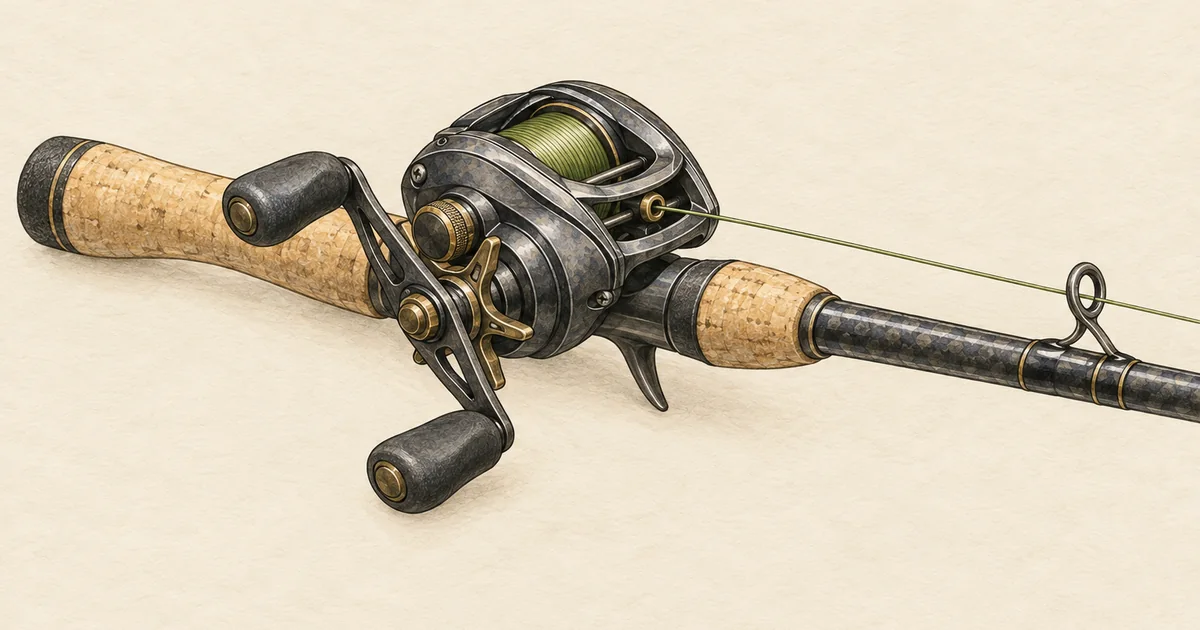
Baitcaster is the name for multiplier reels built for casting baits. To cast, you press the thumb bar, a crossbar above the spool. It switches the free spool on, and the bait’s momentum pulls the line off the freely turning spool. As soon as you reel, the free spool switches off by itself, much like flipping the bail arm over on a fixed-spool reel.
The gear ratio describes how many spool turns a single turn of the handle triggers. 7,0:1 means seven spool turns. Blinker often gives 6:1 or 7:1 for baitcasters, and about 4:1 for many sea multipliers. How much line comes in per turn also depends, according to Rute & Rolle, on the spool diameter. That is why a full spool takes in more than a half-empty one. The number of ball bearings is regarded there as the wrong question when choosing a reel.
Reel on top, thumb on the spool
A baitcaster and a multiplier reel sit on top of the rod, not underneath. The rod therefore needs its own guide arrangement, with the guides on the upper side of the blank, the rod’s shaft. The reel seat usually has a protruding spur, the trigger grip, where the fingers find a hold. More on the casting rod is under Spinning rod, on the boat rod under Sea rod.
During the cast, the thumb rests on the spool. It holds the bait until you release it, and brakes the spool in a controlled way in flight. Shortly before landing you brake harder: according to Rute & Rolle a jerkbait then straightens out, and the line does not wrap round the hook. In the fight the thumb is the emergency brake: on a violent run you press the thumb bar and brake the freely turning spool with your thumb in measured doses.
The casting rod as its counterpart
A baitcaster goes with a casting rod, also sold as a baitcaster rod. According to Blinker, a rod for multiplier reels has more rings than one for a fixed-spool reel, and they stand lower and closer to the blank. That way the line, which comes from above, does not touch the blank even under load. Both ring arrangements are compared on the page Fishing rods. Blinker describes the trigger grip as a spur on the reel seat that gives the hand on the rod extra hold.
The casting rod is popular with pike anglers who fish big baits, jerkbaits and soft plastic shads. According to Blinker, a short rod with a matching reel lets you cast heavy lures comfortably from the wrist and work jerkbaits. It is now also used more often for lighter lure fishing. Lengths and casting weights by lure size are listed under the Pike rod. Blinker mentions rods that take both fixed-spool and multiplier reels in connection with sea rods.
Take your own reel to the shop and check:
- The rings are on top and run low along the blank.
- The reel sits firmly in the reel seat and does not wobble.
- Your lures are within the rod’s casting weight. Only then does it load properly in the cast, and above the maximum, according to Blinker, it risks breaking.
- With the reel attached, the balance point is roughly at the front reel foot. If it lies in front of the fore grip, the combination is top-heavy; if in doubt, Blinker then advises a larger reel.
Three brakes with different jobs
Two brakes work during the cast, one in the fight.
- Cast control in the side plate: It brakes the spool in flight so that the bait steadily pulls line off but the spool does not overrun. With the centrifugal brake, small pins create friction, and you switch them in one by one after opening the side plate. You set the magnetic brake on a numbered wheel on the plate. In experience, the centrifugal brake is considered more forgiving for beginners, while the magnetic brake can be adjusted faster from cast to cast.
- Spool tension: the round cap behind the star drag. When you turn it in, a pin presses harder on the spool and brakes it further.
- Star drag: the star-shaped wheel between handle and body. With it you set how much force a fish needs to pull line off in the fight. It is set like the drag of a fixed-spool reel, see Setting the reel drag. Blinker gives a third of the line’s breaking strength as the upper limit.
Avoiding a backlash: setting up before the first cast
A backlash, in German a Perücke, happens when the spool turns faster than the bait pulls line off. The surplus line forms a tangle on the spool. The triggers are mainly a jerk in the cast, a headwind that slows the bait in flight, and very light baits that do not pull off enough line. A gust of wind or a branch that suddenly stops the bait is also enough. Blinker describes this order for setting up:
- Set the star drag for the fight.
- Tighten the spool tension finger-tight. Hold the rod horizontally with the bait hanging loosely on the line. When you press the thumb bar, it must not move.
- Slowly open the spool tension until the bait sinks slowly by itself. When it touches the bottom, the spool should stop immediately.
- To begin with, set the cast control to maximum and back it off step by step until the casting distance is right and no more backlashes occur.
For the first casts, a weight that flies well and catches little wind is suitable, such as a pear lead. The cast itself must be smooth: the rod loads without a pause.
Two ways to set the spool tension: In the same article, one author tightens the spool tension only far enough that the spool has no sideways play, and regulates the rest with the cast control. For getting started, the article describes setting it by the sinking bait. What your reel requires is in its instructions.
Baitcaster or big multiplier reel
The baitcaster is built for casting lures, such as heavy jerkbaits for pike. Big multiplier reels show their strengths where nothing is cast. They are often the best choice for sea fishing from a boat: they hold a lot of line, let the rig down in a controlled way and retrieve powerfully. That also applies to trolling and to fishing for wels catfish. The tackle guide of the Fischereiverein Löningen names the multiplier mainly for deep-sea fishing, and smaller models also for spinning.
| Feature | Baitcaster | Multiplier reel for the sea |
|---|---|---|
| Use | Casting lures | lowering from the boat, trolling |
| Cast control | Centrifugal or magnetic | not designed for casting |
| Fighting drag | usually a star drag | Star or lever drag |
| Gear ratio | often 6:1 or 7:1 | often around 4:1 |
| Line capacity | modest in fresh water | from 300 m, for very deep water rather 500 m |
The values are guidelines from the trade press. The lever drag, also called the slide drag, is preset with a small wheel and adjusted with a lever. It heats up less easily on powerful runs and is common on high-quality reels for big fish. A clicker, a switchable ratchet, sounds loudly as soon as the spool turns and serves as a bite indicator when trolling. Not every baitcaster tolerates saltwater.
Left-hand or right-hand
Unlike on a fixed-spool reel, the handle cannot be screwed onto the other side; the decision is made at the time of purchase. On a left-hand model the left hand winds and the right hand holds the rod, just as on a fixed-spool reel. In Germany this is regarded as more typical. Right-hand models are popular in big-game fishing, because right-handers there wind with the stronger hand. An English-language overview describes the handle on the right as usual, and left-hand models have only gained ground in recent years.
Level wind and line
The level wind is the small eyelet in front of the spool. A worm gear moves it from one side to the other as you reel, so the line lies evenly and does not jam under its own coils. Because it is a weak point, reels without a level wind are recommended for heavy deep-sea and big-game fishing; there the fingers lay the line.
Today a baitcaster usually carries braided line, because it does not stretch and signals the bait directly. In front of it goes a leader of fluorocarbon or monofilament line of about 1 to 1,5 m as a buffer, and the drag is set more finely than with a monofilament main line. In places with many stones or trees, a monofilament main line can be worthwhile. For jerkbaits for pike, Rute & Rolle recommends braid with a breaking strength of 20 kg or more: if the line snags in the cast, the heavy bait stops abruptly, and great forces come into play. The Line calculator works out the breaking strength after the knot.
Large multipliers for wels catfish and the sea
When fishing for wels catfish, the choice of reel depends on how the bait gets into the water. A Blinker article on catfish fishing advises a heavy multiplier if you take the rig out by boat or with a bait boat; whether either is allowed on your water is stated in the water’s rules and the fishing permit (Erlaubnisschein). If the bait has to be cast a long way and there is no boat, a fixed-spool reel is the better choice there. The reel should be robust and hold plenty of strong line; 30 to 70 kg breaking strain is mentioned. Braid has become the standard main line: at the same breaking strain it is thinner, so more of it fits on the spool. More under Wels catfish fishing and Catfish rod.
At sea, Rute & Rolle calls the multiplier the first choice for big fish and deep-sea fishing with heavy weights, because it is sturdier and holds more line than a fixed-spool reel. How much line the sea demands is shown in the table further up.
Fighting drag: star wheel or lever
The drag used in the fight is also called the fighting drag. On the star drag, according to Blinker, a pinion transmits the set force to the spool. The lever drag sits inside the reel and spool and can brake the spool from both sides. Blinker also sees less risk of accidentally changing the setting with it.
The stated maximum drag is of little use as a yardstick when buying. According to Blinker, some multipliers brake with 30 kg or more, but this range is hardly ever used when fishing, not even with very large fish. What matters more is that the drag starts without a jerk, responds quickly and does not lock up in the process. Good carbon-fibre drag washers above all deliver this.
Star or lever for beginners: Blinker considers the lever drag easier to use. Rute & Rolle sees it the other way round: beginners usually get on more easily with the star drag, while the lever drag takes some experience. Hold both designs in your hand before you buy.
Two speeds, line counter and electric drive
Large multiplier reels come with one or two speeds. The two-speed gearbox switches between a high and a low gear ratio; the low one retrieves more slowly but with more power. Blinker mentions such gearboxes as an option for very large big-game reels from around 30 or 50 lb line class, which is roughly 13,6 or 22,7 kg. According to Rute & Rolle, one speed is normally enough for Norway.
A line counter shows how much line has run off. Rute & Rolle considers it useful for boat fishing in Norway, to reach coley, pollack and cod in midwater at the right depth. If you often fish deeper than 150 or 200 m, the same article suggests considering an electric multiplier, which brings heavy weights up with less effort.
The rod for the large multiplier
A large multiplier goes with a boat rod. For great depths and heavy fish, Blinker names short, powerful rods; more on this under Sea rod. Big-game rods sometimes have roller guides, rings with a small running roller. Blinker considers them useful there, less so for Norway: they are designed for monofilament and thick lines, and thin braid can get jammed in them. Some sea rods end in a gimbal butt (Kreuzabschluss) that you slot into a fighting belt. This helps when playing big fish, and Blinker considers it indispensable on big-game rods. A special form is the interline rod without rings, where the line runs inside the blank. According to Rute & Rolle it is more suited to a multiplier.
Choosing in brief:
| If … | then … |
|---|---|
| the catfish rig is taken out by boat | heavy multiplier, braid 30 to 70 kg |
| the catfish bait has to be cast a long way | Fixed-spool reel |
| boat fishing in Norway, usual depths | single-speed multiplier |
| the predators are in midwater | reel with line counter |
| regularly deeper than 150 to 200 m | consider an electric multiplier |
| the rod has roller guides | monofilament or thick line, no thin braid |
Common mistakes
- Flicking it away as with a fixed-spool reel. A jerk accelerates the spool faster than the bait pulls line off. Load the rod smoothly.
- Starting with the cast control open. For the first casts, set the brakes rather tight and only loosen them with some practice.
- Baits that are too light. Very light baits fly better on a fixed-spool reel. For a worthwhile casting distance, baits from about 1/4 oz are named, around 7 g.
- Screwing the baitcaster onto a spinning rod. The rod must have its guides set up for the multiplier reel.
Frequently asked questions
How do I clear a backlash?
Press the thumb bar and pull off as much line as possible. If it is stuck, press your thumb firmly onto the spool, wind in a few metres and pull off again, as often as needed. Backlashes do not knot up as hopelessly on a multiplier reel as on a fixed-spool reel.
Can I cast with a boat multiplier reel?
Ordinary multiplier reels are not designed for casting. For casting there is the baitcaster with a braked spool.
Does a baitcaster fit my spinning rod?
No. A spinning rod has its guides set up for a fixed-spool reel under the grip, whereas the baitcaster sits on top. You need a casting rod with guides on the upper side, usually with a trigger grip.
Do I need a multiplier for catfish fishing?
Not necessarily. It makes sense when the rig is taken out by boat or bait boat. If you have to cast the bait a long way and have no boat, a fixed-spool reel is the better fit.
Related
- Fishing reels: all reel types at a glance
- Fixed-spool reel: the reel with a stationary spool
- Spinning rod: spinning and casting rod compared
- Sea rod: boat rod with a multiplier reel for the sea
- Braided line: main line for the baitcaster
- Pike rod: choosing a casting rod by lure size
- Catfish rod: rod for wels catfish from the bank and the boat
- Line calculator: breaking strength after the knot and line quantity
Sources
- Blinker: Angeln mit der Baitcaster-Rolle, das solltest Du wissen (Bremsen, Einstellung vor dem Wurf, Ursachen von Perücken, Kurbelseite, Schnur)
- Blinker: Multirolle, Kraftpakete im Einsatz (Prinzip, Einsatz am Meer, Übersetzung, Hebelbremse, Ritzel der Sternbremse, Höchstkraft und Bremsscheiben, Zweiganggetriebe, Schnurführung, Klicker)
- Blinker: Backlash, was hilft bei einer Schnurperücke? (Perücke lösen) und Blinker: Die richtige Angelrute, darauf kommt es an (Beringung, Triggergriff, kurze Baitcasterrute, Wurfgewicht, Balance)
- Rute & Rolle: Das Einmaleins der Rollenübersetzung (Spulendurchmesser, Kugellager) und Rute & Rolle: Grundkurs Jerken (Daumen, Geflecht ab 20 kg)
- Blinker: Die richtige Meeresrute, darauf kommt’s an (Ringe für Multirollen, Triggergriff, kurze Bootsruten, Rollerringe, Kreuzabschluss, Inlinerute, Ruten für beide Rollenarten)
- Blinker: Welsangeln, Tipps und Tricks für den Fangerfolg (Multirolle oder Stationärrolle beim Welsansitz, Schnur 30 bis 70 kg, Geflecht)
- Rute & Rolle: Gerätetipps für Norwegen (Multirolle für Großfisch, Stern- oder Schiebebremse, ein oder zwei Gänge, Schnurzähler, Elektro-Multirolle, Inlinerute)
- Fischereiverein Löningen: Zusammenfassung Gerätekunde (PDF) (Einsatz der Multirolle)
- Wikipedia: Fishing reel (Daumen, Schnurführung, Kurbelseite, Ködergewicht) und Wikipedia: Angelrute (Lage der Ringe)
Text AI-assisted, drawing AI-generated. Sources opened and checked in October and November 2026, no graphics taken from the sources.
All figures are guidelines without guarantee. Drags and adjustment knobs are arranged differently from reel to reel; your reel’s instructions are what counts.