
Knowledge · Tackle
Catfish rod: A rod for wels catfish from bank and boat
A catfish rod has to tame a fish that, according to the Bundesamt für Naturschutz, can grow up to three metres long and 150 kilograms in weight. It keeps it away from branches and rocks and absorbs its lunges. On the bank, in a drifting boat and when spinning, this rod looks different each time.
What a wels catfish demands of the rod
A big wels catfish doesn’t just pull hard, it also lashes with its tail during the fight. The rod therefore needs plenty of backbone, meaning a powerful lower section of the blank, and must still cushion the lunges. That matters especially with braided line, which hardly gives at all: a rod that is too brittle then no longer absorbs any shock. One-piece blanks are common for catfish rods, but the transport length is long.
Then there are snags. Wels catfish hold up on rock revetments, under dead wood and at bridge piers. There the fight is decided in the first few seconds: with the drag locked and plenty of pressure you pull the fish away from the snag, after which it usually heads for open, deeper water. A 300 g lead gets stuck there, according to a DAFV brochure, and the rig breaks off. On rock revetments it therefore recommends a stone hung on a short piece of thin mono that snaps off when a fish takes, as Fig. 1 shows.
In theory, heavy carp tackle will also hold a wels catfish. But the fight then takes considerably longer, and a long fight puts extra stress on the fish, as the page Landing and unhooking a fish shows with studies. The test curve makes the difference visible: the weight at the tip that bends the blank to a right angle. Blinker gives 6 to 8 lb test curve for catfish rods, while a 3 lb carp rod counts as universal.
Worked example with 1 lb equal to around 454 g: a 3 lb carp rod bends to a right angle with around 1,36 kg at the tip. A 6 lb catfish rod needs around 2,72 kg for that, an 8 lb one around 3,63 kg, so twice to almost three times as much. The unit converter converts values in lb, ft or oz on the blank.
Three designs for three methods
Bank fishing, clonking and spinning call for different lengths, and the specialist sources sometimes give different values. The table sets them side by side.
Bank rod for sub-surface float and tethered rigs
For bank sessions, according to Blinker, rods of 3 to 3,5 m have proved their worth, because the long lever gets the strike through better at distance. In its brochure on the Fish of the Year 2026, the Deutscher Angelfischerverband (DAFV) recommends 3 m and 300 g casting weight on any water. Fisch & Fang gives the same values for bank fishing. Some catfish rods for the bank are almost four metres long.
With a tethered rig (Abspannen), a break-away line holds the bait at a fixed point, such as a buoy, a branch reaching into the water or a stone on the bottom. Fisch & Fang uses mono of 0,30 to 0,40 mm for this. The rod stands steeply in the rest, the drag is set tight, and the tension lifts the main line out of the water so that drifting debris slides underneath. When a wels catfish takes, the thin line snaps, the tensioned rod springs back and drives the hook into the mouth. The sub-surface float itself only works in current; set-up and bait are covered under Wels catfish fishing and Baitfish rig.
Boat rod for clonking
When clonking, the boat drifts over the holding spots and the bait hangs in midwater right next to or under the boat. You strike the water surface with the clonk (Wallerholz). The popping sound makes wels catfish curious, and the echo sounder shows whether one rises to the bait. Because there is no casting, the rod is short. The DAFV gives 1,90 m with a small multiplier reel and braid of 0,33 to 0,36 mm, Fisch & Fang 2,10 to 2,40 m in a somewhat lighter build than the bank rod. According to the DAFV, clonking doesn’t work in winter or on shallow rivers with a lot of current.
Spinning rod for wels catfish
For spinning, according to Blinker, a very heavy pike or salmon spinning rod with a 4 to 6 lb test curve is suitable, not much longer than 2,70 m. On casting weight the figures differ: one article in Blinker gives 2,40 to 2,70 m with at most 120 g, Fisch & Fang a rod of about 2,70 m with at least 150 g. If you cast heavy lures all evening, the Blinker article suggests taking the strain off your shoulder with a small fighting belt. Length, action and handle of spinning rods in general are explained on the Spinning rod page, the next lighter class on the Pike rod page.
| Design | Length | Power rating | Reel |
|---|---|---|---|
| Bank rod | 3–3,5 m | 6–8 lb or 300 g | large fixed-spool reel, size 6000 freespool reel, or a multiplier reel when placing the rig by boat |
| Clonking rod | 1,90–2,40 m | lighter than the bank rod | small multiplier reel |
| Spinning rod | 2,40–2,70 m | 4–6 lb, up to 120 g or from 150 g | Fixed-spool reel 5000–6000 |
Reel and line as a guide
Which reel suits depends on how you place the rig. If you take the rig out by boat or with a bait boat, a heavy multiplier reel fits. If you have to cast far and have no boat, a large fixed-spool reel belongs on the rod. For bank sessions Fisch & Fang names robust freespool reels in size 6000, ideally with a ratchet on the freespool. For multiplier reels Blinker gives a capacity of 250 to 300 m of 0,60 mm line. The differences between the designs are explained in Baitcaster and multiplier reel.
As main line, braided line with a breaking strain of 30 to 70 kg has become the standard; the wels catfish doesn’t care about its diameter. In the Bavarian exam questions, 0,50 mm braid rated at 50 kg is the correct answer. According to the same question bank, a small fixed-spool reel holds too little of the heavy line. The DAFV recommends 10 to 20 m of 0,70 mm mono shock leader in front of the rig, because it helps against abrasion. For spinning, two Blinker articles give a fixed-spool reel in size 5000 to 6000 and braid of 0,28 to 0,35 mm or 30 to 35 kg breaking strain. Thicker line casts less well and makes the lure sink more slowly. What the line still holds after the knot is worked out by the line calculator.
Catfish anglers upgrade lures to considerably stronger trebles and split rings than they come with from the factory. How to make the swap is shown in Treble or single hook.
Rests and securing the rod against being pulled in
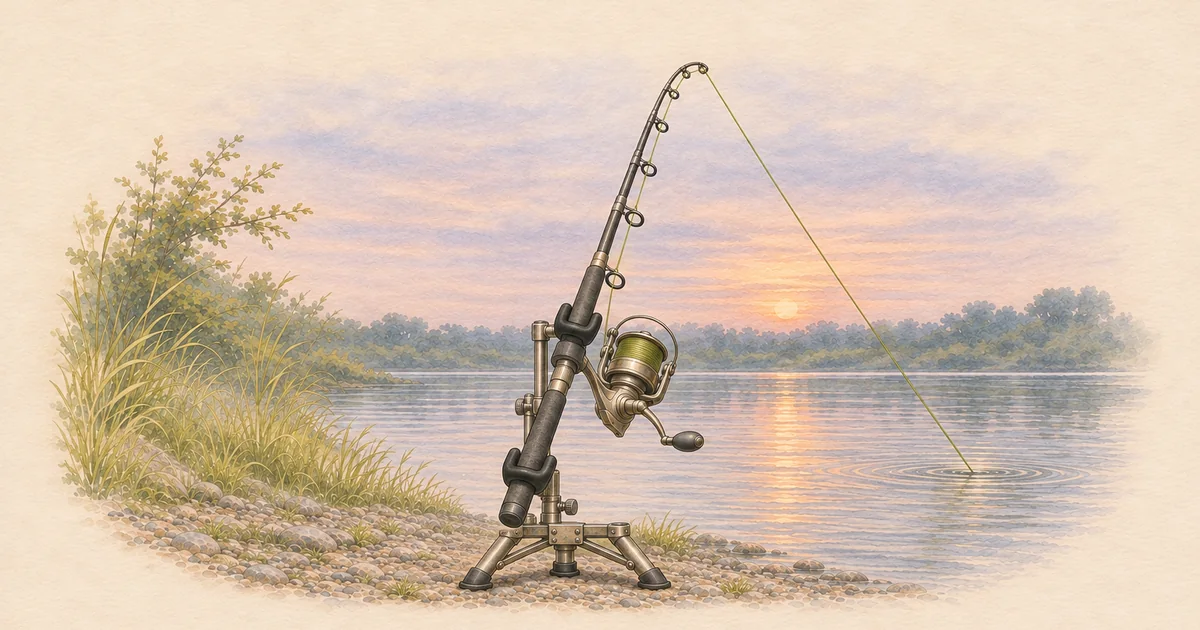
The tethered rod stands under tension for hours and springs back when a fish takes. A simple bankstick, according to Rute & Rolle, quickly twists away as soon as pressure comes on the rod, and the rod ends up in the mud. Fisch & Fang puts its rods in special rests sunk deep into the ground when using tethered rigs. For rods set up high, for example in surf or catfish fishing, Rute & Rolle recommends a tripod, also because rock revetments, gravel or hard clay won’t hold a bankstick; more on this under Rod pod and tripod and Rod rest.
No rod rest replaces the angler at the rod. Saxony’s fisheries regulation says in § 4 Abs. 4: “Rods and lines must be supervised at all times. Electronic bite alarms do not replace supervision.” In other states the rule is in state law or on the fishing permit (Erlaubnisschein).
Before the rig goes out, check the rod rest:
- Push the rest in deep enough that it does not twist under pull; on hard ground set up a tripod.
- Set the rod steeply upright and pull the line tight.
- When tethering (Abspannen), tighten the drag; when fishing static with a freespool reel, set the freespool and switch on the ratchet.
- Keep work gloves within reach and choose your swim so that you can keep all rods in view at all times.
Landing with the catfish grip
You land big wels catfish with the catfish grip on the lower jaw; according to Blinker, even fish of over 2 m can be held securely this way. According to the Bavarian exam catalogue, the thumb presses the lower jaw down from the inside. The other fingers form the counter-hold on the outside, under the jaw. The catfish’s teeth are small and blunt, but numerous and as rough as sandpaper. To avoid grazes, most catfish anglers reach into the mouth wearing simple work gloves, according to Blinker. The body of the fish, on the other hand, you support with wet, bare hands.
Your own hooks are more dangerous than the mouth. Before you grip, check where they are. With artificial lures and rigs with several trebles, often only one is in the mouth and the others hang free. What to do after a hook goes into your hand is covered under Hook injuries and first aid. How to support the fish horizontally afterwards and why gloves on its body can damage its slime layer is explained in Landing and unhooking fish and Fishing gloves.
Night fishing, boats and tethering: what the rules say
In clear water, wels catfish are active mainly at dusk and at night, so many catfish anglers fish through the night. Whether that is allowed at your water is governed by state law, regulations for individual waters and the fishing permit (Erlaubnisschein); dated official examples are given in Night fishing and weather shelter. For clonking and taking baits out by boat, fishing from a boat must be permitted, as the DAFV also points out. This is stated in the water rules (Gewässerordnung) and the fishing permit.
A tethered line can run straight across water used by boats. Specialist articles therefore advise not to obstruct water sports users when tethering. Two official examples concern navigation law. On Lake Constance, under Article 11.01 of the Bodensee-Schifffahrts-Ordnung, in front of harbour entrances and in the fairways of the Rhine sections, among other places, “fishing nets, fish traps and other fishing gear may only be placed in such a way that navigation cannot be obstructed”. At the Eder and Diemel reservoirs, under § 20 Abs. 1 of the Talsperrenverordnung, placing a mooring buoy permanently fixed to the bottom, a buoy chain “and other objects such as fishing gear” requires a permit. Whether a catfish buoy for one night falls under these provisions is not stated explicitly in the texts. Information is available from the responsible navigation authority, on federal waterways the Wasserstraßen- und Schifffahrtsamt, and from the fisheries authority (Fischereibehörde).
Not legal advice: the examples only quote the wording of the regulations, retrieved in November 2026. Water rules of clubs and associations can be stricter. What equipment the states require at the water is covered under Mandatory equipment at the water.
Common mistakes
- Using heavy carp tackle for big catfish. With a 3 lb test curve the fight drags on and the fish becomes exhausted.
- Fishing a stiff, brittle rod with braid. With no stretch in the line, the blank has to absorb the tail slaps.
- Taking the long bank rod into the boat for clonking. There is no casting there, and a rod of around 2 m is easier to handle beside the boat.
- Putting a steeply set rod with a tight drag on a simple bank stick. Under pull it twists away.
- Fitting a small fixed-spool reel to the catfish rod. It holds too little of the thick line a catfish calls for.
Frequently asked questions
Will a carp rod do?
The heaviest carp rods are also used for catfish from the bank. But a typical 3 lb carp rod has at most half the test curve of a catfish rod with 6 to 8 lb, and the fight takes correspondingly longer.
Fixed-spool reel or multiplier?
If you cast the rig, a large fixed-spool or freespool reel is the simpler choice. If you take it out by boat, Blinker recommends a heavy multiplier reel; for clonking, the DAFV recommends a small one. A small fixed-spool reel holds too little of the thick line.
What does 300 g casting weight mean on a catfish rod?
It gives the weight at the end of the line that the rod is built for. According to Blinker, a bank rod should be able to cast a baitfish weighing around a pound a good 20 m with an underhand swing. For artificial lures, the specialist magazines give at most 120 g or at least 150 g for the spinning rod.
Related
- Wels catfish fishing: rigs, baits, leader and hooks step by step
- Fishing rods: test curve, casting weight and all rod types
- Baitcaster and multiplier reel: drags and designs of the multiplier
- Braided line: breaking strain, diameter and knots
- Line calculator: breaking strain after the knot, and drag
- Rod pod and tripod: support for steeply set rods on hard banks
- Fish scales: rule of thumb for the weight of big catfish
- Night fishing and weather shelter: official night rules, with dates
Sources
- Bundesamt für Naturschutz: Europäischer Wels, Fisch des Jahres 2026 (Länge bis 3 m, Gewicht bis 150 kg)
- Deutscher Angelfischerverband: Fisch des Jahres 2026, der Europäische Wels (Broschüre, PDF) (Uferrute, Stein an Abrissschnur, Schlagschnur, Klopfrute, Echolot, Bootsnutzung)
- Bayerische Landesanstalt für Landwirtschaft: Prüfungsfragen zur Fischerprüfung 2023/2024 (PDF) (Fragen 4.090, 4.126, 4.161)
- Freistaat Sachsen: Sächsische Fischereiverordnung (§ 4 Abs. 4, Aufsicht über Handangeln)
- Freistaat Bayern: Bodensee-Schifffahrts-Ordnung, Artikel 11.01 (Fischereigeräte im Fahrwasser, Text gültig ab 1. April 2022) und Bund: Talsperrenverordnung Eder und Diemel, § 20 (Genehmigung für Bojen und Fischereigeräte)
- Blinker: Welsangeln, Tipps und Tricks für den Fangerfolg (Testkurve, Länge, Rolle, Schnur, Spinngerät) und Blinker: Steckbrief Wels (Rückgrat, Länge, Multirolle) sowie Blinker: Welsmontage mit der Unterwasser-Pose (Strömung, Stein, Auslegen)
- Blinker: Spinnfischen auf Wels, Drills für Draufgänger (Spinnrute, Rolle, Schnur, Drillinge, Kampfgurt), Blinker: Was muss ich beim Wallergriff beachten? (Griff bei großen Welsen, Zähne, Handschuhe, Haken) und Blinker: Die richtige Angelrute (Testkurve, einteilige Welsruten)
- Fisch & Fang: Zielfisch Wels, Todsicher Wels (Uferrute, Klopfrute, Freilaufrolle mit Ratsche), Fisch & Fang: Zielfisch Wels, Hier geblieben (Abspannen, Halter) und Fisch & Fang: Spinnfischen auf Wels (Spinnrute, Bremse)
- Rute & Rolle: Rutenhalter, welche gibt es und wofür? (Erdspieß, Dreibein)
Text AI-assisted, drawing AI-generated. Sources opened and checked in November 2026; no graphics taken from the sources.
All information is a guide without guarantee. Which rod suits you depends on the method, the water and the size of the catfish there; what is allowed at the water is governed by state law, water rules and the fishing permit.