
Knowledge · Tackle
Rod pod and tripod: Rod support for hard ground
A rod pod is a frame on which two or more rods lie side by side and which stands on its own legs. You need it where no ground spike goes into the ground: on rock armouring, a jetty or concrete. On a sea beach the tripod takes over this job, and there the rods stand steeply.
Where ground spikes do not hold
When sitting and waiting, the rod usually lies on banksticks. These are ground spikes with a thread onto which rests or bite indicators are screwed, usually two per rod. Jetties, sheet piling, rock armouring, hard clay and gravel often do not allow such spikes. Then the rod pod or tripod remain. In carp fishing the rod pod is regarded as the better choice on stone, concrete and jetties (Blinker).
An example from the North Sea Canal in the Netherlands (Rute & Rolle): on a concrete jetty two picker rods lie horizontally on a rod pod, and the angler fishes with worm for flounder. In carp fishing the rods usually lie on a rest the whole time until a bite comes.
On soft ground much speaks for banksticks. They are more compact and lighter than a pod, and each rod can be set individually.
Construction: crossbars, centre bar, legs
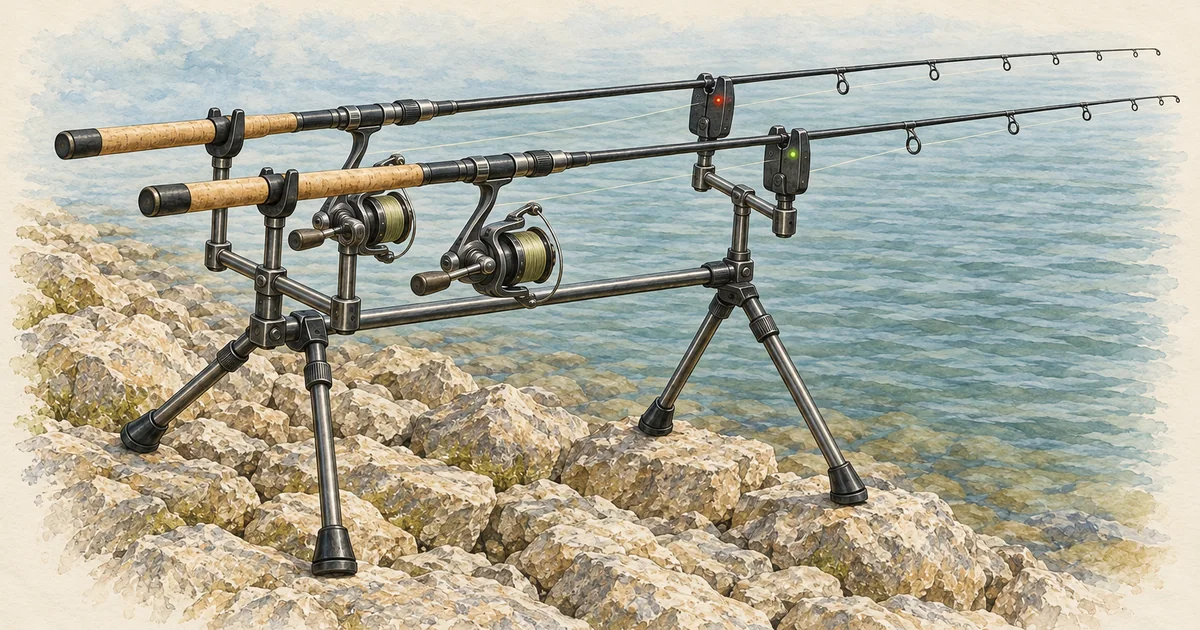
The Blinker glossary translates rod pod as „collapsible, mobile rod stand“. The rods lie on it side by side on a frame of metal or plastic. Fig. 1 shows the parts:
- Front crossbar. In English it is called a buzzer bar, in the glossary „wide rod rest, for two or more rods“. At the front, electronic bite indicators can be screwed on. Teaching material for the angling exam describes the electronic bite alarm as doubling as the front rest.
- Rear crossbar. It carries simple rests for the end of the handle, usually V-shaped. There are also U-shaped rests and holders that clamp the handle. The latter help when hard bites are expected.
- Centre bar. It connects the two crossbars and determines how far apart the rests stand. On classic rod pods the spacings are usually right: the rod does not sag and sticks out far at the front. How to set individual rests correctly is explained under Rod rest.
- Legs. On level jetties a simple pod is enough (Rute & Rolle). If it has to compensate for unevenness or the rods are to lie very securely, the trade press recommends a sturdy model with many adjustment options. A carp angler even screwed long banksticks onto the feet of his pod at a reed-fringed lake because the spot demanded very long legs.
Between reel and front rest, a swinger, a hanging bite indicator, can also hang. How it works is explained under Swingers and hangers.
Stable on stone, jetty and in the wind
A rod stand has to stand firm even in strong wind and gusts, says an article about carp in frost. A sturdy rod pod or banksticks pushed deep into the ground are recommended.
- Crosswind: In strong crosswinds you set the rod so that the tip dips slightly into the water. Then the line lies below the surface and the wind does not catch it. For this the legs must be adjustable.
- Railing: On the Nord-Ostsee-Kanal there is a second solution besides the surf tripod: the rods are tied to the railing with a rail strap, as is usual in boat angling.
- Frost: For burbot in the current, one angler uses a tall pod, the high pod. It stands securely even when no ground spike goes into the frozen ground any more.
The tripod: rods steep for surf and current
From autumn to spring many sea anglers stand with their tripods on the Baltic beaches. The tripod has largely replaced the angle irons that used to be common. It can be set up on any ground, whereas an angle iron has problems on very hard ground and on piers. Only in very strong headwinds and heavy surf is the angle iron still in demand, because the rods stand very high and upright in it.
The difference from the rod pod lies in the rod position. On the pod the rod lies flat and points at the bait. In the tripod it stands steeply, the tip high above the water. On rivers too, bottom anglers set the rod high so that little line lies in the flowing water. Rods on the beach are leant flatter at head height against the tripod only when little weed drifts in the water (Fisch & Fang). So that wind or a big fish does not knock the tripod over, it is weighted with a hung sack full of sand. How sitting and waiting on the beach works is explained under Surf fishing, the matching rod under Sea rod.
The tripod is not limited to the sea. When fishing for eel in a river, an eel angler sets the rods as steeply as possible on a surf tripod so that little current pressure bears on the line. For rods set high it is also recommended when fishing for wels catfish. Some rod pods can be set up high and low (Rute & Rolle) and so cover both cases.
Banksticks, rod pod and tripod compared
| Rest | Ground | Rod | Examples |
|---|---|---|---|
| Banksticks | soft ground | flat or at an angle, each one separately | Carp, bottom fishing on a lake |
| Rod pod | Stone, concrete, jetty | flat, side by side | Carp, flounder from a jetty |
| Tripod | any ground, including sand | steep | Surf, eel in a river, wels catfish |
A rule of thumb from the trade articles named below, not a fixed limit.
Securing the rod against being pulled off
In carp fishing with a self-hooking rig the fish is usually already hooked securely as soon as the alarm beeps and line runs off. If the line then cannot run, the whole pull ends up on the rest. Four points keep the rod on the pod:
- Release the line. With line bite indicators the bale arm must be open, say the Löninger Lehrunterlagen. More convenient is a free-spool reel whose second drag releases line. The starting value for the main drag is given by Setting the reel drag and the Line calculator.
- Point the rod at the bait. If the rod points at the bait, it is not torn sideways off the rest on a bite. On the pod, however, the rods lie parallel, and buzzer bars force both rods onto the same spot. If the baits lie far apart, banksticks are better.
- Hold the handle. Holders that clamp the handle help with hard bites. Snag ears on the bite indicator stop the rod being pulled off the indicator.
- Use the spring. If the rod sticks out far at the front, it also cushions a bite that could otherwise pull it into the water.
Supervision: Even a well-secured rod remains your responsibility. In the question catalogue for the angling exam (Fischerprüfung) in Saxony-Anhalt, the correct answer to the question whether set-out tackle may be left unattended is: no. What applies in your federal state (Bundesland) is governed by state law and the fishing permit (Erlaubnisschein).
Accessories: buzz bar, snag ears and feeder arm
Buzz bar: a crossbar for several rods
Buzzbar, buzz bar and buzzer bar all mean the same part: the crossbar on which several rods lie side by side. Rute & Rolle describes it as a double or triple rest that screws onto the standard thread just like an electronic bite alarm. On a rod pod, the front crossbar is such a buzz bar, and the alarms sit on it. The same bar can also be screwed onto banksticks if the ground takes spikes.
How many positions the bar has says nothing about how many rods you are allowed to fish. That is set by the water regulations and your fishing permit (Erlaubnisschein). All rods on a buzz bar point in the same direction; if the baits are to lie far apart, setting up each rod individually on spikes is better. For swims near snags, an article in Angling Times advises against buzz bars altogether; more on this in the next section.
Snag ears and the rod pod near snags
Snag ears are pins that stand vertically upwards on the bite alarm, with the rod lying between them. According to Blinker, they stop a bite from pulling the rod off the rest when the free spool is set tight. The handle can also be secured with clips. They are used where the fish should get as little line as possible after the bite, for example in front of a bed of water lilies. For such swims, Blinker advises a firmly set free spool and sitting close to the rod.
For the rod pod, this is a limit. An article in Angling Times about carp near snags names the secure position of the rod, together with the drag setting, as the most important thing: when a fish bites, the rod must not move forwards. The author recommends individual ground spikes there and explicitly advises against buzz bars and rod pods, because neither holds firmly enough. For him, a pod is only an option if it stands very low and can be anchored to the ground. Instead of snag ears, he prefers to add another bankstick at half the rod’s length. His setup, point by point:
- Secure the rod: at the back a rest that grips the handle firmly, at the front snag ears or an extra spike at half the rod’s length.
- Point the rod almost at the bait, but a few degrees off. If it points straight at the rig, it hardly gives at all; if it is set at a sharp angle, it bends a long way and gives the carp room to run.
- Set the drag so tight that it gives no line even under heavy pull. The author considers a free spool unnecessary here; Blinker, as described above, recommends a firmly set free spool.
- No thin line: the article gives 0,40 mm diameter as the minimum and recommends a barbless hook.
- The lead must be able to come off on the take; more under Leadcore and safety clip.
- Stay with the rod, a few steps away at most and ready to step in. If you cannot manage that, the author advises leaving snags alone.
The English anglers‘ body Angling Trust also advises never leaving rods unattended, because a hooked fish can otherwise get snagged. What applies in Germany is set by state law and your fishing permit (Erlaubnisschein); see the note on supervision further up.
Feeder rest and feeder arm on hard banks
In feeder fishing the rod tip shows the bite, and at the front the rod lies on its own feeder rest. For still water, Fisch & Fang recommends a flat, wide shape: you slide the rod sideways along it and so adjust the tension on the tip in small steps. On a river, a deeper rest holds the rod more securely. Elongated feeder rests also let you strike straight to the side (Rute & Rolle). Shapes and angles are covered under Rod rest and Feeder rod. Where no ground spike holds, there are three supports:
- Tripod. On hard, stony banks, Fisch & Fang names the tripod as the way out. For heavy feeder fishing in current, it can also be weighted down with a filled jute bag.
- Rod pod. Picker rods also lie flat on the pod, as in the example from the concrete jetty on the North Sea Canal.
- Feeder arm. An adjustable arm attached to one leg of the seat box or fishing chair. According to Angling Times, it holds the rod steady and comfortably without a spike having to go into the ground, which is a big advantage on hard or uneven banks. A feeder fishing world champion sets it high on rivers so that the rod sits as high as possible (Blinker).
At the back, you need a butt clamp. Carp bite so hard on the feeder that they can pull the rod into the water (Angling Times). The clamp should grip the handle firmly rather than just loosely support it. Fig. 2 shows both accessories.
Common mistakes
- Buying a pod where banksticks are enough. On soft ground ground spikes are lighter and more flexible. The pod pays off for stone, concrete and jetties.
- Not weighting the tripod. Without a sandbag, wind or a big fish can knock the stand over.
- Laying the rods across the bait. A hard bite can then pull the rod sideways off the rest.
- Bail arm closed, free spool off, drag tight. This way no line can run off on the take, and the pull goes onto the rod and the stand. Some carp anglers deliberately fish like this near snags, but then with the rod secured and sitting right next to it, as described under accessories.
- Putting the rod on the ground when unhooking. One careless step is enough to damage rod or reel. It is better always to put it in a rod holder.
Frequently asked questions
Do I need a rod pod as a beginner?
Only if you often fish from hard banks or jetties. In carp fishing banksticks are the best solution in many situations: cheap, quick to set up and easy to carry. For stone, concrete and jetties the pod is the better choice.
Is a rod pod suitable for surf fishing?
A pod built flat, rather not. For rods set high in the surf the tripod is the choice, but there are also pods that can be set up high and low.
How many rods fit on a rod pod?
A buzzer bar takes two or more rods. How many rods you may set out at the same time is governed by the federal state (Bundesland) and the water rules. Examples from Saxony and Brandenburg are under Carp fishing.
Is a rod pod suitable for fishing near snags?
Only to a limited extent. An article in Angling Times recommends individual ground spikes there, because pod and buzz bar do not hold the rod firmly enough. If at all, then a very low pod that can be anchored to the ground. Either way, stay right by the rod.
Related
- Banksticks: ground spikes with a thread for soft ground
- Rod rest: rests for tip and handle
- Bite indicators: electronic and simple indicators for sitting and waiting
- Swingers and hangers: hanging bite indicators between reel and rest
- Free-spool reel: releasing line without opening the bale arm
- Surf fishing: reading the beach, casting and sitting and waiting with the tripod
- Sea rod: length and casting weight of the surf rod
- Carp fishing: fixed lead, feeding spot and fight
Sources
- Rute & Rolle: Rutenhalter, welche gibt es und wofür? (harte Ufer, Verstellmöglichkeiten, Griffhalter, Buzzbar als Zwei- oder Dreifach-Auflage, Seitenwind, Dreibein für Brandung und Wels)
- Blinker: Karpfen-Kickstart (Banksticks oder Rod Pod, Ausrichtung zum Köder, Selbsthakmontage)
- Blinker: Englisch beim Angeln (Rod Pod, Buzzer Bar, Swinger, Snag Ears)
- Fischereiverein Löningen: Gerätekunde (PDF) (Bissanzeiger als vordere Auflage, offener Bügel)
- Blinker/AngelWoche: Rutenauflage richtig ablegen (Abstände beim Pod, Federung)
- Blinker: Brandungsangeln (Dreibein statt Winkeleisen, Sandsack)
- Blinker: Karpfen bei Frost (standfest bei Wind)
- Blinker: Plattfischangeln im Nord-Ostsee-Kanal (Relingband)
- Blinker: Quappenangeln mit Leber (High-Pod)
- Blinker: Aale unter Strom (Dreibein am Fluss)
- Blinker: Karpfen-Spots im Verborgenen (Buzzer Bars auf einen Spot)
- Blinker: Mobil angeln (Banksticks leichter)
- Blinker: Gewässer-Tipp Jabler See (lange Beine)
- Blinker: Die 7 häufigsten Fehler, die Ihre Angelrute zerstören (Rute nicht auf den Boden)
- Rute & Rolle: Feedern auf Flundern (Rod Pod auf dem Betonsteg)
- Fisch & Fang: Zitterübung in der Brandung (Ruten flacher bei wenig Kraut)
- Land Sachsen-Anhalt: Fragenkatalog zur Fischerprüfung (PDF) (Aufsicht)
- Blinker: Rosenkrieg, Karpfen an der Krautkante (Snag Ears, Klammern am Griff, kräftiger Freilauf, nah an der Rute)
- Angling Times: How to fish for carp in snags (Einzelspieße statt Pod und Buzzbar, Ausrichtung, feste Bremse, Schnurstärke, Blei löst sich, bei der Rute bleiben)
- Angling Trust: Best Practice Guide to Freshwater Angling (PDF) (Ruten nicht unbeaufsichtigt)
- Fisch & Fang: Das brauchen Sie zum Feedern (Feederauflage am See und am Fluss, Dreibein an harten Ufern)
- Fisch & Fang: 10 Tipps zum Heavy-Feedern im Strom (Dreibein mit Jutebeutel)
- Rute & Rolle: Einfach mal Feedern (längliche Feederauflage)
- Angling Times: The 5 things I wouldn’t go feeder fishing without (Feederarm an Sitzkiste oder Stuhl, fester Griffhalter)
- Angling Times: How to set up properly for feeder fishing (Karpfenbisse ziehen die Rute)
- Blinker: Feederangeln im Fluss, Tipps vom Weltmeister (Feederarm hoch angesetzt)
- Wikipedia: Rod Pod (Auflagen vorn und hinten, nur ergänzend)
Text AI-assisted, drawing AI-generated. Sources opened and checked in October and November 2026, no graphics taken from the sources.
All figures are guide values without guarantee. Which rest suits depends on bank, wind, current and method, and whether you may fish from a jetty or pier is governed by the water rules.