
Knowledge · Tackle
Feeder rod: Classes, interchangeable tips and set-up
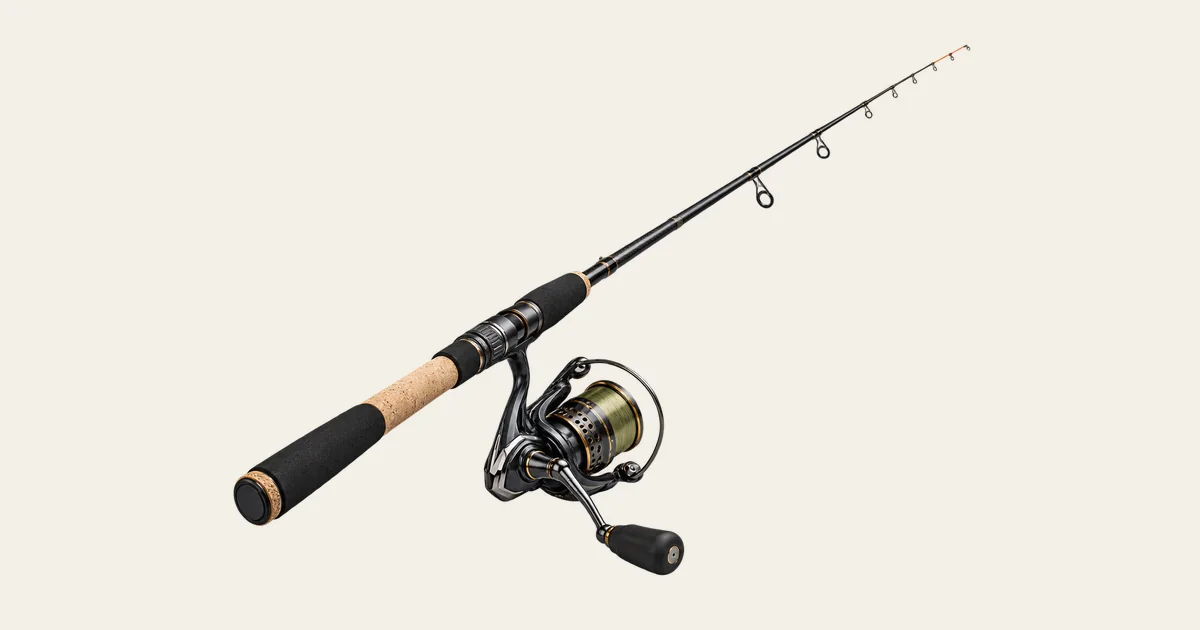
A feeder rod casts a filled feeder and shows the bite on a thin, interchangeable tip. Which class suits is decided by the water: on a pond a light rod is enough, in a big current you need length and casting weight.
What the feeder rod is built for
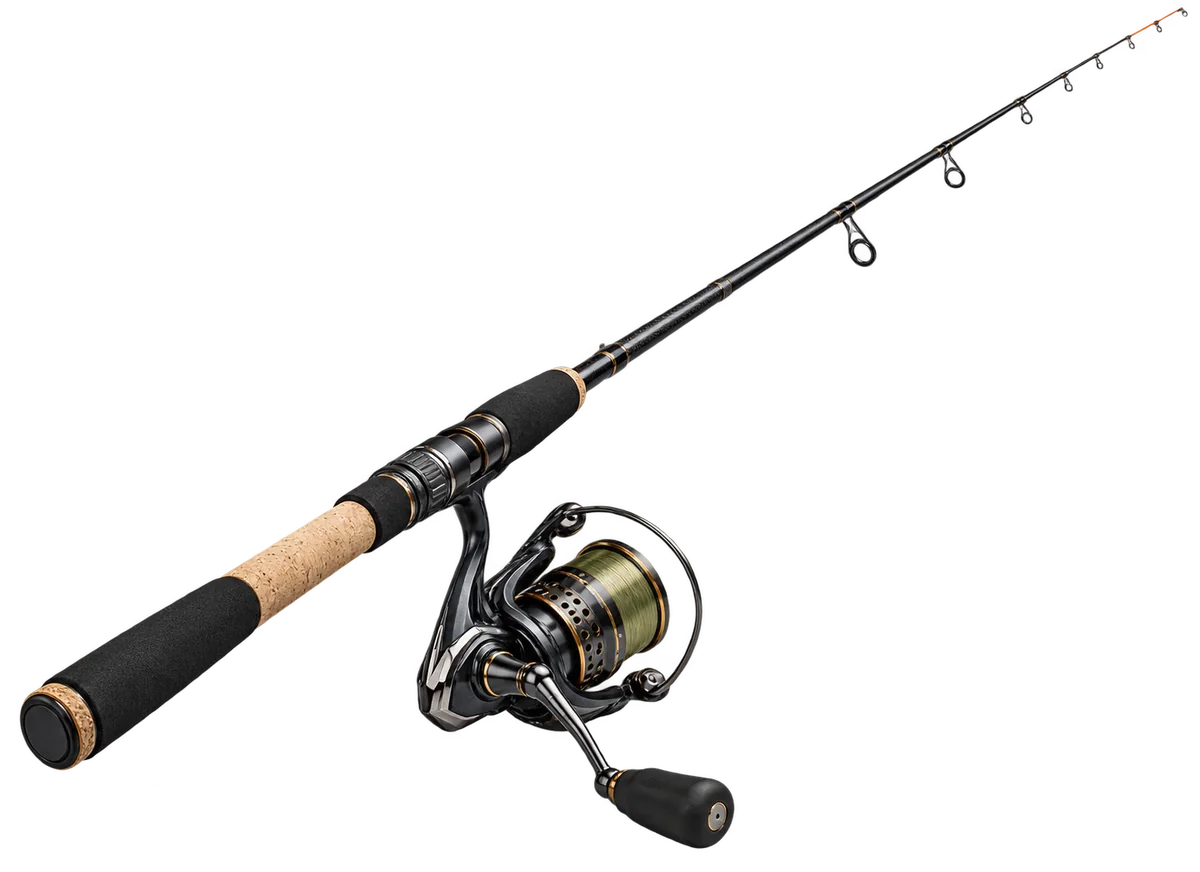
In feeder fishing a feeder hangs on the line instead of a lead. It is casting weight and bait container in one, and the hook bait lies only a hooklength away. The rod therefore needs a strong backbone for the cast and a very fine tip for bite indication. Feeder rods are mostly three-piece push-fit rods. The Bavarian exam questions for the angling exam (Fischerprüfung) also name the interchangeable end tips of different sensitivity as its distinguishing feature. Teaching material for the angling exam gives 3 m to 4,5 m as the normal length. Typical catches are bream and roach, and with stronger tackle carp too.
Classes from light to heavy
The classification comes from England and is not standardised. The sources therefore differ slightly; the table gives the ranges.
| Class | Length | Casting weight | Water |
|---|---|---|---|
| Light | 3,30–3,45 m | up to 50 g | still water with light feeders |
| Medium | 3,60–3,90 m | up to 80–90 g | lake and small river, all-round |
| Heavy | 3,90–4,20 m | up to 150 g, in a current 180–220 g | big river with current |
For getting started, the medium class at around 3,60 m is regarded as the most versatile. From about 120 g casting weight upwards, the tackle is for big rivers such as the Elbe, Weser and Ems. There the length also helps to lift feeder and fish over a stone bank.
Length by casting distance and water
The further out the baiting spot lies, the longer the rod can be. In England the length in feet (ft) is chosen roughly by casting distance:
- 9 ft, about 2,75 m: casts up to about 25 m, the margins and fishing ponds with islands close by.
- 10 ft, about 3,05 m: up to about 40 m, most fishing ponds and smaller reservoirs.
- 11 ft, about 3,35 m: larger still waters and smaller rivers.
- 12 ft and more, from about 3,65 m: long casts on big lakes and rivers, heavy feeders on wide rivers.
In winter, when the fish feed cautiously, a light rod of 3,30 or 3,60 m with up to 60 g casting weight is usually enough. The unit converter converts feet and metres.
Casting weight and feeder weight
The casting weight on the blank, the load-bearing tube of the rod, is the upper limit for everything hanging at the end of the line, in feeder fishing that is the filled feeder. Take the lightest feeder that still stays put and that the tip can be tightened against. Guide values by water are given under feeder.
If the line is clipped into the spool clip, the feeder stops abruptly in flight; hold the rod vertically upwards as you do so, and it absorbs the jolt. On long casts the tip must not keep bouncing, otherwise the line wraps round it and the rig breaks off. For casts of around 60 m, 2 to 3 oz are therefore regarded as suitable.
Worked example: What counts is the filled feeder, not the empty one. A 50 g feeder takes a light feeder rod of up to 50 g casting weight to its limit even when empty, and beyond it with groundbait in. The medium class then has reserve. In a strong current, around 200 g soon adds up with groundbait.
Interchangeable tips and their strength in ounces
Usually two to three interchangeable tips come with the rod. Their strength is printed on the shaft as a test curve in ounces (oz); 1 oz is about 28 g. The number gives the weight that deflects the tip to a right angle, not the casting weight of the rod. Light tips are 0,5 oz (about 14 g), heavy ones 3 oz (84 g) to 5 oz (140 g). If the same weight hangs from all the tips, the one with the smaller number bends further: 28 g deflects a 1 oz tip to a right angle, a 2 oz tip needs about 56 g for that.
The carbon-fibre tips that are more common today are stiffer and stand still quickly after the cast, but show bites more restlessly. Glass fibre shows more calmly and breaks less often when the line has wrapped round the tip in casting. Its field is rather shorter casts up to about 35 m.
- No marking: Hold the tips side by side at the thin end; the softest one sags lowest.
- Shaft: The diameter of the spare tip must fit the rod; shaft sizes of 2,2, 3 or 3,6 mm are usual.
Which tip when
The choice is made mainly by current, wind and casting distance. A medium rod is well equipped with 1 oz in glass for still water and 2 oz in carbon fibre for the river. As guide values, 0,5 oz is given for winter and small fish, 0,75–1 oz for roach close to the bank, 1,5–2 oz for bream at medium range and 3 oz upwards for long casts and the river.
Picker rod and rod for the method feeder
Picker rod for small waters
The picker rod, called a winklepicker in English and often spelt Winkelpicker in German, is the short, light relative: no more than 3 m long, with a considerably lower casting weight and designed for small leads at close range on ponds and canals. It usually lies almost parallel to the bank and horizontally on two rests. It is built for casts of up to about 20 or 30 m; further out, the strike with the soft rod barely gets through.
The name has nothing to do with an angle (Winkel in German). Fisch & Fang and Rute & Rolle trace it back to a thin pin used in England to pick periwinkles (winkles) out of their shells. The rod’s tips are as fine as this pin.
According to Rute & Rolle, today’s pickers usually measure 2,40 to 3,00 m and take no more than 20 to 40 g. Their blank is thinner and softer than on a feeder rod, and the interchangeable tips are finer too. The first pickers were even more delicate. According to Fisch & Fang they appeared around 1980 among Dutch match anglers on polders, town canals and ditches. They were often barely over 2 m long, had only a single glued-in tip and a casting weight well under 20 g. Usually only one or two grams of lead hung on the line. Rods with interchangeable tips only came later.
The short rod comes into its own on ditches, canals and small ponds, where the water is still or only flows sluggishly and the swim is close. It is light, less tip-heavy than many feeder rods and can still be handled on overgrown banks and under low-hanging branches. When playing a fish it bends deep into the blank and absorbs runs. That is why thin lines and small hooks for roach and bleak suit it; on waters without snags, Rute & Rolle also names tench and big bream. Feeders 5 to 8 cm long weighing 10 to 20 g empty are enough there. Alternatively, a swivel lead lies on the bottom and the feed goes out by hand or with a catapult. As with feeder fishing, set the tip at roughly a right angle to the line; a flat, wide rest at the front helps.
- Picker rod if the swim is no more than 20 to 30 m away, the water is still or barely flowing, a light feeder is enough and the bank is cramped or overgrown.
- Feeder rod if you need to cast further, the current pushes the feeder away, or the filled feeder becomes heavier than the picker’s casting weight allows.
Rod for the method feeder
The method feeder is a flat feeder with a short hooklength, against which the fish hooks itself. The rod for it need not be long on smaller waters: 3,00–3,30 m and 60–110 g casting weight are quoted, because the filled feeder weighs a lot.
Setting up the rod and reading bites on the tip
The tip only shows cleanly if line and tip form roughly a right angle. After the cast, wait until the feeder is down, put the rod on the rests and tighten the line until the tip bends slightly. That way you also see drop-backs, where the fish swims towards you and the tip relaxes.
- On the river: Set the rod up steeply. That leaves little line in the current.
- On a lake or pond: Lay the rod flat and to the side of the baiting spot, the tip close to the water. In a strong crosswind it may dip slightly under; then the wind does not catch the line.
- Rest: on a lake wide and flat so that you can shift the rod sideways; on a river lower so that the rod does not slip out. More under rod rest.
How hard you tighten depends on the fish. Usually a very slight bend is enough: then a bite builds up visibly and you tell it from a fish merely bumping the line. For small silver fish and in winter, the tip stays almost without a bend, otherwise the fish drop off the hook again and it stays with short twitches. Which movements call for a strike is shown on the page Feeder fishing.
Distance: line clip and the same cast
If you want to keep the feeding spot in one place, you have to land every cast the same distance. To do this, after the first cast you hang the line in the clip on the spool and from then on always cast to that clip. Before the cast, the feeder should also always hang down the same length from the tip, so that you get a feel for the effort needed. With very small amounts of feed, accuracy decides whether the fish find the spot.
Further out, leverage counts: long-distance rods should be as long as possible, and a long handle serves as extra leverage. Feed that oozes out of the side of the feeder you wipe off, otherwise the feeder flies worse. You protect the finger that releases the line with an elastic band, finger stall or glove, because the thin shock leader quickly cuts in in cold and wet. For long casts you fill the spool to about two millimetres below the rim, as Spooling a reel correctly explains: a spool that is not quite full costs distance, one that is too full raises the risk of bird’s nests.
Reel and line
A medium fixed-spool reel is suitable, size 3000 to 4000 depending on the source, with a finely adjustable drag and a line clip on the spool. The clip stops every cast at the same distance so that the groundbait lands on one spot. Monofilament of 0,20–0,25 mm is usual as mainline: the thinner in still water, the thicker in the current. Its stretch protects the thin hooklength in the fight.
From a distance of about 30 m, braided line has advantages because it hardly stretches. In front of it goes a shock leader, a length of thicker monofilament around 0,30 mm, which absorbs the cast with a heavy feeder. Its knot only runs well through a tip with larger rings. You check breaking strength and knot in the line calculator. More under fishing lines compared and setting the reel drag.
Quiver tip and swing tip
The interchangeable tip of the feeder rod is called a Zitterspitze, Bibberspitze or Quiverspitze in German, after the English quivertip. According to Fisch & Fang it was developed in England towards the end of the 1950s for fine legering. The tackle guide of the Fischereiverein Löningen, study material for the angling exam (Fischerprüfung), lists a second type of additional tip alongside quiver tips: the screw-in swing tip. With it, English anglers were already making big catches of bream and roach at the end of the 1960s, Blinker reports.
Both show the bite at the front of the rod, but in different ways. The quiver tip is the flexible end of the blank itself. It is slightly bent under the tension of the line and twitches as soon as a fish pulls at the bait. The swing tip, by contrast, is a separate stick that hangs from the rod tip on a flexible joint. Its weight keeps the line under tension. If a fish swims off with the bait, the line tightens and the stick rises. If the tip hangs correctly, you also see drop-back bites, where it sags.
How the swing tip is built
- Joint: A piece of rubber tubing with a knurled screw connects the stick to the rod. It is screwed into a tip ring with an internal thread. These rubber links come in softer and stiffer versions; the stiffer ones keep the tip steadier with surface drift and a light current.
- Length: Blinker gives about 30 cm as the standard and about 25 cm as the short version. The long tip belongs on deep water and long casts, the short one on shallow water and close range.
- Material and weight: Wood, plastic or metal wire. Some wooden tips have a brass weight built into the end, others a sliding brass tube held in place by two rubber rings.
- Rings: There should be two, one just behind the thread and one at the end. If the tip only has the end ring, the line runs in a triangle there and tangles on the cast.
Quiver tip or swing tip
Blinker sums up the choice in one basic rule: a quiver tip on running water, a swing tip or quiver tip on still water, and an electronic bite indicator for the night and long sessions. Blinker rates the swing tip as one of the most sensitive indicators for bottom fishing in still water, and in light current only with reservations. A more recent Blinker article singles it out for heavily fished lakes and ponds; on some waters, it says, it is almost the only way to see bites at all.
| Feature | Quiver tip | Swing tip |
|---|---|---|
| Design | flexible end of the rod | arm on a rubber joint |
| Bite | tip jerks and bends | arm rises or drops back |
| Water | river and still water | still water, slight current |
| Cast | as with any rod | tip can flip over |
| Wind | choose the tip by wind strength, submerge it | wire or weighted tip, submerge it |
The rod for it can be shorter than a feeder rod. Blinker recommends 2,70 to 3,05 m, because a longer rod becomes sluggish and delays the strike. The action should not be too stiff and should run right through the rod, with a test curve of around 1 lb, i.e. roughly 454 g. A large first ring above the reel, the butt ring, lets the line run off better on the cast. For the main line Blinker gives 0,15 to 0,18 mm. It has to sink: a floating line forms a bow on the water in wind and pulls on the tip. It must not be too stiff either, otherwise fine tips are hard to set.
Casting and setting a swing tip
- Lay the rod parallel to the bank in front of your seat, on two rests, or three in strong wind. Cast at right angles to the bank. That way you can keep an eye on the handle and the tip at the same time.
- Cast smoothly and in one flowing movement. If you bring the rod softly over your head, release the line late and hold the rod forward until the rig hits the water, the tip stays steady. A jerky cast makes it spring back and flip over. Its rings then catch the line, the cast stops abruptly and the rig can snap off.
- Straight after the rig lands, push the rod tip and swing tip under water and wait with the bail arm open. When the swing tip drops, the rig is on the bottom.
- Reel in line until it runs in a straight line from the tip to the rig and lies below the surface. A bow of line on the surface puts too much tension on the tip.
- Close the bail arm and tighten until the tip hangs at a slight angle, about 2 cm above the water. In wind and drift you submerge it 2 to 3 cm and lift it out a little when you get a bite.
If the tip keeps flipping over on the cast: A softer rod helps. Blinker also mentions swing tips with the line running inside: if the line is threaded through a plastic tube, the tip does not flip over.
Common mistakes
- Tip too hard: Delicate bites stay invisible, and the fish feels more resistance.
- Tip too soft: The strength depends on current and wind. If it does not match, the tip keeps swaying with them or bends right round just from tightening in the pull of the current, and bites are lost in that.
- Feeder above the casting weight: The groundbait counts too. The rod cannot take more than the printed casting weight.
- Spare tip with the wrong shaft: It twists or flies out in the cast.
- Lifting the fish out by the tip: From a fish weight of about 400 g, the landing net is part of it, otherwise the fine tip may break.
- Line pulled round the ring when winding in: if the line lays itself round an upper ring while baiting up, the tip bends almost into a full circle when you wind and cracks. After filling the feeder, wind the reel carefully and keep an eye on the tip.
Frequently asked questions
Which feeder rod suits a beginner?
The medium class, about 3,60 m long with 80 to 90 g casting weight. It is enough for lake and small river; for big rivers a heavy rod is added later.
Is the oz figure on the tip the casting weight?
No. It gives the test curve, that is the weight that bends the tip to a right angle. How heavy the full feeder may be is told by the casting weight on the blank, even though some articles call the oz figure that.
Which tip do I take on a lake and which on a river?
In still water often a glass tip of around 1 oz, on a river a carbon-fibre tip of around 2 oz. In a strong current or on long casts, 3 oz and more are needed.
How long should a feeder rod be?
That depends on the casting distance. For casts up to about 25 m around 2,75 m is enough, up to 40 m around 3 m. On big lakes and rivers 3,65 m and more are usual; the heavy class goes up to 4,20 m.
What is the difference between a quiver tip and a swing tip?
The quiver tip is the flexible end of the rod and jerks on a bite. The swing tip hangs as a separate arm on a rubber joint; its weight keeps the line taut, and on a bite it rises. Its main field is still water.
Related
- Feeder fishing: baiting spot, sequence at the water and bite patterns
- Feeder rig: tying running and loop rigs
- Feeder: designs, weight and filling
- Rod rest: feeder rest and spacing of the rests
- Bottom rod: the sit-and-wait approach with a lead instead of a feeder
- Match rod: when at distance you would rather have the float show the bite
- Spooling a reel correctly: putting on line and shock leader
- Fishing rods: construction, markings and all rod types
Sources
- Fisch & Fang: Das brauchen Sie zum Feedern (Klassen, Spitzen je Klasse, Rolle, Auflagen, Schnur)
- Blinker: Feederspitzen, für jede Situation gewappnet (Steifheit, Werkstoffe, Schaft, Ringe, Nachwippen) und Blinker: Angeln mit Futterkorb, ein Grundkurs (Testkurve, Korbgewichte, Glas und Kohlefaser)
- Blinker: Feederangeln, Friedfische füttern und fangen (Wurfgewichte bis zum Strom, Kescher ab 400 g) und Blinker: Method Feeder (Korb, Rutenlänge, Wurfgewicht)
- Rute & Rolle: Feedern für Einsteiger (Rolle, Schnur) und Rute & Rolle: 10 heiße Tipps zum Feedern für kalte Tage (leichte Rute im Winter)
- Angling Times: How to choose the best feeder rod (Länge nach Wurfweite), Angling Times: How to choose the right quivertip (Spitzenstärke, große Ringe, Strömung) und Angling Times: How to get the right bend in your quivertip (Spannung, weite Würfe)
- Fisch & Fang: Woher stammt der Name „Winklepicker“? (Pickerrute, Herkunft von Picker und Zitterspitze) und Rute & Rolle: Der Winklepicker, ein sensibler Klassiker (Länge, Wurfgewicht und Einsatz des Pickers) sowie Fisch & Fang: 10 Tipps zum Heavy-Feedern im Strom (Gewicht mit Futter, Wurf mit Clip)
- Rute & Rolle: Rutenhalter, welche gibt es und wofür? (steil oder flach seitlich, Spitze bei Seitenwind ins Wasser) und Rute & Rolle: Erfolg mit der Feederrute (bei Strömung Richtung Himmel)
- Fischereiverein Löningen: Zusammenfassung Gerätekunde (Länge, rechter Winkel), Fischereiverein Löningen: Gerätekunde (Wurfgewicht nicht überschreiten, Zusatzspitzen) und Bayerische Landesanstalt für Landwirtschaft: Prüfungsfragen zur Fischerprüfung 2023/2024 (PDF) (Merkmal der Feederrute)
- Blinker: Futterkorb auf Distanz: Weit werfen und viel fangen! (Schnurclip, gleiche Korblänge, Fingerschutz, Spulenfüllung) und Blinker: Gerade empfindliche Ruten können leicht mal brechen (Bruch der Zitterspitze beim Einkurbeln)
- Blinker: Auf die Spitze getrieben, Angeln mit der Schwingspitze (Aufbau, Längen, Rute, Schnur, Wurf und Aufstellung), Blinker: Spitzen-Spiele, Angeln mit Schwingspitze im Stillwasser (Funktion, Herkunft, Überschlagen, Wind) und Blinker: Bodenblei und Futterkorb, eine Übersicht (Grundregel zur Wahl des Bissanzeigers)
Text AI-assisted, drawings AI-generated. Sources opened and checked in November 2026, no graphics taken from the sources.
All figures are guide values without guarantee. Classes and markings are not standardised and differ with manufacturer, water and current.