
Knowledge · Tackle
Feeder: Designs, weight and filling
A feeder is casting weight and bait container in one: it carries groundbait or maggots to the bottom and releases them there right next to the hookbait. Which design suits, how heavy the feeder must be and how firmly you fill it depends mainly on the current at your swim.
Open feeders made of wire and plastic
The open feeder is a short tube of wire mesh or perforated plastic. Into it goes groundbait made from moistened breadcrumbs or a ready mix, often with a few maggots or grains of sweetcorn. With the wire feeder and its large mesh, the feed is out quickly. That is why you use it at the start, to lay a trail of feed fast, and reckon on five to ten feeder loads for it. The plastic feeder with fewer holes lays down a compact ball of feed that dissolves more slowly. That helps when the fish are sluggish.
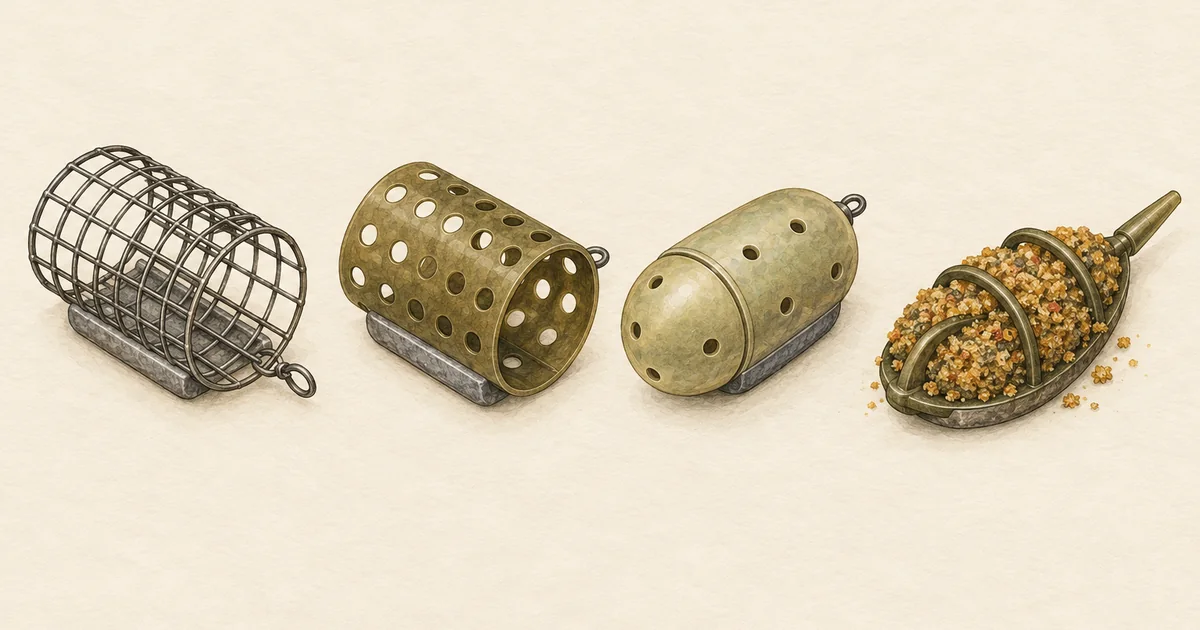
Size controls the amount. Small wire feeders suit winter, when the fish should be tempted but not filled up. Large feeders come into play at the start and in rivers, because the current carries off more feed there.
Lead strips and speed feeder
On the wire feeder the weight is often a lead strip at the side, also called a lead sled. According to Blinker, square wire feeders come with lead sleds of between 5 and 25 g, graded in steps of 5 g. The training material for the angling exam (Fischerprüfung) of the Landesfischereiverband Baden-Württemberg links the extra lead on the feeder with greater casting distance.
On the speed feeder the lead hangs at the bottom of the feeder. The centre of gravity is low, and the feeder flies weight first. It suits places where the fish sit far out, for example beyond a shallow margin or on the shelf edge, the drop-off into deeper water. The greater the distance between lead and feeder, the more easily it gives up its contents.
Closed maggot feeder
The maggot feeder is a plastic cylinder with few holes and removable caps or a lid. It is made for live feed: the maggots crawl out gradually, so the swim gets fresh feed over a longer period. According to Blinker, the closed feeder matters mainly in rivers, because the current otherwise carries loose feed away too early. Which maggots are suitable is explained under Maggots & larvae.
An empty plastic feeder weighs little and presents a large surface to the current. It therefore drifts easily or is even lifted off the bottom, which is why it needs more lead than the open wire feeder. Some models carry a fixed weight at the lower end; with the English maggot feeder you add weight with split shot and can adjust it. Small, lightly weighted feeders enter the water quietly and belong in still water or a weak current.
Method feeder: feed on the outside of the cage
The method feeder reverses the principle. It is flat, and the feed sticks to the outside of the cage instead of inside it. The hookbait hangs on a short hooklength and lies in the mound of feed. Whereas feed from an ordinary feeder should come out as quickly as possible, on the method feeder it has to hold for a long time. It is used mainly in still water.
The main line runs through the feeder, and the swivel at the end of the line sits firmly in its guide. In this way the method feeder works like a fixed lead: if the fish swims off with the bait, the weight of the feeder pulls the hook into the mouth. For big bream, according to a Blinker article, the feeder should weigh at least 60 g, and the feed comes on top. Besides the classic flat feeder there are semi-closed models for pellets. The flat feeder releases powder feed more easily.
Weight by current and casting distance
The basic rule: as light as possible, but heavy enough for the feeder to stay put and for you to tighten the quiver tip against it. The table gives guide values from specialist magazines for the empty feeder.
| Water | Feeder weight |
|---|---|
| still water | 10–20 g |
| small river | 30–50 g |
| moderate current | 30–60 g |
| strong current | 80–120 g, up to 150 g |
Whether the rod can cast the full feeder is covered under feeder rod. For raging rivers there is the claw feeder: a protruding wire bracket and a great deal of lead hold it on the bottom. How to judge the current at your swim is explained under Reading the current.
For long distances the design matters. For casts of 80 to 100 m, speed feeders are suitable, because only feeders with a low centre of gravity fly stably. Feed that squeezes out at the side when filling is wiped off before the cast, otherwise the feeder flies worse.
Filling: loose, firm or pressed
The feed has to survive the cast in the feeder and come out quickly on the bottom. If it sticks, you only lose it on the retrieve and lay a trail that draws fish away from the swim. So do not mix it too wet. A test is small balls that hold together when squeezed and do not fall apart straight away.
- Open feeder in still water: push the feed in from both ends and press it down only lightly between thumb and forefinger, as Rute & Rolle describes, warning against pressing too firmly. According to Fisch & Fang, in still water the feed may break up at the surface.
- Open feeder in a river: here, according to Fisch & Fang, the feed should only be released on the bottom. For strong current the magazine describes an airy, almost dry mix that can still be pressed into a stable ball and survives the cast and the descent.
- Maggots in the closed feeder: take off the cap, fill in the maggots, put the cap back on. With feeders that have an open window, a plug of feed closes the opening so that the maggots do not leave the feeder during the cast.
- Maggots in the open feeder: on their own they are no good for it. The sandwich filling works: a plug of feed at the bottom, maggots in the middle, a second plug on top. On the bottom the plugs break up and release the maggots.
- Method feeder: Put some groundbait into the mould and press the feeder into it, leaving a smooth mound on top. It also works by hand. The groundbait must bind well enough to survive the impact on the water. Dampened small pellets also stick. The steps with the mould are further down.
To start, you bring feed to the swim with several full feeders. Rute & Rolle gives about five feeders on a lake and 15 to 20 in a river, because the current carries more away. How the baited area is topped up afterwards is covered under Feeder fishing.
Feed in moderation: In the question catalogue of the Bayerischen Landesanstalt für Landwirtschaft for the angling exam (Fischerprüfung), excessive baiting is considered something to reject, because it enriches the water with nitrogen and phosphorus and worsens water quality. According to the Anglerverband Niedersachsen, many clubs there have set maximum amounts of feed per day. Whether and how much you may bait is governed by the water rules and your fishing permit (Erlaubnisschein).
Mould for the method feeder
The mould is a small tray into which the method feeder fits exactly. English anglers call it a method mould; in Germany it is also known as a Method-Form or Futterpresse. According to Angling Times, there is now a matching mould for every feeder size. In the past the groundbait was pressed around the feeder by hand, and the ball quite often broke up in the air. From the mould, by contrast, you get a load in a few seconds that is always the same size and holds together until it reaches the water. The pressed feeder also flies more aerodynamically.
- Prepare the feed: dampen groundbait or micro pellets until they stick. How long pellets need to soak for this is explained under Pellets.
- Bait first: place the hookbait on its short hooklength in the empty mould.
- Fill the mould: add feed on top of the bait until the hollow is full.
- Press in the feeder: press the method feeder firmly into the mould, frame side first.
- Remove and cast: release the feeder with its mound of feed from the mould. The bait now sits on top in the feed. After the cast, keep the line taut between rod tip and feeder.
You control how firm the load is through moisture and pressure. An article in Angling Times mixes the groundbait for shallow water on the dry side, just damp enough to survive the cast on the feeder. If it is too wet, the ball stays intact on the bottom and covers the bait. Blinker describes the same aim for big bream: the load should withstand powerful casts, the impact and the sinking, and then break down within a few minutes.
Layers and double loading
The mould can also be used to press layers that break down at different speeds. For cold water, Angling Times describes this sequence: fill the mould three-quarters full with dampened micro pellets and press the feeder in with a lot of force. This base layer holds on the bottom for a long time. Then fill the mould halfway, place the bait on the feed and press the feeder in a second time with less pressure; this layer breaks down more quickly. Finally a few dry, hard micro pellets go into the mould, and the feeder is pressed in once more. Some of them come off as it sinks. On the bottom the little grains move more and act as an eye-catcher in clear water.
If you need more feed on the feeder, you press on a second layer: load it as usual first, then put more feed in the mould and press the already loaded feeder in again. In England this is called double skinning. Angling Times stresses that the double-pressed ball holds together better in flight.
If the hooklength is longer than the feeder, it tangles easily. For larger baits for bream, Blinker uses about 15 cm of hooklength and therefore moulds a loop of it into the feed so that only a short piece sticks out. When the load breaks down on the bottom, the hooklength is free again. How the feeder sits on the line is shown in the Feeder rig.
Common mistakes
- Feed mixed too wet. It stays in the feeder, comes out on the retrieve and draws the fish away from the swim. If very firm feed is lying on the bottom, a short tug on the rod helps.
- Maggots on their own in the open wire feeder. Without a plug of feed they crawl out early. That is what the maggot feeder or the sandwich filling is for.
- Light plastic feeder in the current. When empty, it drifts off. In a river a maggot feeder needs more lead than a wire feeder.
- Leaving feed on the rim of the feeder. What squeezes out at the side costs distance on a long cast. Wipe it off before casting.
- Method feeder mix too loose. If the mound breaks on impact, the bait lies on the bottom without feed. Mix the feed wetter until it sticks to the feeder.
Frequently asked questions
Which feeder is suitable for a beginner?
An open wire feeder with a lead strip at the side, the weight matched to the current. That is the recommendation for beginners. If you want to feed with maggots, a closed feeder is added.
Why is the feeder still full on the retrieve?
The feed was too wet or pressed too firmly. Mix the next portion drier and press it only lightly into the feeder.
Do I need a mould for the method feeder?
No. The feed can also be moulded around the feeder by hand. What matters is that it sticks well and survives the impact.
How do I get more feed onto the method feeder?
With a second layer: press the loaded feeder into the freshly filled mould once more. If that is not enough, use a larger feeder.
Related
- Feeder rig: how the feeder hangs on the line, running and loop rigs
- Feeder fishing: baited area, routine at the water and bite indication
- Feeder rod: classes and casting weight for heavy feeders
- Swivels, snaps and split rings: the small parts the feeder hangs from
- Fishing weights: weights for the bottom without feed
- Sweetcorn & particles: what goes into the feed and onto the hook
- Line calculator: comparing the breaking strain of mainline and hooklength
Sources
- Blinker: Angeln mit Futterkorb: Ein Grundkurs (Kunststoffkorb, Speedkorb, Korbgröße, Gewicht, Futter, Sandwich-Füllung)
- Blinker: Bodenblei und Futterkorb, eine Übersicht (Drahtkorb, Bleischlitten, Speedkorb, Madenkörbe, Krallenkorb, Ruck bei festem Futter)
- Blinker: Method Feeder: Die Methode für dicke Friedfische (Pressform, Futterhügel, klebriges Futter, Pellet-Korb) und Blinker: Brassen angeln: Alle Grundlagen (Korb für Einsteiger, Method-Feeder als Festblei, 60 g, Bindung der Mischung, Vorfachschlaufe im Futter)
- Blinker: Feederangeln: Friedfische füttern und fangen (geschlossene Körbe im Fluss, Futterpfropf) und Blinker: Futterkorb auf Distanz (Speedkorb, Futter abstreifen)
- Fisch & Fang: 10 Tipps zum Heavy-Feedern im Strom (Körbe und Futter für den Strom) und Fisch & Fang: Das brauchen Sie zum Feedern (wo sich das Futter löst)
- Rute & Rolle: Feedern für Einsteiger (Füllen, Korbgewichte, Startfütterung) und Rute & Rolle: Erfolg mit der Feederrute (Futter nicht zu fest pressen)
- Angling Times: How to rig up a method feeder (Form benutzen, Reihenfolge, straffe Schnur) und Angling Times: How to catch more on the method feeder (Formen für alle Körbe, gleich große Ladung)
- Angling Times: Keep catching on the Method in winter (Schichten pressen) und Angling Times: How and when to use groundbait on the Method Feeder (trockene Mischung, doppelte Lage, größerer Korb)
- Angling Times: Hybrid vs Method, which is better? (Double Skinning)
- Landesfischereiverband Baden-Württemberg: Gerätekunde, Arbeitsblätter zur Fischerprüfung (PDF) (Blei am Korb und Wurfweite)
- Bayerische Landesanstalt für Landwirtschaft: Prüfungsfragen zur Fischerprüfung 2023/2024 (PDF) (übermäßiges Anfüttern) und Anglerverband Niedersachsen: Faktencheck Anfüttern (PDF) (Tageshöchstmengen in Vereinen)
Text AI-assisted, drawing AI-generated. Sources opened and checked in October and November 2026, no graphics taken from the sources.
All figures are guide values without guarantee. Which feeder and which weight suit depends on current, casting distance and feed, and how much you may feed is set by the water rules.