
Knowledge · Tackle
Swivels, snaps and split rings
A swivel joins two line ends so that both sides can turn independently of each other. Together with the snap and the split ring it forms the small parts between line and bait. Here you can read which designs exist, when you need them and why none of them may be weaker than your line.
Three small parts, three jobs
A swivel consists of two eyes that sit loosely in a small metal sleeve, the barrel. Inside it they turn freely against each other. The tackle guide of the Fischereiverein Löningen names two jobs: the swivel keeps the spin of the bait away from the line, and it serves as a suspension for the artificial lure or hooklength.
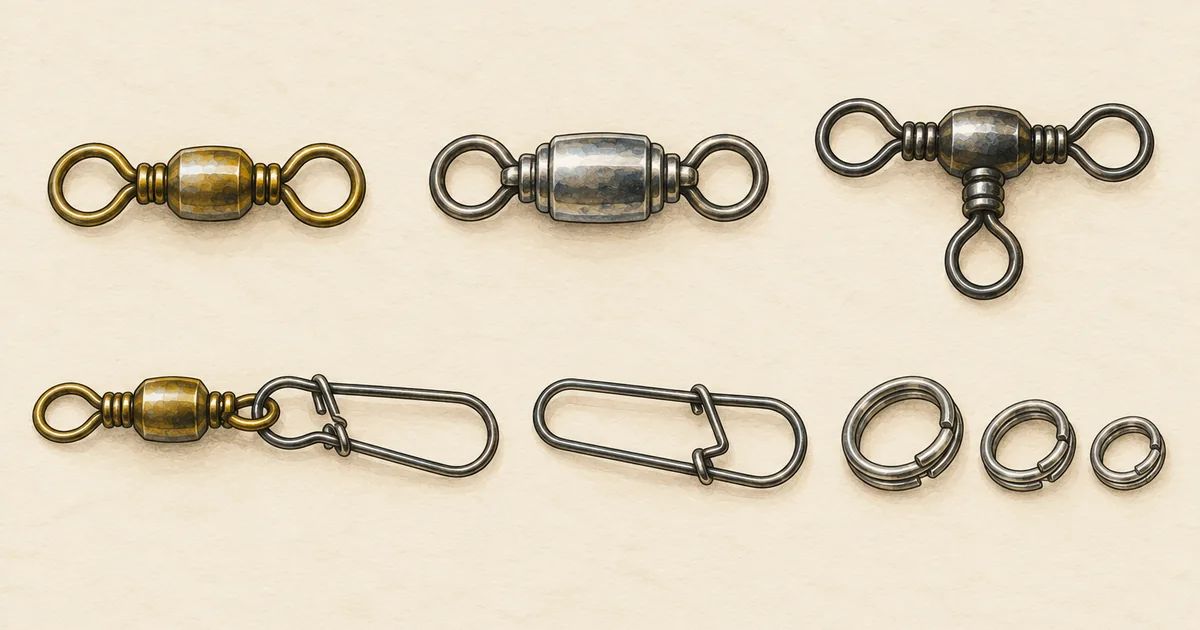
Without it the line twists, that is, it turns in on itself. According to the exam question catalogue for the angling exam in Saxony-Anhalt, this twist arises from spinning lures with no swivel in front of them. Other causes are a stick on the hook that makes the rig spin on the retrieve, or a fish being played. Twisted monofilament line wraps around the rod tip and loses so much strength that it can break while playing a fish.
The snap, also called a clip or snap link, is a wire bow with a closure. You open it, hook the bait on and close it again. This way you change the bait without tying a new knot each time. The split ring, finally, is a wire ring of two tightly lying coils, similar to a key ring. On crankbaits and spoons it joins the lure’s eye to the treble hook, a hook with three points.
Swivel designs
The Löninger exam material distinguishes single and multiple swivels. The one used most often, according to it, is the barrel swivel, which comes with and without a snap.
| Design | Construction | Typical use |
|---|---|---|
| Barrel swivel | two eyes, one barrel | Connect the main line to the hooklength, spacer on the Carolina rig |
| Snap swivel | Barrel swivel with snap | Spinners and other rotating lures |
| Ball-bearing swivel | Swivel with ball bearing | spinners, sea fishing |
| three-way swivel | three barrels in a row | lures with a lot of spin |
| Three-way swivel | extra eye at a right angle | side arm for natural bait |
| Sliding swivel | slides on the line | float held by a stopper |
Triple swivels and three-way swivels sound similar but do different jobs. The triple swivel is a reserve against line twist, for example when trout anglers drag dough that keeps spinning on its own axis. If one barrel jams because dirt has lodged in it, the other two keep turning. The three-way swivel, by contrast, carries a side arm; how it is fitted is shown in the side-arm rig. Sliding swivels for floats are threaded onto the line and held in place with a rubber stopper.
For the spinner, a high-quality swivel is recommended, ideally a ball-bearing one, because otherwise the blade keeps twisting the line. According to Löningen, sea swivels usually have a ball bearing and are chromed or nickel-plated. None of the sources reviewed shows any advantage for lures that do not rotate at all.
Snaps: shapes and strength
Löningen only distinguishes between standard and safety snaps. A Blinker article on snaps from 2026 makes finer distinctions:
- Standard snaps: open easily and also fit through tight eyes, for example on a soft plastic shad. According to the article, they are enough for perch, zander and pike with lures of about 7 to 15 cm.
- Snaps with a double lock: by design they carry more and spring open less often. They suit pike and sea fishing, but are hard to thread through small eyes and fit crankbaits and spoons better.
- Spiral snaps: the lure is twisted into a short wire spiral. The metal is bent less than with an ordinary snap, which can fatigue and break after many lure changes.
- Snaps for ultralight: tiny, so that on lures of 3 cm they interfere with neither action nor appearance. Even size 000 still carries 4,5 kg according to Blinker.
Swivels and snaps come in many sizes and strengths. If the breaking strain is printed in lb on the packet, the unit converter converts it; 1 lb is about 454 g.
At least as strong as the line
The examination catalogue of the Bayerischen Landesanstalt für Landwirtschaft is clear on this: when spinning, the swivel must have at least the same breaking strain as the line. The same goes for snaps and split rings, because a rig breaks at its weakest part. Fisch & Fang accordingly advises matching snaps and swivels on a steel trace to the strength of the wire.
The knot counts too: what your line still holds afterwards is worked out by the line calculator. Monofilament is tied to the swivel with the improved clinch knot and six to eight turns; braid is doubled over first.
Worked example: The main line is rated at 8 kg on the spool, the hooklength at 6 kg. A snap rated at 4,5 kg would be the weakest link in this chain. Choose one at least as strong as the hooklength, and the small part is no longer the weak point.
Split rings and split-ring pliers
Anyone swapping the treble hooks on artificial lures has to open the split ring. You recognise split-ring pliers by a cone-shaped spike on one of the jaws. You place it where the end of the wire lies and squeeze the pliers together. The spike pushes the two coils apart, and the eye of the treble slips in between. Then the pliers can go: you guide the eye once all the way round the ring until it comes out at the other end. You repeat this at the eye of the lure. The pliers come in sizes to match the ring, from ultralight to catfish and sea lures.
Without pliers, small rings can sometimes be opened with a thumbnail, large ones with a hook point or a knife blade. Both are only a stopgap, because the point and the blade can slip and end up in your finger.
In heavy spinning for wels catfish or big sea fish, anglers leave out the snap altogether because it is a possible weak point. A swivel or a closed ring goes on the hooklength, and the lure hangs directly on it from a split ring.
When you can do without a swivel or snap
Whether a swivel is needed depends on the lure, not on the style of fishing. On the spinner, which always rotates, a snap swivel is necessary. On the spoon, which may rotate, it is important. Crankbaits and soft plastics do not spin on their own axis when worked correctly, so a plain snap is usually enough there.
The examination catalogues take a more general view. In Bavaria the swivel is considered particularly important in spinning, and as a method that manages without a swivel, Bavaria and Saxony-Anhalt name only fly fishing. Conversely, the coarse angler sometimes needs one too: when reeling in fast, even maggots on the hook can spin and twist a feeder or float rig.
On a steel trace the swivel sits at the top and the snap at the bottom; details are under pike trace. If you want to fish with no metal at the lure at all, tie it on directly with a movable loop, for example using the non-slip loop knot.
Connectors on bottom and sea rigs
On the bottom and at sea, extra small parts come into play that keep lead, feeder and hook apart or let them run freely on the line. Many of them have English names.
Three-way swivel
Besides the two opposite eyes, the three-way swivel has a third one that sticks out to the side. Blinker counts it among the more classic parts that are needed less often today but have kept their place. That place is the rig with a side arm. The exam questions in Bavaria and Saxony-Anhalt describe the paternoster as a bottom rig whose weight sits at the end of the line while the hooks hang on movable side arms. The main line goes to the top of the swivel, the line to the lead at the bottom, and the arm with the hook at the side. Without a swivel you tie the arm with a dropper loop; lengths and tying steps are under Side-arm rig.
A Blinker article also uses the three-way swivel when trolling for zander, that is, when the lure is pulled along behind the boat. The main line goes to one of the two opposite eyes. On the other hangs a lead line no more than one metre long, and on the side eye the hooklength with the crankbait. The lead line has a lower breaking strain than any other line in the rig: if the lead snags, only it breaks and the rest comes back. The author chooses the hooklength somewhat stronger and longer than the lead line. Where the bottom gets shallower, lead and crankbait move closer together, and a longer lead line could then tangle in the hooklength. Whether trolling is allowed on a water is governed by the federal state, the water’s own rules and the fishing permit (Erlaubnisschein).
Anti-tangle boom
The anti-tangle boom, also called a feeder boom or ledger boom, is a curved tube with a snap. The main line runs through it, and the feeder or lead hangs offset on the snap and so stays away from the hooklength (Fisch & Fang). According to Blinker, coarse anglers copied the part from the running boom that sea anglers use on natural-bait rigs, and made it smaller. It shows its strength on long casts and in difficult current. There, simple running-lead rigs tangle easily, and if the line cannot run freely you get missed bites. The boom keeps the feeder away from the hooklength in the cast and lets the line run freely. In return, rigging up takes a little longer and a break-off costs more.
At sea the same principle comes in a heavy-duty version. For natural baits for halibut in Norway, Blinker extends the main line with 1,5 m of mono about 1 mm thick as abrasion protection, threads an anti-tangle boom and a rubber bead onto it and ties on a snap swivel. The actual hooklength there measures around 70 cm. On the coast, a flounder angler in Fisch & Fang puts a long, free-running tube with a snap in front. He clips the pear lead into it and so can quickly swap it for a lighter or heavier one when needed. The soft silicone anti-tangle tubing above the lead is explained on the page Stoppers, beads and shrink tube. Why a boom helps on a muddy bottom is explained under Running lead rig.
Running bead with swivel
The running bead with swivel, known in English as a swivel bead, is a bead with a built-in snap swivel. It slides on the main line, and the feeder or lead goes on the snap. Fisch & Fang uses it to build a simple running rig: below the bead goes a rubber bead or a piece of silicone tubing as a buffer, and below that a small swivel for the hooklength. Because the feeder runs on the line, a fish can, according to Blinker, move off a few centimetres with the bait before it feels any resistance. The feeder can be changed on the snap without re-tying.
Instead of the bead, a snap swivel sliding freely on the line also does the job. The flounder angler from Fisch & Fang clips ball leads onto it this way and puts a rubber stopper with a bead between lead and hook so that the weight does not slide down to the hook. How the running rig is fished on a river is shown in the Feeder rig, and the feeder shapes are under Feeder.
Wire booms on sea rigs
On paternosters and surf rigs, short wire arms hold the snoods, that is the side arms with the hooks, away from the main body of the rig. Fisch & Fang mentions such booms for natural-bait fishing from a fishing cutter and for pirking. A Blinker article shows a two-hook rig for the surf and the pier with two wire arms: they stop the snoods from tangling, and the baits work a little way off the bottom.
The simplest design has a drawback. If the snood is tied directly to the eye at the end of the arm, a biting fish can twist it, and it has to be replaced. Fisch & Fang therefore puts a swivel on the end of the wire. Booms do not have to be made of metal: in surf and boat fishing in the Netherlands, according to the magazine, red spacers stand out that you can make yourself from the plastic bristles of a street broom; usually three sit on one paternoster. How many hooks a paternoster may carry is governed by state law and the fishing permit (Erlaubnisschein); an example is given under Side-arm rig. Ready-made feather rigs for herring and mackerel are shown in Sea paternoster, and fishing from the beach in Surf rig.
Which part suits which problem:
- The bait should stand above the lead lying on the bottom: three-way swivel or tied side arm.
- Feeder and hooklength tangle in the cast: anti-tangle boom.
- The fish should first move off without resistance, and the feeder should be quick to swap: running bead with swivel.
- Snoods on the sea rig tangle: wire booms, ideally with a swivel at the end.
- When trolling, the lead often snags: choose a weaker lead line on the three-way swivel than the rest of the rig, so that only it breaks.
Common mistakes
- The snap is weaker than the line. Then the rig breaks at the snap. Compare the figure on the packet with your hooklength.
- A snap that is too big on a small lure. On a 3 cm crankbait an ordinary snap already adds noticeable weight and can change the action.
- Hanging the spinner on a snap only. Without a rotating barrel, the spin of the blade goes straight into the line.
- Fishing a swivel that jams. If dirt sits in the barrel, it no longer turns and the line twists anyway. Give it a quick spin between your fingers before fishing.
- Carrying on with a fatigued snap. Every lure change bends the wire, and after many changes it can fatigue and break. If the clasp no longer closes cleanly, fit a new one.
Frequently asked questions
Do I need a swivel on a crankbait?
Usually not. A crankbait does not spin on its own axis when worked correctly, so a snap is enough. If the line twists anyway, put a swivel in front of it.
What breaking strain should a swivel have?
At least the same as the line, as the Bavarian examination catalogue states for spinning. According to Blinker, strong swivels are available with well over 100 kg; very small snaps on strong line are more critical.
Why is there often no swivel at the bottom of a steel trace?
Because the swivel between line and trace already prevents twisting, as the Bavarian examination catalogue also describes. At the bottom a snap is enough for changing lures. For a spinner, some anglers put a second swivel in front of the snap as anti-twist protection.
What is the difference between an anti-tangle boom and a running bead?
Both slide on the main line and carry the feeder or lead on the snap. The boom’s curved tube also keeps the feeder away from the hooklength and so helps against tangles in the cast. According to Blinker, compared with a simple running-lead rig it costs a little more time to rig up and more money when it breaks off.
Related
- Pike trace: wire, sleeves and the small parts at both ends
- Spinner: the lure that creates the most twist
- Improved clinch knot: tying the line securely to the swivel eye
- Side-arm rig: three-way swivel with weight and bait
- Feeder rig: feeder running or on a spacer
- Stoppers, beads and heat-shrink tubing: more small parts for rigs
- Fishing hooks: single hooks and trebles at a glance
- Line calculator: working out the breaking strain after the knot
Sources
- Bayerische Landesanstalt für Landwirtschaft: Staatliche Fischerprüfung in Bayern, Prüfungsfragen 2023/2024 (PDF) (Wirbel gegen Verdrehen, Bruchfestigkeit beim Spinnfischen, Fliegenfischen ohne Wirbel, Paternosterangel)
- Land Sachsen-Anhalt: Fragenkatalog zur Fischerprüfung (PDF) (Drall durch drehende Köder ohne Wirbel, keine Wirbel beim Fliegenfischen, Paternosterangel)
- Fischereiverein Löningen: Gerätekunde (PDF) (Aufgaben, Bauformen von Wirbel und Karabiner, Meereswirbel mit Kugellager)
- Blinker: Wirbel zum Angeln: Hier geht’s um den Dreh! (Aufbau, Drall und Tragkraftverlust, Karabinerwirbel, Dreiwegewirbel und sein heutiger Einsatz, Knoten, zweiter Wirbel am Vorfach)
- Blinker: Was bringen Dreifach-Wirbel beim Angeln? (Dreifachwirbel, Wirbel je nach Köder, Maden, Schmutz im Tönnchen)
- Blinker: Das Einmaleins der Einhänger (Bauformen, 4,5 kg bei Größe 000, Ermüdung, Sprengring statt Karabiner)
- Blinker: Wie funktioniert eine Sprengringzange? (Ablauf, Notlösungen, Verletzungsgefahr)
- Blinker: Spinnfischen mit dem Spinner (kugelgelagerter Wirbel am Spinner)
- Rute & Rolle: Angelwirbel, Haupttypen und ihre Funktionen (Tönnchenwirbel, Carolina-Rig, Durchlaufwirbel mit Stopper)
- Fisch & Fang: Zielfisch Hecht, Stahl der Wahl (Einhänger und Wirbel passend zur Tragkraft des Vorfachs)
- Blinker: Zander abgeschleppt (Schleppmontage mit Dreiwegewirbel, Länge und Tragkraft der Bleischnur)
- Blinker: Montage mit Abstandhalter und Blinker: Lauf-Montage (Herkunft, Nutzen und Nachteile des Ledger Booms; Laufperle, Widerstand beim Abziehen)
- Blinker: Angelmontage für Norwegen, einfach selber bauen (Anti-Tangle-Boom an der Heilbuttmontage, Maße)
- Blinker: Plattfisch-Vorfach für jede Situation (Doppelhaken-Vorfach mit zwei Drahtarm-Abstandshaltern)
- Fisch & Fang: Das brauchen Sie zum Feedern (Swivel Bead, Puffer, Abstandhalter mit gebogenem Röhrchen)
- Fisch & Fang: Flundern für Landratten (Anti-Tangle-Röhrchen mit Karabiner, frei gleitender Karabinerwirbel)
- Fisch & Fang: Drehbarer Abstandhalter und Fisch & Fang: Abstandhalter aus Borsten (Drahtarme vom Kutter, Drall am Armende, Abstandhalter aus Kunststoffborsten)
Text AI-assisted, drawing AI-generated. Sources opened and checked in October and November 2026, no graphics taken from the sources.
All figures are guide values without guarantee. Which small parts suit depends on lure, line and target fish; the breaking strain printed on the packet is what counts.