
Knowledge · Fishing methods
Pirking
In pirking you let a heavy metal lure down to the bottom from a drifting boat or cutter, lift it with the rod and let it sink again. How heavy the pirk has to be depends on the drift. In 2026 anglers may not fish for cod in the Baltic Sea.
Heavy lure, drifting boat
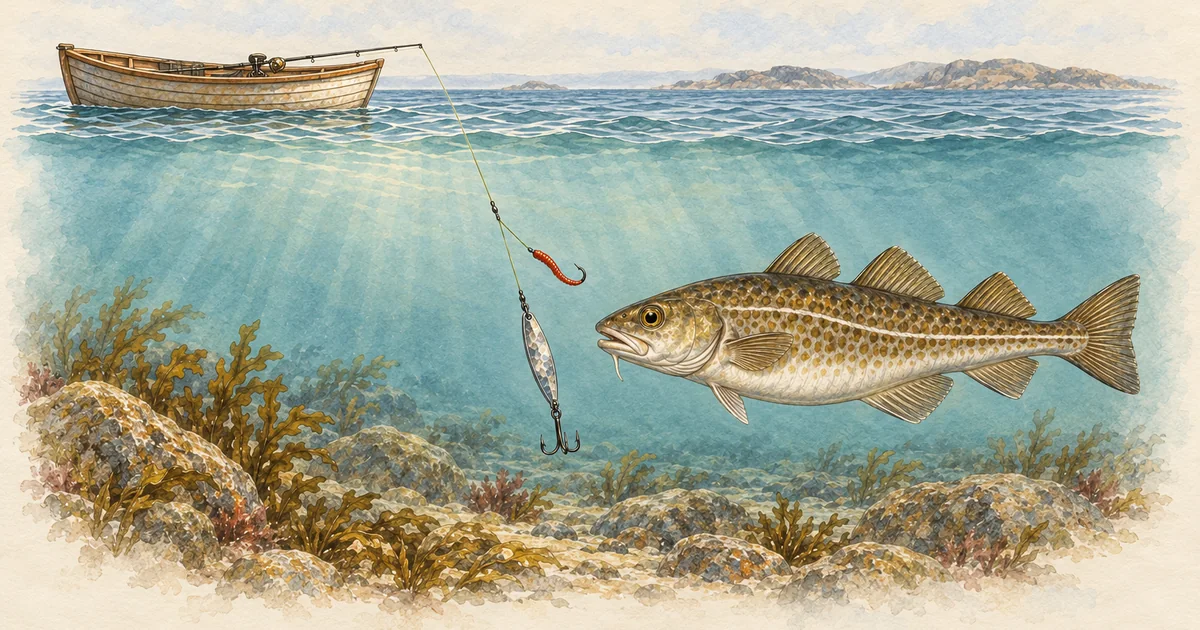
A pilker is made of lead or another metal and is meant to imitate a prey fish. It only comes alive through the up-and-down of the rod. According to Blinker, that lets it reach the fish even at great depth and in strong current. You fish from the drift: the cutter stops at the fishing spot and drifts with the wind. Shapes and colours are shown on the Pilker page.
For comparison: the soft plastic (shad) on a jig head, a lead head with a hook, can be worked very slowly. Blinker sees that as its great advantage over the pilker. The magazine recommends natural baits on the natural bait rig when nothing bites on the pilker.
Lee and windward: your side of the boat decides the technique
How a cutter trip runs is described in Fishing from a cutter and boat. For presentation it matters which side you stand on (Blinker, Fisch & Fang):
- Windward, facing the wind (drifting away from the lure): The boat drifts away from the lure, the line runs at a slant outwards. You lower the pilker beneath the rod tip. If its weight suits the drift, it drags slowly over the bottom. If you constantly have to pay out line, it is too light.
- Lee side, wind at your back (drifting towards the lure): The boat drifts towards the lure. If you only lower it, the boat drifts over your line and it chafes through. So you cast far in the direction of the drift and lift the rod steeply, otherwise the pilker will not break away from the bottom.
- Tipping point: If the boat drifts past the cast lure, you end up dragging it behind you. According to Fisch & Fang, cod often grab it then, because the pirk and the droppers change direction.
How heavy the pirk needs to be
As a rule of thumb, Blinker says: as light as possible, as long as the pirk still touches the bottom. Fisch & Fang nevertheless advises beginners to go slightly heavier when in doubt. Guide values from the angling press:
| Use | Pilker | Source |
|---|---|---|
| Baltic Sea, up to 30 m deep | 50–125 g | Spoon |
| German waters, 10–30 m deep | 60–200 g, depending on current | Rod and reel |
| Deep water, strong current or drift | 180–250 g | Spoon |
| Reefs and wrecks | 200–500 g | Spoon |
| Norway and Iceland, over 30 m deep | 200–500 g | Spoon |
The Baltic figures date from before the cod ban. For Norway the sources differ: an equipment list in Blinker gives pirks from 30 to 200 grams. The same article recommends thin line: it offers the water less resistance, so you can get by with lighter weights.
Presentation: lift, let it sink
The sequence according to Blinker and Fisch & Fang:
- Lower the pirk until the line suddenly goes slack, then tighten up.
- Lift with the rod tip: briskly enough for the lure to leave the bottom, but not so high that it leaves the fish’s field of view.
- Let it sink on a tight line until the pirk touches down again.
The fish mostly bite while the pirk is sinking, writes a boat angler in Fisch & Fang. You feel a bite on the lift, but a bite on the drop you have to see. If the line twitches or goes slack before the pirk can have reached the bottom for that depth, you strike (Blinker). Coloured line helps.
Wild ripping gets you nowhere: often it is enough, according to Fisch & Fang, to drag the pirk along the bottom. According to Blinker, cod usually sit on the bottom or two or three metres above it. For coley, after touching down you wind up about five metres and keep searching upwards in five-metre steps (Blinker).
Droppers and hooklength
Droppers are small extra lures above the pirk, tied on short side arms, for example with the dropper loop. Training material for the angling exam (Fischerprüfung) calls them springers (Springer): usually twister tails on a side snood (Fischereiverein Löningen). Fisch & Fang puts one, at most two, of them 40 to 50 centimetres above the pirk. Blinker ties the hooklength from monofilament line 0,50 to 0,65 millimetres thick.
If a shoal of cod is chasing herring or sand eels, then according to Blinker the single pirk catches better. If the fish are picking up crabs and worms on the bottom, a slowly dragged pirk with droppers often catches more. In that case the treble can come off: the pirk acts only as a weight, and there are fewer snags.
Hook count, as of October 2026: How many lures and hooks are allowed is set by the water. In the coastal waters of Mecklenburg-Western Pomerania, since the end of September 2026 up to two lures with up to three hooks each have been allowed per hand-held rod (§ 9 Abs. 5 Küstenfischereiverordnung). When fishing for mackerel and herring, a paternoster with up to six single hooks is allowed. The regulation does not say how it counts the pirk and droppers; with two droppers above the pirk the limit may be exceeded. If in doubt, ask the fisheries authority (Fischereibehörde). Elsewhere the rules of the federal state (Bundesland) or the fishing permit (Erlaubnisschein) apply.
Target fish and waters
The training material from Löningen names the pirk as a lure for cod-like fish. Not every species sits on the bottom:
- Cod: just above the bottom.
- Coley: usually a good way higher up.
- Pollack: according to Blinker mostly a bycatch when pirking; targeted with a light pirk worked quickly.
- Mackerel: bites on the paternoster, which according to Blinker has a lead or a pirk of 150 to 250 grams at its end.
- Ling and tusk: deep-water fish, caught in Norway mainly on natural bait. For both, Blinker also describes pirks with a strip of fish on the treble (ling, tusk).
As waters, Blinker describes the North Sea with its wrecks and reefs, and Norway. In Norway, visitors may use only hand-held tackle (Fiskeridirektoratet). Minimum sizes (Mindestmaß) and export quota are covered under Fishing holiday in Norway, the Danish rules under Fishing holiday in Denmark and the Swedish ones under Fishing holiday in Sweden.
Cod in the Baltic Sea
The Baltic Sea was long regarded as a very good cod water. Today the spawning stock of the western Baltic is far below the limit value set by fisheries science (Thünen-Institut für Ostseefischerei). For anglers that meant:
- 2017: Daily catch limits per angler and a spawning closed season apply for the first time.
- 2022: Targeted commercial fishing is closed, and anglers account for 71 percent of the known total catch.
- Since 2024: Recreational fishing for cod is banned entirely.
For 2026, Article 10 of Verordnung (EU) 2025/2454 lays down: recreational fishing for cod is banned in subdivisions 22 to 32 of the Baltic Sea. A cod caught by accident must be returned to the sea immediately; only in the eastern Baltic (subdivisions 27 to 32) may an unintended bycatch be kept when fishing for other species. So targeting cod is already prohibited, not just taking one home. The Deutsche Angelfischerverband speaks of the harvest ban, which remains in place. The Thünen-Institut considers a recovery of the stock unlikely in the short and medium term.
As of October 2026, as in the catch calendar. The catch limits are decided anew every year.
Tackle and safety on board
Which rod suits is covered under Sea rod. For line, braid has become the norm, because it keeps direct contact with the lure (Fisch & Fang). According to Blinker, with it you can feel the pirk touch down even at 100 metres. The price of the lack of stretch: with a firm drag the hook pulls out more easily. A few metres of monofilament hooklength cushion the jolts and serve as a weak link (Blinker). More under Fishing line compared and Setting the reel drag.
The sea rescue service urges extreme caution in a swell when baiting up and unhooking fish: otherwise the hook ends up in your finger, or someone goes overboard. The Norwegian fisheries authority (Fischereibehörde) advises always wearing a life jacket at sea. More under Boat and life jacket and Hook injury and first aid.
Frequently asked questions
Is pirking still allowed in the Baltic Sea?
In 2026 the EU regulation bans recreational fishing for cod, not the method. In Mecklenburg-Western Pomerania the Küstenfischereiverordnung lists pirking as permitted, as long as the rod is not used for ripping. Targeted pirking for cod does fall under the ban, though. If in doubt, ask the fisheries authority (Fischereibehörde) beforehand.
What is the difference between pirking and jigging?
With classic pirking, the pirk itself does the catching. If droppers hang on a side arm above it, Blinker and Fisch & Fang speak of jigging. The pirk is then often just a casting weight and attractor.
Is a fish finder necessary?
Blinker calls it practically indispensable, because you need to know how deep the fish are sitting. How much line is out is shown by multicoloured braid: according to Blinker each colour stands for ten metres.
Related
- Pirk: designs, colours, rigging.
- Fishing from a charter boat and boat: routine on board, fishing licence (Fischereischein), minimum sizes (Mindestmaß).
- Sea fishing: overview from the surf to the charter boat.
- Beachcasting: cod and flatfish from the beach.
- Catch calendar: best months for each species.
- Line calculator: breaking strength of line and hooklength.
Sources
- Rat der EU: Verordnung (EU) 2025/2454, Fangmöglichkeiten Ostsee 2026 (Artikel 10).
- Thünen-Institut für Ostseefischerei: Dorsch westliche Ostsee (Bestand, Regeln seit 2017).
- Deutscher Angelfischerverband: Fangregeln Ostsee 2026 (Entnahmeverbot).
- Land Mecklenburg-Vorpommern: Fünfte Änderung der Küstenfischereiverordnung vom 11. September 2026 (§ 9, Haken) und Arbeitskopie der Verordnung (§ 16, Pilken).
- Fiskeridirektoratet: Meeresangeln in Norwegen (Gerät, Rettungsweste).
- Die Seenotretter (DGzRS): Angeln an der Küste und auf See (Seegang).
- Fischereiverein Löningen: Gerätekunde zur Fischerprüfung (Pilker, Springer).
- Blinker: Pilker richtig montieren und präsentieren, Köderführung bei Drift, Hochseeangeln Nordsee und Ostsee (Führung, Gewichte, Beifänger).
- Blinker zu den Arten: Dorsch, Köhler, Pollack, Leng, Lumb (Standtiefen, Gewichte).
- Blinker: Angeln in Norwegen, Angelausrüstung für Norwegen (Reviere, Schnur).
- Fisch & Fang: Ein Platz an der Reling (Führung, Beifänger, Kipp-Punkt) und Rute & Rolle: Dorsch (Gewichte).
Text AI-assisted, drawing AI-generated. Sources opened and checked in October 2026; no graphics taken from the sources.
All figures are guide values without guarantee. What you may catch and keep is governed by the EU and by the federal state (Bundesland) in whose waters you fish; the safety notes are no substitute for medical advice.