
Knowledge – Fish
Ling: Features, habitat in the deep, rig, catching
The ling (Molva molva) is one of the largest cod relatives. It lives on the bottom over rock and on wrecks, usually at great depth, from 100 to 400 metres. Anglers catch it mainly in Norway and off the British Isles with natural baits.
In short: The best time to catch ling is September to February, in the morning, during the day and in the evening. Good spots on the coast: wreck, reef, drop-off and stony mixed bottom. Proven baits: fillets of mackerel or herring, squid, prawns or sand eel on a paternoster or a long-trace rig; also a pilker with fish strips. Step by step: ling fishing.
- Very elongated body with a long second dorsal fin and a long anal fin
- Long barbel on the chin, longer than the diameter of the eye
- Back mottled brown, and dorsal and anal fins with a pale edge
Catch chances through the year
- Hardly any chance
- Possible
- Good
- Peak season
- Spawning (observe the closed season)
Editorial assessment for waters in Germany, not a measured value and no guarantee. Spawning time is not the same as the legal closed season.
Species profile and sources in the catch calendarAll species compared month by monthThe rules of your federal state
How to recognise it
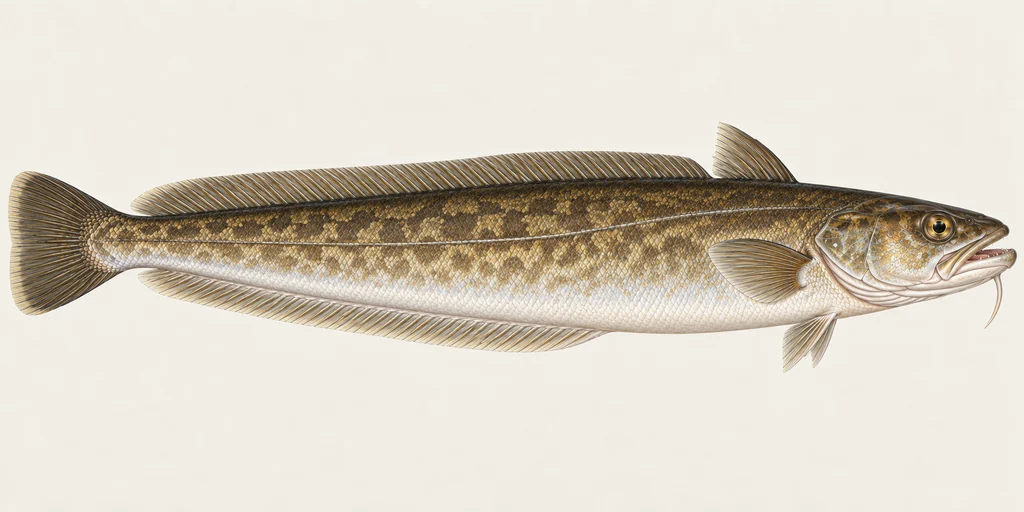
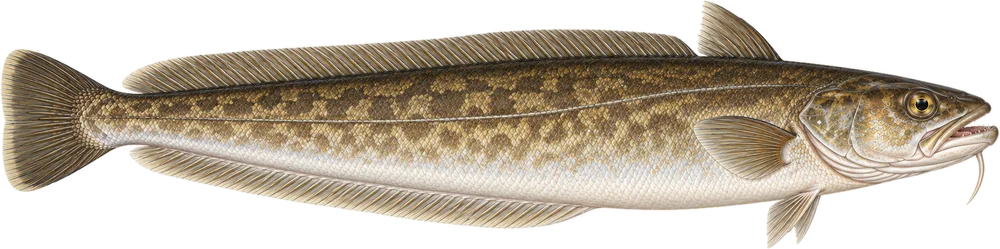
The ling has a long, slim build. The upper jaw projects beyond the lower. On the chin sits a barbel that is longer than the diameter of the eye. The back is reddish-brown to grey-brown, turning white towards the belly. The flanks are clearly marbled.
The dorsal fin (75 to 83 soft rays) and the anal fin (58 to 64) are long, their rear part dark with a pale edge. At the end of the first dorsal fin there is a black spot. The caudal peduncle is stout, clearly stouter than in the blue ling.
According to FishBase, a good 100 centimetres is typical, and the maximum is given as 200 centimetres and 45 kilograms. Norwegian researchers give 2 metres and 40 kilograms. Ling mature at five to seven years; the maximum age is 25 years, probably up to 30.
The blue ling has larger eyes, a shorter barbel and a thinner caudal peduncle, and its belly has a bluish sheen. It grows to about 1.50 metres and lives at depths of 200 to 1500 metres, so anglers hardly ever see it. In Norway it is protected all year, so with every long fish from great depth check the barbel, eyes and caudal peduncle.
The ling is also confused with the tusk. The tusk has only one long, continuous dorsal fin; in the ling it is divided.
Side by side
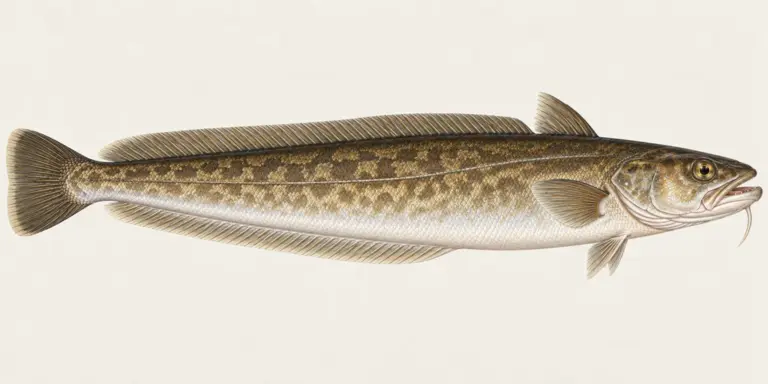
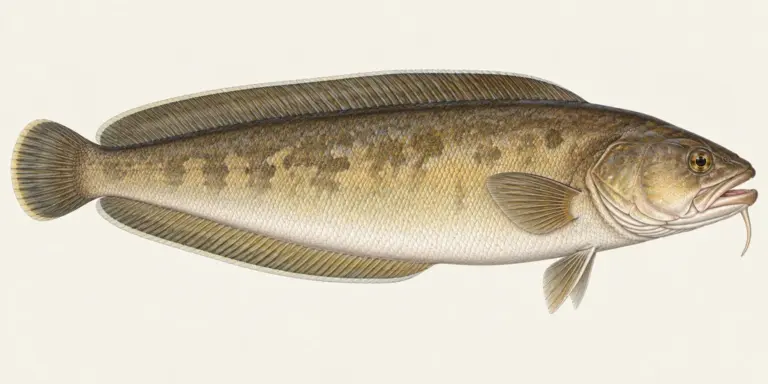
AI-generated illustrations.
Where it holds
The ling lives in the north-east Atlantic, from the Barents Sea and Iceland to Morocco, and also in the Skagerrak, Kattegat and Øresund. Single fish even turn up in the south-western Baltic Sea. It inhabits hard bottom and sandy bottom with large stones. It avoids the shallow areas of the North Sea.
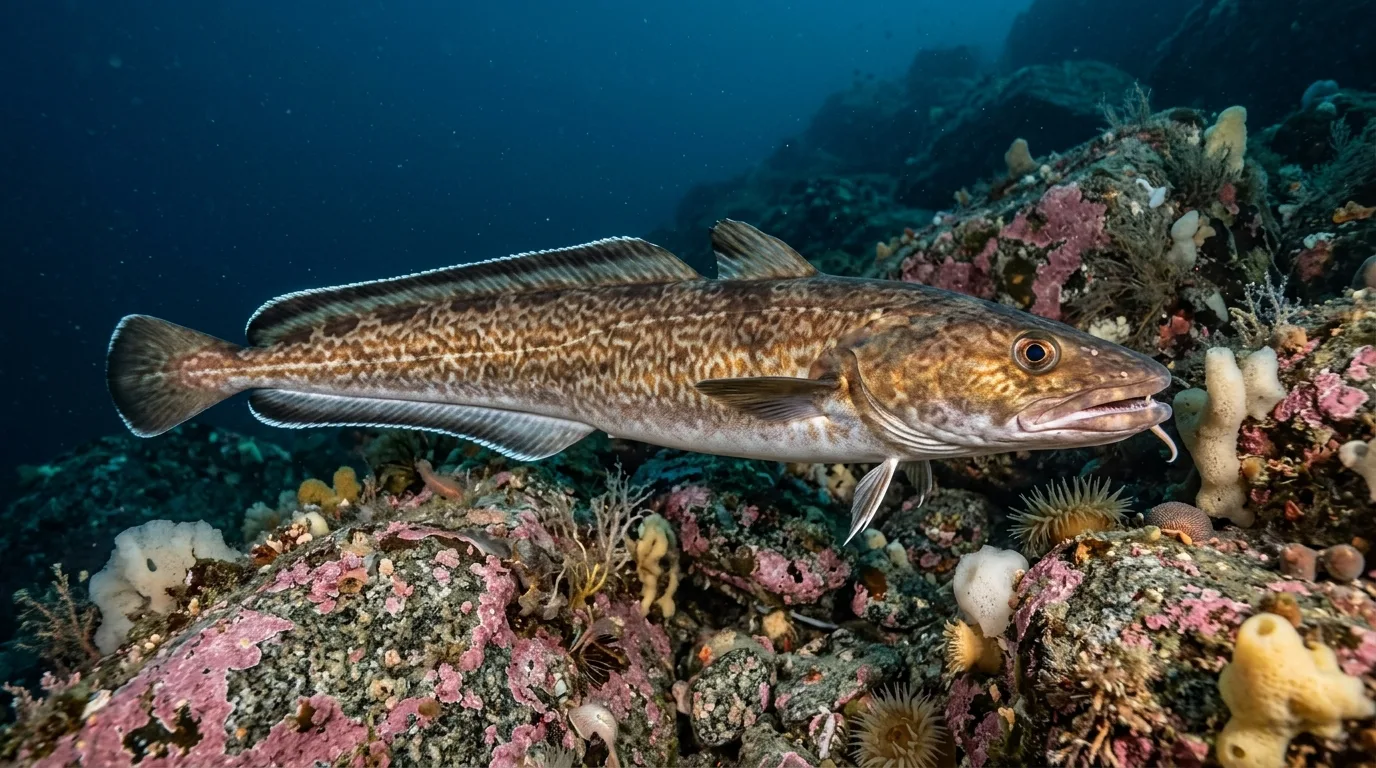
It is most common at 300 to 400 metres, but occurs from about 60 to 1000 metres. Young fish stand shallower and closer to the coast. Wrecks, reefs and rocky bottom are the key spots, because the ling loves hiding places that rise from the bottom. On wrecks and rocky shoals, even big fish stand in just 40 metres.
You can catch smaller ling in Scotland, Ireland and Norway when boat fishing close inshore, and from a rocky shore where the bottom drops away steeply.
Holding spots in the picture
Choose a season and time of day: the picture shows where the species sits then. Tap a fish or a spot in the list to bring it closer. The picture is schematic and AI-generated, every water is different.
Chance of a catch in springgoodSpawning, observe the closed seasons
Catch chance in summergood
Catch chance in autumnPeak season
Catch chance in winterMain season
- J
- F
- M
- A
- M
- J
- J
- A
- S
- O
- N
- D
Spawning season
Active time Tagged ling swam around mainly at dawn and dusk; they found bait by day and did not react to it at night.
Active time Tagged ling swam around mainly at dawn and dusk; they found bait by day and did not react to it at night.
Active time Tagged ling swam around mainly at dawn and dusk; they found bait by day and did not react to it at night.
No peak time Tagged ling swam around mainly at dawn and dusk; they found bait by day and did not react to it at night.
On the coast
Stony mixed ground
Ling are found here all year round.
Drop-off
Ling are found here all year round.
Wreck, reef
Ling are found here all year round.
Deep, colder water
Ling are found here all year round.
Ling stay in hideouts that rise from the bottom: wrecks, reefs, rock formations and steep edges in the depths. They live on hard ground and sandy ground with big stones. On plateaus they usually stand right at the rim of the edge.
Spring: catch chance according to the catch calendar good. Spawning falls in this period, so observe the closed season (Schonzeit). Spawning takes place from April to June at 100 to 300 metres.
Summer: catch chance according to the catch calendar good.
Autumn: catch chance according to the catch calendar main season.
Winter: catch chance according to the catch calendar main season. Ling can be fished for all year round. The angling press names November to February as especially good months.
Depth: Ling are most common at 300 to 400 metres, and occur from 60 to 1000 metres. On wrecks and rocky shoals, big fish sometimes stand at just 40 metres. Young fish live shallower and closer to the coast.
Size comparison: AI-generated drawing, schematic.
How it hunts and spawns
The ling is a voracious predator. It eats cod, herring and flatfish, plus lobsters, crabs, squid and starfish. It stands singly or in loose groups near its hiding places.
Spawning takes place from April to June at 100 to 300 metres, according to Swedish sources even from March to July at 60 to 300 metres. The most important spawning grounds are in the Bay of Biscay, west of the British Isles, around the Faroe Islands and south of Iceland. A female can release 20 to 60 million eggs. Eggs, larvae and juveniles live in open water for the first two years.
Norwegian researchers suspect that ling move into deeper areas and to the spawning grounds as they age or grow. From Swedish waters they migrate in spring to the North Sea and the Atlantic.
When it bites
Ling can be fished for all year round. According to the Blinker species profile, March to October is a good season and November to February a very good one, and a Blinker report from southern Norway names the autumn months as the time of the best catches in the deep. In winter, however, you can get out on open water only on calm days, so in practice the weather determines the season.
Today’s catch index needs JavaScript. Season and spawning time are in the catch calendar.
You will find the monthly overview of all species and the water temperature check in the catch calendar.
What you catch it with
Step by step: Ling fishing: tips on bait, rig and tackle – season, spots, bait, tackle and rules on one page.
You fish from a boat or charter boat with natural baits on the bottom. The tackle must be strong: a sturdy boat rod, large multiplier reels, braided line with a breaking strain of 20 to 25 kilograms or thick monofilament, and weights from 200 to over 500 grams, depending on depth, current and drift. You are fishing in deep water from a rolling boat, and weak tackle and weak nerves fall by the wayside.
A simple two-armed paternoster with an end weight is enough as a rig. The long-trace rig catches better: a running boom on the main line, a trailing hook trace of one to one and a half metres on the snap swivel, plus weights of 300 and 500 grams in your bag. In strong current you need up to twice as much.
Fillets of mackerel or herring serve as bait, as do squid, prawns or sand eel on a very sharp hook of size 4/0 or larger. The mouth is leathery, and blunt hooks do not go in reliably. More on fish strips. You also catch ling when jigging with a pilker; British anglers add fish strips to large trebles.
The bite is energetic. After the strike you must stop the fish taking line and wedging itself in the wreck or a rock crevice. Once it has a few metres of open water below it, you can ease the drag a little, because now it may rage. Play it carefully upwards and do not pump: pumped fish tire quickly, but the swim bladder expands enormously and paralyses the ling, and it needs time to adjust.
Allow for pressure equalisation: When pumped up quickly, the swim bladder expands and often emerges from the mouth. Playing the fish up slowly gives it time to adjust. Even so, a fish released from great depth will not survive; see releasing fish.
Lead it away from the wreck: After the bite the ling tries to disappear into the wreck or rock. Set the drag so that you can hold it for the first few metres, and give a little line in open water.
Sharp hooks: The mouth is leathery and hard. Blunt hooks do not go in reliably; check them before every drop, and a hook sharpener belongs in your bag.
Suitable lures
Fillets of mackerel or herring, squid, prawns or sand eel on a paternoster or a long-trace rig; also a pilker with fish strips.
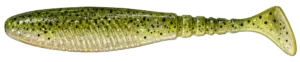

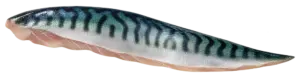
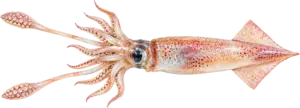
AI-generated illustrations. A click opens the lure’s page.
Rigs for these baits: natural bait rig for the sea.
What to do with your catch
FishBase lists the ling as a food fish, marketed fresh, dried or salted and frozen. Steaming, frying, grilling and baking are usual. Fish you catch yourself should be stunned and killed immediately, then gutted and chilled; more under storage and hygiene. A fish of over a metre fillets well.
What you need to observe
Closed seasons, minimum sizes and harvest slots are set by the federal states (Bundesländer) and by the fisheries authorities of the neighbouring countries on the coast (Denmark, Norway, Poland). They vary by type of water, stretch of coast and time of year. We only give figures together with the date and source; the fisheries regulation of your federal state and your fishing permit (Erlaubnisschein) are always what is binding. You will find a list of links to the official sources in the catch calendar.
A fish of legal size that you want to keep you stun and kill at once, in line with animal welfare rules. Protected, undersized fish or fish too large under a harvest slot you unhook, if possible still in the water and with wet hands, and release gently. What exactly applies is regulated by state law and your fishing permit (Erlaubnisschein).
In Norway separate rules apply to sea anglers: you fish only with hand-held gear, selling the catch is banned, and the blue ling is protected all year. Ling is not on the Fiskeridirektoratet’s list of minimum sizes for recreational anglers, but minimum sizes do apply to other species such as cod and haddock. Treat fish you release as gently as possible: wet your hands with seawater first and remove the hook carefully. The rules change; the Fiskeridirektoratet is the binding source.
On the stock: the advice of the International Council for the Exploration of the Sea (ICES) for 2026 and 2027 is around 30 percent lower than the previous advice in the North Sea and western waters and around 20 percent lower in the Norwegian Sea and Barents Sea. The reason is a continued decline in catch per unit effort. FishBase rates the species‘ vulnerability to fishing as very high.
What closed season, minimum size and harvest slot mean and where to find them is explained on the page Closed season and minimum size explained.
Frequently asked questions (FAQ)
How do I tell ling and tusk apart?
The ling has two dorsal fins, the tusk only one long continuous one. The ling is also clearly slimmer, and its barbel is longer than the diameter of the eye.
What do I use to catch ling?
Natural baits on the bottom: fillets of mackerel or herring, squid or sand eel on a sharp hook from 4/0, on a paternoster or a long-trace rig with a heavy weight.
Can I release a ling?
From great depth hardly at all. The drop in pressure damages the fish so badly that it usually dies after release. Fish there only for fish you may and want to use.
Sources
The rating of catch chances is an editorial assessment. The facts come from these sources, and the text is worded in our own words. The illustration is an original design by Angel Momente in the style of a natural history plate (AI-generated, see the AI notice).
- FishBase: Molva molva
- Havforskningsinstituttet: Lange (Leng)
- Havs- och vattenmyndigheten: Långa (Laichzeit, Laichtiefe, Laichgebiete)
- Blinker: Steckbrief Leng
- Fiskeridirektoratet: Sea angling in Norway, regulations (geschonte Arten, Ausfuhrquote)
- Blinker: Barotrauma bei Fischen
- Fiskeridirektoratet: Minimum sizes for salt water species (untermaßige Fische, Messung)
- Blinker: Steckbrief Lumb (Unterscheidung vom Leng)
- Havforskningsinstituttet: Nye kvoteråd for brosme og lange (ICES-Rat für 2026 und 2027)
- Fiskeridirektoratet: Minstemål i fritidsfiske (kein Mindestmaß für Sei und Lyr, Lange nicht aufgeführt)
- Blinker: Angeln in Südnorwegen, hier ist alles möglich (Herbst als beste Zeit für Leng und Lumb in der Tiefe)
- Wikipedia: Leng
- Blinker: Norwegen, Angeln im Fjord (Saison, Naturköderangeln)
- Blinker: Angeln in Norwegen (Zielfische, Tiefen, Reisezeit)
- Løkkeborg et al. 2000, Journal of Experimental Marine Biology and Ecology: Food-search strategy in ling (Molva molva L.): crepuscular activity and use of space (Abstract)
Created with AI support from the sources listed. Figures only appear in the text if a source gives them. Last updated: 27 October 2026. Found a mistake? Write to us. Who is behind this site: About me.
More in the lexicon
- All fish species at a glance
- Catch calendar – month, water temperature and profile for 93 species
- Line calculator – breaking strain after the knot, drag guideline, backing
- Angling methods