
Knowledge – Fish
Pollack: Features, spots, methods and baits
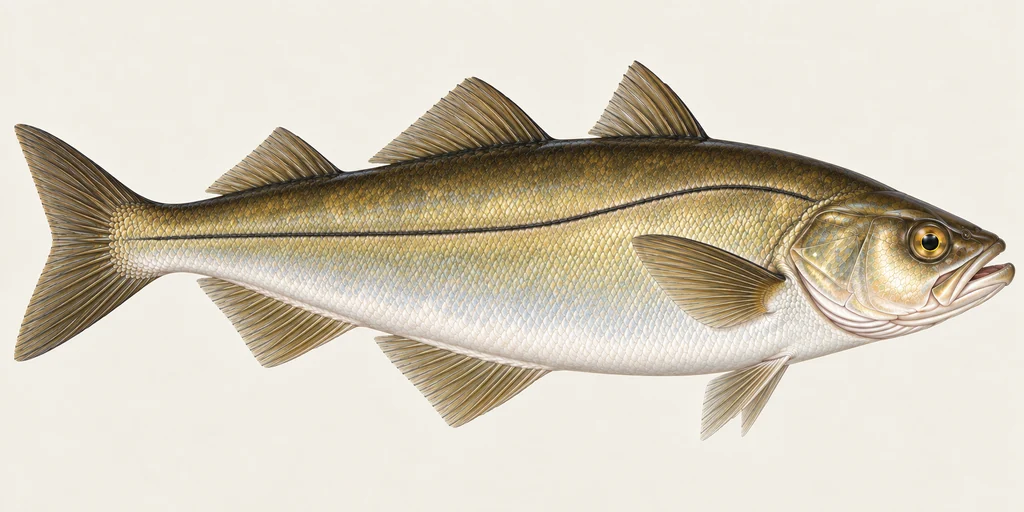
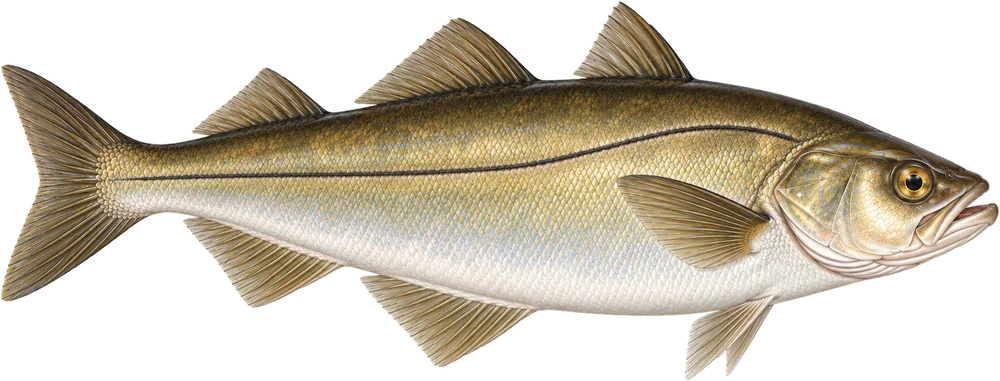
The pollack (Pollachius pollachius), also called the wreck fish by anglers, belongs to the cod family. It lives close inshore over rock, in kelp forests and on wrecks in the north-east Atlantic. It is told apart from the coley by its dark, curved lateral line.
In short: The best time to catch pollack is June to September, in the morning, in the evening and at night. Good spots on the coast: wreck, reef, drop-off and open water. Proven baits: slim spoons and pilkers, pale feathers and small rubber eels on a paternoster; ragworm or strips of mackerel and herring on a long-trace rig. Step by step: pollack fishing.
- Dark lateral line with a distinct arch over the pectoral fin
- Strongly protruding lower jaw without a barbel
- Brownish-olive to yellowish flanks, darker back and silvery-grey belly
Catch chances through the year
- Hardly any chance
- Possible
- Good
- Peak season
- Spawning (observe the closed season)
Editorial assessment for waters in Germany, not a measured value and no guarantee. Spawning time is not the same as the legal closed season.
Species profile and sources in the catch calendarAll species compared month by monthThe rules of your federal state
How to recognise it
The pollack is slimly built. Its lower jaw clearly projects beyond the upper, there is no chin barbel, and the eyes look large. The back is dark and stands out sharply from the silver-grey flanks and belly. The flanks often carry yellowish to orange stripes or spots, the fins are dark and the pelvic fins yellowish.
The surest feature is the lateral line. It is dark to greenish and arches sharply upward above the pectoral fin, then runs straight on. At the base of the pectoral fin there is no dark spot.
According to FishBase, about 75 centimetres is usual, and the maximum values are given as 130 centimetres and a good 18 kilograms. Norwegian researchers give 130 centimetres and 10 kilograms, while the angling press reckons on 50 to 60 centimetres on average. The maximum age is 8, 13 or 15 years depending on the source, because age determination is considered uncertain.
On the coley the lateral line is pale and straight, the back almost black and the inside of the mouth dark. The coley is built more elegantly and is more agile, while the pollack looks goggle-eyed because of its large eyes.
The cod, by contrast, has a projecting upper jaw, a conspicuous chin barbel and a pale lateral line that curves over the pectoral fin. With the pollack it is the other way round: dark line, projecting lower jaw, no barbel.
Side by side
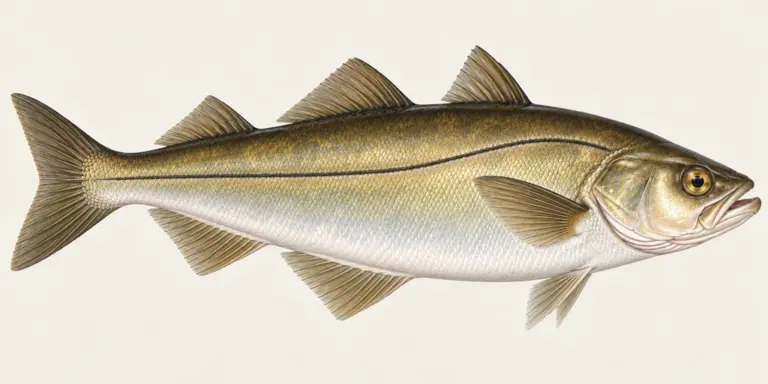
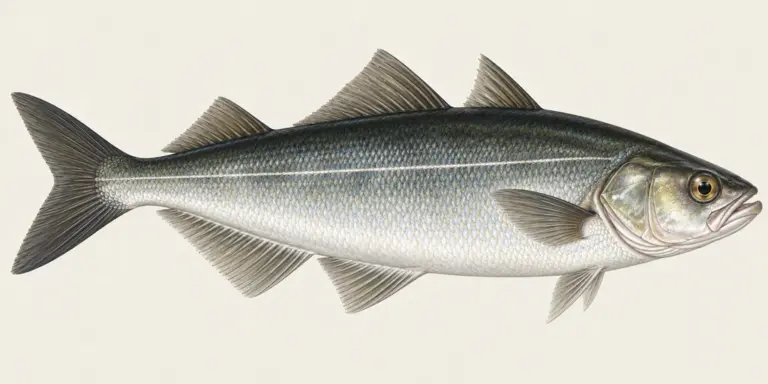
AI-generated illustrations.
Where it holds
The pollack lives in the north-east Atlantic from Iceland, the Faroe Islands and Norway to the Bay of Biscay, around the British Isles and in the North Sea. In Sweden it occurs along the whole west coast and in the northern Øresund. In the southern Baltic Sea there are isolated records, and after saltwater inflows also in Swedish waters.
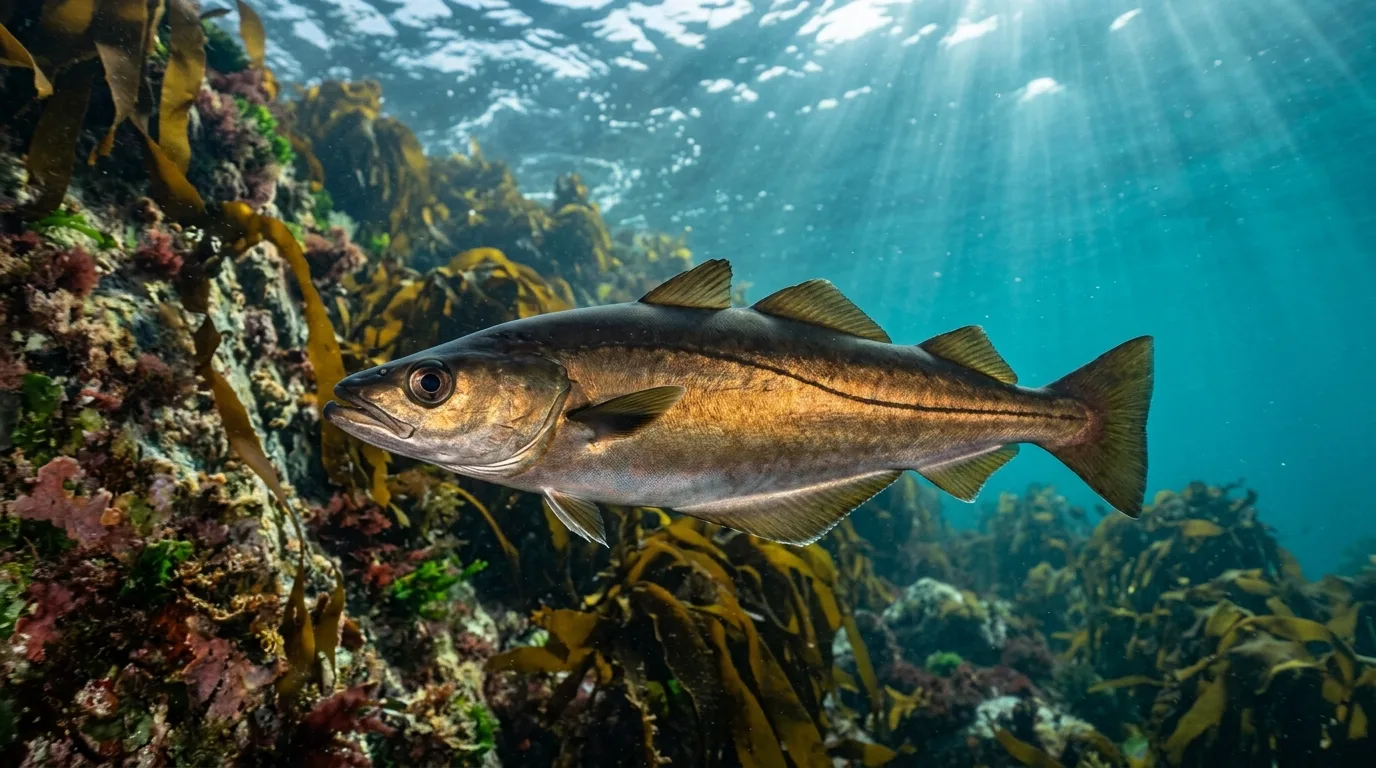
It stands over hard ground down to about 200 metres, usually at 40 to 100 metres. Young fish spend two to three years close inshore, among rocks and kelp, over sandy beaches and in river mouths. Larger fish move out into more open water, to reefs, underwater rocks, wrecks and drilling platforms.
From the shore, look for spots with broken, boulder-strewn and densely overgrown ground. In the kelp forests near the shore there are fine fish of three to six pounds, provided the ground is broken up by rocky gullies and the water is deep. You can also fish from piers and bridges, as long as the water is not freshened. The really big pollack stand further out over underwater rocks, on reefs and at wrecks. Unlike cod and coley, they never move far out onto the open sea.
Holding spots in the picture
Choose the season and time of day: the picture shows where the species stands then. Spots outlined in red apply only in the chosen season. Tap a fish or a spot in the list to bring it closer. The picture is schematic and AI-generated, every water is different.
Chance of a catch in springgoodSpawning, observe the closed seasons
Catch chance in summerPeak season
Catch chance in autumngood
Catch chances in winterpossiblespawning season, observe the closed seasons
- J
- F
- M
- A
- M
- J
- J
- A
- S
- O
- N
- D
Spawning season
Active time Dusk is considered favourable, and on into the night too.
No peak time Dusk is considered favourable, and on into the night too.
Active time Dusk is considered favourable, and on into the night too.
Active time Dusk is considered favourable, and on into the night too.
On the coast
Drop-off
Pollack are found here all year round.
Wreck, reef
Pollack are found here all year round.
Open water, mid-water
Pollack are found here all year round.
Just below the surface
Pollack are found here only in summer.
Pollack hold off rocky coasts with broken, heavily overgrown bottom, between kelp beds and rocks, by reefs and wrecks. Good spots are shore edges with rock that drops away quickly and kelp growth. They mostly hunt in mid-water and stay in their territory.
Spring: catch chance according to the catch calendar is possible in March, good in April and May. Spawning falls in this period, so observe the closed seasons. In Norwegian waters the pollack spawns in March and April.
Summer: catch chance according to the catch calendar is peak season. The summer half-year from April to the end of September counts as high season. With warmer water pollack move into shallower zones, and around midsummer they often hunt at the surface at night.
Autumn: catch chance according to the catch calendar is peak season in September, good in October and possible in November.
Winter: catch chance according to the catch calendar is possible. Spawning falls in this period, so observe the closed seasons. Because the pollack stays close to the coast, it can be caught all year round.
Depth: The pollack lives from the coast down to about 200 metres, preferring 40 to 100 metres over stony ground.
Size comparison: AI-generated drawing, schematic.
How it hunts and spawns
The pollack is a predator. Young fish feed mainly on crustaceans, older ones hunt herring, sprat and sand eel. According to Norwegian studies, pelagic fish, prawns and krill are also on the menu.
Adult fish stand singly or in small, loose groups and stay in their territory. When fish fry or shoals of sardines come close, they leave the bottom and become unusually careless. They then often hunt in a pack, surround their prey and drive it to the surface. According to Swedish sources they are most active at dusk.
Spawning takes place, depending on the area, between January and May in open water at 100 to 200 metres, in Norwegian waters and in the North Sea in March and April. Dense shoals gather on the spawning grounds, and the fish probably migrate there.
When it bites
Because the pollack stays close to the coast, you can fish for it all year round. The high season is the summer half-year from April to the end of September. This matches the calendar, which rates the months June to September best.
According to Blinker, you catch the best fish on the ebb tide and on dark days. That fits the Swedish information that the pollack is most active at dusk: plan your sessions for the edges of the day.
Today’s catch index needs JavaScript. Season and spawning time are in the catch calendar.
You will find the monthly overview of all species and the water temperature check in the catch calendar.
What you catch it with
Step by step: Pollack fishing: tips on bait, rig and tackle – season, spots, bait, tackle and rules on one page.
From a rocky shore you fish with a sturdy spinning or carp rod and slim, not-too-colourful spoons of up to 30 grams. The lure is cast out, sinks, is drawn in with a few quick turns of the handle and flutters back down. Many bites come on the drop, so you need contact with the line. Basics are covered under spinning. Surf anglers report that the ragworm catches very well on many coasts.
From a boat you fish with a paternoster: three to four pale feathers or small rubber eels on short snoods, with a weight at the bottom whose size depends on depth and drift. The rig goes down to the bottom, is lifted a little and kept moving with short, playful jerks. If fish fry are nearby, this works especially well. Instead of the weight, a slim pirk in a sand-eel look also works. Over dense kelp the risk of snagging rises.
If there are no prey fish on the spot, you are better off fishing with natural baits on the long-trace rig. A trace of at least two metres hangs from the swivel, with a size 2/0 hook at the end carrying a ragworm or a thinly cut strip of mackerel or herring. On the long trace, the current gives the bait a life of its own.
For all methods the rule is: the bait must play. Clumsy lumps of iron will fool cod, but not big pollack. After the bite the fish bolts fiercely and makes more than one reel scream, and it does not give up until the very end. So keep it away from kelp and rocks. It has no teeth or spines, and how to land it safely and unhook it is covered under landing and unhooking fish.
Keep in contact with the line: The pollack often takes the bait on the drop. Without contact with the line you will not notice the bite.
The bait must play: Slim, lively lures convince more than clumsy, heavy ones. Draw them in with short jerks and let them flutter down again.
Keep it away from obstacles: After the bite the pollack pulls hard towards kelp and rock. Set the drag beforehand and lead the fish out of cover at once.
Mind the depth: According to the angling press, no fish cranked up from 50 metres or more survives being put back (see returning fish). Only fish there for fish you intend to eat.
Suitable lures
Slim spoons and pirks, pale feathers and small rubber eels on the paternoster; ragworm or strips of mackerel and herring on the long-trace rig.
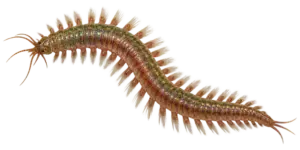
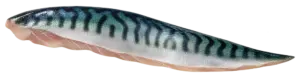
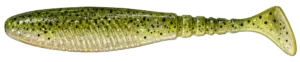
AI-generated illustrations. A click opens the lure’s page.
Rigs for these baits: surf rig, natural bait rig for the sea.
What the pollack tastes like and what to bear in mind
The flesh of the pollack is considered dry, but of good flavour. How to look after it after the catch is covered under stunning and killing fish, gutting fish and filleting fish.
On contaminants: the Norwegian Institute of Marine Research examined 295 pollack from Norwegian coastal waters and the North Sea for the food authority Mattilsynet. No value in the fillet exceeded the limits. In the liver it found dioxin and PCB above the limits, so Mattilsynet generally warns against fish liver from the coastal areas, and pregnant and breastfeeding women and children should not eat it at all. This does not replace medical advice.
What you need to observe
Closed seasons, minimum sizes and harvest slots are set by the federal states (Bundesländer) and by the fisheries authorities of the neighbouring countries on the coast (Denmark, Norway, Poland). They vary by type of water, stretch of coast and time of year. We only give figures together with the date and source; the fisheries regulation of your federal state and your fishing permit (Erlaubnisschein) are always what is binding. You will find a list of links to the official sources in the catch calendar.
A fish of legal size that you want to keep you stun and kill at once, in line with animal welfare rules. Protected, undersized fish or fish too large under a harvest slot you unhook, if possible still in the water and with wet hands, and release gently. What exactly applies is regulated by state law and your fishing permit (Erlaubnisschein).
Norway has its own rules for sea anglers: you may only fish with hand-held tackle, and selling the catch is prohibited. For the pollack the Fiskeridirektoratet prescribes no minimum size (Mindestmaß) for recreational anglers; for other species such as cod and haddock, minimum sizes do apply. Fish you put back should be treated as gently as possible: wet your hands with seawater first and remove the hook carefully. The rules change, and the Fiskeridirektoratet is the binding source.
In Sweden the pollack is protected in the Skagerrak and Kattegat at the start of the year and all year round in some fjord areas; an EU-wide minimum conservation reference size applies to landings. The Swedish authority Havs- och vattenmyndigheten is the binding source.
On the stock: the IUCN lists the pollack as of least concern in Europe and worldwide. For the North Sea, ICES advises as for data-poor stocks and bases the catch advice on the total catches of the last three years. Swedish experts say that the status relative to maximum sustainable yield cannot be assessed, and point out that there is no catch statistic for recreational fishing.
What closed season, minimum size and harvest slot mean and where to find them is explained on the page Closed season and minimum size explained.
Frequently asked questions (FAQ)
How do I tell a pollack from a coley?
On the pollack the lateral line is dark and curved over the pectoral fin, on the coley it is pale and straight. The pollack also has a distinctly projecting lower jaw and large eyes.
Which baits catch pollack?
From the shore with slim spoons of up to 30 grams, from the boat with feathers or small rubber eels on the paternoster. On the long-trace rig, ragworm and thin strips of mackerel or herring catch.
Where does the pollack stand?
Over rock and scree, in kelp forests, on reefs and at wrecks, usually at 40 to 100 metres of water. There it often stands in mid-water, in Norway in summer by day frequently around 15 metres below the surface. Young fish stay close inshore.
Sources
The rating of catch chances is an editorial assessment. The facts come from these sources, and the text is worded in our own words. The illustration is an original design by Angel Momente in the style of a natural history plate (AI-generated, see the AI notice).
- FishBase: Pollachius pollachius
- Havforskningsinstituttet: Lyr (Pollack)
- Havs- och vattenmyndigheten: Bleka/Lyrtorsk (Laichzeit, Laichtiefe, Bestand)
- Thünen-Institut, Fischbestände online: Seelachs (Köhler und Pollack)
- Blinker: Steckbrief Pollack
- Fiskeridirektoratet: Sea angling in Norway, regulations (geschonte Arten, Ausfuhrquote)
- Blinker: Steckbrief Köhler
- Blinker: Barotrauma bei Fischen
- FishBase: Gadus morhua (Merkmale zur Abgrenzung vom Dorsch)
- Fiskeridirektoratet: Minimum sizes for salt water species (untermaßige Fische, Messung)
- Havforskningsinstituttet: Har kartlagt miljøgifter i tre nye fiskeslag (Pollack, Filet und Leber)
- Fiskeridirektoratet: Minstemål i fritidsfiske (kein Mindestmaß für Sei und Lyr, Lange nicht aufgeführt)
- Wikipedia: Pollack
- Blinker: Norwegen, Angeln im Fjord (Saison, Naturköderangeln)
- Blinker: Angeln auf Pollack, 6 Richtige für den Fangerfolg
- Blinker: Fangen Sie Ihren Pollack mit der Fliege
Created with AI support from the sources listed. Figures only appear in the text if a source gives them. Last updated: 27 October 2026. Found a mistake? Write to us. Who is behind this site: About me.
More in the lexicon
- All fish species at a glance
- Catch calendar – month, water temperature and profile for 93 species
- Line calculator – breaking strain after the knot, drag guideline, backing
- Angling methods