
Knowledge – Fish
Mackerel: Features, season and fishing with a paternoster
The mackerel (Scomber scombrus) is a fast shoaling fish of the North Atlantic. It has no swim bladder and changes depth with ease. In summer it hunts close to the coast and is then caught from charter boats and from piers.
In brief: You catch mackerel best in August, mainly during the day. Good spots on the coast: open water and just below the surface. Proven baits: a mackerel rig with a pirk or small spoons. Step by step: Fishing for mackerel.
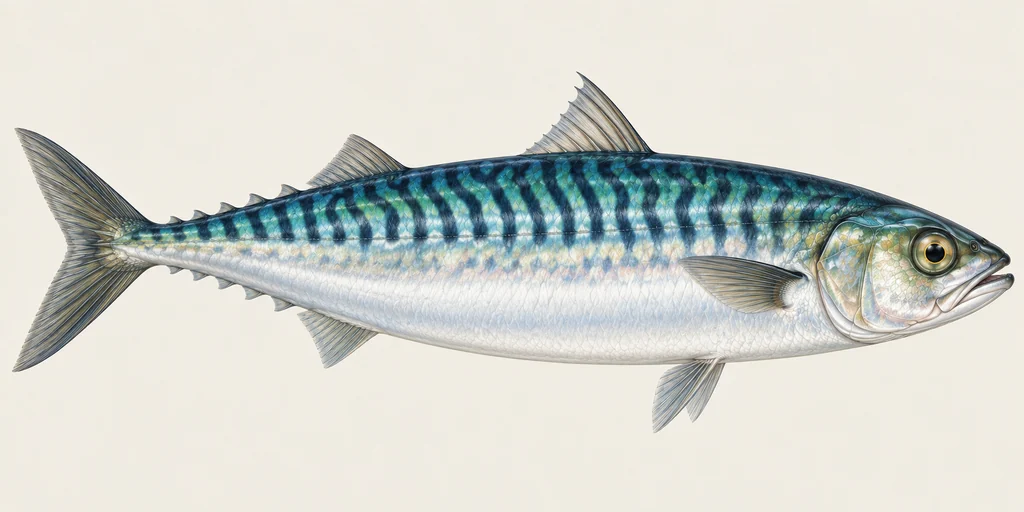
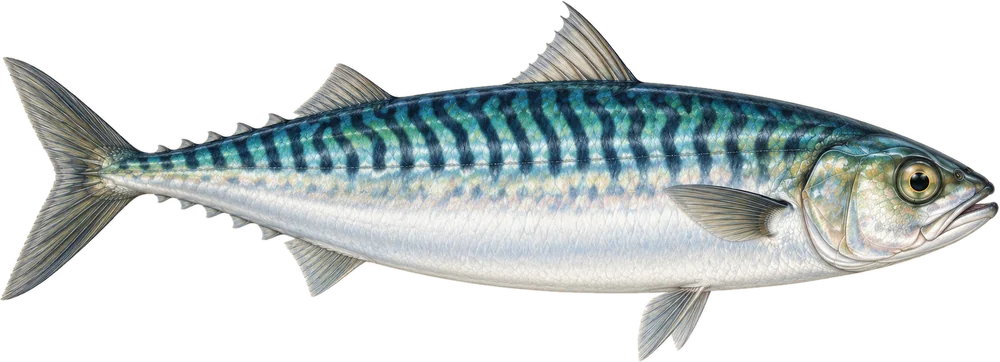
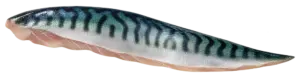
- Dark, irregular crossbands on a green-blue back
- Five small finlets each behind the second dorsal fin and the anal fin
- Torpedo-shaped body without a swim bladder, with a slim caudal peduncle and a deeply forked tail fin
Catch chances through the year
- Hardly any chance
- Possible
- Good
- Peak season
- Spawning (observe the closed season)
Editorial assessment for waters in Germany, not a measured value and no guarantee. Spawning time is not the same as the legal closed season.
Species profile and sources in the catch calendarAll species compared month by monthThe rules of your federal state
How to recognise it
The body is elongated and streamlined, the tail fin deeply forked. The back gleams greenish blue and carries dark, irregular cross bands. The flanks shimmer pearly and the belly is white.
Behind the second dorsal fin and the anal fin there are five small single finlets each. The body is covered with small, firm scales. A swim bladder is missing. Mackerel can grow to 60 centimetres and reach 17 years, with about 30 centimetres typical.
In the North Sea and Baltic Sea the mackerel is hard to mistake for anything else. Further south other mackerel species occur, such as the slightly smaller, differently marked Spanish mackerel. The garfish also hunts at the surface but is much slimmer and has a beak.
Side by side
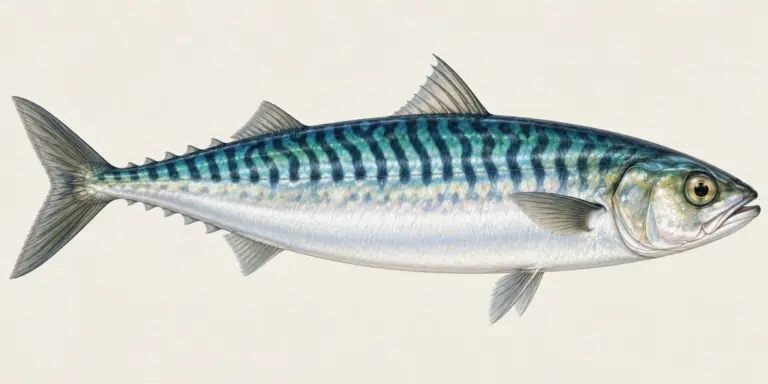
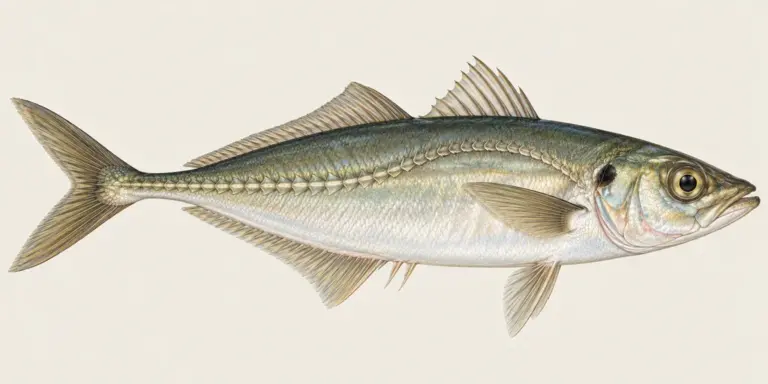
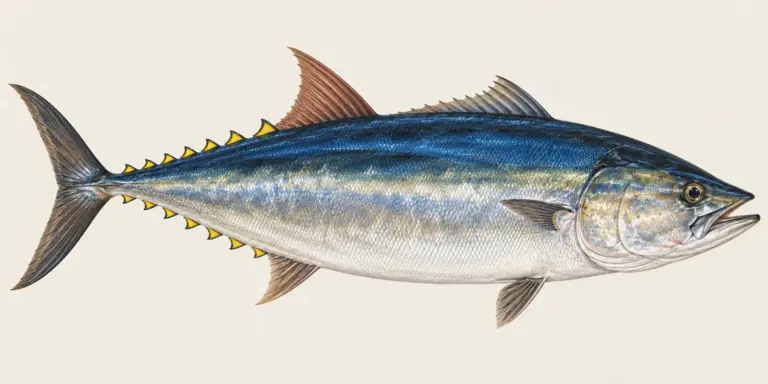
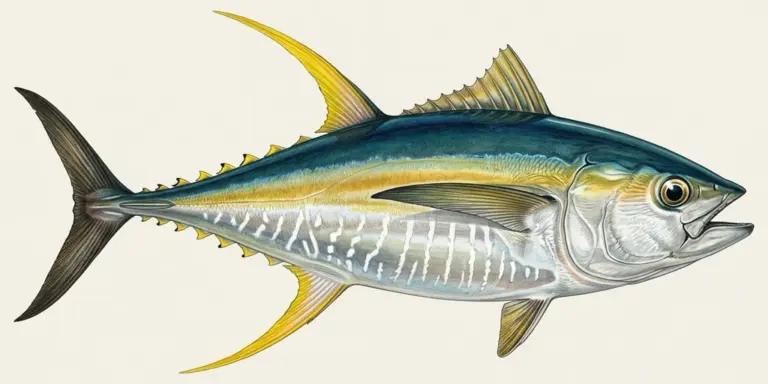
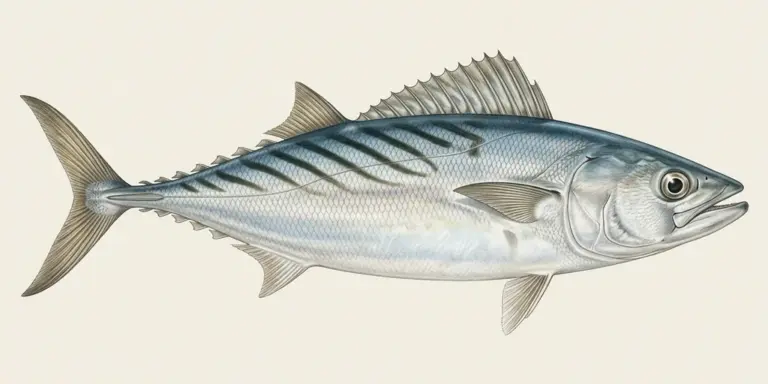
AI-generated illustrations.
Where it lives
Mackerel live on both sides of the Atlantic, in Europe from Gibraltar to the North Cape, in the North Sea, the western Baltic Sea and the Mediterranean. The shoals stay in open water, mostly near the surface.
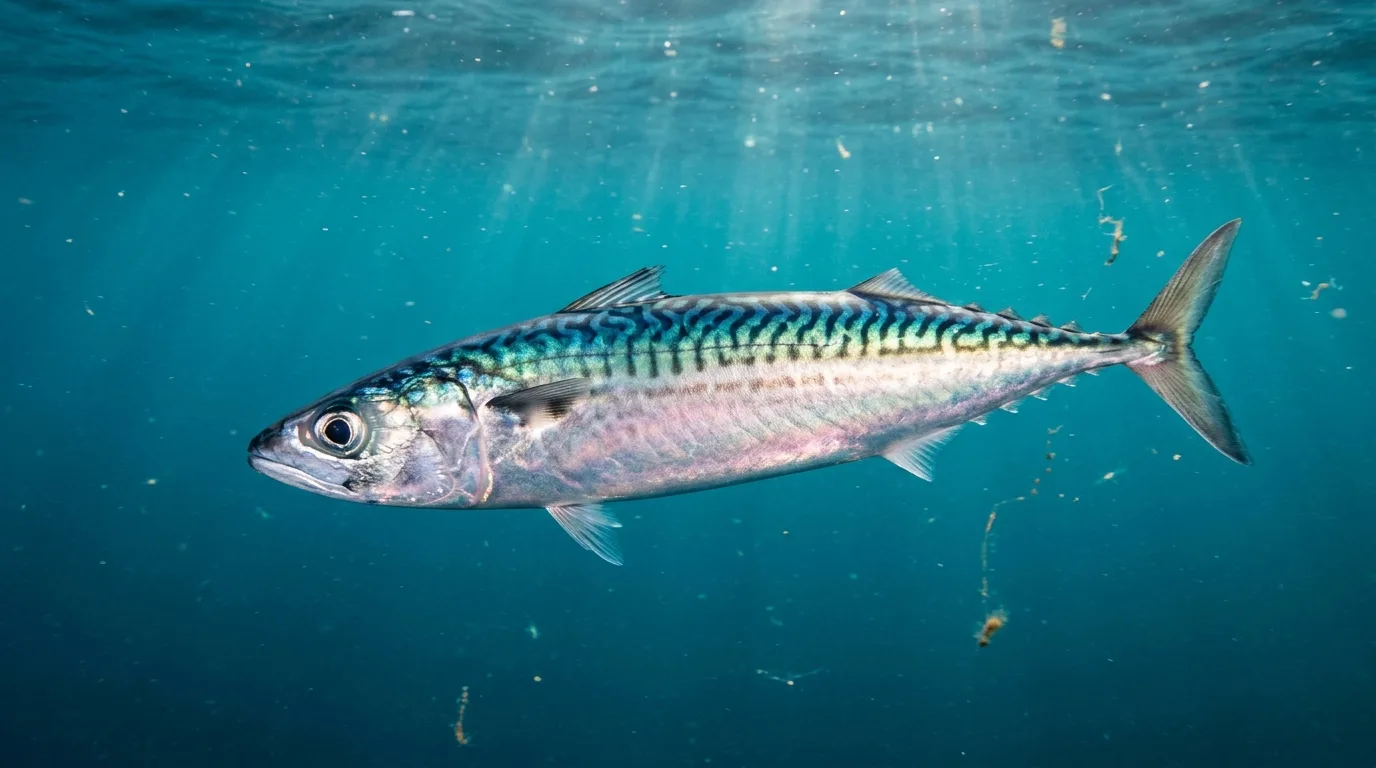
They spend the winter in deeper water at the edge of the shelf. In spring, at 11 to 14 °C, they approach the coast. They avoid shallow water. That is why fishing in the North Sea is mostly done from charter boats. In the western Baltic Sea, too, mackerel turn up regularly in summer, especially in July and August: in the Little Belt, in the Flensburger and Kieler Förde, around Fehmarn and off Warnemünde. They are mostly caught there from a boat, and at a few piers and quays also from the shore.
Holding spots in the picture
Choose the season and time of day: the picture shows where the species stands then. Spots outlined in red apply only in the chosen season. Tap a fish or a spot in the list to bring it closer. The picture is schematic and AI-generated, every water is different.
Chance of a catch in springslim
Chance of a catch in summergoodSpawning, observe the closed seasons
Catch chance in autumnpossible
Catch chance in winterhardly any
- J
- F
- M
- A
- M
- J
- J
- A
- S
- O
- N
- D
Spawning season
No main time Mackerel are mostly active during the day.
Active time Mackerel are mostly active during the day.
No main time Mackerel are mostly active during the day.
No main time Mackerel are mostly active during the day.
On the coast
Open water, mid-water
Mackerel are found here only in spring, summer and autumn.
Just below the surface
Mackerel are found here only in spring, summer and autumn.
Mackerel live as shoaling fish in open water and usually stay near the surface. From the shore they are found only where deep water reaches close in: off breakwaters, piers and landing stages. With an offshore wind they are often closer to the shore, with an onshore wind further out.
Spring: according to the catch calendar, chances are slim in March and April and possible in May. In spring, at water temperatures of 11 to 14 °C, the shoals approach the coast.
Summer: according to the catch calendar, chances are good in June and July, and August is the peak season. Spawning falls in this period, so observe closed seasons. After spawning the mackerel feed very actively and roam in small groups. The season runs from May to September.
Autumn: according to the catch calendar, chances are good in September, possible in October and slim in November. When the water cools in September, the shoals move back to the edge of the shelf.
Winter: chances according to the catch calendar are slim. Mackerel spend the winter in deeper water far from the coast. In this resting period they do not feed.
Depth: Mackerel stay near the surface but want about ten metres of water below them. Flat beaches are therefore ruled out.
Size comparison: AI-generated drawing, schematic.
How it hunts and spawns
Mackerel eat zooplankton and small fish such as young herring, sand eels and sprats. During their winter rest they take no food. After spawning their demand rises sharply, and they hunt fish fry in packs.
Spawning takes place in late spring and summer, from May to July in the North Sea and the Skagerrak. Eggs and larvae drift freely in the water. Because it has no swim bladder, the mackerel has to keep swimming all the time so as not to sink.
When it bites
The season runs from May to September, depending on weather and region. The main time is July and August, and good catches often come as early as June. When the water cools in September, the shoals move back to the edge of the shelf.
On the North Sea, fine high-pressure weather is considered favourable. With an offshore wind the fish often stand closer to the shore, with an onshore wind further out.
Today’s catch index needs JavaScript. Season and spawning time are in the catch calendar.
You will find the monthly overview of all species and the water temperature check in the catch calendar.
What to catch it with
Step by step: Fishing for mackerel: tips on bait, rigs and tackle – season, spots, bait, tackle and rules on one page.
From a charter boat you fish with the mackerel rig: several feathered hooks on short side arms, with a weight below. You let the rig down to the bottom and wind it up with jerks until you find the depth of the shoal.
On light tackle spinning is the more sporting variant, for example at Norwegian fjords or from piers with deep water. Slim spoons and small artificial lures are suitable. Mackerel are also caught on the fly rod with a sinking line.
From a pier, float fishing also works: narrow strips of fresh herring fillet or a strip of cut bait from the mackerel itself go on the hook.
Watch the gulls: A hunting flock of gulls often shows small fish at the surface being harried by mackerel.
Cool it at once: Mackerel flesh is oily, with a fat content of about 12 per cent. Deal with the catch straight away and store it cool.
Suitable lures
Mackerel rig with a pirk or small spoons.
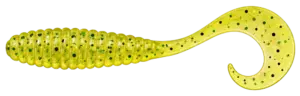
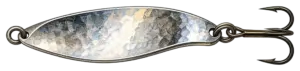

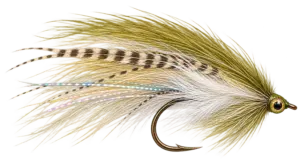
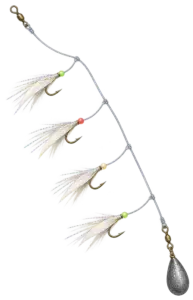
AI-generated illustrations. A click opens the lure’s page.
Rigs for these baits: Side-arm rig.
What mackerel tastes like and how to keep it fresh
The mackerel is an oily fish. How much fat it carries depends strongly on the season and the fishing area. In the shops you mostly find it smoked or tinned. Freshly caught, it goes well in the pan, where you need hardly any oil because it cooks in its own fat. After freezing, fried mackerel quickly tastes rancid, whereas thawed it is still good for the smoker. The method is described under Smoking fish.
In warm conditions the oily fish spoils quickly, so from the catch to the kitchen it must be kept chilled all the way. If mackerel is not cooled properly, histamine can form. Affected fish need not look spoiled or smell bad, and neither cooking nor freezing breaks the histamine down. Like any sea fish, mackerel can also carry roundworm larvae; heat and frost kill them, and thoroughly cooked fish is safe in this respect.
What you need to observe
Closed seasons, minimum sizes and harvest slots are set by the federal states (Bundesländer) and by the fisheries authorities of the neighbouring countries on the coast (Denmark, Norway, Poland). They vary by type of water, stretch of coast and time of year. We only give figures together with the date and source; the fisheries regulation of your federal state and your fishing permit (Erlaubnisschein) are always what is binding. You will find a list of links to the official sources in the catch calendar.
A fish of legal size that you want to keep you stun and kill at once, in line with animal welfare rules. Protected, undersized fish or fish too large under a harvest slot you unhook, if possible still in the water and with wet hands, and release gently. What exactly applies is regulated by state law and your fishing permit (Erlaubnisschein).
For sea anglers the rules change from year to year. The IUCN rates the mackerel as least concern. Scientists, however, have for years criticised catch volumes above the recommendations.
What closed season, minimum size and harvest slot mean and where to find them is explained on the page Closed season and minimum size explained.
Frequently asked questions (FAQ)
Why does the mackerel have to keep swimming?
It has no swim bladder. Without movement it would sink. In return it can change depth quickly.
When is mackerel time?
In summer, from May to September depending on region and weather, best in July and August.
Can I catch mackerel from the shore?
Only where deep water lies within casting range, for example at long piers, rocky coasts and fjord shores.
Sources
The rating of catch chances is an editorial assessment. The facts come from these sources, and the text is worded in our own words. The illustration is an original design by Angel Momente in the style of a natural history plate (AI-generated, see the AI notice).
- Wikipedia: Makrele
- FishBase: Scomber scombrus
- Blinker: Steckbrief Makrele
- Thünen-Institut, Fischbestände online: Makrele
- Havforskningsinstituttet: Makrell (Makrele)
- FISCH & FANG: Vorsicht, bissige Meute (Makrelen an der Pose mit Heringsstreifen)
- Blinker: Von Aal bis Meerforelle, Köder für das Molenangeln (Sprotten)
- Blinker: Makrelenangeln, 6 Tipps zum Erfolg (beste Zeit Juni bis August)
- FISCH & FANG: Makrelen im Visier (Makrelenfänge in der westlichen Ostsee im Juli und August, Stand 2012)
- Blinker: Angeln in der Ostsee, das solltest du wissen (Makrelen ab Juni, Dorsch im Frühjahr und Herbst)
- Spektrum Akademischer Verlag, Lexikon der Ernährung: Makrelen
- Blinker: Makrelen braten, zwei Rezepte zum Nachkochen
- Blinker: Makrele grillen auf brasilianische Art (Tipps zum Kühlen)
- Europäische Behörde für Lebensmittelsicherheit (EFSA): Fischlagerung im Einzelhandel, Empfehlungen der EFSA zur Temperatur
- Bundeszentrum für Ernährung (BZfE): Fisch und Meeresfrüchte, Gesundheit und Umwelt
- LAVES Niedersachsen: Parasiten in Fischen und Fischereierzeugnissen – ein Problem?
- Blinker extra: Die Fische der Ostsee und wie man sie beangelt (Stand 2007)
Created with AI support from the sources listed. Figures only appear in the text if a source gives them. Last updated: 27 October 2026. Found a mistake? Write to us. Who is behind this site: About me.
More in the lexicon
- All fish species at a glance
- Catch calendar – month, water temperature and profile for 93 species
- Line calculator – breaking strain after the knot, drag guideline, backing
- Angling methods